Decision-making in tech teams often spirals into endless debates, leaving crucial projects stalled. For project managers in Hungary, battling this cycle of analysis paralysis becomes even tougher as choices multiply and pressure mounts. Understanding the true causes behind persistent indecision and spotting common myths will help you reclaim control. Discover smarter ways to drive action, simplify workflow, and maximize productivity with AI-driven decision frameworks—all without falling into the trap of overthinking.
Table of Contents
- Defining Analysis Paralysis And Common Myths
- Key Types Of Analysis Paralysis In Teams
- Core Causes And Psychological Drivers
- Major Impacts On Project Outcomes
- Effective Strategies And Ai Solutions
Defining Analysis Paralysis and Common Myths
Analysis paralysis represents a complex psychological phenomenon where decision-making becomes stalled by excessive overthinking. Overwhelming mental processing prevents individuals from taking decisive action, creating a cycle of perpetual contemplation without resolution.
At its core, analysis paralysis emerges from several critical psychological mechanisms:
- Fear of making incorrect decisions
- Perfectionist tendencies
- Information overload
- Anxiety about potential consequences
- Cognitive decision fatigue
Psychologist Barry Schwartz’s research illuminates a critical insight: paradoxically, more choices do not guarantee better outcomes. Paradox of choice research demonstrates that an abundance of options can actually increase anxiety and reduce satisfaction, making decision-making more challenging.
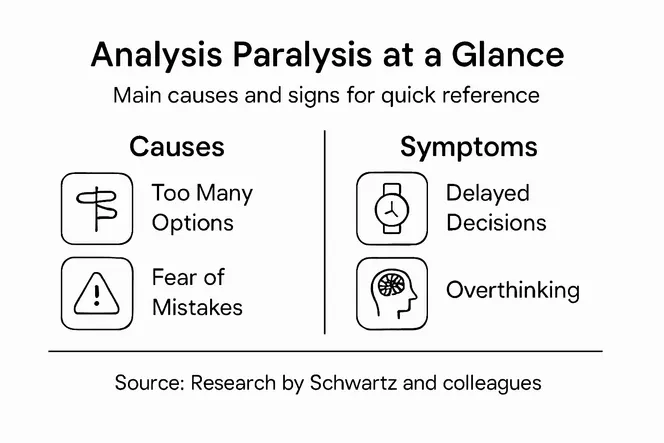
Historically, this phenomenon has been understood through various narratives, including Aesop’s classic fable about a fox with numerous escape plans compared to a cat with a single, straightforward strategy. This allegory perfectly illustrates how complex overthinking can immobilize decision-makers, while simplicity and focus drive action.
Common myths about decision-making often perpetuate analysis paralysis:
- Myth: More information always leads to better choices
- Myth: Perfect decisions exist
- Myth: Extensive analysis guarantees optimal outcomes
- Myth: Choosing quickly means being impulsive
Pro tip: Implement a time-boxed decision framework where you allocate specific time limits for gathering information and making choices to prevent endless deliberation.
Key Types of Analysis Paralysis in Teams
Analysis paralysis in team environments manifests through multiple complex dynamics that can severely impede organizational productivity. Organizational decision-making challenges create systemic barriers that prevent teams from executing effectively and making timely strategic choices.
The primary types of team-based analysis paralysis include:
- Consensus Paralysis: Where teams become stuck attempting to achieve unanimous agreement
- Risk Assessment Paralysis: Excessive deliberation over potential negative outcomes
- Hierarchical Paralysis: Decision-making bottlenecks caused by complex approval processes
- Information Overload Paralysis: Being overwhelmed by excessive data and conflicting information
Organizational network dynamics reveal that analysis paralysis operates like a contagious mechanism, where hesitation spreads through team structures. This phenomenon creates what researchers call a ‘paralysis multiplier’ - where individual uncertainties compound into collective organizational gridlock.
Team decision-making structures typically reveal these common patterns:
- Over-reliance on leadership validation
- Repeated reopening of previously discussed decisions
- Continuous searching for perfect solutions
- Fear of potential negative consequences
Analysis paralysis transforms teams from dynamic problem-solvers into perpetual deliberation machines, blocking innovation and momentum.
Pro tip: Establish clear decision-making protocols with explicit time limits and designated decision owners to prevent endless team deliberations.
For a clearer understanding, here’s a comparison of analysis paralysis in individuals versus teams:
| Aspect | Individuals | Teams |
|---|---|---|
| Root Cause | Self-doubt, fear of mistakes | Consensus, approval bottlenecks |
| Decision Speed | Often very slow | Typically prolonged |
| Main Risk | Missed personal opportunities | Project delays, lost innovation |
| Example Outcome | Indecision on life choices | Deadlock in project meetings |
| Key Relief Strategy | Time-boxed decision-making | Defined decision ownership |
Core Causes and Psychological Drivers
Psychological barriers play a critical role in driving analysis paralysis, creating complex mental roadblocks that prevent decisive action. Perfectionism and decision anxiety emerge as primary contributors to this debilitating cognitive pattern.
The core psychological drivers of analysis paralysis include:
- Perfectionism: Setting unrealistically high decision standards
- Fear of Failure: Catastrophizing potential negative outcomes
- Imposter Syndrome: Doubting personal competence and decision-making abilities
- Cognitive Overload: Processing excessive information simultaneously
- Decision Fatigue: Mental exhaustion from continuous choice-making
Psychological research reveals that these drivers create a vicious cycle of mental gridlock. Individuals become trapped in an endless loop of comparison, worst-case scenario thinking, and paralyzing self-doubt. This mental mechanism transforms decision-making from a productive process into an anxiety-driven struggle.
Neurological underpinnings demonstrate how psychological drivers manifest:
- Trigger excessive information processing
- Activate stress response mechanisms
- Reduce cognitive flexibility
- Increase decision-related anxiety
The human brain evolved to avoid risk, but modern complexity transforms this survival mechanism into a decision-blocking obstacle.
Pro tip: Practice time-boxed decision-making by setting strict time limits and forcing yourself to choose, even with incomplete information.

Major Impacts on Project Outcomes
Project performance suffers dramatically when analysis paralysis takes hold, transforming potentially successful initiatives into prolonged, ineffective endeavors. Project planning disruptions create systemic challenges that erode organizational effectiveness and team momentum.
The most significant impacts of analysis paralysis on project outcomes include:
- Timeline Extensions: Prolonged decision-making processes causing critical delays
- Budget Overruns: Additional costs from excessive deliberation and reduced productivity
- Stakeholder Confidence Erosion: Diminishing trust in project leadership
- Team Morale Deterioration: Frustration from continuous indecision
- Competitive Disadvantage: Missing critical market opportunities
Software project performance research demonstrates that analysis paralysis transforms potentially agile projects into stagnant, unproductive environments. The consequences extend beyond immediate project metrics, fundamentally undermining organizational adaptability and innovation potential.
Quantifiable project impacts typically manifest through:
- Increased project timelines by 30-50%
- Reduced team productivity
- Higher probability of project failure
- Decreased stakeholder engagement
Analysis paralysis doesn’t just delay projects—it systematically dismantles their potential for success.
Pro tip: Implement a decision-making framework with clear escalation paths and time-bound decision windows to prevent prolonged deliberation.
Effective Strategies and AI Solutions
Decision-making frameworks provide critical pathways for overcoming analysis paralysis, transforming potential stagnation into actionable progress. Strategic decision techniques enable teams and individuals to break through cognitive bottlenecks and execute more effectively.
Key strategies for combating analysis paralysis include:
- Time Boxing: Setting strict decision deadlines
- Option Limitation: Reducing choices to two or three core alternatives
- Risk Assessment: Evaluating potential outcomes systematically
- Iterative Decision Making: Embracing incremental progress
- Psychological Safety: Creating environments that support decisive action
AI-enhanced decision strategies demonstrate remarkable potential in streamlining complex decision processes. Artificial intelligence can analyze vast datasets, highlight key insights, and reduce cognitive load, enabling faster and more confident choices.
Effective AI-powered approaches for overcoming analysis paralysis involve:
- Automated data synthesis
- Predictive outcome modeling
- Real-time risk assessment
- Pattern recognition in decision history
Technology transforms analysis paralysis from a roadblock into a navigable challenge.
Pro tip: Implement a 10-10-10 decision rule: evaluate choices by their potential impact in 10 minutes, 10 months, and 10 years to gain perspective.
Below is a summary of traditional versus AI-driven solutions to analysis paralysis:
| Approach | Human-Driven Methods | AI-Driven Methods |
|---|---|---|
| Data Processing Speed | Limited by cognitive load | Instantaneous across datasets |
| Bias Risk | Subject to personal bias | Can reduce human bias |
| Complexity Management | Challenging with overload | Handles vast, complex data |
| Decision Confidence | Variable, often lower | Often higher with analytics |
| Implementation Cost | Minimal tools needed | Investment in technology |
Break Free From Analysis Paralysis With Smarter Project Management
Struggling with endless decision delays and team deadlocks can drain your project momentum and cause frustration. This article highlights how analysis paralysis creates costly delays and blocks innovation through fear of mistakes, information overload, and consensus bottlenecks. If you want to overcome these roadblocks, embracing streamlined workflows and clear decision ownership is essential to regain control and boost productivity.

Discover how Gammatica.com, an AI-driven project and team management platform, can help you simplify complex decisions, automate repetitive tasks, and empower your teams to execute swiftly with confidence. Leverage features like AI suggestions, Kanban boards, and real-time collaboration tools so your business can avoid the pitfall of indecision and save up to 16 hours weekly. Take action now to transform your processes and prevent analysis paralysis by exploring our powerful solutions at Gammatica.com.
Frequently Asked Questions
What is analysis paralysis?
Analysis paralysis is a psychological phenomenon where overthinking leads to difficulty in making decisions, resulting in stalled action and perpetual contemplation without resolution.
What are some common myths about decision-making that contribute to analysis paralysis?
Common myths include the beliefs that more information always leads to better choices, perfect decisions exist, extensive analysis guarantees optimal outcomes, and that quick decisions are impulsive.
How can teams overcome analysis paralysis?
Teams can overcome analysis paralysis by establishing clear decision-making protocols, designating decision owners, and implementing time limits for discussions to prevent endless deliberation.
What strategies can individuals use to combat analysis paralysis?
Individuals can use strategies like time boxing, limiting options to two or three alternatives, embracing iterative decision-making, and creating environments that promote psychological safety.