Missed deadlines, unclear handoffs, and recurring workflow hiccups can quickly stall even the most agile European tech teams. For project managers juggling complex deliverables in fast-paced startup environments, pinpointing these underlying issues is vital for continuous improvement. Using a systematic approach to root cause analysis enables you to address bottlenecks at their source, helping your team move from reactive problem-solving to proactive, sustained productivity.
Table of Contents
- Step 1: Assess Key Issues Impacting Your Workflow
- Step 2: Select The Right Root Cause Analysis Template
- Step 3: Customize The Template For Your Project Needs
- Step 4: Gather And Organize Relevant Project Data
- Step 5: Validate Solutions And Monitor Results
Step 1: Assess key issues impacting your workflow
Understanding the root causes of workflow disruptions requires a systematic approach. In this step, you’ll learn how to diagnose the fundamental issues preventing smooth project execution by conducting a comprehensive root cause analysis.
To effectively assess workflow issues, start by gathering comprehensive data about your current processes. This means collecting information from multiple sources such as team feedback, performance metrics, and project documentation. Look for patterns of recurring problems, bottlenecks, or consistent delays that indicate systemic challenges.
Here are key techniques to uncover workflow issues:
- Interview team members about their daily challenges and obstacles
- Review recent project timelines and identify consistent performance gaps
- Analyze task completion rates and track where productivity slows down
- Compare expected versus actual project outcomes
- Document specific instances of missed deadlines or communication breakdowns
The goal is not just identifying surface-level problems but understanding the deeper systemic issues preventing optimal performance. By methodically examining your workflow, you can pinpoint precise areas requiring strategic intervention.
Effective root cause analysis transforms problems from recurring obstacles into opportunities for systematic improvement.
Professional tip: Always validate your initial assessment with multiple team members to ensure you’re not overlooking critical perspectives.
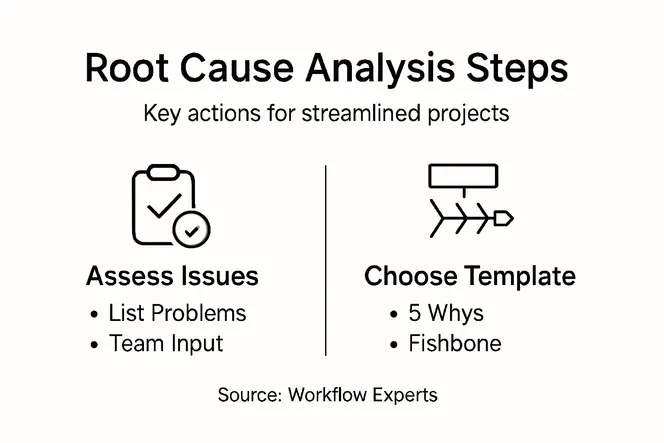
Step 2: Select the right root cause analysis template
Selecting an appropriate root cause analysis template is crucial for systematically uncovering the underlying issues in your workflow. This step will help you choose a template that matches your problem complexity.
Effective root cause analysis templates vary depending on the type and complexity of the issue you’re investigating. Some templates work better for simple linear problems, while others excel at examining complex, multifaceted challenges. Consider your specific scenario when selecting a template.
Here are the most common root cause analysis templates:
- 5 Whys Template: Best for straightforward problems with clear cause-and-effect relationships
- Fishbone (Ishikawa) Diagram: Ideal for complex issues involving multiple potential contributing factors
- Pareto Chart: Useful for identifying the most significant factors impacting a problem
- Failure Mode and Effects Analysis (FMEA): Recommended for analyzing potential failure points in processes
- Scatter Diagram: Helpful for identifying correlations between different variables
Each template offers unique advantages in diagnosing workflow challenges. Your selection should align with the problem’s complexity, the amount of available data, and your team’s analytical capabilities.
Here’s a comparison of popular root cause analysis templates to help you match each to your project needs:
| Template Type | Ideal Use Case | Complexity Level |
|---|---|---|
| 5 Whys | Simple, direct problems | Low |
| Fishbone (Ishikawa) Diagram | Multiple contributing factors | Medium to High |
| Pareto Chart | Prioritizing most impactful issues | Medium |
| FMEA | Proactive failure prevention | High |
| Scatter Diagram | Detecting variable correlations | Medium |
The right root cause analysis template transforms confusion into clarity, turning complex problems into actionable insights.
Professional tip: When in doubt, start with the 5 Whys template and escalate to more complex tools if your initial analysis reveals deeper systemic issues.
Step 3: Customize the template for your project needs
Customizing your root cause analysis template is essential for creating a targeted and effective problem-solving approach. This step will help you adapt the template to your specific project requirements.

The key to successful customization is understanding your project’s unique characteristics and workflow challenges. This means modifying template sections to capture the most relevant information for your specific situation. Different industries and project types demand different levels of detail and focus.
Here are critical strategies for template customization:
- Modify problem statement sections to reflect your specific context
- Add project-specific data fields that capture unique metrics
- Adjust timeline tracking to match your workflow cadence
- Include industry-specific categories for root cause investigation
- Create custom sections for capturing contextual details
Digital templates offer significant advantages in customization, allowing real-time edits and collaborative refinement. By tailoring your template, you transform a generic tool into a precision instrument for diagnosing workflow challenges.
Use this summary to understand the impact of customizing your analysis template:
| Customization Aspect | Potential Benefit | When to Use |
|---|---|---|
| Problem Statement | Ensures relevance | At project kickoff |
| Industry-Specific Fields | Captures unique details | Specialized industries |
| Timeline Adaptation | Aligns with workflow pace | Projects with unique pace |
| Collaboration Features | Gains broader insights | Cross-functional teams |
| Data Field Additions | Improves evidence gathering | Large or complex projects |
A well-customized root cause analysis template is like a Swiss Army knife: versatile, precise, and perfectly suited to your unique needs.
Professional tip: Involve team members from different departments when customizing your template to ensure comprehensive and diverse perspectives.
Step 4: Gather and organize relevant project data
Root cause analysis demands a comprehensive approach to data collection and organization. This step will help you systematically collect evidence for thorough investigation.
Effective data gathering requires a multi-source strategy that combines both qualitative and quantitative information. You’ll want to create a structured approach that captures insights from team members, historical records, performance metrics, and system logs. The goal is to build a holistic view of the problem that goes beyond surface-level observations.
Here are key strategies for gathering and organizing project data:
- Conduct stakeholder interviews to collect qualitative insights
- Review historical project documentation and performance records
- Analyze system logs and digital tracking metrics
- Collect quantitative performance data
- Create a centralized data repository for easy reference
- Cross-reference information from multiple sources
- Document observations with specific dates and contextual details
Your data collection process should be systematic and thorough. Each piece of information acts like a puzzle piece, helping you construct a comprehensive understanding of the root causes behind workflow challenges.
Effective data gathering is like detective work: every detail matters, and seemingly unrelated information can unlock critical insights.
Professional tip: Use collaborative digital tools that allow real-time data sharing and version tracking to streamline your information collection process.
Step 5: Validate solutions and monitor results
The final stage of root cause analysis involves rigorously testing and verifying your proposed solutions.
Validation is not a one-time event but an ongoing process of measurement, assessment, and continuous improvement. Your goal is to confirm that the implemented solutions actually resolve the root causes and prevent future recurrence of the identified problems. This requires a systematic approach that combines quantitative metrics, qualitative feedback, and structured performance tracking.
Here are key strategies for solution validation and monitoring:
- Establish baseline performance metrics before implementing changes
- Define clear, measurable success indicators
- Track quantitative and qualitative performance data
- Schedule regular review intervals
- Collect feedback from team members and stakeholders
- Compare current performance against historical benchmarks
- Be prepared to make iterative adjustments
Successful validation requires patience and a commitment to detailed observation. Think of it like fine-tuning an instrument - small, precise adjustments can dramatically improve overall performance.
Effective solution validation transforms root cause analysis from a theoretical exercise into a practical, results-driven process.
Professional tip: Create a dedicated dashboard that automatically tracks key performance indicators to simplify ongoing monitoring and reduce manual tracking effort.
Transform Your Root Cause Analysis Into Effortless Project Success
Struggling to identify the true causes behind workflow disruptions can drain your team’s energy and delay critical projects. This article highlights the importance of structured root cause analysis templates and customized data gathering to unlock clear insights. If you want to eliminate confusion, stop recurring problems, and stay on top of solution validation with ease, it is time to reimagine your project management approach.

Experience how Gammatica.com can revolutionize your root cause analysis process by integrating AI-driven task management, customizable templates, and team collaboration tools. Automate data collection and align your team’s efforts with real-time insights that save you up to 16 hours every week. Start streamlining your projects today with powerful automation and intuitive workflows. Explore our platform now and turn complex project challenges into smooth, scalable solutions.
Frequently Asked Questions
What is a root cause analysis template, and why is it important for streamlined projects?
A root cause analysis template is a structured tool designed to identify and address underlying issues affecting project workflows. It is essential for streamlined projects because it helps teams systematically diagnose problems, leading to more effective solutions and improved overall performance.
How do I choose the right root cause analysis template for my project?
Select a root cause analysis template that matches the complexity of your issue. For straightforward problems, the 5 Whys template may be sufficient, while more complex challenges might require tools like the Fishbone Diagram or Failure Mode and Effects Analysis (FMEA).
What steps should I follow to customize my root cause analysis template?
To customize your template, modify the problem statement to fit your context, add project-specific data fields, and include relevant categories for investigation. Tailoring the template ensures you gather the most pertinent information for your unique project needs.
How do I collect and organize relevant project data for root cause analysis?
Gather data by conducting stakeholder interviews, reviewing historical project documentation, and analyzing performance metrics. Organize this information in a centralized repository to create a comprehensive overview of the challenges you face.
What are the best practices for validating solutions after root cause analysis?
Establish baseline performance metrics and define clear success indicators before implementing changes. Regularly track performance data and collect feedback to ensure that the solutions effectively address the root causes, making adjustments as needed.