Every Project Manager who has faced tangled workflows knows how hard it is to keep teams aligned in a fast-moving tech environment. When processes become convoluted, even routine tasks can snowball into time-consuming challenges. Using a SIPOC diagram brings clarity by providing a structured overview of suppliers, inputs, processes, outputs, and customers. This high-level mapping lets teams quickly spot bottlenecks, align priorities, and communicate process essentials across departments.
Table of Contents
- What A SIPOC Diagram Involves
- The Five Key SIPOC Elements Explained
- When And Why To Use SIPOC Diagrams
- Benefits Of SIPOC For Project Management
- Common Pitfalls And Best Practices
What a SIPOC Diagram Involves
A SIPOC diagram represents a powerful visual mapping technique that helps project managers comprehensively understand complex business processes at a high level. Structured process visualization allows teams to capture critical workflow elements in a single, easy-to-understand overview.
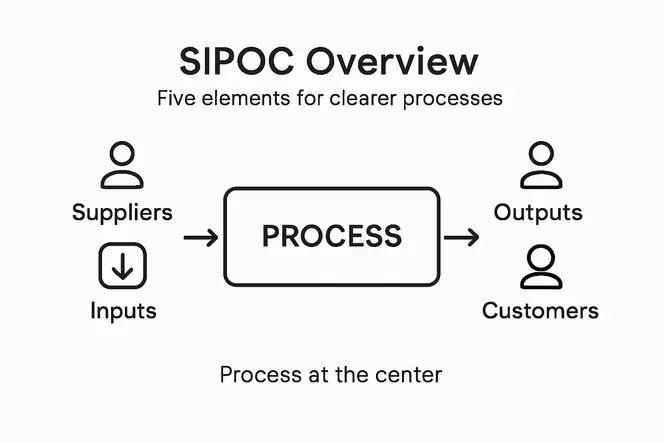
The SIPOC diagram consists of five fundamental components that provide a comprehensive snapshot of any organizational process:
- Suppliers: The entities or individuals who provide inputs into the process
- Inputs: Resources, information, or materials required to start the process
- Process: The sequential steps that transform inputs into outputs
- Outputs: The results or deliverables produced by the process
- Customers: The individuals or groups who receive and use the process outputs
Each component plays a crucial role in understanding how work flows through an organization. Process mapping helps teams identify bottlenecks and potential improvement opportunities by breaking down complex workflows into digestible segments.
By creating a SIPOC diagram, project managers can quickly establish clear boundaries, align team understanding, and prepare for more detailed process analysis. The visual nature of this tool makes it especially effective for communicating process details across different departments and stakeholder groups.
Pro tip: When creating your first SIPOC diagram, start by mapping a specific, well-understood process to build confidence in the technique before tackling more complex workflows.
The Five Key SIPOC Elements Explained
Understanding the five core SIPOC elements is crucial for project managers seeking to map and improve complex business processes. Each component plays a unique and interconnected role in creating a comprehensive process overview that reveals critical workflow insights.
Let’s break down the five key elements in detail:
- Suppliers: The origin point of any process
- Can be internal or external entities
- Provide essential resources, materials, or information
- Typically represent the starting point of the workflow
- Inputs: The resources required to initiate the process
- Materials, information, or specifications needed
- Directly supplied by the identified suppliers
- Must meet specific quality and quantity requirements
- Process: The transformative steps that convert inputs into outputs
- Sequential activities that add value
- Represents the core workflow methodology
- Includes key steps, decision points, and transformation mechanisms
- Outputs: The results produced by the process
- Products, services, or deliverables created
- Directly resulting from process activities
- Must meet customer expectations and requirements
- Customers: The recipients and end-users of the outputs
- Can be internal or external stakeholders
- Evaluate and consume the process results
- Provide critical feedback for continuous improvement
Process mapping reveals critical improvement opportunities by clearly defining each element’s role and interaction. This systematic approach helps organizations identify potential bottlenecks, streamline workflows, and enhance overall process efficiency.

By understanding how these five elements interconnect, project managers can develop more robust, transparent, and adaptable business processes that deliver consistent value to stakeholders.
The following table summarizes how each SIPOC component influences process improvement:
| SIPOC Component | Key Influence on Improvement | Example Benefit |
|---|---|---|
| Suppliers | Sets resource quality | Reduces delays |
| Inputs | Determines process readiness | Minimizes waste |
| Process | Drives workflow efficiency | Cuts rework |
| Outputs | Validates customer value | Boosts satisfaction |
| Customers | Provides actionable feedback | Informs changes |
Pro tip: Always validate each SIPOC element with actual stakeholders to ensure accuracy and capture nuanced workflow details that might not be immediately apparent.
When and Why to Use SIPOC Diagrams
SIPOC diagrams are strategic tools for project managers seeking clarity and structure in complex business processes. Gathering critical process information becomes significantly more straightforward when teams employ this systematic visualization technique.
There are several key scenarios where SIPOC diagrams prove particularly valuable:
- Process Creation: When developing new organizational workflows
- Process Improvement: Before launching comprehensive improvement initiatives
- Stakeholder Communication: To establish clear, shared understanding
- Project Scoping: Defining precise boundaries and expectations
- Performance Analysis: Identifying potential inefficiencies and bottlenecks
Documenting existing processes helps teams reach consensus by providing a high-level overview accessible to both experienced professionals and newcomers. The diagram’s power lies in its ability to transform complex workflows into digestible, visual representations that highlight critical interactions and dependencies.
Using a SIPOC diagram allows project managers to quickly establish process boundaries, understand stakeholder roles, and evaluate potential performance issues. By mapping out suppliers, inputs, processes, outputs, and customers, teams can systematically analyze each workflow element and identify opportunities for optimization.
Here’s a comparison of when to use a SIPOC diagram versus other mapping tools:
| Scenario | SIPOC Diagram | Flowchart |
|---|---|---|
| High-level overview | Ideal | Less appropriate |
| Detailed step capture | Not comprehensive | Best suited |
| Early project phase | Highly effective | Useful, not required |
| Cross-team collaboration | Strong alignment | Often complex |
Pro tip: Create your first SIPOC diagram collaboratively with team members from different departments to ensure comprehensive and diverse perspectives.
Benefits of SIPOC for Project Management
SIPOC diagrams offer project managers a powerful framework for understanding and improving organizational processes. Clarifying work scope and collaboration becomes dramatically more effective with this systematic approach to process mapping.
The key benefits of SIPOC for project management include:
- Enhanced Stakeholder Alignment: Creates a shared understanding of process components
- Precise Scope Definition: Establishes clear project boundaries and expectations
- Resource Optimization: Prevents overproduction and misallocation of resources
- Customer-Centric Approach: Ensures outputs directly meet customer requirements
- Simplified Complex Workflows: Breaks down intricate processes into manageable elements
Mapping process components supports project success by providing a comprehensive, high-level view that enables more strategic decision-making. The diagram serves as a critical tool during the Define phase of improvement methodologies like Six Sigma, helping teams establish a solid foundation for measuring, analyzing, and controlling process performance.
By systematically identifying suppliers, inputs, process steps, outputs, and customers, project managers can develop more targeted, efficient solutions. This approach reduces the risk of misalignment, ensures resources are properly utilized, and creates right-sized solutions that directly address stakeholder needs.
Pro tip: Involve team members from multiple departments when creating your SIPOC diagram to capture diverse perspectives and uncover hidden process insights.
Common Pitfalls and Best Practices
SIPOC diagrams require careful navigation to maximize their effectiveness in project management. Avoiding common diagram creation mistakes is crucial for generating meaningful process insights.
Common pitfalls project managers should be aware of include:
- Information Overload: Adding excessive detail that obscures core process understanding
- Unclear Boundaries: Failing to define precise process start and end points
- Limited Stakeholder Input: Not involving key team members during diagram development
- Static Documentation: Treating the SIPOC as a one-time exercise instead of a living document
- Overly Complex Representation: Including more than 5-7 core process steps
Maintaining SIPOC diagram effectiveness requires a strategic approach to creation and ongoing maintenance. Best practices emphasize keeping the diagram high-level, focusing on critical process elements, and regularly reviewing and updating the documentation to reflect current workflow realities.
Successful SIPOC implementation demands a disciplined approach that balances simplicity with comprehensive insight. Project managers should prioritize clear communication, stakeholder alignment, and continuous improvement when developing and utilizing these process mapping tools.
Pro tip: Schedule quarterly SIPOC diagram reviews with cross-functional team members to ensure ongoing accuracy and relevance.
Elevate Your Workflow Clarity with Gammatica
Struggling to visualize your process clearly with tools like SIPOC diagrams but finding it hard to turn that clarity into action and results? The article highlights challenges such as defining precise process boundaries, aligning stakeholders, and breaking down complex workflows into digestible elements. Gammatica.com is designed to solve these exact problems by offering an AI-driven platform that streamlines project and team management through intuitive workflow tools like Kanban boards, checklists, and automation. With features tailored to boost collaboration across departments and reduce administrative burden, it helps turn your high-level SIPOC insights into actionable, real-world outcomes.

Experience the power of combining SIPOC diagram clarity with Gammatica’s comprehensive automation and task management capabilities today. Reduce waste, improve communication, and free up to 16 hours weekly by orchestrating your workflow smarter. Ready to transform your project management approach and lead with confidence? Visit Gammatica now, explore the platform’s full benefits, and start simplifying complex processes across your organization.
Frequently Asked Questions
What is a SIPOC diagram?
A SIPOC diagram is a visual mapping tool that outlines the Suppliers, Inputs, Process, Outputs, and Customers involved in a business process to provide a high-level overview of workflows.
When should I use a SIPOC diagram?
You should use a SIPOC diagram during process creation, improvement initiatives, stakeholder communication, project scoping, and performance analysis to clarify and streamline complex workflows.
What are the key components of a SIPOC diagram?
The key components of a SIPOC diagram include Suppliers (entities providing inputs), Inputs (resources needed for the process), Process (steps transforming inputs into outputs), Outputs (deliverables produced), and Customers (recipients of the outputs).
How can a SIPOC diagram improve project management?
A SIPOC diagram enhances project management by creating stakeholder alignment, defining clear project scopes, optimizing resources, focusing on customer needs, and simplifying complex workflows for better decision-making.