Keeping team meetings productive can feel impossible when every sprint brings new challenges and shifting priorities. For mid-level managers in Hungary’s competitive tech scene, finding smarter ways to drive collaboration and measurable improvement has never mattered more. A well-structured Retro Agenda offers more than routine reflection, transforming feedback sessions into focused opportunities for actionable change. Discover how modern approaches and AI-powered enhancements can turn your next retrospective into a catalyst for sustained team growth.
Table of Contents
- Defining Retro Agenda And Its Purpose
- Key Components Of An Effective Retro Agenda
- Formats And Variations In Modern Retro Agendas
- Integrating AI For Smarter Retrospective Meetings
- Common Pitfalls And How To Avoid Them
Defining Retro Agenda And Its Purpose
A Retro Agenda is a structured team reflection process designed to systematically evaluate and improve performance, communication, and collaboration. Derived from Agile sprint retrospectives, this strategic meeting enables teams to analyze their recent work, identify challenges, and develop actionable improvement strategies.
The primary purpose of a Retro Agenda extends beyond simple discussion - it’s a focused mechanism for continuous team enhancement. Teams utilize this dedicated time to:
- Reflect on recent project performance
- Discuss encountered obstacles and potential solutions
- Identify process improvements
- Strengthen team communication and collaboration
- Develop concrete action plans for future sprints
During a typical Retro Agenda session, team members engage in honest, constructive dialogue about their collective experience. Psychological safety becomes crucial, encouraging participants to share insights without fear of criticism. The goal isn’t to assign blame but to create a collaborative environment where continuous improvement becomes the standard.
The most effective Retro Agendas transform retrospective discussions from passive reflections into dynamic, forward-looking strategy sessions.
Successful implementation requires structured facilitation, active participation, and a commitment to translating discussion points into tangible improvements. By systematically reviewing what worked, what didn’t, and how processes can be optimized, teams can progressively enhance their performance and team dynamics.
Pro tip: Create a dedicated digital workspace where team members can contribute retrospective insights asynchronously, ensuring comprehensive input before the actual meeting.
Key Components Of An Effective Retro Agenda
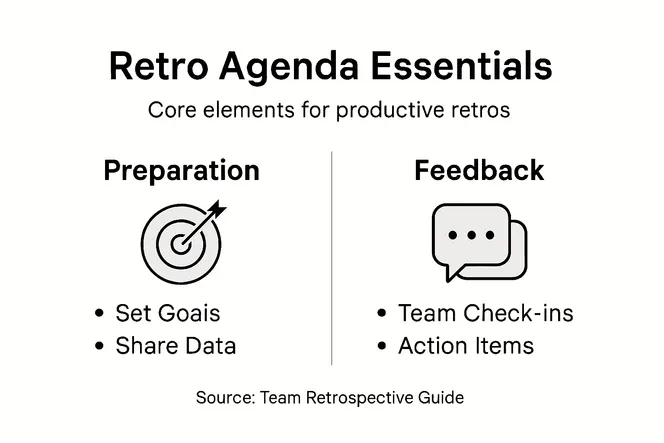
An effective Retro Agenda is more than a simple meeting template - it’s a strategic framework designed to drive meaningful team improvement. The key components transform retrospective sessions from routine discussions into powerful opportunities for growth and collaboration.
Critical components of a robust Retro Agenda include:
- Time Management: Allocate specific time blocks for different discussion phases
- Structured Discussion Format: Create a clear, predictable meeting flow
- Balanced Participation: Ensure every team member has an opportunity to contribute
- Actionable Outcome Tracking: Document insights and assign specific improvement actions
- Psychological Safety: Foster an environment of open, non-judgmental communication
The meeting’s structure typically involves several essential stages that guide productive dialogue. These stages help teams systematically unpack their recent experiences, identify patterns, and develop targeted improvement strategies. A well-designed Retro Agenda moves beyond surface-level observations to uncover deeper team dynamics and performance insights.
The most powerful Retro Agendas transform retrospective conversations from passive reflections into dynamic strategic planning sessions.
Successful implementation requires careful facilitation and a commitment to creating a safe, constructive dialogue space. Facilitators must skillfully navigate team dynamics, encourage honest feedback, and ensure that discussions remain focused and solution-oriented. This approach helps teams move beyond blame and toward collaborative problem-solving.
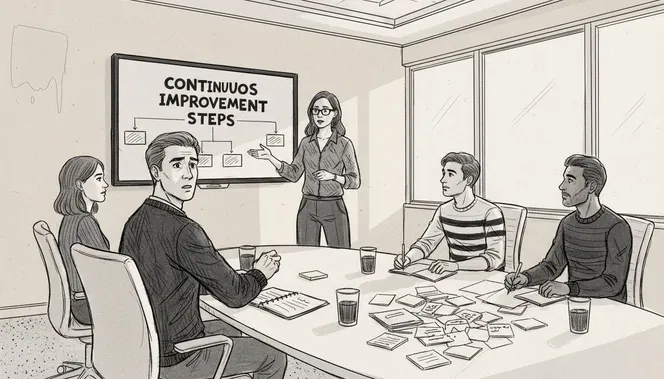
Each component of the Retro Agenda serves a specific purpose in driving continuous improvement. By carefully designing and executing these meetings, teams can create a culture of transparency, learning, and ongoing professional development.
Pro tip: Rotate meeting facilitators to bring fresh perspectives and prevent retrospective fatigue, ensuring diverse facilitation styles and engagement approaches.
Formats And Variations In Modern Retro Agendas
Modern team retrospectives have evolved beyond traditional meeting structures, embracing dynamic and innovative formats that keep teams engaged and motivated. These approaches recognize that one-size-fits-all methodologies quickly become stale and ineffective in driving meaningful continuous improvement.
Several popular retrospective formats have emerged to address different team needs and communication styles:
- Start-Stop-Continue: Identify actions to begin, halt, and maintain
- Positive-Negative-Actionable (PNA): Explore successes, challenges, and concrete next steps
- Mad-Glad-Sad: Explore emotional responses to recent team experiences
- Sailboat: Visualize team journey using metaphorical sailing imagery
- Temperature Check: Gauge team energy and sentiment through visual voting
Each format offers unique advantages in uncovering team insights and promoting transparent communication. The Sailboat method, for instance, encourages teams to visualize their journey by mapping potential risks (anchors), team goals (destination), and current momentum (wind). This metaphorical approach helps teams think creatively about their challenges and opportunities.
Here’s a concise overview comparing popular retrospective meeting formats and their best use cases:
| Retrospective Format | Ideal Team Situation | Strengths |
|---|---|---|
| Start-Stop-Continue | Teams needing focus on change readiness | Highlights priorities and habits |
| Mad-Glad-Sad | Addressing team morale or emotions | Surfaces hidden emotional blockers |
| Sailboat | Strategic planning or big-picture review | Reveals risks and team aspirations |
| Temperature Check | Detecting energy or engagement shifts | Quick feedback on team sentiment |
| Positive-Negative-Actionable | Solution-oriented or process-driven teams | Balances feedback with clear actions |
Effective retrospective formats are like musical instruments - each has a unique sound, but the real magic happens when skilled musicians collaborate.
Successful teams rotate between different retrospective formats to prevent monotony and maintain engagement. By introducing variety, facilitators can unlock different communication patterns, encourage diverse perspectives, and ensure that team members remain intellectually and emotionally invested in the continuous improvement process.
The key is flexibility and intentionality. No single format works perfectly for every team or every sprint. Skilled facilitators learn to read their team’s energy, adapt their approach, and create an environment where honest, constructive feedback becomes the norm.
Pro tip: Conduct a meta-retrospective quarterly to evaluate which retrospective formats generate the most meaningful insights for your specific team dynamics.
Integrating AI For Smarter Retrospective Meetings
The emergence of artificial intelligence is revolutionizing team retrospectives, offering unprecedented insights and facilitation capabilities. Modern AI tools are transforming traditional retrospective meetings from subjective discussions into data-driven, strategically focused conversations that unlock deeper team understanding.
AI-powered retrospective enhancements include:
- Automated Sprint Summaries: Quickly synthesize project performance data
- Sentiment Analysis: Detect underlying team emotional patterns
- Intelligent Action Item Generation: Create targeted, measurable improvement recommendations
- Pattern Recognition: Identify recurring challenges across multiple sprints
- Personalized Facilitation Suggestions: Recommend optimal discussion formats
These AI capabilities fundamentally change how teams approach continuous improvement. By processing vast amounts of communication data, collaboration metrics, and project performance indicators, intelligent systems can surface insights that human facilitators might overlook. The technology acts as an objective, data-driven team coach, providing nuanced perspectives that enhance traditional retrospective approaches.
The table below summarizes AI’s added value during different stages of a retrospective meeting:
| Retro Stage | AI Enhancement | What It Solves |
|---|---|---|
| Preparation | Automated data summaries | Saves time on report building |
| Discussion | Sentiment and pattern analysis | Uncovers team mood shifts |
| Action Planning | Intelligent action suggestions | Ensures actionable outcomes |
| Post-Meeting | Recurring issues recognition | Detects long-term trends |
AI doesn’t replace human insight - it amplifies our capacity to understand complex team dynamics and drive meaningful change.
Successful AI integration requires a balanced approach that preserves human emotional intelligence while leveraging technological capabilities. Teams must view AI as a collaborative tool that supports, rather than replaces, genuine human interaction. The most effective implementations use AI to prepare, contextualize, and enrich conversations, not to dictate outcomes.
Modern Scrum Masters and team leaders are increasingly recognizing AI’s potential to transform retrospectives from routine meetings into strategic growth opportunities. By combining machine learning’s analytical power with human creativity and empathy, teams can unlock unprecedented levels of self-awareness and continuous improvement.
Pro tip: Select AI retrospective tools that offer transparency in their analysis and provide configurable privacy controls to maintain team trust and data security.
Common Pitfalls And How To Avoid Them
Retrospective meetings can quickly become ineffective without careful planning and execution. Understanding and mitigating common retrospective challenges is crucial for maintaining team growth and continuous improvement momentum.
The most prevalent pitfalls teams encounter include:
- Blame Culture: Focusing on individual mistakes instead of systemic improvements
- Lack of Follow-Up: Generating action items without tracking or implementing them
- Superficial Discussions: Avoiding deep, meaningful conversations about team dynamics
- Inconsistent Participation: Allowing dominant personalities to monopolize conversations
- Meeting Fatigue: Treating retrospectives as routine, checkbox activities
Each of these pitfalls can significantly undermine the potential value of retrospective meetings. Psychological safety becomes paramount in creating an environment where team members feel comfortable sharing genuine insights and vulnerabilities without fear of retribution or judgment.
Effective retrospectives are not about finding fault, but about collective problem-solving and mutual understanding.
Successful teams develop strategies to counteract these challenges. This involves establishing clear ground rules, rotating facilitation responsibilities, and maintaining a forward-looking perspective that emphasizes learning and growth. The facilitator plays a critical role in guiding conversations away from blame and toward constructive, solution-oriented dialogue.
Implementing structured approaches like time-boxing discussions, using objective data to inform conversations, and creating explicit accountability mechanisms can transform retrospectives from potentially unproductive sessions into powerful tools for team development. The key is maintaining a delicate balance between honest reflection and constructive forward momentum.
Pro tip: Implement a rotating “retrospective health check” where team members anonymously rate the effectiveness of recent retrospectives to continuously improve the meeting format.
Transform Your Retro Agenda Into a Productivity Powerhouse
Team retrospectives are essential for continuous improvement but can fall short without the right tools to streamline discussions, track action items, and maintain engagement. If your team struggles with inconsistent participation, lack of follow-up, or wasting valuable time organizing retrospective meetings, it is time to rethink your approach. Applying concepts like psychological safety, structured facilitation, and actionable outcome tracking from your Retro Agenda can be much easier with the right digital platform.
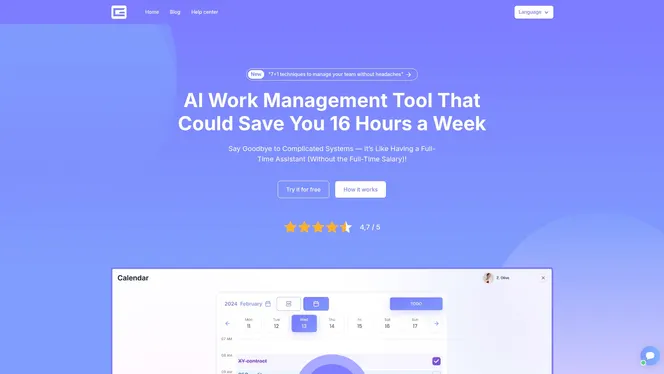
Unlock next-level team collaboration with Gammatica.com, an AI-driven project and team management platform designed to reduce administrative burdens and free up to 16 hours weekly. Leverage AI-generated suggestions, customizable templates, and seamless integrations to automate your retrospective preparations, document insights in real time, and track actionable improvements effortlessly. Whether you need comprehensive task management, calendar coordination, or secure online meetings via Zoom or Google Meet, Gammatica empowers your team to focus on strategic growth instead of manual follow-up. Get started now at https://gammatica.com and witness your retrospectives become efficient engines of meaningful change.
Frequently Asked Questions
What is a Retro Agenda?
A Retro Agenda is a structured team reflection process designed to evaluate and improve performance, communication, and collaboration, primarily used in Agile sprint retrospectives.
Why is psychological safety important in a Retro Agenda?
Psychological safety encourages team members to share honest insights without fear of criticism, fostering a collaborative environment essential for productive discussions during retrospectives.
What are some common pitfalls to avoid in retrospective meetings?
Common pitfalls include fostering a blame culture, lack of follow-up on action items, superficial discussions, inconsistent participation, and meeting fatigue. Addressing these can enhance the effectiveness of retrospectives.
How can AI enhance retrospective meetings?
AI can enhance retrospectives by providing automated sprint summaries, sentiment analysis, intelligent action item generation, pattern recognition, and personalized facilitation suggestions, contributing to more data-driven and insightful conversations.