
The most common team management mistakes you need to know
Most managers don’t fail because they lack intelligence or effort. They fail because of recurring, fixable behaviors that quietly erode trust, engagement, and results. These common team management mistakes show up in organizations of every size, and the cost is real: A large portion of the variance in team engagement is driven by the manager alone.
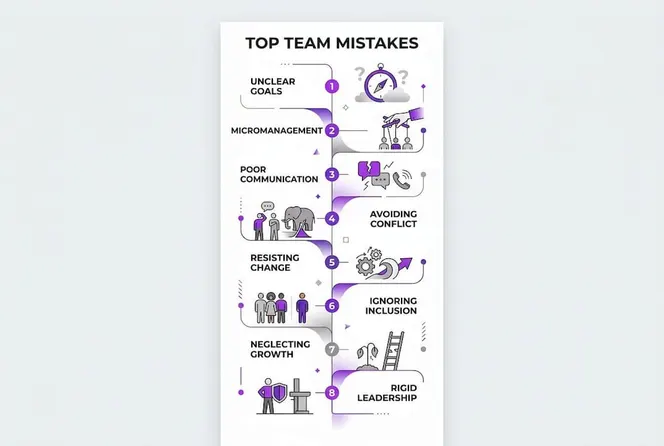
Here’s a quick look at the mistakes covered in this article:
- Failing to shift from individual contributor to manager mindset
- Setting vague or unmeasured goals
- Micromanaging instead of delegating
- Poor communication and missing recognition
- Neglecting one-on-ones and avoiding conflict
- Resisting change and poor planning
- Taking yourself too seriously and ignoring psychological safety
- Overlooking diversity, inclusion, and professional development
- Failing to adapt your leadership style
Each one is correctable. Knowing where to look is the first step.
1. Why the jump from individual contributor to manager trips people up
Getting promoted because you were great at your job is common. Leading a team well is a completely different skill. About 38% of new leaders fail within their first 18 months, largely because they keep doing the work instead of enabling others to do it.
The shift requires you to become a process facilitator, not an answer provider. Your value is no longer in your personal output. It’s in how well your team performs without you doing everything yourself.
Watch for these signs you haven’t made the transition:
- You regularly complete tasks your team members should own
- You feel anxious when you’re not directly involved in decisions
- Your team waits for your input before moving forward
- You struggle to tolerate uncertainty or ambiguity
The fix is deliberate. Set boundaries around what you will and won’t do personally. Practice sitting with discomfort when your team works through problems on their own. The goal is a team that runs well even when you step back.
2. Setting unclear goals and expectations
Vague goals are one of the most damaging team leadership pitfalls, and they’re also one of the easiest to overlook. When your team doesn’t know exactly what success looks like, they fill in the gaps themselves, often incorrectly.
The SMART framework (Specific, Measurable, Achievable, Relevant, Time-bound) exists for a reason. A goal like “improve customer satisfaction” gives your team nothing concrete to aim for. “Increase our NPS score from 42 to 55 by September 30” gives them a target, a timeline, and a way to measure progress.
Strategies that actually work:
- Write goals down and share them in a place the whole team can access
- Confirm understanding by asking team members to restate the goal in their own words
- Review goals at regular intervals, not just at the start of a quarter
- Be explicit about what “done” looks like for every major deliverable
3. Micromanagement and failure to delegate effectively
Many employees report experiencing micromanagement, and the damage goes beyond morale. When people feel watched at every step, they stop taking initiative. Over time, your team becomes dependent on you for even minor decisions, which slows everything down.

Micromanagement usually comes from a fear of losing control, not from bad intentions. The antidote is building visibility into your workflows so you don’t need to hover. When task progress is transparent, you can trust without checking in constantly.
Pro Tip: Use a task management system with clear ownership and status tracking. When everyone can see what’s in progress, blocked, or done, you get the visibility you need without the constant check-ins that signal distrust.
Common delegation barriers and how to address them:
- “No one else can do it as well as I can” — coach them until they can
- “It’s faster if I just do it” — true once, costly long-term
- “I don’t want to overload my team” — ask them; they often want more responsibility
4. Poor communication and lack of employee recognition
One of the top team communication errors is assuming that information shared once is information received. It isn’t. Repetition, clarity, and the right channel all matter. A poll of 1,400 executives found that failing to provide timely feedback is the single most common leadership mistake.
Recognition is the other side of this coin. Employees who feel unseen disengage quietly, and by the time you notice, they’re already mentally out the door.
Practical ways to improve both:
- Hold brief weekly team check-ins to align on priorities and surface blockers
- Give specific, timely feedback rather than saving it for annual reviews
- Recognize contributions publicly, not just privately
- Ask your team how they prefer to receive feedback — people differ significantly
5. Not making time for employees and avoiding conflict
Managers who are always “too busy” for one-on-ones send a clear message: your team’s needs are not a priority. Regular individual meetings build the trust that makes everything else, including hard conversations, easier.

Conflict avoidance is equally damaging. About 70% of employees avoid difficult conversations, but when a manager does the same, the whole team feels it. Unresolved tension festers into resentment, and resentment kills collaboration.
Pro Tip: Schedule one-on-ones as recurring calendar blocks, not as optional catch-ups. Treat them like client meetings. Canceling sends a signal you may not intend.
Steps to handle conflict proactively:
- Address issues within 48 hours of noticing them, before they compound
- Focus on behavior and impact, not personality or intent
- Use a neutral framing: “I noticed X happened. Can we talk about it?”
- Follow up after the conversation to confirm the issue is resolved
For managers leading distributed teams, remote team management adds another layer of complexity to both availability and conflict resolution.
6. Resisting change and poor time management
Teams take their cues from their managers. When you resist new processes, tools, or organizational shifts, your team reads that as permission to do the same. The result is a group that falls behind while the rest of the organization adapts.
Poor time management compounds this. Managers who spend their days reacting to emails and putting out fires rarely have space to think strategically, develop their team, or plan ahead.
Common time management errors among managers:
- Treating every request as equally urgent
- Attending every meeting without asking whether their presence is necessary
- Failing to block time for deep work and planning
- Letting administrative tasks crowd out people management
Adopting a change mindset starts with modeling it. When a new tool or process rolls out, be the first to engage with it genuinely, not just in words.
7. Taking yourself too seriously and ignoring psychological safety
Rigid, humorless leadership creates distance. Teams that can’t laugh together, admit mistakes, or ask “dumb questions” are teams that hide problems until they become crises.
Google’s internal research identified psychological safety as the top predictor of team effectiveness. It’s not about being nice. It’s about creating conditions where people speak up, disagree openly, and take reasonable risks without fear of embarrassment or punishment.
Steps to build a more open team culture:
- Admit your own mistakes openly and without drama
- Respond to bad news with curiosity, not blame
- Invite disagreement explicitly: “What am I missing here?”
- Celebrate effort and learning, not just outcomes
High-intellect leaders are especially prone to a related blind spot: misreading silence as agreement. When you’re the smartest person in the room, people often stop challenging you. That’s not consensus. That’s a warning sign.
8. What research says about how management mistakes affect teams
The data on leadership behavior and team outcomes is consistent and worth sitting with.
70% of team engagement variance is attributable to the manager. No other organizational factor comes close.
Research also identifies three recurring dysfunction patterns in leadership teams:
- Shark tank: Infighting and competition that undermines collective goals
- Petting zoo: Excessive harmony where no one challenges ideas, leading to stagnation
- Mediocracy: Complacency where average performance becomes the accepted standard
The petting zoo pattern is especially common and underestimated. Teams that never disagree aren’t aligned. They’re conflict-averse. Building a “debate by design” culture, where structured dissent is expected and welcomed, corrects this directly.
Managers who lack self-awareness about their own communication style can create team stress without realizing it. The fix isn’t a personality overhaul. It’s regular, honest feedback from people who feel safe enough to give it.
9. Ignoring diversity and inclusion in team management
Homogeneous teams feel easier to manage in the short term. They’re not. Teams that lack diverse perspectives miss blind spots, make narrower decisions, and struggle to connect with varied customers and markets.
Inclusion isn’t a checkbox. It’s a daily management practice. When certain voices consistently dominate meetings, when feedback is delivered differently based on who’s receiving it, or when career opportunities cluster around a particular profile, the team notices, even if you don’t.
For managers leading cross-cultural or international teams, the challenge is even more specific. Managing multicultural teams requires deliberate attention to communication norms, decision-making styles, and how conflict is expressed across cultures.
Practical steps:
- Actively solicit input from quieter team members in meetings
- Audit who gets stretch assignments and sponsorship over time
- Learn how different team members prefer to give and receive feedback
10. Neglecting professional development for your team members
Employees who feel stagnant leave. It’s that direct. Career development is one of the top drivers of retention, yet many managers get so focused on quarterly deliverables that they stop investing in their team’s growth.
Development doesn’t require a formal program or a training budget. Coaching conversations, stretch assignments, and honest career discussions cost nothing but time. The managers who retain their best people are usually the ones who talk about the future regularly, not just performance in the present.
What this looks like in practice:
- Ask each team member about their career goals at least once a quarter
- Connect people with mentors or projects that build toward those goals
- Share relevant learning resources, articles, or courses proactively
- Recognize growth, not just results
11. Failing to adapt your leadership style to your team
One management style does not fit every person or every situation. A new hire needs more structure and guidance. An experienced team member needs autonomy and trust. Treating both the same way frustrates both.
Situational leadership, the idea that your approach should flex based on the individual’s skill and confidence level, is well-established for a reason. The managers who improve team dynamics most consistently are the ones who read the room and adjust.
This also applies across team dynamics. A team in crisis needs decisive direction. A high-performing team in a stable phase needs space to self-direct. Applying the same approach regardless of context is one of the quieter team leadership pitfalls, because the mismatch often isn’t obvious until performance drops.
The leadership lesson most managers learn too late
Most management advice focuses on what to do. The harder question is what to stop doing.
The managers I’ve seen struggle most aren’t lazy or indifferent. They’re often the most driven people in the room, which is exactly the problem. They hold on too tight, move too fast, and assume their way of working is the right way for everyone. The transition from high performer to effective leader requires giving up the thing that got you promoted: being the one with all the answers.
Psychological safety isn’t soft. It’s the condition under which your team will actually tell you what’s going wrong before it becomes a crisis. Conflict isn’t a failure of team culture. Avoiding it is. And the managers who build the most loyal, high-performing teams are almost always the ones who’ve learned to be genuinely curious about their own blind spots, not just their team’s.
The research on leadership dysfunction is clear: teams don’t fail because of bad strategy. They fail because of unchecked leadership habits that compound over time. The good news is that habits change. Start with one.
Gammatica helps you manage your team without the guesswork
Avoiding management mistakes gets significantly easier when you have real-time visibility into what your team is actually doing. Gammatica gives managers a single place to track tasks, manage workflows, and coordinate across projects, so you spend less time chasing updates and more time leading.

With AI-driven task suggestions, Kanban boards, and built-in automation through Make.com integrations, Gammatica reduces the administrative load that pulls managers away from their people. Teams using the platform can reclaim up to 16 hours weekly, time that goes back into coaching, planning, and the kind of one-on-ones that actually build trust. If you’re ready to see how it works for your team, explore Gammatica for founders or book a demo call to see it in action.