Misconceptions about project management methods can quietly drain resources and delay success for even the most innovative European tech teams. With over 60 percent of international projects reportedly missing deadlines due to outdated or misunderstood practices, the difference between American and European strategies becomes critical. This article explores actionable insights for project managers eager to harness both traditional and AI-driven frameworks, empowering your teams to meet evolving demands with clarity and efficiency.
Table of Contents
- Defining Project Management Methods And Misconceptions
- Comparing Agile, Waterfall, And Hybrid Approaches
- Essential Features For Effective Team Collaboration
- How Ai Enhances Project Workflows And Automation
- Common Pitfalls And Risk Management Strategies
Defining Project Management Methods and Misconceptions
Project management represents a strategic approach to planning, executing, and controlling organizational initiatives across various complex landscapes. At its core, project management involves coordinating resources, timelines, and team efforts to achieve specific objectives within predetermined constraints. Systematic research from academic literature reveals multiple methodological frameworks that guide professionals in navigating intricate business challenges.
Traditional project management methods like PMBOK (Project Management Body of Knowledge), PRINCE2 (Projects IN Controlled Environments), and ISO 21500 provide structured frameworks for delivering successful projects. These methodologies share common characteristics such as defining clear project scopes, establishing communication protocols, and implementing robust tracking mechanisms. They differ in their specific approaches but converge on fundamental principles of systematic planning, risk management, and stakeholder engagement.
Common misconceptions often undermine effective project management strategies. Many professionals mistakenly believe that rigid adherence to processes guarantees success, when in reality, flexibility and adaptive thinking are crucial. Projects frequently encounter unexpected challenges that require nuanced responses beyond prescriptive guidelines. Understanding that project management is both an art and a science helps teams develop more resilient and responsive approaches to complex initiatives.
Pro tip: Develop a flexible project management framework that balances structured methodologies with adaptive problem solving techniques, allowing your team to navigate uncertainties while maintaining clear strategic objectives.
Comparing Agile, Waterfall, and Hybrid Approaches
Project management methodologies have evolved significantly, offering diverse strategies to address complex organizational challenges. Each approach—Agile, Waterfall, and Hybrid—brings unique strengths and considerations for effectively managing team workflows and project deliverables. Modern research explores how project managers strategically customize these methodologies to optimize performance across different project environments.
The Waterfall methodology represents a traditional, linear approach where project phases flow sequentially from initiation through completion. Teams complete one phase before moving to the next, with clear documentation and predetermined milestones. In contrast, Agile methodology embraces flexibility, iterative development, and continuous adaptation. Agile teams work in short sprints, regularly reassessing project requirements and allowing dynamic responses to changing stakeholder needs. This approach prioritizes collaboration, customer feedback, and incremental progress over rigid planning.
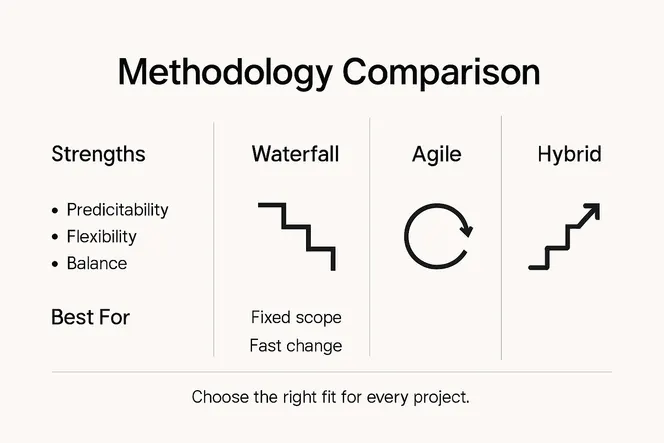
Hybrid methodologies emerge as a sophisticated solution bridging traditional and adaptive project management techniques. By selectively integrating Waterfall’s structured planning with Agile’s responsive frameworks, hybrid approaches offer unprecedented flexibility. Organizations can customize their project management strategy, balancing predictability with adaptability. This approach proves particularly effective in complex projects requiring both detailed planning and the capacity to pivot quickly in response to emerging challenges or technological shifts.
Pro tip: Assess your project’s unique characteristics and stakeholder requirements before selecting a methodology, recognizing that no single approach fits all scenarios and that strategic customization often yields the most successful outcomes.
Here’s a concise comparison of key project management methodologies and what makes each unique:
| Methodology | Main Focus | Flexibility | Best Use Case |
|---|---|---|---|
| Agile | Iterative delivery | High | Fast-changing requirements |
| Waterfall | Sequential planning | Low | Fixed, stable requirements |
| Hybrid | Balanced structure | Medium | Complex, evolving projects |
Essential Features for Effective Team Collaboration
Team collaboration represents the cornerstone of successful project management, transforming individual efforts into collective achievements. Professional project management research consistently highlights critical components that enable high-performing teams to work seamlessly across diverse environments. Understanding these essential features allows organizations to create robust collaborative frameworks that drive productivity and innovation.

Effective collaboration hinges on several key elements. Communication channels must be clear, transparent, and accessible to all team members. This involves establishing multiple interaction platforms—ranging from digital communication tools to regular in-person or virtual meetings—that facilitate both formal project updates and informal knowledge sharing. Role definition plays a crucial part, ensuring each team member understands their specific responsibilities, accountability boundaries, and how their individual contributions integrate into the broader project objectives.
Emotional intelligence and trust emerge as fundamental yet often overlooked collaboration drivers. Successful teams develop psychological safety where members feel comfortable sharing ideas, admitting mistakes, and providing constructive feedback. This requires leadership that promotes open dialogue, actively listens, and creates an inclusive environment that values diverse perspectives. Technical collaboration tools support these interpersonal dynamics by providing shared workspaces, real-time document editing, task tracking, and transparent progress monitoring that keep everyone aligned and informed.
Pro tip: Implement a quarterly team alignment workshop where members can reassess communication strategies, realign on shared goals, and proactively address any emerging collaboration challenges.
How AI Enhances Project Workflows and Automation
Artificial Intelligence (AI) is revolutionizing project management by transforming traditional workflow processes into intelligent, adaptive systems. Recent technological innovations demonstrate AI’s profound impact on project management strategies through advanced automation, predictive analytics, and intelligent decision-support mechanisms. By integrating machine learning algorithms and data-driven insights, AI enables project teams to transcend conventional operational limitations and achieve unprecedented levels of efficiency.
AI-powered tools excel at automating repetitive administrative tasks, freeing project managers to concentrate on strategic planning and complex problem-solving. These intelligent systems can automatically generate comprehensive project reports, track resource allocation, predict potential bottlenecks, and provide real-time risk assessments. Machine learning algorithms analyze historical project data to identify patterns, recommend optimal scheduling strategies, and suggest proactive interventions before potential issues escalate. This predictive capability transforms project management from a reactive to a anticipatory discipline, significantly reducing uncertainty and improving overall project outcomes.
The most transformative aspect of AI in project workflows involves its ability to create dynamic, self-adjusting systems. Advanced AI platforms can continuously learn from project performance data, adapting workflows in real-time based on team productivity, resource constraints, and changing project requirements. These systems provide unprecedented visibility into project metrics, enabling managers to make data-driven decisions with greater precision and confidence. By integrating natural language processing, collaborative AI tools can also facilitate more effective communication, translating complex technical language and bridging potential misunderstandings across diverse team environments.
Pro tip: Start small by identifying one repetitive project management task where AI can provide immediate value, then gradually expand your AI integration strategy based on measured improvements and team feedback.
Below is a summary of how AI enhances essential project management aspects:
| AI Capability | Business Impact | Example Benefit |
|---|---|---|
| Task automation | Saves manager time | Automatic status updates |
| Predictive analytics | Prevents project delays | Early risk identification |
| Workflow adaptation | Boosts team efficiency | Real-time process adjustments |
Common Pitfalls and Risk Management Strategies
Project management inherently involves navigating complex challenges that can derail even the most meticulously planned initiatives. Systematic research reveals critical insights into the most prevalent project management risks that organizations must strategically anticipate and mitigate. Understanding these potential pitfalls becomes the first line of defense in maintaining project integrity and ensuring successful outcomes.
Scope creep emerges as one of the most insidious risks facing project teams. This phenomenon occurs when project requirements gradually expand beyond original parameters without corresponding adjustments to timeline, budget, or resources. Effective risk management demands establishing clear project boundaries, implementing rigorous change control processes, and maintaining transparent communication with stakeholders. Teams must develop robust documentation protocols that explicitly define project scope, deliverables, and acceptance criteria, creating a definitive reference point for evaluating potential scope modifications.
Resource management represents another critical area of potential project failure. Insufficient human capital, skill misalignment, or improper resource allocation can create cascading challenges that compromise project momentum. Successful risk mitigation involves comprehensive workforce planning, skills gap analysis, and creating flexible staffing strategies that allow rapid reallocation of talents. Advanced project management approaches recommend developing comprehensive resource mapping, maintaining skill inventories, and establishing cross-training mechanisms that enhance team adaptability and resilience against unexpected personnel transitions.
Pro tip: Develop a living risk register that is updated weekly, capturing emerging challenges, assigning clear ownership for mitigation strategies, and conducting regular retrospective assessments to continuously improve your risk management approach.
Unlock Seamless Team Productivity with Intelligent Project Management
The article “Methods of Project Management Driving Team Productivity” highlights the urgent need to balance structured methodologies with flexible collaboration while overcoming challenges such as scope creep resource misalignment and communication gaps. These pain points often slow down progress and drain valuable time. If you want to empower your team with a tool that automates administrative tasks improves workflow visibility and fosters collaborative alignment then Gammatica.com is the solution designed for these exact needs.
Experience real impact with features like:
- AI-driven task management that saves hours weekly
- Integrated Kanban boards and checklists tailoring to Agile Waterfall or Hybrid styles
- Automated workflows combined with CRM and calendar coordination for flawless team synchronization
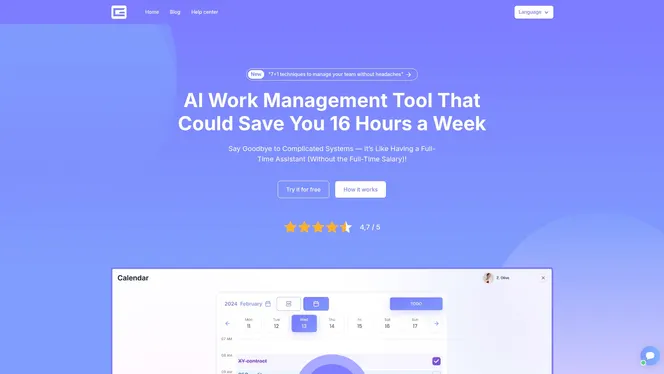
Ready to drive your project management beyond traditional limits and accelerate your team’s productivity Start now by exploring Gammatica to see how our platform can be customized to your project methodology and team dynamics. Discover how to reduce scope creep manage evolving workflows and boost collaboration without added complexity. Visit Gammatica and take control of your projects with AI-powered precision today.
Frequently Asked Questions
What are the main project management methodologies?
Traditional project management methodologies include PMBOK (Project Management Body of Knowledge), PRINCE2 (Projects IN Controlled Environments), and ISO 21500. Each framework provides structured approaches to planning and executing projects effectively.
How does Agile project management differ from Waterfall?
Agile is an iterative and flexible approach that allows for continuous adaptation and collaboration, while Waterfall is a linear and sequential model that requires completing one phase before moving onto the next. Agile focuses on responding to changing requirements, whereas Waterfall prioritizes detailed planning and documentation.
What are the benefits of using a hybrid project management approach?
A hybrid approach combines traditional Waterfall planning with Agile flexibility, allowing organizations to leverage the strengths of both methodologies. This can lead to improved adaptability and efficiency, especially in complex projects with evolving requirements.
How can artificial intelligence improve project management workflows?
AI enhances project management by automating repetitive tasks, providing predictive analytics to identify potential risks, and adapting workflows in real-time based on team performance. This leads to increased efficiency and allows project managers to focus on strategy and problem-solving.