Launching a new project often means balancing urgency with clarity. For project managers in mid-sized SaaS companies, an effective kickoff call agenda does more than introduce the team—it lays the groundwork for collaboration, accountability, and direction. A well-crafted agenda ensures everyone understands their roles, timelines, and goals from the very beginning. By focusing on open communication and careful planning, you can transform initial meetings into powerful momentum builders that drive lasting success.
Table of Contents
- Kickoff Call Agenda Defined And Its Importance
- Types Of Kickoff Call Agendas For Teams
- Essential Components Of A Kickoff Call
- Typical Roles And Stakeholder Responsibilities
- Key Risks, Challenges, And Common Mistakes
Kickoff Call Agenda Defined and Its Importance
A kickoff call agenda represents the strategic blueprint that launches collaborative projects, setting the foundation for team success. Unlike routine meetings, these initial gatherings are critical pivot points that determine project trajectory and team alignment. Project management experts confirm these meetings encapsulate essential planning elements that propel initiatives forward.
The primary purpose of a kickoff call agenda encompasses several key objectives:
- Establishing clear project goals and expectations
- Introducing team members and defining individual roles
- Outlining project timelines and critical milestones
- Creating open communication channels
- Identifying potential risks and mitigation strategies
Understanding the nuanced importance of these meetings transforms them from mere administrative tasks into strategic opportunities. Technical professionals recognize that effective kickoff calls prevent misalignment and create a shared vision among stakeholders. By dedicating focused time to collaborative planning, teams can dramatically improve their chances of project success.
Kickoff call agendas serve as more than procedural documents—they are living roadmaps that guide teams through complex project landscapes. These initial meetings signal commitment, establish trust, and generate collective momentum toward shared objectives. When executed thoughtfully, they can convert individual contributors into a cohesive, aligned team.
Pro tip: Distribute the kickoff call agenda at least 48 hours in advance, allowing team members to prepare thoughtful questions and come ready to engage proactively.
Types of Kickoff Call Agendas for Teams
The landscape of kickoff call agendas is diverse, reflecting the varied contexts and objectives of modern business interactions. Professional organizations highlight that different meeting types demand unique approaches to ensure maximum effectiveness and engagement.
Primary types of kickoff call agendas include:
- Internal Team Kickoff: Focuses on team alignment, role clarification, and project coordination
- Client-Facing Kickoff: Emphasizes project objectives, deliverables, and establishing client relationship
- Sales Kickoff: Concentrates on motivational elements, performance goals, and product strategy updates
- Seasonal/Annual Kickoff: Reviews past performance, sets future objectives, and builds organizational momentum
- Cross-Departmental Kickoff: Bridges communication between different organizational units and aligns interdepartmental goals
Each kickoff call agenda type requires a strategic approach tailored to its specific audience and purpose. Internal team kickoffs typically dive deep into operational details, workflow processes, and individual responsibilities. In contrast, client-facing kickoffs prioritize establishing trust, communicating value propositions, and setting clear expectations about project scope and deliverables.
The nuanced differences between these agenda types underscore the importance of customization. A one-size-fits-all approach fails to address the unique communication needs and dynamics of different meeting contexts. By recognizing and adapting to these variations, teams can transform kickoff calls from routine meetings into powerful strategic tools that drive engagement, alignment, and successful outcomes.
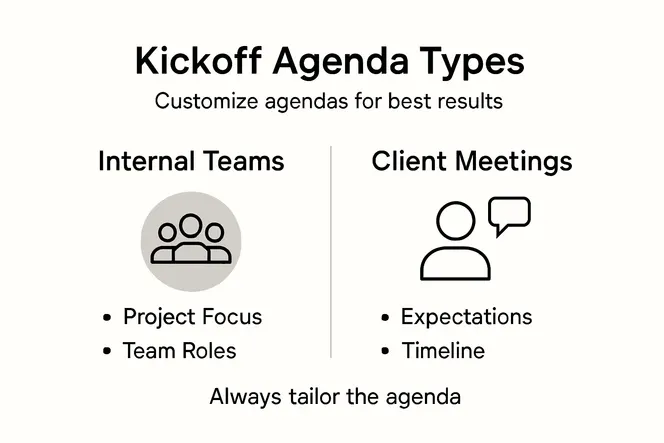
Here is a comparison of different kickoff call agenda types and their primary focus:
| Agenda Type | Main Audience | Strategic Focus |
|---|---|---|
| Internal Team Kickoff | Project Team | Operational alignment |
| Client-Facing Kickoff | Clients | Relationship and expectations |
| Sales Kickoff | Sales Staff | Motivation and goals |
| Annual/Seasonal Kickoff | Organization | Performance review, momentum |
| Cross-Departmental Kickoff | Multiple Teams | Interdepartmental collaboration |
Pro tip: Create a flexible kickoff call template that can be quickly customized for different meeting types, saving time and ensuring consistent, professional communication.
Essential Components of a Kickoff Call
A successful kickoff call requires careful planning and strategic inclusion of key project communication elements. Software engineering experts recommend a comprehensive approach that ensures all critical aspects of project initiation are thoroughly addressed.
Essential components of a kickoff call include:
- Project Purpose and Objectives: Clearly articulate the project’s core mission and desired outcomes
- Participant Introductions: Allow team members to understand individual roles and expertise
- Scope Definition: Establish precise boundaries of project work and deliverables
- Timeline and Milestone Mapping: Create a visual representation of key project stages
- Roles and Responsibilities: Explicitly define each team member’s specific contributions
- Communication Protocols: Outline preferred communication channels and reporting mechanisms
- Risk Assessment: Identify potential challenges and preliminary mitigation strategies
Project management professionals emphasize that these components are not just checklist items but strategic building blocks for team alignment. Each element serves a crucial function in transforming individual contributors into a cohesive, goal-oriented unit. The introductory phase sets the tone for collaboration, while detailed discussions about scope and responsibilities prevent potential misunderstandings.
Successful kickoff calls go beyond mere information sharing—they create a shared vision and collective commitment. By meticulously addressing each component, teams establish a solid foundation that supports smooth project execution, reduces potential conflicts, and increases the likelihood of achieving desired outcomes. The art of a great kickoff call lies not just in covering topics, but in fostering genuine understanding and enthusiasm among participants.

Pro tip: Distribute a pre-meeting packet with draft agenda, participant bios, and preliminary project documentation to maximize kickoff call productivity.
Typical Roles and Stakeholder Responsibilities
Project dynamics are fundamentally shaped by the clear definition of roles and responsibilities. Software engineering experts emphasize that successful project execution depends on establishing unambiguous accountability from the project’s inception.
Typical roles and their core responsibilities include:
- Project Manager:
- Coordinates overall project strategy
- Facilitates communication between stakeholders
- Manages project timeline and resource allocation
- Team Members:
- Execute specific project tasks
- Provide technical expertise and implementation skills
- Report progress and potential challenges
- Executive Stakeholders:
- Provide strategic direction
- Approve major project decisions
- Ensure alignment with organizational goals
- Client Representatives:
- Define project requirements
- Provide ongoing feedback
- Validate project deliverables
- External Partners/Consultants:
- Offer specialized expertise
- Support complex project components
- Provide independent perspectives
Project management professionals confirm that effective role definition extends beyond mere job descriptions. It involves creating a collaborative ecosystem where each participant understands their unique contribution to the project’s success. The kickoff call serves as the critical moment to establish these expectations, preventing potential misunderstandings and fostering a culture of mutual accountability.
Role clarity is not about rigid hierarchies but about creating a flexible, transparent framework that empowers each team member. When responsibilities are explicitly defined, teams can navigate complex projects with confidence, reducing friction and maximizing collective potential. The most successful projects emerge from a shared understanding of individual and collective responsibilities.
The following table summarizes the impact of clarifying roles during kickoff calls:
| Role Definition Impact | Project Outcome | Team Dynamics |
|---|---|---|
| Clear role assignments | Faster decision-making | Increased accountability |
| Unclear responsibilities | Frequent miscommunications | Lower team morale |
| Flexible responsibility framework | Enhanced adaptability | Greater collaboration |
Pro tip: Create a one-page responsibility matrix before the kickoff call, detailing each role’s specific expectations and decision-making authority.
Key Risks, Challenges, and Common Mistakes
Project kickoff calls are vulnerable to numerous potential pitfalls that can derail team performance and project success. Professional associations highlight that proactive risk management is crucial during these critical initial interactions.
Common risks and challenges include:
- Communication Breakdowns:
- Misaligned expectations
- Unclear project objectives
- Insufficient stakeholder engagement
- Structural Vulnerabilities:
- Undefined roles and responsibilities
- Inadequate documentation
- Poor meeting preparation
- Strategic Limitations:
- Scope creep potential
- Unrealistic timeline expectations
- Limited follow-up mechanisms
- Team Dynamics Challenges:
- Low participant motivation
- Hierarchical communication barriers
- Resistance to collaborative approaches
Software engineering experts warn that these risks can significantly compromise project outcomes. The most critical mistakes often emerge from assumptions about shared understanding, when in reality, team members may interpret project goals and expectations differently. Successful mitigation requires deliberate, transparent communication that leaves no room for ambiguity.
Navigating these challenges demands a strategic approach that prioritizes clarity, inclusivity, and continuous alignment. By anticipating potential risks and implementing proactive communication strategies, teams can transform potential obstacles into opportunities for enhanced collaboration and project success. The most resilient teams view kickoff calls not as mandatory administrative tasks, but as critical moments of collective vision-setting and mutual commitment.
Pro tip: Conduct a pre-kickoff meeting diagnostic by sending a structured questionnaire to participants, identifying potential misalignments before the actual call.
Streamline Your Kickoff Calls with Gammatica’s AI-Powered Project Management
Launching a project with a clear kickoff call agenda is essential to prevent misalignment and boost team collaboration. Yet, managing diverse roles, setting timelines, and handling communication protocols can quickly become overwhelming. Challenges like undefined responsibilities and scope creep can stall progress before it even begins. Gammatica.com offers an AI-driven platform designed to simplify these complexities by providing customizable templates, automated task management, and seamless communication tools. Our solution empowers you to create precise agendas that set your teams up for success while saving up to 16 hours weekly in administrative work.

Experience how Gammatica’s integrated features – from Kanban boards to online meeting support with Zoom or Google Meet – help your team maintain clarity and stay on track from kickoff to project completion. Don’t let early project missteps slow you down. Visit Gammatica now to start transforming your kickoff calls into strategic launchpads. Take control of your project success by trying a platform built to automate, organize, and empower your team today.
Frequently Asked Questions
What is a kickoff call agenda?
A kickoff call agenda is a strategic blueprint that outlines the objectives, roles, timelines, and communication protocols for a project, setting the foundation for effective team collaboration.
Why is a kickoff call important for project success?
A kickoff call is crucial as it aligns team members, establishes clear goals and expectations, and creates open communication channels, significantly enhancing the likelihood of project success.
How should I structure a kickoff call agenda?
A kickoff call agenda should include components like project purpose, participant introductions, scope definition, timeline mapping, roles and responsibilities, communication protocols, and risk assessment to ensure comprehensive coverage of essential topics.
What are common mistakes to avoid during a kickoff call?
Common mistakes include unclear communication, undefined roles, poor meeting preparation, and assuming everyone has a shared understanding of project goals, all of which can lead to misalignment and project challenges.