TL;DR:
- Clear, measurable success metrics are essential for project alignment and stakeholder confidence.
- Combining hard quantitative and soft qualitative metrics provides a holistic view of project success.
- Using proven frameworks like SMART and PMI M.O.R.E. ensures meaningful, consistent measurement practices.
Most project teams believe they’re on track right up until they’re not. Only 31% of projects are fully delivered on time, within budget, and within scope — which means the majority of enterprise initiatives fall short by at least one measure. The uncomfortable truth is that most teams aren’t failing because they lack talent or resources. They’re failing because they never clearly defined what success looks like in the first place. This guide walks you through practical success metric examples, proven frameworks, and field-tested benchmarks so you can lead your team with clarity and confidence.
Key Takeaways
| Point | Details |
|---|---|
| Metrics enable real results | Teams with clear, actionable metrics meet more business goals and improve project outcomes. |
| Balance hard and soft metrics | Combining quantitative targets and satisfaction measures drives holistic project success. |
| Frameworks improve accountability | Using PMI, SMART, or McKinsey models helps teams consistently deliver on strategy. |
| Benchmark and adapt | Adopt proven enterprise metrics as a starting point and tailor them for your team’s needs. |
Why success metrics matter for enterprise teams
Vague goals produce vague results. When your team doesn’t have a shared, measurable definition of success, every stakeholder ends up working from a different mental picture. One person thinks the project is a win because the product launched. Another thinks it failed because adoption was low. Without clear metrics, you’re not managing performance — you’re managing opinions.
This is especially costly in medium to large enterprises, where misalignment cascades across departments, budgets, and timelines. Employee productivity drops when teams don’t understand what they’re working toward. Accountability weakens. Stakeholder trust erodes.
Here’s what’s at stake: teams with high business acumen achieve 83% of their business goals. That’s a massive gap compared to teams operating without clear success criteria. The difference isn’t luck — it’s discipline around measurement.
What happens when enterprise teams skip defining metrics?
- Projects drift in scope because there’s no agreed finish line
- Budget overruns go undetected until it’s too late to course-correct
- Stakeholders lose confidence when they can’t see evidence of progress
- Team morale suffers when effort isn’t connected to visible outcomes
- Post-project reviews become finger-pointing sessions instead of learning opportunities
Metrics solve all of these problems by converting ambition into accountability. They give you a shared language for progress, a basis for decisions, and a foundation for continuous improvement.
Pro Tip: Involve both team leads and key stakeholders in the metric selection process from the very beginning. When everyone agrees on what success looks like before the project starts, you get better clarity, stronger buy-in, and far fewer disputes at the finish line.
The goal isn’t to create a bureaucratic checklist. It’s to give your team a compass. When success is defined clearly, people know where to focus, how to prioritize, and when to celebrate.
Types of success metrics: hard vs. soft and why both matter
Now that you understand why metrics matter, let’s talk about what kinds to use. Most enterprise teams default to hard metrics because they’re easy to report. But that’s only half the picture.
Hard metrics are quantitative. They’re the numbers you can pull from a dashboard: return on investment, schedule variance, budget compliance, defect rates, and delivery speed. They’re essential because they’re objective and comparable across projects.
Soft metrics are qualitative. They capture things like stakeholder satisfaction, employee engagement, team morale, and perceived value. They’re harder to measure, but they often predict long-term success better than any spreadsheet.
“Both hard and soft criteria are needed for holistic project success. Hard criteria like ROI above 25% and defect rates below 2% tell you what happened. Soft criteria like satisfaction tell you whether it was worth it.”
Here’s a quick comparison to make this concrete:
| Metric type | Example | Enterprise use case |
|---|---|---|
| Hard | On-time delivery rate | Measure schedule performance across portfolios |
| Hard | Budget variance | Track cost control on capital projects |
| Hard | Defect rate below 2% | Monitor quality in product development |
| Soft | Stakeholder satisfaction score | Gauge confidence in project outcomes |
| Soft | Employee engagement level | Assess team health and retention risk |
| Soft | Perceived business value | Evaluate strategic alignment post-launch |
How do you balance both in practice? Follow these steps:
- Start by identifying your top three hard metrics tied to project scope, schedule, and budget
- Add at least two soft metrics that reflect stakeholder and team experience
- Assign an owner to each metric so accountability is clear
- Define your measurement method before the project kicks off, not after
- Review both sets of metrics at every major milestone, not just at the end
The teams that win long-term are the ones that track both. Hard metrics tell you if you delivered. Soft metrics tell you if it mattered.
Frameworks for building effective success metrics
Distinguishing metric types is a great start. But how do you actually build metrics that stick? That’s where frameworks come in.
The most widely used starting point is SMART goals: Specific, Measurable, Achievable, Relevant, and Time-bound. A SMART metric isn’t “improve team productivity.” It’s “increase on-time task completion by 15% within Q3.” That’s a goal your team can actually act on.

Beyond SMART, the PMI M.O.R.E. model is one of the most powerful tools available to enterprise project leaders. It stands for Metrics, Outcomes, Realization, and Execution. When teams apply all four principles together, the results are striking: applying all M.O.R.E. principles can triple net success scores from 27 to 94. That’s not a marginal improvement — it’s a transformation.
| Framework stage | Before M.O.R.E. | After M.O.R.E. |
|---|---|---|
| Metrics defined | Vague or output-only | Specific, outcome-linked |
| Outcomes tracked | Rarely measured | Tracked at each phase |
| Realization confirmed | Assumed post-launch | Verified with data |
| Execution score | 27 (net success) | 94 (net success) |
Another approach worth knowing is the McKinsey delivery framework, which uses value trees to map how individual project outputs connect to broader business outcomes. It’s especially useful for large transformation programs where the link between daily work and strategic goals can get lost.
Key steps for selecting the right framework for your team:
- Audit your current metrics to see if they’re output-focused or outcome-focused
- Match your framework choice to your project type (operational vs. transformational)
- Pilot one framework across a single team before rolling it out organization-wide
- Train team leads on how to use the framework, not just what it is
Pro Tip: Pick one core framework and use it consistently across all teams. Mixing frameworks creates confusion and makes cross-team benchmarking nearly impossible.
Consistency is the multiplier. A good framework applied consistently beats a perfect framework applied inconsistently every single time.
Enterprise-ready success metric examples to benchmark against
Equipped with frameworks, let’s get specific. Here are five field-tested success metrics that enterprise project teams use to measure performance and benchmark progress.
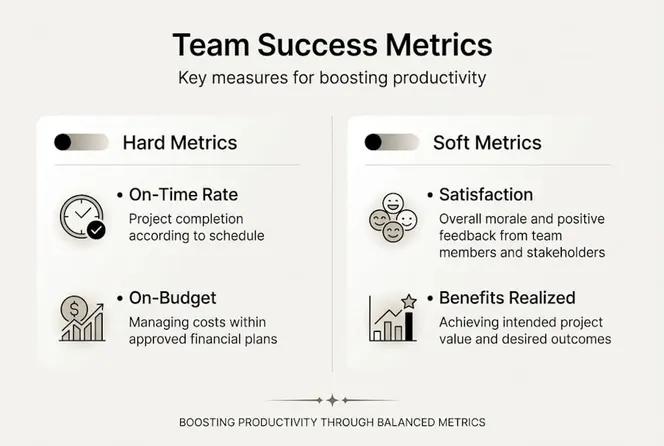
1. Business goals met rate Target: 80% or higher. This measures how many of your defined business objectives were actually achieved by project close. It’s the ultimate outcome metric.
2. On-schedule delivery rate Target: 60% or higher. Tracks the percentage of projects or milestones delivered by the planned date. Consistently below 60% signals a systemic planning or resource problem.
3. On-budget completion rate Target: 70% or higher. Measures how often projects finish within the approved budget. Chronic overruns point to estimation gaps or scope management issues.
4. Benefits realized rate Target: 70% or higher. This one is often skipped, but it’s critical. Did the project actually deliver the ROI or value it promised? Post-launch tracking is required to answer this honestly.
5. Stakeholder satisfaction score Target: Varies, but aim for 4 out of 5 or above on standardized surveys. This soft metric often predicts whether leadership will fund future initiatives.
PMI-recommended enterprise targets set the bar at business goals met above 80%, on-schedule above 60%, on-budget above 70%, failure rate below 10%, and benefits realized above 70%. These aren’t aspirational numbers — they’re the thresholds that separate high-performing organizations from average ones.
How do you adapt these benchmarks to your context? Start by measuring your current baseline across all five metrics. Then set a 12-month improvement target for each one. Don’t try to move all five at once. Pick the two metrics where you’re furthest from the benchmark and focus your energy there first.
- Use your project management platform to automate data collection
- Review benchmarks quarterly with your leadership team
- Celebrate incremental progress — even a 5% improvement in on-budget rate is real money saved
These aren’t just numbers on a report. They’re the signal that tells you whether your organization is getting better at delivering value.
What most leaders overlook about success metrics
Here’s something worth saying plainly: most teams stop at the metrics that are easy to report. Delivery on time? Check. Budget met? Check. And then they move on. But the real question — did this project actually change anything for the better? — often goes unanswered.
We’ve seen projects that hit every hard metric and still lost stakeholder trust. The product launched on time and under budget, but the team was burned out, the rollout was rushed, and the business unit that requested it never fully adopted the solution. By every dashboard measure, it was a success. In reality, it was a missed opportunity.
True success isn’t just about ticking boxes. It’s about learning. Did your team get better? Did your organization become more capable? Did the project create conditions for the next initiative to go more smoothly?
Metrics should be living tools, not final verdicts. Revisit them regularly. When business priorities shift, your success criteria should shift too. The organizations that consistently outperform don’t just measure more — they measure smarter, and they use what they learn to adapt.
Turn insights into action with enterprise-ready tools
Knowing your success metrics is one thing. Tracking, automating, and acting on them at scale is another challenge entirely.
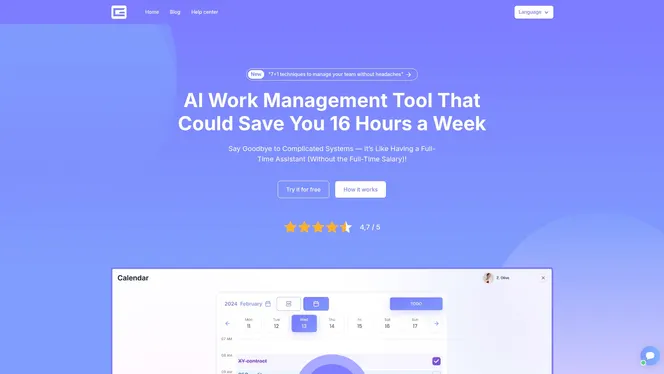
Gammatica for founders and enterprise leaders offers an AI-driven platform that connects your metrics to your daily workflows. From automated task tracking and Kanban boards to team sales insights and CRM tools, Gammatica helps you move from spreadsheet chaos to a single, organized source of truth. Teams using Gammatica report freeing up to 16 hours per week by reducing manual reporting and administrative overhead. If you’re ready to stop guessing and start measuring what actually matters, Gammatica gives you the infrastructure to do exactly that.
Frequently asked questions
What are good examples of success metrics for project teams?
Strong examples include percentage of business goals met, on-time delivery rate, percent on-budget, stakeholder satisfaction scores, and benefits realized. PMI recommends targets of 80% for business goals, 60% for on-schedule, and 70% for on-budget and benefits realized.
How do you measure qualitative or soft success metrics?
You can use surveys, structured interviews, and sentiment analysis to capture stakeholder or team satisfaction. Soft criteria like satisfaction are critical for holistic success and should be tracked alongside hard metrics at every major milestone.
Are there proven frameworks for building better metrics?
Yes, popular frameworks include SMART goals, the PMI M.O.R.E. model, and McKinsey’s value tree approach. Applying all M.O.R.E. principles can triple your net success score, making it one of the highest-impact frameworks available to enterprise teams.
How often should you update your team’s success metrics?
Teams should revisit and refine metrics at least annually or whenever business priorities or project scopes shift significantly. Metrics that made sense at the start of a multi-year program may no longer reflect what the organization needs to measure.