TL;DR:
- Effective project kickoffs depend on thoughtful execution, not just a polished agenda, to ensure alignment and accountability.
- Including the right people, clarifying scope and roles, and documenting decisions promptly are crucial for project success.
Most project managers assume that a detailed agenda is the secret to a great kickoff meeting. Print it out, share it in advance, and you’re good to go. But that assumption leads to more failed projects than most teams want to admit. Projects with effective kickoffs are 40% more likely to finish on time and 35% more likely to meet their objectives. The gap between those teams and the ones that struggle isn’t the agenda. It’s everything that happens around it: who’s in the room, how alignment is forced, and what gets documented immediately after. This article walks you through the full picture.
Key Takeaways
| Point | Details |
|---|---|
| Clear agenda essentials | A strong kickoff covers purpose, goals, scope, non-goals, roles, milestones, and next steps. |
| Right people in the room | Invite all decision-makers to avoid stalled agreements and future project delays. |
| Actionable follow-up | Send a summary of decisions, owners, and deadlines within 24 hours to lock in alignment. |
| Explicit non-goals | Clarify what’s out of scope and set up a change request process to prevent scope creep. |
| Execution over checklist | Successful kickoffs depend more on execution mechanics than on having a perfect agenda. |
What is a kickoff meeting and why does it matter?
A kickoff meeting is the first official session where everyone involved in a project gathers to align on what the project is, why it exists, and how it will be executed. It brings stakeholders, team members, and decision-makers together before real work begins. Think of it as the foundation you pour before building anything of consequence. Get it wrong, and cracks show up weeks later.
The goals of a kickoff meeting are specific and worth spelling out clearly:
- Clarify objectives: Everyone should leave knowing exactly what success looks like and how it will be measured.
- Define roles and responsibilities: Who owns what? Who makes decisions when there’s a conflict?
- Set scope boundaries: What is the project doing, and equally important, what is it not doing?
- Surface risks and dependencies: Identify obstacles early so they don’t become emergencies later.
- Establish communication norms: How often will you meet? Who gets status updates, and in what format?
Each of these goals prevents a specific category of project failure. Unclear roles cause duplicated effort or dropped tasks. Fuzzy scope leads to renegotiation mid-sprint. Poor communication habits breed confusion and frustration. The kickoff is your chance to prevent all of this before it starts.
“Projects with effective kickoff meetings are 40% more likely to finish on time and 35% more likely to meet objectives.”
That statistic isn’t surprising once you think about it. When teams are aligned from the start, they spend less time correcting misunderstandings and more time executing. The kickoff is one of the highest-leverage activities in any project. Yet most teams treat it like a formality rather than a strategic investment.
Essential elements of an effective kickoff meeting
Understanding the “why” sets us up to explore the “how.” Here’s what an effective kickoff actually includes.
A practical kickoff agenda typically covers purpose and overview, goals and success criteria, scope and non-goals, roles and decision rights, timeline and milestones, risks and dependencies, a communication plan, and a next-steps close with specific action items. That’s not just a list to check off. Each element serves a distinct purpose.
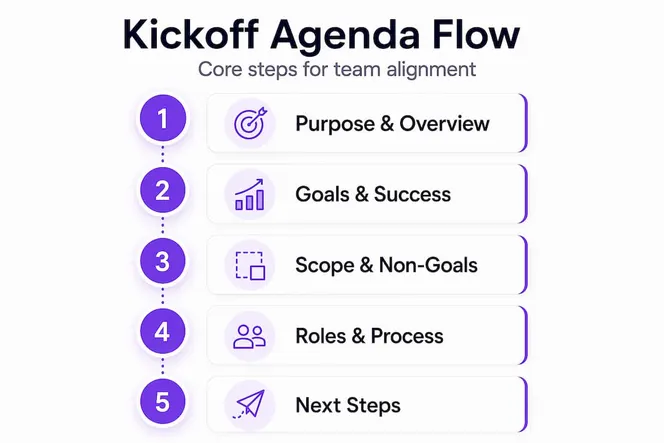
Agenda structure at a glance
| Agenda element | Primary purpose |
|---|---|
| Purpose and overview | Sets context and reminds everyone why this project exists |
| Goals and success criteria | Defines what “done” and “successful” actually mean |
| Scope and non-goals | Prevents creep by defining what is explicitly out of bounds |
| Roles and decision rights | Avoids confusion about ownership and authority |
| Timeline and milestones | Creates shared expectations for pace and key dates |
| Risks and dependencies | Surfaces blockers before they derail the work |
| Communication plan | Aligns the team on how and how often updates happen |
| Action items and next steps | Converts the meeting into tangible, assigned responsibilities |
Notice “non-goals” on that list. It deserves special attention because most teams skip it entirely. Non-goals are explicit statements of what the project will not deliver. For example, “This initiative will not include mobile app development” or “We will not redesign the billing page in this phase.” Without non-goals, stakeholders often assume their pet priorities are included by default. That assumption becomes a conversation you have to undo under pressure.
The change-request process is equally important to define upfront. When someone wants to add scope mid-project, what happens? Who reviews it? What are the implications on budget and timeline? Teams that define this at kickoff dramatically reduce the friction of scope conversations later.
Recommended agenda flow
Here’s a step-by-step sequence that works well for most kickoffs:
- Open with the “why” (5 minutes): Remind everyone why this project matters. Connect it to business objectives or team priorities.
- State goals and success metrics (10 minutes): Be specific. “Increase conversion by 15%” is better than “improve the funnel.”
- Walk through scope and non-goals (10 minutes): This is where you get explicit confirmation that everyone agrees on what’s in and what’s out.
- Assign roles and decision rights (10 minutes): Name names. Who is the single point of contact for design decisions? Who approves final deliverables?
- Review timeline and milestones (10 minutes): Walk through major phases and hard deadlines.
- Identify risks and dependencies (10 minutes): Open the floor for people to name concerns. Document everything.
- Establish communication norms (5 minutes): Meeting cadence, status update format, preferred channels.
- Close with action items (5 minutes): Every decision should generate at least one named action with a deadline and an owner.
Pro Tip: Don’t let technical discussions take over. If someone dives deep into implementation details, acknowledge it and park it for a follow-up. The kickoff is about big-picture alignment, not architecture debates.
Who should be in the room and common kickoff risks
A thoughtful agenda isn’t enough if the right people aren’t there. Let’s look at who must attend and what can go wrong if they’re missing.
Key roles and the cost of their absence
| Role | Why they must attend | Consequence of absence |
|---|---|---|
| Project manager or lead | Drives the agenda and owns follow-up | No clear accountability post-meeting |
| Executive sponsor | Signals organizational priority | Team may underestimate urgency |
| Key decision-makers | Required for real-time scope and role confirmations | Decisions become provisional and stall later |
| Subject matter experts | Surface technical risks early | Blind spots on feasibility and dependencies |
| Client or stakeholder lead (if applicable) | Aligns external expectations with internal plans | Misaligned deliverables, client surprises |
The pattern is clear. Each role not present creates a specific gap that shows up later as a project problem. Running a kickoff with the wrong attendees or missing a key decision-maker can make agreements provisional and stall decisions at critical moments.
Beyond attendance, there are two recurring pitfalls that catch even experienced teams off guard.
Pitfall 1: Premature kickoff. Running a kickoff before contractual commitments are binding is a genuine risk, especially in client work. Kickoff before contract can create misalignment about obligations and generate what essentially becomes free work if the deal doesn’t close or the scope shifts. Confirm that agreements are finalized before you convene a kickoff for any external engagement.
Pitfall 2: Skipping voices that matter. It’s common to invite the loudest voices and overlook the quiet but essential ones. The person who manages integrations, the compliance officer, or the customer success manager who knows the client’s actual pain points. These voices surface risks that the main team simply doesn’t know to ask about. Cast a wider net for your initial kickoff invite list, then trim it down based on necessity rather than habit.
Pro Tip: Before sending kickoff invites, list every decision that needs to be made in the meeting and then confirm there is a named person attending who has the authority to make each one. If someone is missing, delay the meeting. A kickoff with gaps in decision-making authority is worse than no kickoff at all.
From meeting room to results: Alignment, action, and follow-up
After convening the right group and nailing the agenda, the real work follows: ensuring plans and responsibilities don’t evaporate post-meeting.

Here’s a truth most managers learn the hard way. Alignment reached in a room is temporary. Alignment captured in writing is durable. The single most high-leverage action you can take after a kickoff is sending a structured summary within 24 hours. Kickoff summaries with decisions, action items, owners, and deadlines should be sent promptly to convert verbal alignment into an operational reference.
What should that summary include? Follow this structure:
- Project overview and objectives: One or two sentences reminding everyone what this project is and why it matters.
- Decisions made: A bulleted list of every specific decision reached during the meeting, with no ambiguity.
- Action items: Each item should have exactly one named owner, a clear deliverable, and a specific deadline. “Someone will handle the brief” is not an action item. “Maria will deliver the creative brief by Friday, April 18th” is.
- Open questions: Things that were raised but not resolved, with a named owner responsible for answering each one.
- Next meeting date and format: When does the team reconvene and what will be covered?
This summary isn’t just a courtesy. It becomes the operational reference that keeps the project honest for weeks. When someone claims the scope includes a feature you never agreed to, you point to the summary. When a deadline is missed and someone says they didn’t know it was their responsibility, the summary tells the story.
A note on statistic-driven results: Organizations that master the kickoff-to-execution process, with tight summaries, clear ownership, and consistent follow-through, see onboarding and project success rates climb into the 85 to 95% range. The connection between structured follow-up and outcomes is not coincidental.
Pro Tip: Use a standard template for your kickoff summaries. When everyone on your team knows the format, writing and reading summaries takes half the time. Templates also make it easier to onboard new team members or hand off projects without losing context.
The uncomfortable truth about kickoff meetings: It’s not the agenda, it’s the execution
Here’s a perspective that most guides won’t tell you directly: the teams that run the best kickoffs are not the ones with the most polished agendas. They’re the ones that push hard for uncomfortable alignment in the room and move fast on accountability the moment the meeting ends.
Most teams believe that checking all the agenda boxes means the kickoff was a success. Cover the goals, walk through the timeline, assign a few tasks, and you’re done. But most kickoff failures are less about agenda content and more about execution mechanics: ensuring the right people are present, forcing explicit alignment on what is in versus out of scope, and converting decisions into a follow-up artifact that teams can actually run against.
The uncomfortable part is “forcing explicit alignment.” That phrase is deliberate. In most kickoffs, people nod along because they don’t want to slow things down or seem difficult. But that nodding masks genuine disagreements about scope, priorities, and ownership that will surface later under pressure. The project manager’s job in a kickoff is not to move through the agenda smoothly. It’s to surface every unspoken assumption and get real confirmation.
Ask pointed questions. “When I say the scope includes customer notifications, does everyone agree that means email only, not SMS?” “When I say the design team owns the UI decisions, does that include copy?” These feel awkward to ask. Ask them anyway.
We’ve found, consistently, that teams who obsess over meeting dynamics and real-time accountability, rather than just structure and content, have smoother projects and better results. The agenda is the skeleton. The execution is the muscle. Both matter, but one drives outcomes far more than the other.
Streamline your next kickoff with Gammatica
The steps in this article represent a proven process. The challenge most teams face is sustaining that process across every project, every quarter, without it becoming a burden.
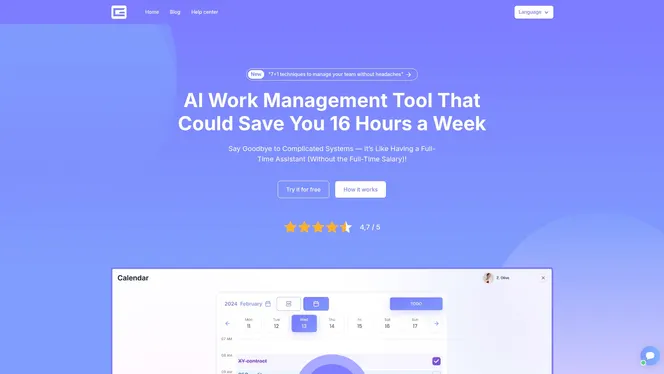
That’s where the right tools make a real difference. Gammatica is an AI-driven project and team management platform that helps you automate the administrative side of kickoffs, from pre-built agenda templates and checklist creation to action item tracking and calendar coordination. Whether you’re managing a growing founding team or running a high-volume sales team pipeline, Gammatica keeps every stakeholder aligned and every project phase visible. You get Kanban boards, automated workflows, and team collaboration tools in one place, so your kickoff decisions don’t disappear into a shared drive. Give your next project the structured start it deserves.
Frequently asked questions
How long should a project kickoff meeting last?
Most kickoff meetings run between 30 and 90 minutes, giving the team enough time to align on goals, roles, and scope without drifting into excessive implementation detail.
Who is responsible for sending the kickoff summary?
The project manager or meeting owner should send a structured summary covering action items, owners, and deadlines within 24 hours, as prompt follow-up converts verbal agreements into an operational reference.
What’s the risk of skipping non-goals at kickoff?
Skipping non-goals creates scope creep because stakeholders assume their priorities are included by default, which leads to repeated boundary renegotiation under pressure throughout the project.
Is it a mistake to run a kickoff before the contract is signed?
Yes, especially in client engagements. A pre-contract kickoff can generate misaligned obligations and ambiguity about what work is actually committed, which creates problems if the agreement shifts.
What is the number one reason kickoff meetings fail?
Missing key decision-makers combined with poor follow-up are the top culprits: agreements made without authority become provisional, and without a written summary, clarity dissolves quickly.