Only 21% of employees worldwide are engaged at work. That number should stop you cold. It means the vast majority of your team is showing up, doing the minimum, and leaving value on the table every single day. Most leaders assume their teams are performing reasonably well because tasks get completed and deadlines are met. But activity is not performance. This guide cuts through the noise and gives you evidence-backed frameworks for measuring what actually drives profitability, retention, and growth. You will walk away knowing exactly which metrics to track, how to measure them, and how to turn data into real improvement.
Key Takeaways
| Point | Details |
|---|---|
| Focus on outcomes | Tracking what teams accomplish matters more than recording every activity or hour. |
| Engagement drives profit | Higher engagement levels lead to significant gains in productivity, profitability, and retention. |
| Use proven tools | Validated surveys and frameworks like Q12, TEI, and OKRs reliably link measurement to real performance improvements. |
| Manager quality is crucial | A skilled manager influences up to 70% of a team’s engagement and results. |
| Keep it simple | Choosing and acting on a few key metrics yields better results than tracking dozens. |
Why team performance metrics matter
Team performance metrics are objective measures of collective results, team health, and continuous improvement. They tell you not just what got done, but how well, how fast, and at what cost to your people. Without them, you are managing by gut feeling, and gut feelings do not scale.

The business case is hard to ignore. Engaged teams are 23% more profitable and see 51% less turnover than disengaged ones. On the flip side, low engagement costs the global economy $438 billion in lost productivity every year. These are not soft numbers. They show up directly in your bottom line.
So why do so many teams still underperform? Because most managers track the wrong things. They count hours worked, emails sent, and meetings attended. These are activity metrics, and they measure effort, not impact. A team can be incredibly busy and still miss every meaningful business outcome.
Here is what good metrics actually connect to:
- Profitability: Are projects delivered on time and within budget?
- Productivity: Is output increasing relative to input over time?
- Retention: Are your best people staying, or quietly looking for the door?
- Innovation: Is the team generating new ideas or just maintaining the status quo?
- Customer satisfaction: Are internal results translating to external value?
One of the most powerful levers you have is manager quality. Research shows that manager quality drives 70% of the variance in team engagement. That is a staggering number. It means your team’s performance is, in large part, a reflection of how well your managers are doing their jobs.
“The single biggest decision you make in your job is who you name manager. When you name the wrong person manager, nothing fixes that bad decision.” — Gallup
If you want to improve team performance, start by measuring the right things and connecting them to outcomes that matter. Explore team motivation techniques to pair your metrics with the right motivational strategies.
Essential team performance metrics to track
Knowing the value of measurement, the next step is identifying which metrics truly matter. Not all metrics are created equal. Some reveal the health of your team. Others expose gaps in output or adaptability. The best approach is to pick a focused set that covers multiple dimensions.
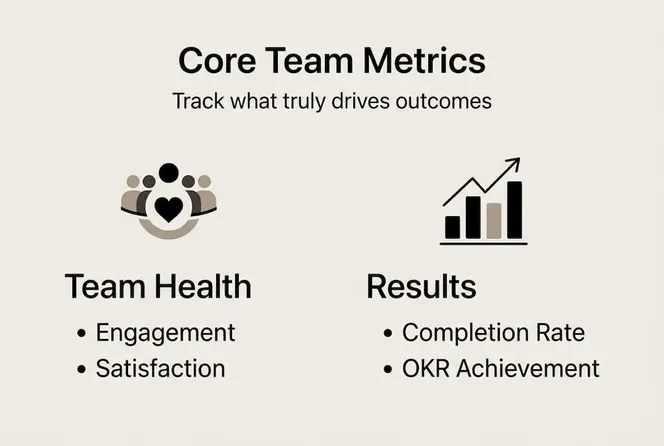
| Metric | What it reveals |
|---|---|
| Employee engagement | Emotional commitment and discretionary effort |
| Team satisfaction | Morale, culture, and risk of turnover |
| Project completion rate | Reliability and execution quality |
| Cycle time | Speed and process efficiency |
| OKR achievement | Alignment between effort and strategy |
| Innovation rate | Creative output and adaptability |
| Quality score | Error rate, rework, and customer impact |
These key metrics like engagement and OKRs are directly linked to higher business outcomes when tracked consistently. A strong team effectiveness metrics overview can help you understand how these dimensions interact.
Here is how to group them by purpose:
- Output metrics: Project completion rate, OKR achievement, cycle time. These measure what gets done.
- Health metrics: Engagement scores, satisfaction surveys, absenteeism. These measure how sustainable your pace is.
- Adaptability metrics: Innovation rate, learning hours, cross-functional collaboration. These measure future readiness.
- Quality metrics: Error rates, customer satisfaction, rework percentage. These measure the value of what gets done.
The engagement number deserves special attention. Engaged teams achieve 18% higher productivity and 78% less absenteeism. That is not a marginal difference. That is the gap between a team that thrives and one that just survives.
Pro Tip: Pick 3 to 5 key metrics, not 15. Clarity beats volume every time. When everyone on the team knows exactly what they are being measured on, focus sharpens and performance follows.
How to measure team performance: Methodologies
With key metrics in mind, accurate measurement is the next challenge. Choosing the right tool matters as much as choosing the right metric.
| Method | Focus | Pros | Best use |
|---|---|---|---|
| Gallup Q12 | Engagement | Validated, benchmarkable | Annual or biannual deep dives |
| McKinsey TEI | Team effectiveness | Strategic alignment | Leadership and executive teams |
| OKRs | Goal achievement | Clear, measurable | Quarterly planning cycles |
| Pulse surveys | Real-time sentiment | Fast, lightweight | Weekly or monthly check-ins |
| Continuous feedback | Behavior and growth | Actionable, personalized | Ongoing coaching |
Validated tools like Gallup Q12 and McKinsey’s Team Effectiveness Index correlate strongly with real business results. They are not just surveys. They are diagnostic instruments.
Here is a simple cycle to run in your team:
- Assess: Run a pulse survey or Q12 to establish your baseline.
- Discuss: Share results openly with the team. No hidden agendas.
- Act: Identify two or three specific improvements and assign owners.
- Review: Check progress at the next cycle. Adjust based on what you see.
Continuous feedback loops outperform annual reviews for real-time adjustment. Annual reviews are like checking the weather report once a year and hoping it still applies. Monthly or even weekly feedback keeps the team calibrated and responsive.
One important caution: avoid forced ranking or normal distribution in performance reviews. Most knowledge work follows a power law, where a small number of contributions drive the majority of results. Forcing everyone into a bell curve distorts reality and demoralizes your top contributors.
Pro Tip: Involve your entire team in choosing which metrics to track. When people help design the measurement system, they trust it more, game it less, and contribute more accurate data.
For manager-driven teams, the methodology you choose should reflect the team’s maturity and the manager’s coaching style.
Common challenges and expert solutions
Even with the right metrics and measurement tools, obstacles frequently emerge. Here are the most common ones and how to handle them.
The biggest pitfalls:
- Gaming the numbers (Goodhart’s Law): When a measure becomes a target, it stops being a good measure. Teams optimize for the metric, not the outcome it was meant to represent.
- Ignoring calibration: Without regular calibration sessions, managers rate performance inconsistently, making comparisons meaningless.
- Overvaluing activity metrics: Tracking hours, messages, or task counts without tying them to outcomes creates the illusion of productivity.
- Expertise traps: Senior team members may score poorly on speed metrics because they are solving harder problems. Context always matters.
Small teams show more engagement volatility, and manager quality impacts outcomes more than team size does. A five-person team with a great manager will consistently outperform a twenty-person team with a mediocre one.
“Manager quality trumps team size for engagement and results. The best investment a company can make is in the people who lead its people.”
Here is what actually works:
- Train and empower managers to have regular, honest conversations about performance. Skills do not appear automatically with a promotion.
- Triangulate feedback sources by combining self-assessments, peer reviews, and manager input. No single source tells the full story.
- Use strengths-based recognition. Strengths-based approaches deliver 29% higher profits compared to deficit-focused management. Focus on what people do well and build from there.
For motivation for high-performing teams, the solution is rarely more measurement. It is smarter measurement paired with genuine coaching.
Turning insights into action: Making metrics work for your team
Now that you see common barriers and fixes, it is time to put your learning into practice. Data without action is just overhead.
Follow these steps to build a metrics-driven performance culture:
- Choose your metrics. Select 3 to 5 metrics that map directly to your business goals. Engagement, OKR completion, and cycle time are a strong starting trio.
- Collect data consistently. Use pulse surveys, project management tools, and direct feedback. Consistency matters more than perfection.
- Analyze for patterns. Look for trends over time, not just snapshots. A single bad week is noise. Three bad months is a signal.
- Coach around the data. Use metrics as conversation starters, not scorecards. Ask your team what the numbers mean to them.
- Optimize in small experiments. Test one change at a time. Measure the impact. Scale what works and drop what does not.
Investing in manager development can drive a 20 to 28% performance lift. That is a return worth pursuing. The chain of impact runs from manager behavior to team engagement to business outcomes. Break it anywhere and results suffer.
Research also shows that teams prioritizing learning or performance outperform teams that try to balance both at the same time. Pick a focus for each quarter and go deep on it.
Pro Tip: Run small experiments with your metrics. Change one variable, measure the result for four weeks, and decide whether to keep it. This keeps your system agile without overwhelming the team.
Our take: Why most metric programs fail—and what actually works
Here is the uncomfortable truth most performance consultants will not tell you: most metric programs fail not because of bad data, but because of bad intent. Companies build dashboards to monitor people, not to help them grow. That distinction changes everything.
When managers account for 70% of variance in team engagement, over-measuring without coaching just creates anxiety, not performance. We have seen companies track 30 different KPIs and still miss their annual targets because no one was acting on the data.
The teams that actually improve are the ones that pick a few vital signs, talk about them openly, and coach consistently around them. They treat metrics as a shared language, not a surveillance system. Overly complex dashboards and forced ranking systems do not motivate high performers. They push them toward the exit.
Our recommendation: make your metrics transparent, tie them directly to growth opportunities, and use them to celebrate progress. When your team sees that data leads to support and recognition rather than punishment, they will give you better data and better results.
Leverage metrics for exceptional results with Gammatica
Ready to turn your performance data into real team results? The right platform makes all the difference.
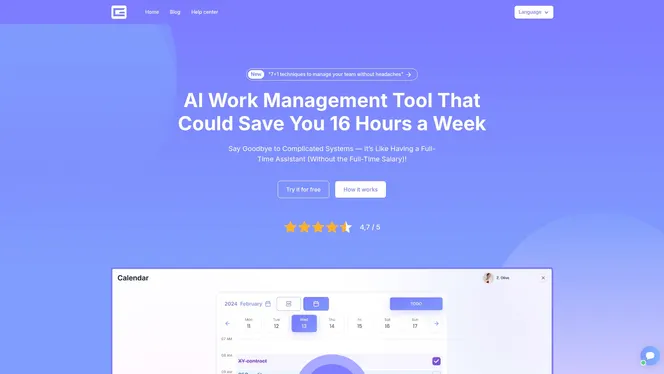
Gammatica is built for business leaders who want to stop guessing and start measuring what matters. With built-in task management, OKR tracking, automation, and team collaboration tools, you get a single place to collect, analyze, and act on your performance data. The sales performance tools are especially powerful for teams looking to connect team metrics directly to revenue outcomes. Users report freeing up to 16 hours weekly by automating administrative work, which means more time for coaching and less time on spreadsheets. Explore Gammatica today and see how measurable performance improvement feels.
Frequently asked questions
What are the top three team performance metrics to track?
Employee engagement, project completion rate, and OKR achievement are the most impactful metrics for tracking team performance. Engaged teams outperform on profit, productivity, and retention consistently.
How do I know if my team’s metrics are too focused on activity vs. outcomes?
If you mainly track hours or tasks completed but do not see improvements in business results, your metrics are likely too activity-based. Outcome metrics yield better business impact than activity tracking alone.
What tools are best for measuring team engagement?
Validated surveys like Gallup Q12 or continuous pulse surveys are proven to measure and improve engagement effectively. The Q12 engagement survey is directly linked to higher productivity and profitability.
Can the same metrics apply to small and large teams?
The core principles apply across team sizes, but small teams show more metric variability while large teams need stronger focus on manager effectiveness. Team size and manager traits both affect how engagement data should be interpreted.
How often should teams review their performance metrics?
Teams get the best results by reviewing metrics at least monthly, using feedback loops to adjust quickly. Continuous feedback enables faster improvement than waiting for an annual review cycle.