Over 1 million professionals worldwide hold the Project Management Professional certification, and American project managers continue to lead in both demand and salary potential. Securing a PMP credential opens new doors for career advancement and helps organizations achieve greater project success. This guide tackles what the PMP really means for professionals, separates fact from fiction, and outlines the real benefits and requirements for anyone aiming to join this distinguished group.
Table of Contents
- Defining PMP Certification And Common Myths
- Requirements And Competencies For PMP Eligibility
- Exam Structure, Process, And Core Domains
- Career Benefits For Teams And Organizations
- Comparing PMP With Other Project Certifications
Defining PMP Certification and Common Myths
The Project Management Professional (PMP) certification represents a globally recognized credential that validates a project manager’s expertise and professional standing. Established by the Project Management Institute (PMI), this certification signifies an individual’s ability to lead, direct, and manage complex project initiatives across various industries.
At its core, the PMP certification establishes a standardized framework of skills that creates consistency and trust in project management practices. Professionals who obtain this credential demonstrate advanced knowledge in project planning, execution, monitoring, and closing processes. The certification covers critical competencies including strategic and tactical planning, resource allocation, risk management, stakeholder communication, and performance tracking.
Despite its prominence, several myths surround the PMP certification process. Contrary to popular belief, the exam’s passing score is not a fixed percentage but determined through sophisticated psychometric analysis. Many professionals mistakenly assume that only PMI Registered Education Providers can prepare candidates for the exam, which is incorrect. Multiple training platforms and educational resources can effectively support PMP exam preparation.
Pro Tip: Research Multiple Training Options: Before investing in PMP exam preparation, explore various study resources, compare their curriculum, read student reviews, and select a program that matches your learning style and professional background.
Requirements and Competencies for PMP Eligibility
The Project Management Professional (PMP) certification has stringent eligibility requirements designed to ensure that candidates possess substantial project management experience and educational preparation. Applicants must meet specific educational and professional experience criteria that vary based on their academic background and professional journey.
Candidates have two primary pathways to meet the PMP certification requirements:
-
High School Diploma Pathway:
- Minimum 60 months (5 years) of project leadership experience
- Completion of 35 contact hours in project management education
-
Four-Year Degree Pathway:
- Minimum 36 months (3 years) of project management experience
- Completion of 35 contact hours in project management education
Authorized Training Partners provide the required project management education hours to help candidates meet the certification prerequisites. These training programs cover essential project management competencies, including strategic planning, risk management, stakeholder communication, and project lifecycle methodologies.
Beyond formal requirements, successful PMP candidates demonstrate advanced skills in leadership, problem solving, and strategic thinking. The certification process evaluates a professional’s ability to navigate complex project environments, manage diverse teams, and deliver results across various industries and organizational contexts.

Pro Tip: Strategic Documentation: Meticulously document your project management hours and keep detailed records of your professional experiences, as these will be crucial during the PMP certification application process.
Exam Structure, Process, and Core Domains
The PMP certification exam represents a comprehensive assessment of project management knowledge and skills, designed to validate a professional’s ability to lead complex project initiatives. The exam is structured to test candidates across multiple dimensions of project management expertise, challenging them to demonstrate practical and theoretical understanding.
The exam consists of 180 questions distributed across three critical domains:
-
People Domain (42% of exam content)
- Team leadership and management
- Interpersonal skills
- Conflict resolution
- Communication strategies
- Stakeholder engagement
-
Process Domain (50% of exam content)
- Project planning techniques
- Risk management
- Schedule development
- Cost control
- Quality management
- Performance measurement
-
Business Environment Domain (8% of exam content)
- Organizational strategy
- Governance
- Compliance requirements
- Enterprise environmental factors
The updated exam format incorporates predictive, agile, and hybrid project management approaches, reflecting the dynamic nature of modern project management. Candidates will encounter multiple question types including multiple-choice, matching, fill-in-the-blank, and multiple-response questions. The entire examination spans 230 minutes, requiring strong time management and comprehensive knowledge across project management methodologies.
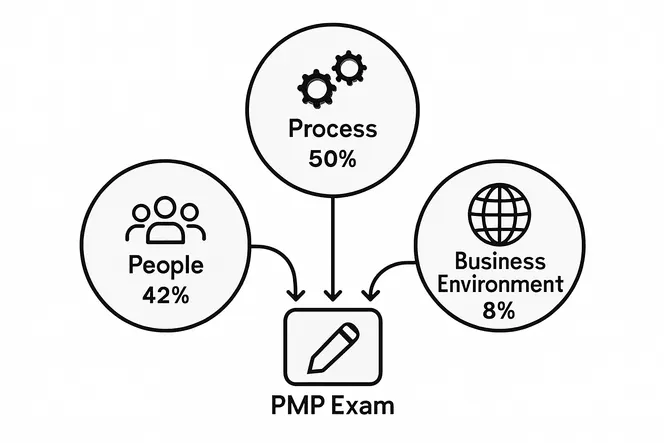
Here’s a summary of PMP exam domains and their primary focus:
| Domain | Focus Areas | Exam Weight (%) |
|---|---|---|
| People | Leadership, conflict resolution | 42 |
| Process | Planning, risk, measurement | 50 |
| Business Environment | Strategy, compliance, governance | 8 |
Pro Tip: Strategic Exam Preparation: Practice with diverse question types and allocate study time proportionally to each domain, with extra focus on the Process and People domains which constitute 92% of the exam content.
Career Benefits for Teams and Organizations
Organizations with PMP-certified project managers gain significant competitive advantages in today’s complex business landscape, transforming their project management capabilities through standardized, strategic approaches. The certification represents more than a personal achievement; it becomes a catalyst for organizational excellence and operational efficiency.
The career benefits span multiple critical areas:
-
Organizational Performance
- Increased project success rates
- Standardized management practices
- Improved risk mitigation strategies
- Enhanced strategic alignment
-
Team Productivity
- More consistent project delivery
- Better communication protocols
- Reduced project failure risks
- Advanced problem solving techniques
Across diverse industries like IT, construction, and healthcare, PMP certification drives substantial improvements in project management effectiveness. Certified professionals bring sophisticated skills in resource allocation, stakeholder management, and strategic planning, which directly translate to measurable organizational outcomes.
Beyond tangible metrics, PMP certification cultivates a culture of continuous improvement and professional development. Organizations that invest in PMP-certified talent demonstrate commitment to excellence, attracting top-tier professionals and creating environments of structured innovation and strategic execution.
Pro Tip: Strategic Talent Development: Encourage team members to pursue PMP certification by offering partial or full reimbursement for exam and training costs, creating a win-win scenario for individual growth and organizational capability enhancement.
Comparing PMP With Other Project Certifications
Project management certifications offer professionals diverse pathways to validate their skills and expertise, with each certification targeting different career stages and organizational needs. Understanding the nuanced differences between these credentials can help professionals make strategic career development decisions.
Key Project Management Certification Comparisons:
-
PMP (Project Management Professional)
- Target: Experienced project managers
- Required Experience: 36-60 months of project leadership
- Complexity: Advanced
- Global Recognition: Highest
-
CAPM (Certified Associate in Project Management)
- Target: Entry-level professionals
- Required Experience: Minimal project management background
- Complexity: Foundational
- Global Recognition: Moderate
-
PgMP (Program Management Professional)
- Target: Senior program managers
- Required Experience: Extensive program management
- Complexity: Strategic
- Global Recognition: Specialized
-
PfMP (Portfolio Management Professional)
- Target: Portfolio management executives
- Required Experience: High-level strategic management
- Complexity: Enterprise-wide
- Global Recognition: Executive-level
PMI offers this range of certifications to accommodate professionals at various stages of their project management journey, allowing individuals to select credentials that align with their specific career trajectories and organizational roles. The PMP remains the most comprehensive and widely recognized certification, representing a gold standard in project management expertise.
The table below outlines how different project management certifications align with career stages:
| Certification | Best For | Industry Value | Typical Prerequisite |
|---|---|---|---|
| PMP | Experienced managers | High global recognition | 3-5 years of experience |
| CAPM | Entry-level professionals | Moderate global reach | Secondary education |
| PgMP | Senior program managers | Specialized strategic | Extensive program work |
| PfMP | Executives in portfolios | Top enterprise level | Senior strategic roles |
Pro Tip: Strategic Certification Planning: Assess your current career stage, industry requirements, and long-term professional goals before selecting a project management certification, ensuring maximum return on your professional development investment.
Enhance Your PMP Journey with Smarter Project Management Solutions
Achieving PMP certification requires mastering complex workflows, managing diverse teams, and executing strategic project plans with precision. The challenges of coordinating multiple projects, tracking progress, and maintaining team alignment can slow your progress and increase administrative burdens. With the insights from “What Is PMP Certified and Why It Matters,” it is clear that mastering People, Process, and Business Environment domains demands powerful tools that save time and improve collaboration.
Take control of your certification preparation and ongoing project management with Gammatica. Our AI-driven platform supports task management, team collaboration, and project tracking with automation that helps you streamline workflows and reduce administrative hassle. Imagine freeing up hours each week to focus on applying PMP principles effectively rather than getting bogged down by manual coordination. Empower yourself and your team with features like checklist creation, calendar coordination, and integration with popular tools like Make.com and Zoom. Start your journey to certified professionalism while elevating your current project execution by exploring Gammatica’s AI-powered project solutions today.
Frequently Asked Questions
What is PMP certification?
PMP certification, or Project Management Professional certification, is a globally recognized credential offered by the Project Management Institute (PMI) that validates a project manager’s expertise in leading and directing projects across various industries.
Why is PMP certification important?
PMP certification demonstrates advanced knowledge and skills in project management, enhancing career prospects and improving organizational performance through standardized practices and effective risk management strategies.
What are the eligibility requirements for PMP certification?
To be eligible for PMP certification, candidates must have either a high school diploma with 60 months of project leadership experience or a four-year degree with 36 months of project management experience, along with 35 contact hours of project management education.
How is the PMP exam structured?
The PMP exam consists of 180 questions covering three domains: People (42%), Process (50%), and Business Environment (8%). It tests candidates’ knowledge across various project management competencies and includes multiple question types.