TL;DR:
- Effective workflow optimization involves redesigning how work flows, not just adopting new software.
- Blending classic methods like Lean with modern AI approaches leads to better, adaptable processes.
- Successful initiatives require mapping real workflows, securing leadership support, and ongoing cultural commitment.
Most business leaders assume workflow optimization means buying better software or automating repetitive tasks. That assumption costs organizations thousands of hours every year. True workflow optimization is about rethinking how work actually moves through your organization, from first input to final output, across every team and handoff point. It’s a systemic effort, not a software purchase. In this guide, we’ll clarify what workflow optimization really means, compare classic and modern approaches, share the principles that actually work, and highlight the pitfalls that quietly kill even the best-intentioned projects.
Key Takeaways
| Point | Details |
|---|---|
| Optimize flows, not just tasks | True workflow optimization means improving the way work moves across people and technologies for maximum impact. |
| Blend old and new methods | Modern leaders use both classic frameworks and adaptive, AI-driven systems to drive results. |
| Prioritize real-world mapping | Analyze actual workflow behavior, not just policy, for sustainable improvements. |
| Avoid common pitfalls | Never automate a broken process, and always address ownership and buy-in upfront. |
What is workflow optimization?
Workflow optimization is the structured improvement of how tasks, information, and decisions move across teams and technologies. It’s not just about making things faster. It’s about making the right things happen in the right order, with the right people involved, and with as little friction as possible.
Here’s where many leaders go wrong: they confuse digitalization with optimization. Installing a new project management tool is not optimization. Automating a broken approval process just makes the wrong thing happen faster. Real optimization means you understand the current state of your workflows, identify where things break down, redesign the flow, and then apply technology to support that improved process.
Common benefits that teams experience with genuine workflow optimization include:
- Increased productivity across departments, not just within silos
- Fewer bottlenecks and hand-off delays that slow delivery
- Better employee experience because people spend less time on friction and more time on meaningful work
- Improved output quality because fewer steps get skipped or mishandled
- Greater visibility for managers who need to spot problems early
Modern workflow optimization goes further than process diagrams on a whiteboard. As AI optimizes entire workflows rather than single tasks, organizations are rethinking how decisions get made, how exceptions are routed, and how teams hand off work without losing context.
“The goal is not to automate tasks but to optimize entire workflows, even when no single step is perfectly handled by any one tool or system.”
Pro Tip: Never automate a broken process. Map it, fix it, test it manually, and only then consider digitizing or automating it. Skipping this step is one of the most expensive mistakes a growing organization can make.
Classic vs. modern approaches to workflow optimization
Now that we’ve defined workflow optimization, let’s compare how classic and modern frameworks approach this central goal. Understanding both sides helps you choose the right tools for where your organization is right now.
Classic methods like Lean and Six Sigma have served organizations well for decades. Lean focuses on eliminating waste, standardizing steps, and improving flow. Six Sigma uses data and measurement to reduce variation and defects. The DMAIC framework (Define, Measure, Analyze, Improve, Control) gives teams a structured path from problem to solution. These approaches are disciplined, repeatable, and proven across manufacturing, healthcare, and financial services.
Modern methods introduce AI, agentic systems (software that can act autonomously within a defined scope), dynamic path design, and systems thinking. The CORE stack is a useful mental model here: Capture, Orient, Refine, Execute. Instead of linear improvement projects, modern approaches treat workflows as adaptive systems that respond to real-time information.
| Dimension | Classic (Lean/Six Sigma) | Modern (AI/CORE stack) |
|---|---|---|
| Focus | Waste elimination and variance reduction | End-to-end flow design and adaptability |
| Tools | Process maps, control charts, kaizen events | AI assistants, automation platforms, real-time dashboards |
| Advantages | Structured, data-driven, deeply proven | Fast iteration, handles exceptions, scales quickly |
| Drawbacks | Slow to implement, requires specialist training | Risk of over-engineering; tech obsession without root-cause focus |
| Best for | Stable, high-volume processes | Dynamic, multi-variable workflows |
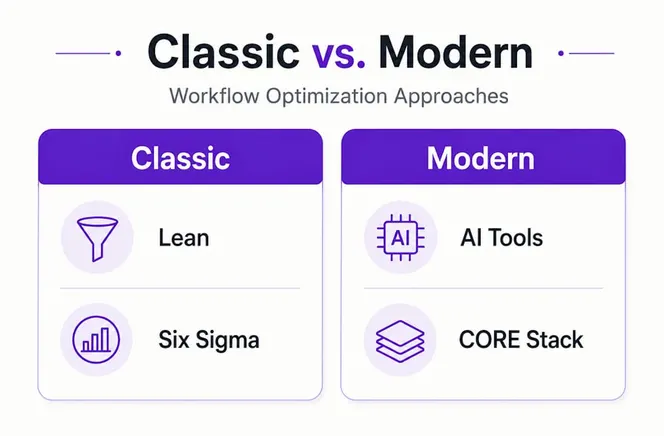
The smartest leaders don’t choose one or the other. They blend foundational Lean thinking with modern systems design. As rethinking how work gets done shows, traditional data-driven methods and AI-powered workflow reshaping aren’t opposites. They work best together, especially when leaders understand both the discipline of measurement and the flexibility of adaptive systems.
Key advantages of combining both approaches:
- You get the rigor of measurement with the speed of modern tooling
- Classic methods help you identify what to fix; modern tools help you fix it faster
- Teams trained in Lean adapt more easily to AI-driven workflow tools because the underlying logic is similar
“Blending foundational process discipline with modern systems thinking is how organizations consistently outperform peers in both efficiency and adaptability.”
Key principles for successful workflow optimization
With the landscape in mind, business leaders need to internalize these non-negotiable principles before launching any optimization initiative. Getting these right separates teams that see lasting improvement from those that cycle through the same problems repeatedly.
-
Map actual workflows, not assumed ones. Most organizations have documented processes that nobody actually follows. Before you optimize anything, observe how work truly flows. Shadow team members. Review how tasks actually get handed off. You’ll almost always find a gap between what the policy document says and what happens in practice. That gap is where value hides. As research consistently shows, mapping actual vs. documented processes is one of the highest-leverage actions a team can take.
-
Prioritize the 80% of routine flows. The 80/20 rule applies here directly. About 80% of your work likely follows a predictable path. Focus your optimization energy on making those standard flows fast, consistent, and nearly frictionless. Don’t overengineer for the 20% of edge cases at the expense of the majority.
-
Standardize where possible, but leave room for exceptions. Every workflow needs a default path and a clear exception-handling process. If your system can only handle the perfect case, it will break constantly. Design for the standard, then document how exceptions get routed.
-
Secure executive sponsorship early. Change without visible leadership support stalls. When people see that senior leaders are genuinely committed, they take the initiative seriously. When sponsorship is absent, the project quietly fades.
-
Answer “What’s In It For Me” (WIIFM) for every stakeholder. People don’t resist change because they’re difficult. They resist because they don’t understand how it benefits them. Be direct. Explain how the new workflow saves time, reduces stress, or improves results for the individuals involved, not just for the organization.
Statistic to keep in mind: Organizations that clearly communicate the personal benefit of process changes consistently see adoption rates 30 to 40 percent higher than those that focus only on business outcomes.
Pro Tip: Avoid shared ownership when assigning accountability for a workflow improvement. When everyone is responsible, no one is. Name a single process owner for each workflow, give them authority to make decisions, and hold them accountable for outcomes. This one change dramatically improves follow-through.
Common pitfalls and how to avoid them
Even well-intentioned optimization projects go astray. Here’s how to spot and sidestep the biggest traps before they derail your initiative.
Signs a workflow project is at risk:
- Stakeholder communications have been inconsistent or infrequent
- No single person owns the process improvement effort
- Teams are confused about which tool to use for which task
- The project was defined by the IT team or operations team without frontline input
- Quick wins are absent after the first 60 days
| Pitfall | What goes wrong | How to avoid it |
|---|---|---|
| Automating poor processes | Errors and inefficiencies happen faster and at greater scale | Map and fix the process before any automation is applied |
| Forcing 100% of cases into one workflow | Exceptions break the system and adoption stalls | Design a standard path for 80% of cases; create a separate exception route |
| Lack of a process owner | No accountability means no follow-through | Assign one named owner with decision-making authority |
Automating a poorly designed process is the single most common and costly mistake. If your approval chain has unnecessary steps, automating it just confirms those unnecessary steps at machine speed. Teams end up frustrated because problems move faster, not better.

Trying to capture every scenario in one rigid workflow is equally damaging. Real work is messy. When a workflow can’t accommodate legitimate variation, people work around it. They use email, text messages, and side conversations to handle exceptions, and you lose all visibility into those decisions.
Resistance to change is not a character flaw. It’s a rational response to insufficient communication. If you haven’t explained why the workflow is changing, what the personal benefit is, and who people can contact with concerns, you will face pushback. Executive sponsorship and clear WIIFM messaging aren’t optional extras. They’re the conditions that make adoption possible.
One practical approach: run a brief “workflow walk-through” session with real users before any system goes live. Let them tell you what doesn’t make sense. You’ll catch problems that no one in the planning room anticipated, and you’ll build trust in the process at the same time.
Our perspective: What most workflow guides miss
These missteps are so common for a reason, and here’s a perspective most guides completely skip over.
Leadership teams frequently confuse tool acquisition with problem-solving. A new platform gets purchased, a rollout plan gets created, and the organization expects efficiency gains to follow automatically. But the platform is not the solution. The platform supports the solution. When the underlying workflow is unclear, fragmented, or based on assumptions nobody has tested, adding technology amplifies the confusion.
The reality gap is where the most value hides. As research on mapping actual vs. documented processes consistently shows, the distance between how an organization thinks its processes work and how they actually function is almost always significant. Seeing the real flow, not the ideal one, is what unlocks improvement. Most guides skip this because it’s slow, unglamorous work. But it pays off more reliably than any tool selection.
Tool-obsessed advice consistently underperforms compared to systems and layered thinking. The CORE stack (Capture, Orient, Refine, Execute) is one useful frame here. Instead of asking “what tool do we need?” ask “what information needs to be captured, how should it orient our decisions, how do we refine our understanding, and how do we execute with clarity?” That sequence applies whether you’re running a five-person team or a 500-person department.
Pro Tip: Spend twice as much time observing frontline realities as you do evaluating new automation platforms. The insights you gather watching how work actually flows will be worth more than any feature comparison spreadsheet.
The deepest truth about workflow optimization is this: it’s a leadership and cultural commitment, not a project with a start and end date. Organizations that treat it as a one-time initiative get one-time results. Organizations that build continuous improvement into how they operate, where process ownership is normal, where WIIFM is always answered, and where actual workflows are visible to leaders, sustain gains year over year. That mindset is the real differentiator.
Streamline your team’s workflows with Gammatica
Having explored what truly matters in workflow optimization, the next practical question is: how do you make this visible and manageable for your team every day?
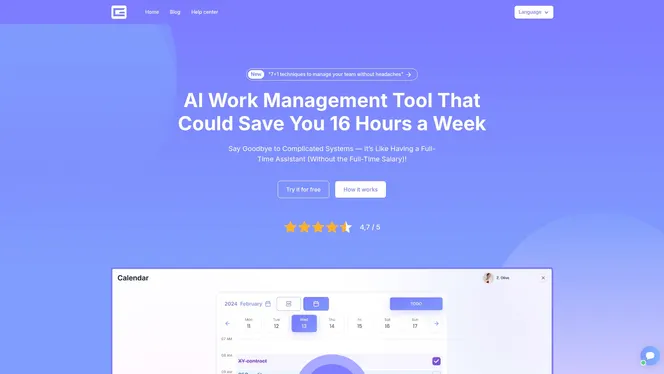
Gammatica is built specifically for business leaders and managers who want real visibility, clear accountability, and less administrative friction across their operations. From Kanban boards and automated task routing to CRM tools and team checklists, Gammatica gives your team a single place to capture work, track progress, and execute with consistency. Leaders running growing teams can explore the solution for founders to see how workflows operate in real time, and sales managers can discover automated sales workflow features designed to close more deals with less manual effort. If freeing up to 16 hours per week sounds like a goal worth pursuing, Gammatica is worth a closer look.
Frequently asked questions
What’s the difference between workflow optimization and automation?
Workflow optimization involves entire workflows, not just isolated tasks. Automation typically targets specific repetitive actions, while optimization redesigns how work flows end-to-end across teams and systems.
How do you know if your workflow is optimized?
If most work flows efficiently, exceptions are handled smoothly, and bottlenecks or rework are rare, your workflow is likely well-optimized. Consistent output quality and low employee frustration are also strong indicators.
What are the most common workflow optimization frameworks?
Popular frameworks include Lean, Six Sigma, and DMAIC, and more recently the CORE stack for layered, adaptive optimization. As classic vs. modern approaches show, the most effective organizations blend both traditions.
How can leaders overcome resistance to workflow changes?
Leaders must answer the WIIFM question clearly for every stakeholder and secure visible executive buy-in to drive adoption. Resistance almost always signals a communication gap, not a people problem.
Can workflow optimization benefit both large and mid-sized organizations?
Yes. Both gain from increased efficiency, reduced errors, and clearer accountability. Mid-sized organizations often see faster results because fewer layers of approval are needed to implement changes.