TL;DR:
- Only about 31% of projects fully succeed due to poor application of lifecycle management.
- Effective stage-gate governance depends on data-driven decision-making and genuine review processes.
- Choosing the right lifecycle approach (predictive, adaptive, hybrid) aligns with project uncertainty and complexity.
Less than one-third of projects actually hit all their goals. That single fact should stop any project leader in their tracks. Only about 31% of projects are deemed fully successful, with 50% challenged and 19% failing outright. Most teams don’t fail because they lack talent or budget. They fail because they treat lifecycle stages as a simple checklist rather than a genuine management system. In this article, you’ll get a clear breakdown of lifecycle stage definitions, proven governance models, a practical comparison of the main frameworks, and concrete steps to drive better project delivery at your organization.
Key Takeaways
| Point | Details |
|---|---|
| Lifecycle clarity boosts success | Clear understanding and use of lifecycle stages sharply improves project results. |
| Stage-gates enhance control | Formal decision checkpoints help leaders adapt and course-correct for productive outcomes. |
| Choose models wisely | Selecting between predictive, adaptive, or hybrid methods depends on project goals and uncertainty. |
| Custom-fit your approach | Tailoring lifecycle stages to project size and complexity yields better results than rigidly following templates. |
What are project lifecycle stages?
Think of a project lifecycle as a map for a road trip. Without it, you’re guessing at turns, burning fuel on wrong routes, and arriving late. With it, everyone on the team knows exactly where you are, what’s expected at each stop, and how to reach the destination efficiently.
A project lifecycle is the sequence of phases a project passes through from its start to its formal close. Each phase represents a distinct set of activities, decisions, and deliverables. The lifecycle gives structure to what would otherwise be chaotic, overlapping work. It also creates natural moments for leadership to check in, course-correct, and confirm the project is still worth pursuing.
The PMI five-stage model is one of the most widely recognized frameworks in the world. According to the PMBOK Guide, a project lifecycle is commonly decomposed into five phases:
- Initiation: Define the project’s purpose, feasibility, and high-level scope. Stakeholders authorize the project to move forward here.
- Planning: Develop the detailed roadmap. This includes schedules, budgets, resource plans, risk registers, and communication strategies.
- Execution: The team does the actual work. Deliverables are produced, vendors are managed, and resources are deployed.
- Monitoring and controlling: Running in parallel with execution, this phase tracks performance against the plan, flags variances, and manages changes.
- Closing: Formally complete the project, hand off deliverables, capture lessons learned, and release resources.
PRINCE2 (Projects in Controlled Environments), a popular UK-developed framework used globally, takes a slightly different approach. Instead of phases, PRINCE2 uses management stages that are determined by the project board and tailored to the project’s risk profile. Each management stage ends with a formal review before the next one is authorized.
Here’s how the two frameworks compare at a glance:
| Dimension | PMI (PMBOK) | PRINCE2 |
|---|---|---|
| Stage terminology | Phases | Management stages |
| Number of stages | Five standard phases | Flexible, board-determined |
| Who drives stages | Project manager | Project board |
| Focus | Process-based activities | Business justification |
| Best for | Broad, process-driven teams | Governance-heavy environments |
| Scalability | Moderate | High, by design |
Both frameworks serve the same fundamental goal: give teams a shared structure for managing complexity. For teams managing project stages for consultants or client-facing delivery, knowing which model fits your environment is a real competitive advantage.
The key takeaway here is that lifecycle stages are not bureaucratic paperwork. They are decision-enabling structures. Used well, they tell you when to make critical calls, not just what to do.
Stage-gate governance: checkpoints that actually drive value
Once you know the stages, the next challenge is making sure your organization doesn’t just sleepwalk through them. That’s where stage-gate governance comes in.

Stage-gate governance structures projects into stages separated by formal decision points where leadership can proceed, pause, recycle or revise, or stop a project entirely. Each “gate” is a structured review where project sponsors and decision-makers evaluate evidence before committing more resources.
Here’s a table showing how typical project gates work in practice:
| Gate | Timing | Key decision | Decision options |
|---|---|---|---|
| Gate 1 | After initiation | Is this worth planning? | Proceed, stop, revise scope |
| Gate 2 | After planning | Is the plan solid? | Proceed, revise plan, hold |
| Gate 3 | Mid-execution | Are we on track? | Proceed, adjust, escalate |
| Gate 4 | Near completion | Ready to close? | Proceed to close, revisit deliverables |
| Gate 5 | Post-close | What did we learn? | Document, archive, improve |
The real power of stage-gate governance is the quality of decision-making at each checkpoint. The risk is that gate reviews become rubber-stamping sessions. A project sponsor nods along to a 50-slide deck, clicks approve, and nothing meaningful is questioned.
“The most dangerous thing you can do at a gate is treat it as a formality. Gates only create value when there’s genuine willingness to say no.” — Project Governance Practitioner
Evidence-based governance is the antidote to rubber-stamping. At each gate, teams should present verifiable data: actual cost versus planned cost, schedule performance index, risk exposure changes, and updated business case calculations. Leaders who use multi-project tracking strategies across their portfolio find it much easier to compare gate evidence consistently.
Pro Tip: Right-size the evidence to your project’s risk and complexity. A low-risk internal process improvement doesn’t need the same gate rigor as a $5 million customer-facing technology rollout. Match your governance intensity to what’s actually at stake.
When gates are taken seriously, they become one of the most valuable tools in a project manager’s arsenal. They create a culture of accountability and early intervention, where small problems get caught before they become expensive ones.
Predictive, adaptive, and hybrid lifecycles: choosing your model
With stage boundaries and governance in view, the next step is choosing the overall lifecycle approach that best fits your project and team context.
Predictive, adaptive, and hybrid lifecycles each take a fundamentally different approach to planning and delivery. Predictive (waterfall-like) models emphasize upfront planning and sequential phases, adaptive approaches restructure delivery into iterative cycles, and hybrid approaches separate governance and funding checkpoints from iterative team execution.
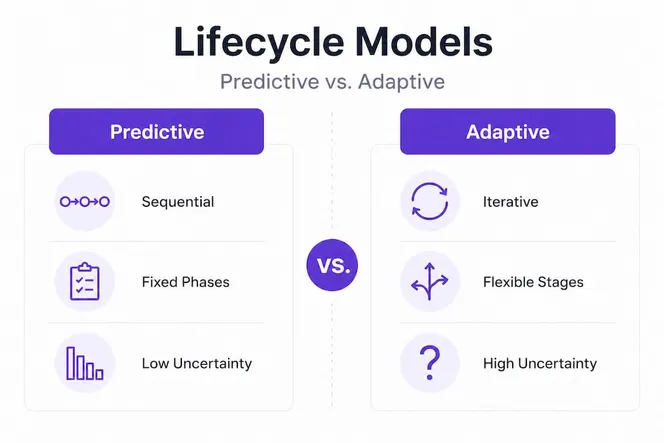
Here’s how they break down in practice:
Predictive (waterfall) lifecycle
- Best for: Projects with clearly defined requirements, fixed budgets, and low uncertainty
- Examples: Construction projects, regulatory compliance programs, hardware installations
- Pros: Easy to plan, clear milestones, straightforward accountability
- Cons: Inflexible to change, late feedback loops, costly if scope shifts mid-project
Adaptive (agile) lifecycle
- Best for: Projects with evolving requirements, high uncertainty, or where user feedback is critical
- Examples: Software development, marketing campaigns, product design
- Pros: Fast feedback loops, high flexibility, continuous improvement built in
- Cons: Harder to predict final cost and timeline, requires team discipline and stakeholder engagement
Hybrid lifecycle
- Best for: Mid-sized organizations juggling governance requirements alongside dynamic delivery
- Examples: IT transformation programs, new product launches with regulatory checkpoints
- Pros: Combines financial governance with delivery flexibility, adaptable to shifting priorities
- Cons: Requires clear role definitions to avoid confusion between iterative teams and stage-gate sponsors
For flexible proposal planning in client-driven environments, hybrid models are particularly well-suited because you can lock governance and budget milestones while keeping the delivery team agile.
Pro Tip: Don’t pick a lifecycle model based on what your team is comfortable with. Pick the model that matches the uncertainty level of the project itself. A team that loves agile working on a fixed-regulation compliance project will create chaos if they ignore the need for predictive structure.
A practical question to ask when selecting your model: “How much do we not know about the final solution at project start?” The higher the uncertainty, the more adaptive your lifecycle should be. The clearer the requirements, the more a predictive structure protects your budget and schedule.
Managing lifecycle stages for better project results
You’ve compared the main approaches. Now let’s translate all of this into actionable steps that mid-sized organizations can apply to actually improve results.
Remember the opening number: only 31% of projects fully succeed. That’s not because organizations lack lifecycle frameworks. Most have them documented somewhere. The gap is almost always in how those frameworks are applied in day-to-day management.
Here are six concrete steps to leverage lifecycle stages for measurably better outcomes:
-
Define stage criteria before the project starts. For each lifecycle stage, write down what “done” looks like before work begins. Ambiguous stage exits are one of the biggest causes of scope creep and rework. For example, define that the planning stage is complete only when the risk register is reviewed and approved, not just when the Gantt chart is drafted.
-
Assign a decision owner to every gate. Every stage-gate review needs a single accountable decision-maker. Committees without a named decision owner default to consensus, which usually means no meaningful challenge happens. Name the person, give them the authority, and hold them responsible for the quality of the decision.
-
Use objective, measurable evidence at gates. Replace opinion-based gate reviews with data-driven ones. Cost performance index (CPI), schedule performance index (SPI), risk-adjusted value, and stakeholder satisfaction scores are all concrete indicators. Teams that use project analytics tools integrate this data automatically, reducing preparation time and improving decision quality.
-
Tailor the lifecycle to the project, not the org chart. One organization-wide standard is a starting point, not a final answer. A three-month internal workflow improvement and a two-year enterprise system rollout need fundamentally different lifecycle structures. Build in explicit flexibility by defining “lite” and “full” governance tracks based on project size, risk, and complexity.
-
Capture lessons at every stage close, not just at project close. Most organizations schedule a post-mortem at project end. By then, key team members may have moved on and memories are fuzzy. A quick lessons-learned capture at each stage close keeps insight fresh and actionable. Over time, this builds an institutional knowledge base that genuinely improves how future projects are run.
-
Revisit your lifecycle model at major scope changes. If the project’s scope or requirements shift significantly mid-project, that’s a signal to reassess whether the current lifecycle model still fits. A project that started as predictive may need to shift toward a hybrid approach if requirements become more volatile. Build explicit decision points for lifecycle model review into your governance framework.
Pro Tip: Revisit decision criteria at every gate, and use project analytics to spot early warning signals. A schedule that’s slipping 5% in phase two is a minor correction. That same slip ignored until phase four becomes a budget crisis. The sooner the signal, the cheaper the fix.
A practical perspective: making lifecycle stages work for your organization
Here’s something the standard project management textbooks won’t tell you: most organizations that follow recognized lifecycle frameworks still underperform because they confuse compliance with capability. They check the boxes, produce the artifacts, and conduct the gate reviews. But the stages become theater rather than genuine management.
The real value of lifecycle stages isn’t in the documentation they generate. It’s in the conversations they force. When a gate review requires decision-makers to examine real data and make a real call, it creates organizational learning. When a stage close asks the team to articulate what they’d do differently, it builds institutional intelligence. That’s the difference between an organization that gets marginally better over time and one that dramatically improves project success rates.
We’ve also seen a common trap in mid-sized companies: applying enterprise-grade lifecycle governance to small, low-risk projects. The overhead kills the momentum and breeds resentment toward the process itself. The lesson? Your lifecycle framework needs to scale down as well as up. If a project takes six weeks, a five-stage PMI model with full gate documentation is overkill. A two-stage approach with one solid midpoint review is far more effective.
And about hybrid approaches. People often treat “hybrid” as a buzzword or a compromise for teams that can’t commit to either waterfall or agile. That’s backward. Hybrid is often the most sophisticated choice, not the easiest. It requires leaders to understand both governance discipline and iterative delivery principles deeply enough to combine them intelligently. The organizations that get hybrid right consistently outperform those that rigidly stick to one methodology because “that’s how we’ve always done it.”
The bottom line: don’t let your lifecycle stages become wallpaper. Treat each stage boundary as a genuine decision point, customize your model to fit real project conditions, and use evidence to drive your gates. That mindset shift, more than any specific framework, is what separates the 31% from the rest.
Connect your lifecycle to smarter project delivery
If this approach to lifecycle management resonates with you, the next step is putting it into practice with tools built for exactly this kind of work.
Gammatica is a project management platform designed for business leaders and project managers at mid-sized organizations who need more than basic task lists. With AI-driven automation, Kanban boards, stage-based checklists, and real-time analytics, Gammatica helps your team move through lifecycle stages with clarity and confidence. You can automate project workflows to reduce administrative overhead, set up stage-gate checkpoints with built-in approval flows, and track performance across your entire project portfolio. Teams using Gammatica report freeing up to 16 hours per week previously lost to manual coordination. That’s time your team can reinvest in the decisions that actually move projects forward.
Frequently asked questions
What are the five stages of the project lifecycle?
The five stages are initiation, planning, execution, monitoring and controlling, and closing, as defined by the PMI standard in the PMBOK Guide.
How does stage-gate governance improve project outcomes?
Stage-gate governance breaks projects into stages with formal decision points, making it easier for leadership to intervene, adjust resources, or stop a project before costs escalate further.
What’s the difference between predictive and adaptive lifecycles?
Predictive models follow sequential planning and phases, making them ideal for low-uncertainty projects; adaptive models use iterative cycles and adjust plans continuously based on feedback and changing requirements.
Why do many projects fail even with recognized lifecycles?
Most projects fall short because lifecycle stages are treated as documentation exercises rather than genuine decision checkpoints. Research shows only 31% succeed fully, pointing to weak gate governance and unclear stage criteria as core culprits.