Over 60 percent of new American businesses rely on financial templates to track their performance accurately. Managing finances can make or break the future of any enterprise, especially when complex data is involved. For business owners, the right Profit and Loss Template brings clarity by translating daily transactions into actionable insights that reveal profitability, spot trends, and support smart decisions.
Table of Contents
- What Is A Profit And Loss Template
- Variations Of Profit And Loss Templates
- How A P&L Template Operates Practically
- Real‑World Use Cases For P&L Templates
- Pitfalls And Common Mistakes To Avoid
What Is A Profit And Loss Template
A Profit and Loss Template is a critical financial document that provides a comprehensive snapshot of a business’s financial performance over a specific time period. According to corporate finance experts, this template summarizes a company’s revenues, expenses, and overall profitability by systematically tracking income and expenditure streams.
The primary purpose of a Profit and Loss (P&L) template is to help business leaders understand their financial health at a glance. Financial documentation organizations define it as a tool that measures profitability by meticulously subtracting total expenses from total income. This straightforward calculation reveals whether a business is generating a profit or experiencing financial losses during a specific accounting period.
Key components of a typical Profit and Loss template include:
- Revenue streams: Total income from sales, services, or other business activities
- Cost of Goods Sold (COGS): Direct expenses related to producing products or services
- Operating expenses: Indirect costs like rent, utilities, salaries, and marketing
- Net income/loss: The final calculation showing financial performance
Pro Tip: Financial Efficiency Strategy: Create a standardized P&L template with automated calculation fields to save time and reduce manual data entry errors, enabling faster and more accurate financial analysis.
Variations Of Profit And Loss Templates
Profit and Loss Templates are not one-size-fits-all financial documents. Instead, they can be highly customized to meet the unique reporting needs of different businesses and industries. Financial software experts recommend adapting templates to include specific components that provide the most meaningful insights for each organization’s financial strategy.
Business leaders can choose from several primary variations of Profit and Loss Templates, each designed to serve different analytical purposes. These variations include:
- Cash Basis Template: Tracks income and expenses when money actually changes hands
- Accrual Basis Template: Records financial transactions when they are earned or incurred, regardless of cash movement
- Condensed Template: Provides a high-level overview with minimal detailed breakdown
- Detailed Template: Offers comprehensive line-item analysis of every revenue and expense category
Some industry-specific variations focus on unique financial tracking requirements. For instance, retail businesses might emphasize inventory costs, while service-based companies could prioritize labor expenses and project-based income. Manufacturing organizations often require more complex templates that break down production costs, raw material expenses, and overhead allocations.
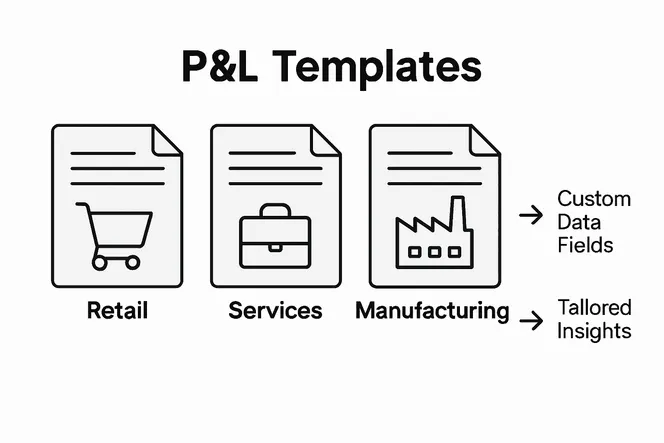
Here’s how different P&L template types serve various business needs:
| Template Type | Best For | Main Advantage |
|---|---|---|
| Cash Basis | Small businesses and freelancers | Simple cash flow tracking |
| Accrual Basis | Growing companies | Accurate matching of income/expenses |
| Condensed | Quick executive reviews | Fast overview, minimal details |
| Detailed | In-depth financial analysis | Thorough, granular breakdown |
Pro Tip: Template Customization Strategy: Work with your accounting team to develop a P&L template that not only meets standard reporting requirements but also provides actionable insights specific to your business model and strategic goals.
How A P&L Template Operates Practically
A Profit and Loss Template transforms complex financial data into a clear, actionable roadmap for business decision-making. Practically, it operates like a financial storytelling tool, converting raw numbers into meaningful insights that reveal the true financial narrative of a business. The template systematically tracks every dollar earned and spent, creating a comprehensive financial snapshot that goes beyond simple arithmetic.
The operational process of a P&L template typically follows a structured workflow:
- Data Collection: Gathering all financial transactions from various sources
- Categorization: Sorting transactions into specific revenue and expense categories
- Calculation: Computing total income, total expenses, and net profit/loss
- Analysis: Interpreting the financial results and identifying trends
Business leaders use P&L templates to perform critical financial diagnostics. By comparing different periods, managers can identify seasonal fluctuations, track expense trends, assess revenue growth, and make data-driven strategic decisions. The template becomes a powerful diagnostic tool that highlights financial strengths and potential areas of improvement, allowing for proactive financial management.

Real-world application involves more than just number-crunching. Successful businesses integrate P&L templates into their strategic planning, using them to forecast future financial performance, justify budget allocations, attract investors, and demonstrate financial health. The template serves as a communication bridge between financial data and strategic decision-making.
Pro Tip: Financial Performance Tracking: Schedule monthly P&L template review meetings with key stakeholders to transform raw financial data into actionable strategic insights that drive business growth.
Real‑World Use Cases For P&L Templates
Profit and Loss Templates serve as versatile tools across multiple business scenarios, providing critical financial insights for strategic decision-making. Entrepreneurs consistently use these templates as essential instruments for analyzing total costs and assessing business performance across various operational contexts.
Different business scenarios demonstrate the template’s practical applications:
- Startup Funding: Presenting comprehensive financial health to potential investors
- Small Business Management: Tracking monthly expenses and revenue patterns
- Corporate Budgeting: Allocating resources and identifying cost-cutting opportunities
- Tax Preparation: Documenting financial performance for accurate tax reporting
- Merger and Acquisition Analysis: Evaluating financial viability of potential business transactions
Specific industry use cases highlight the template’s adaptability. Retail businesses might use P&L templates to analyze product line profitability, while service companies can track project-specific financial performance. Manufacturing organizations can break down production costs, overhead expenses, and revenue streams to understand intricate financial dynamics.
Advanced applications extend beyond basic financial tracking. Sophisticated businesses leverage P&L templates for predictive modeling, using historical financial data to forecast future performance, identify emerging trends, and make proactive strategic decisions. The template transforms from a retrospective reporting tool to a forward-looking strategic instrument that guides organizational growth and financial planning.
Below is a summary of how P&L templates drive real business decisions in different scenarios:
| Scenario | Business Goal | Strategic Benefit |
|---|---|---|
| Startup Funding | Attract investors | Demonstrates financial viability |
| Small Business Mgmt. | Monitor ongoing performance | Identifies savings and revenue trends |
| Corporate Budgeting | Allocate resources | Reveals cost-cutting opportunities |
| Mergers & Acquisitions | Evaluate transaction targets | Assesses profitability and risks |
Pro Tip: Comparative Analysis Strategy: Create year-over-year and quarter-over-quarter P&L template comparisons to uncover subtle financial trends and make data-driven business improvements.
Pitfalls And Common Mistakes To Avoid
Creating a Profit and Loss Template requires precision and careful attention to detail. Financial professionals often encounter several critical mistakes that can undermine the template’s accuracy and strategic value. Understanding these potential pitfalls is essential for maintaining reliable financial documentation and making informed business decisions.
Common mistakes in P&L template development include:
- Inconsistent Categorization: Mixing expense and revenue categories across different reporting periods
- Incomplete Data Tracking: Overlooking minor expenses or irregular income streams
- Manual Data Entry Errors: Relying solely on manual input without verification mechanisms
- Lack of Standardization: Using different calculation methods across multiple reporting cycles
- Ignoring Historical Context: Failing to compare current performance against previous financial periods
Many businesses struggle with complex accounting nuances that can compromise their P&L template’s integrity. For instance, misclassifying expenses between operational and non-operational categories can distort financial performance analysis. Some organizations inadvertently create template inconsistencies by not establishing clear financial reporting protocols or using outdated calculation methods that do not reflect current business realities.
Advanced financial management requires a systematic approach to template development. Successful organizations implement robust verification processes, leverage automation tools, and create standardized template frameworks that minimize human error and provide consistent, reliable financial insights. Regular template audits and cross-referencing with multiple financial documents can help identify and rectify potential discrepancies before they impact strategic decision-making.
Pro Tip: Error Prevention Strategy: Implement automated cross-checking mechanisms and quarterly template validation processes to ensure consistent and accurate financial reporting across all business units.
Streamline Your Financial Insights With AI-Powered Management
Understanding the complexities of a Profit and Loss Template is crucial for making informed business decisions and avoiding common mistakes like inconsistent categorization or incomplete data tracking. The challenge lies in transforming raw financial data into actionable insights without losing time to manual errors or inefficient processes. You need a solution that offers automation, precision, and real-time collaboration to enhance your financial reporting and overall business management.

Take control of your Profit and Loss analysis by integrating your financial workflows with Gammatica.com — an AI-driven project and team management platform designed to boost productivity and reduce administrative burdens. Use smart templates, automated calculations, and seamless team coordination tools to save hours every week while improving accuracy. Act now to transform your financial reporting into a strategic advantage through streamlined task management, calendar coordination, and powerful automation. Explore more at Gammatica.com and start making confident, data-driven decisions today.
Frequently Asked Questions
What is a Profit and Loss Template?
A Profit and Loss Template is a financial document that summarizes a business’s revenues, expenses, and overall profitability over a specific time period, helping leaders understand their financial health at a glance.
How does a Profit and Loss Template help in business decision-making?
The template assists in tracking income and expenses systematically, providing insights into financial performance that can guide strategic decisions, identify trends, and spotlight areas for improvement.
What are the main components of a Profit and Loss Template?
Key components include revenue streams, cost of goods sold (COGS), operating expenses, and net income or loss, which together present a comprehensive overview of financial performance.
What are the common pitfalls to avoid when creating a Profit and Loss Template?
Common mistakes include inconsistent categorization of data, incomplete tracking of income and expenses, reliance on manual data entry, and lack of standardization, which can compromise the template’s accuracy and effectiveness.