TL;DR:
- Self-management is crucial for effective leadership, impacting decision quality and team morale.
- Building self-awareness and practicing daily habits can significantly enhance leadership effectiveness.
- Culture, identity shifts, and proper support determine the success of self-management in teams.
Only 15% of people are genuinely self-aware, and the odds don’t improve just because someone holds a leadership title. That gap matters more than most managers realize. When you struggle to regulate your own emotions, energy, and reactions, every decision you make and every interaction you have ripples outward to your team. The good news? Self-management is a skill, not a fixed trait. In this article, we walk you through evidence-based frameworks, practical daily tactics, and clear connections between managing yourself and getting better results from your people.
Key Takeaways
| Point | Details |
|---|---|
| Self-management comes first | Leaders must manage themselves before they can inspire or direct others effectively. |
| Most leaders lack self-awareness | Only a small percentage of leaders are truly self-aware, impacting their teams’ success. |
| Use proven frameworks | Models like the Ladder of Inference help leaders challenge assumptions and improve decisions. |
| Daily habits matter | Simple tactics and heuristics, applied consistently, drive lasting self-management improvement. |
| Self-management boosts teams | The way leaders manage themselves sets the tone for team productivity, well-being, and culture. |
Why self-management is the foundation of effective leadership
Before you can guide a team, you have to be able to guide yourself. It sounds simple. In practice, it’s one of the harder disciplines a leader faces.
Self-management in a leadership context means three things working together: emotional regulation (staying composed under pressure), self-awareness (knowing how your behavior affects others), and proactivity (acting on values rather than reacting to circumstances). Miss any one of those and your leadership starts to crack.
The data backs this up. Self-management is the first pillar of effective management, and it must come before team management or performance management. Yet over 50% of managers report feeling burned out, which directly impairs both decision quality and their ability to inspire their teams.
“A manager who cannot manage themselves cannot sustainably manage others. Burnout is not a personal failure; it’s a systems failure that starts with missing self-management habits.”
What happens when self-management breaks down? The effects are predictable and costly:
- Poor judgment under stress. Reactive decisions replace thoughtful ones.
- Lower team morale. Emotional volatility from leadership creates anxiety in the whole group.
- Increased conflict. Without emotional regulation, small friction becomes big problems.
- Reduced psychological safety. Teams stop raising concerns when leaders are unpredictable.
On the positive side, even small improvements in management practice generate real gains. A 0.1 improvement in management practices score correlates to an 8.6% increase in productivity. That’s a remarkable return for what often amounts to a few intentional behavior changes.
When you invest in self-management, the benefits compound:
- Better judgment. You pause before reacting, choosing the right response over the fast one.
- Stronger team culture. Calm, consistent leadership sets the tone everyone else follows.
- Higher trust. Teams trust leaders who are predictable and self-aware.
- More effective decisions. You separate emotion from analysis when it counts most.
Think of self-management as the operating system running underneath everything else you do as a leader. Every strategy, every conversation, every decision runs on top of it.
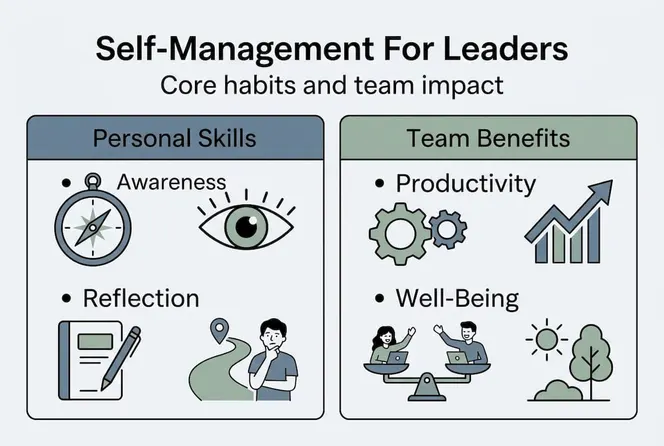
Building self-awareness: The Ladder of Inference and practical models
Self-awareness doesn’t come naturally to most people, and that’s not a character flaw. It’s a function of how our brains work.
The Ladder of Inference, developed by organizational psychologist Chris Argyris, is one of the most useful tools leaders have for catching unconscious assumptions and interrupting biases before they affect decisions. The model shows how we move from raw data to beliefs and actions in a split second, often without realizing it.
Here’s how to apply it in real decisions:
- Pause before acting. When you feel a strong reaction forming, stop. Name what you’re feeling.
- Identify what data you selected. Out of everything happening, what specific detail triggered your response?
- Notice what meaning you added. What assumptions did you layer on top of that data?
- Question your conclusions. Is there another plausible interpretation? What would a neutral observer say?
- Check your action against your values. Is the action you’re about to take consistent with how you want to lead?
This process slows down what psychologists call System 1 thinking and activates System 2. The table below shows the practical differences:
| Feature | System 1 thinking | System 2 thinking |
|---|---|---|
| Speed | Fast, automatic | Slow, deliberate |
| Effort | Low | High |
| Risk | Prone to bias | More accurate |
| Best for | Routine tasks | Complex decisions |
| Leader application | First impressions | Strategic judgment |
Given that only 15% of people are truly self-aware, most leaders are running on System 1 far more often than they think. The Ladder of Inference gives you a way to catch that drift and redirect.
Pro Tip: Keep a short daily reflection journal. At the end of each day, write down one decision where you noticed a strong automatic reaction. Trace it back up the Ladder. Over three to four weeks, patterns will emerge that no feedback session could reveal as clearly.
Tools and tactics for daily self-management
Frameworks are only as good as the habits that put them into practice. Here is what works in the day-to-day reality of managing a team.

Research shows that managers use self-change heuristics, which are simple personal rules, to unlearn command-and-control behaviors and replace detrimental habits with more effective ones. Rather than overhauling your entire leadership approach at once, you pick one specific habit and replace it with a clear, actionable rule.
Here are proven daily tactics:
- Morning intention setting. Before checking messages, spend five minutes identifying your top priority and how you want to show up emotionally that day.
- Scheduled reflection breaks. Brief midday pauses (even ten minutes) reduce decision fatigue and reset focus.
- Active feedback loops. Ask one team member each week for a specific piece of honest feedback on your leadership behavior.
- Mindfulness anchors. Use a recurring cue, like the first meeting of the day, to do a brief body scan and emotional check-in.
- End-of-day review. Note what went well, what triggered you, and what you’d do differently.
Practical mechanics like micro-learning sessions (short bursts of focused learning on topics like emotional intelligence or resilience) and brief coaching conversations reinforce new habits more reliably than intensive off-site workshops.
Here’s a useful comparison when choosing your approach:
| Approach | Pros | Cons | Best used for |
|---|---|---|---|
| Heuristics (simple rules) | Fast to apply, easy to remember | May oversimplify complex situations | Breaking one specific habit |
| Full frameworks (e.g., Ladder) | Thorough, addresses root causes | Requires time and practice | Deep behavior change |
| Micro-learning | Fits busy schedules, low friction | Needs repetition to stick | Building new skills incrementally |
| Coaching | Personalized, high accountability | Requires access and investment | Sustained transformation |
Pro Tip: Name one habit you know is holding your leadership back. Write a single replacement rule for it. For example: “When I feel interrupted, I will ask a clarifying question before responding.” Simple rules create real change when applied consistently.
Linking self-management to team performance and well-being
The impact of your self-management doesn’t stop at your own behavior. It flows directly into how your team performs, feels, and grows.
Mental health self-management at work acts as a moderator between stressful work conditions and well-being outcomes. Leaders who practice it consistently are more likely to report flourishing at work, and that energy is contagious. Teams model what they see.
Here’s what changes when a leader manages themselves well:
- Conflict resolution improves. Regulated leaders address friction directly instead of avoiding it or escalating it.
- Trust increases. Predictable, self-aware leaders create safety for honest conversations.
- Productivity rises. Teams spend less time managing around leadership volatility and more time doing real work.
- Retention strengthens. People stay longer when they feel psychologically safe and respected.
But here’s an honest caveat: self-management boosts productivity most powerfully for high performers operating with psychological safety. For team members low in job mastery or interest, it can actually worsen outcomes if it isn’t paired with structural clarity and proper support.
“Self-management is not a universal solution. It works best as part of a culture where clarity, support, and safety already exist.”
Watch for these warning signs that self-management culture may be backfiring:
- Team members seem confused about their roles or decision boundaries.
- Some employees feel unsupported or disconnected from leadership.
- High performers thrive while others consistently fall behind without anyone addressing it.
- Autonomy has replaced accountability instead of complementing it.
- Psychological safety is assumed but never actively built.
The goal is a resilient, flourishing culture. That starts with you modeling the behaviors you want to see, creating the conditions where self-management can work for everyone.
A different take: Why most leaders underestimate the challenge of self-management
Most leadership advice makes self-management sound like a productivity hack. Add a morning routine. Journal more. Breathe before you react. And those things do help. But they’re not the hard part.
The real challenge is identity. Many leaders have built their self-concept around being decisive, authoritative, and always in control. Shifting that means confronting beliefs that feel foundational, not just habits that feel inconvenient. That’s a different kind of work.
In our experience, the leaders who make the most lasting progress aren’t the ones who add new habits fastest. They’re the ones willing to sit with discomfort when their automatic responses no longer match the leaders they want to be. That gap between old identity and new behavior is where real growth lives.
Quick fixes skip this entirely. Sustainable change requires what researchers call “unlearning” at an identity level. It’s slower. It’s less comfortable. And it’s the only thing that actually sticks.
If your self-management practice isn’t creating real behavioral change after a few months, the question isn’t which tool to add next. It’s which belief about yourself you haven’t examined yet.
Next steps: Empower your leadership with better self-management
Reading about self-management is a great start. Turning insight into daily action is where the real difference happens.

If you’re serious about growing as a leader while keeping your team organized, accountable, and high-performing, you need tools that support both sides of that equation. Gammatica for Founders gives you an AI-driven platform to manage tasks, workflows, and team collaboration, so the operational load doesn’t crowd out the self-reflection time you need. When your systems run smoothly, you have the space to lead with intention. Explore how Gammatica can free up your time and sharpen your leadership focus today.
Frequently asked questions
What is the first step in managing yourself as a leader?
The first step is building self-awareness. The Ladder of Inference model helps leaders recognize automatic thoughts and challenge biases before they drive poor decisions.
How does self-management affect team performance?
Self-management boosts productivity and well-being most for high performers in psychologically safe environments, but results depend heavily on team trust and role clarity.
What simple tactics can improve daily self-management?
Start with a morning intention routine, midday reflection breaks, and one simple replacement rule for a habit you want to change. Managers use self-change heuristics like these to break ingrained command-and-control behaviors effectively.
Does self-management reduce burnout for managers?
Yes. Over 50% of managers experience burnout, but those who practice consistent self-management report better decision quality and significantly lower stress over time.
Are there risks to promoting self-management in teams?
Absolutely. If a team lacks job mastery or interest, self-management can backfire. Autonomy without clarity and support reduces performance rather than boosting it.