TL;DR:
- Most organizational change efforts fail because managers neglect the human side, not due to faulty plans. Recognizing emotional responses and proactively diagnosing team faultlines help prevent resistance and polarization. Effective communication, reinforcement, and ongoing support are essential to sustain lasting change and improve business outcomes.
Most managers approach organizational change as a logistics problem. New system, new process, new org chart. Roll it out, send the announcement email, and wait for adoption. The problem? Up to 70% of change initiatives fail, and the root cause is almost never the technology or the plan. It’s how people are managed through the transition. Managing change in teams is fundamentally a human challenge, and the managers who treat it that way consistently outperform those who don’t. Here’s what the research and real experience say about doing it right.
How change really affects your team
Before you can apply any change management strategies, you need to understand what your team members are actually experiencing. The Kübler-Ross Change Curve, originally developed to describe grief, maps directly onto how people respond to organizational change. They move through denial, anger, bargaining, and depression before reaching acceptance. The mistake most managers make is expecting people to jump straight to acceptance once the rationale is explained.
Here’s what makes this tricky: not everyone moves through these stages at the same pace. You might have three people who are enthusiastically embracing a new workflow system while two others are still quietly mourning the old one. Both responses are valid. Both need attention.
The numbers reinforce why this matters so much. Employees going through organizational transitions report 23% higher stress levels and a 15-18% engagement drop during initial phases of change. That’s not a minor productivity dip. That’s a significant drain on your team’s capacity, creativity, and cohesion.
Two things stand out here for managers:
- Even positive changes trigger loss. A promotion for a team member means the existing team structure ends. A new platform means years of hard-won expertise in the old one becomes less relevant. Acknowledge this explicitly.
- Silence is not agreement. Managers often mistake silence for stability, but silence almost always masks anxiety, not comfort.
“The emotional journey of change is not a distraction from the work. It is the work.”
Recognizing where each team member sits on the emotional spectrum allows you to adapt your support, your communication, and your timeline. Adapting to organizational change starts with accepting that your team’s feelings are data points, not inconveniences.
Team dynamics during change: faultlines and group fractures
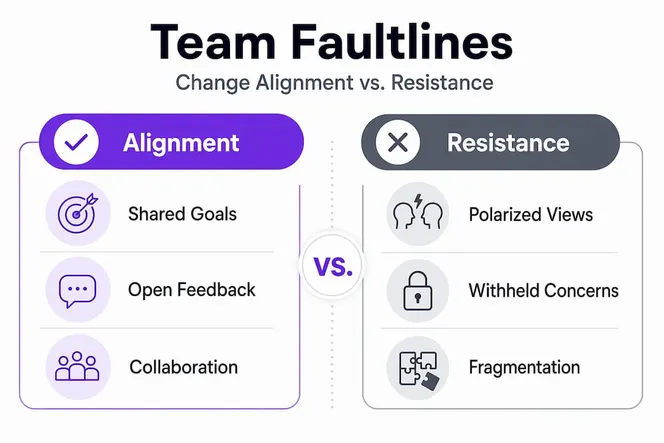
Individual emotional responses are just one layer. At the group level, change does something particularly dangerous: it activates faultlines. A faultline is a latent division in a team based on shared attributes like tenure, department background, age, or functional identity. Under normal conditions, these divisions stay dormant. Under the pressure of change, they crack open.

Pre-existing team faultlines activate under change, causing polarization and resistance that can destroy team cohesion. A restructuring, for example, might split a team along tenure lines: those who’ve been around long enough to remember “how it used to work” versus newer hires who have no attachment to old systems. Neither group is wrong, but if left unmanaged, this split becomes a political problem.
Research identifies four patterns of how teams respond collectively to change:
| Response Pattern | Description | Risk Level |
|---|---|---|
| Convergent | Most team members align on a shared view | Low |
| Minority belief | A small subgroup holds dissenting views | Moderate |
| Fragmented | Individuals vary widely with no clear majority | High |
| Bimodal | Two distinct camps form with opposing views | Very High |
The bimodal pattern is the most dangerous. When a team splits into two roughly equal camps, every meeting becomes a negotiation, and large-scale changes like restructures or technology overhauls are the most potent triggers for this outcome. The fragmented pattern is also underestimated. It looks like healthy individuality, but it often signals that the team has no shared narrative around the change, which is a communication failure.
Pro Tip: Run a quick anonymous pulse survey before launching any significant change initiative. Ask one question: “How do you feel about the upcoming change on a scale of 1 to 10?” The distribution of answers will immediately tell you whether you have a convergent team or a bimodal split. That single data point should shape your entire communication plan.
Diagnosing your team’s faultlines proactively means mapping who is likely to align and who is likely to resist, then designing engagement approaches that deliberately mix subgroups. Cross-functional working groups, mixed-tenure feedback sessions, and shared problem-solving workshops all reduce the chance that faultlines deepen into permanent fractures.
Communication strategies that build genuine buy-in
Most change communication fails not because there isn’t enough of it, but because it’s sequenced incorrectly. Sequencing errors cause employees to know what is changing but not why, which is the exact opposite of what builds commitment. When people understand the “why” deeply, they can tolerate ambiguity in the “how.” When they only know the “what,” every unclear detail becomes a source of anxiety.
Here’s a communication sequence that actually works for how to manage team transitions:
- Start with the vision and the “why.” Before anyone knows what’s changing operationally, they need to understand the problem being solved and what success looks like. Make this concrete. “We’re switching platforms because our current one costs us an estimated eight hours per week in manual data entry per person” lands better than “to improve operational efficiency.”
- Open a feedback loop before plans are finalized. Including teams early in shaping change plans creates ownership. Even if their feedback changes nothing major, the act of being consulted reduces resistance significantly.
- Segment your messaging by role. A software developer and a sales manager do not need the same information in the same format. Tailor your communication to what each group actually needs to know and when.
- Use live conversation, not just written updates. Emails get deleted. Town halls invite passive reception. Small-group conversations, team check-ins, and two-way dialogs create psychological safety and allow concerns to surface before they become problems.
- Assign communication owners. If everyone is responsible for communicating change, no one is. Name the person accountable for each team’s update cadence and stick to it.
Effective communication in teams during change is not about volume. Effective change messaging is about sequencing and shared vision, building one clear narrative that aligned leaders repeat consistently across every channel and conversation.
Pro Tip: Create a shared “change FAQ” document that gets updated in real time as questions emerge. Tools that support collaborative documentation, like a company wiki, allow team members to find answers without waiting for the next all-hands meeting, which cuts down on anxiety-driven hallway conversations.
Sustaining change: what happens after the launch
The most overlooked phase of managing change in teams is what happens after the initial rollout. The announcement is done. The training is complete. Now the hard part begins: making sure new behaviors actually stick.
Overcoming resistance to change is not a one-time event. It’s an ongoing process that requires consistent reinforcement and leadership attention.
- Normalize the grief and loss cycle openly. When you acknowledge in a team meeting that transitions are genuinely hard and that some frustration is expected, you reduce shame and increase honesty. Ignoring the grief cycle leads to lower trust and slower recovery. Naming it out loud does the opposite.
- Use informal one-on-one check-ins as an early warning system. Informal check-ins uncover hidden resistance that silence masks in group settings. A quick fifteen-minute conversation with each team member every two weeks during a major transition is one of the highest-return habits a manager can build.
- Align your reinforcement mechanisms. Recognition, performance conversations, and updated policies must all reinforce the new behaviors. If you ask people to adopt a new process but still reward them on metrics built around the old one, the old behavior wins every time.
- Celebrate visible small wins. When a team member successfully uses the new workflow to close a deal faster, name it publicly. When a group completes their first week using the new system without reverting, acknowledge it. These micro-celebrations build momentum and make the change feel achievable rather than overwhelming.
- Watch for regression actively. Building team resilience requires monitoring, not just hope. Track which teams or individuals are slipping back to old habits and treat that as a conversation prompt, not a performance issue.
Here’s the business case if you need it: companies that integrate people-centered change management outperform peers by 15% in total shareholder return. That’s not a soft metric. That’s the financial argument for everything covered in this section.
My honest take on where most managers go wrong
I’ve worked through enough change projects to have a strong opinion on the most common failure mode. It’s not poor planning. It’s the assumption that once people understand the logic of a change, they’ll get on board.
Logic and emotion do not work on the same timeline. I’ve seen technically brilliant change programs collapse because the leader presented a compelling business case, got polite nods in the room, and interpreted that as alignment. It wasn’t. It was politeness hiding real fear. When those fears weren’t addressed, they became rumors, then resistance, then quiet sabotage of the new process.
What I’ve learned is that the most effective change leaders I’ve encountered are the ones who treat emotional honesty as a strategic tool, not a touchy-feely detour. They say things like “I know this is hard” in front of the whole team. They ask “what are you most worried about?” before asking “are you on board?” That ordering matters enormously.
I’ve also seen how adaptive leadership produces better outcomes than rigid change roadmaps. The leaders who cling to their original 12-step change plan regardless of what the team is signaling create more damage than the ones who stop, reassess, and adjust. Flexibility in method, combined with clarity on destination, is the combination that works.
My practical advice: spend the first week of any major change initiative doing nothing but listening. No selling, no training, no rollout. Just listening. You will learn more about what the transition will require in those five days than in any planning session you’ve held.
— Viktor
How Gammatica supports your team through transitions
Managing transitions well requires more than good intentions. It requires the right tools to keep communication clear, feedback visible, and team progress trackable in real time.
Gammatica’s AI-driven platform gives managers a practical edge during periods of change. Collaborative wikis capture shared knowledge and keep FAQs updated as new questions emerge. Kanban boards make task ownership transparent so nothing falls through the cracks during a transition. Automated check-in workflows reduce the time it takes to surface team concerns, and built-in communication tools keep everyone aligned without requiring yet another meeting. If you want to see how these features map to your specific change management needs, book a demo call with the Gammatica team and walk through how the platform can support your next transition.
Key takeaways
| Point | Details |
|---|---|
| Most change initiatives fail on the human side | Up to 70% of change efforts fail due to poor people management, not poor planning. |
| Emotional responses are predictable | Teams follow recognizable stages of change. Recognizing where individuals are helps you respond effectively. |
| Faultlines activate under pressure | Pre-existing team divisions surface during transitions. Proactive diagnosis and cross-group engagement prevent polarization. |
| Communication must lead with “why” | Sequencing vision before operational detail builds buy-in and reduces anxiety-driven resistance. |
| Reinforcement makes change stick | Recognition, updated policies, and regular check-ins are what separate lasting change from temporary compliance. |
FAQ
Why do most change initiatives fail?
Up to 70% of change initiatives fail primarily because of inadequate management of the human dimension. Poor communication, ignored emotional responses, and lack of team involvement are the most common culprits.
What are team faultlines and why do they matter?
Team faultlines are latent divisions based on shared characteristics like tenure, function, or background. They tend to stay dormant under normal conditions but activate during organizational change, creating polarization and resistance that can derail even well-designed transitions.
How should leaders communicate change to their teams?
Lead with the “why” before explaining operational details. Early feedback loops before plans are finalized convert passive recipients into invested participants. Small-group conversations work better than broadcast emails for building genuine understanding.
How do you sustain change after the initial rollout?
Align reinforcement mechanisms: recognition, performance reviews, and updated policies must all reward new behaviors, not old ones. Regular informal check-ins help surface regression early enough to address it.
What is the business case for people-centered change management?
Organizations that prioritize the human side of change outperform peers by 15% in total shareholder return, according to BCG research published in 2026. The return on investing in your team’s experience during transitions is measurable and significant.