Project confusion costs real money. Studies show that more than 50 percent of American businesses cite poor scope definition as a main cause of missed deadlines and overspending. If you are managing a growing team in Hungary, unclear project parameters can quickly turn simple tasks into complex headaches. This guide helps you avoid common misunderstandings, clarifies what every professional scope of work should include, and offers actionable insights for making your next project run smoother with AI-driven tools.
Table of Contents
- Scope of Work Explained and Misconceptions
- Types of Scope Documents and Key Differences
- Essential Elements of an Effective Scope Statement
- Defining Roles, Responsibilities, and Deliverables
- Common Pitfalls and How to Avoid Them
Scope of Work Explained and Misconceptions
A Scope of Work represents the foundational blueprint defining a project’s boundaries, expectations, and deliverables. Unlike generic project plans, this document serves as a precise contract between stakeholders, outlining exactly what will be accomplished, how it will be achieved, and the specific parameters guiding project execution.
Misconceptions about project scopes are surprisingly common and can derail even well-intentioned initiatives. Comprehensive facility project documentation highlights that many project failures stem from ambiguous or poorly defined work parameters. Teams often mistakenly believe that simply listing tasks constitutes an effective scope of work, when in reality, a robust scope requires nuanced details about responsibilities, timelines, resources, and potential constraints.
Effective scope development involves multiple critical components. These typically include:
- Clear Objectives: Precisely articulated project goals
- Detailed Deliverables: Specific, measurable outcomes
- Performance Standards: Quality and acceptance criteria
- Resource Allocation: Required personnel, equipment, and budget
- Timeline Milestones: Specific checkpoints and deadlines
Professional project managers recognize that research misconceptions can dramatically impact project trajectories. Just as academic research requires clear hypotheses, business projects demand equally rigorous definition. Vague language, assumptions, or undefined expectations create significant risks of misalignment, cost overruns, and potential project failure.
Pro Tip - Scope Clarity Strategy: Before finalizing any project scope, conduct a comprehensive review with all stakeholders, requiring each to initial specific sections and confirm their understanding to prevent future misinterpretations.
Types of Scope Documents and Key Differences
Understanding the various types of scope documents is crucial for effective project management. Each type serves a distinct purpose and provides a unique lens for defining project parameters, ensuring stakeholders have a comprehensive view of project expectations and limitations.
Project scope document templates reveal several primary categories of scope documents, each tailored to specific organizational and project needs. The most common types include:
- Preliminary Scope Statement: Initial high-level overview of project goals and potential constraints
- Detailed Scope Document: Comprehensive breakdown of specific deliverables, requirements, and boundaries
- Product Scope Document: Focuses explicitly on product-related specifications and features
- Project Scope Document: Encompasses broader project management requirements and organizational constraints
Scope statements vary significantly across different industries and project types. For instance, a software development project might require an intricate technical scope document detailing specific coding standards, while a construction project would emphasize physical deliverables, material specifications, and structural requirements.

Key differences between scope documents are not just cosmetic but fundamental. Technical scopes tend to be more granular, while strategic scopes remain broader and more conceptual. The level of detail depends on project complexity, organizational culture, and specific stakeholder requirements.
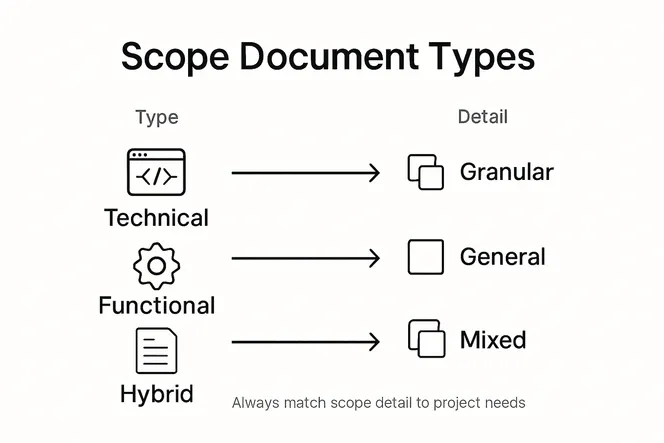
Here’s a comparison of common scope document types and their typical usage scenarios:
| Scope Document Type | Typical Use Case | Level of Detail |
|---|---|---|
| Preliminary Scope | Early-stage project alignment | High-level, general |
| Detailed Scope | Complex projects with many requirements | Granular, exhaustive |
| Product Scope | Product development or enhancement | Feature-focused, specific |
| Project Scope | Organization-wide initiatives | Broad, managerial focus |
Pro Tip - Scope Document Selection: Always match your scope document type to your project’s specific complexity and organizational context, recognizing that one size does not fit all project management scenarios.
Essential Elements of an Effective Scope Statement
Creating a comprehensive scope statement is the foundational blueprint for successful project execution. This critical document serves as a roadmap that aligns team expectations, defines project boundaries, and establishes clear performance parameters for all stakeholders involved.
Detailed project scope documentation typically encompasses several key elements that transform abstract project concepts into tangible, actionable guidelines. The most crucial components include:
- Project Charter: Formal authorization and high-level project objectives
- Problem Statement: Clear definition of the challenge being addressed
- Project Goals and Objectives: Specific, measurable outcomes
Comprehensive facility project guidelines highlight the importance of precision in defining project parameters. A well-constructed scope statement must go beyond basic descriptions, diving deep into nuanced details that prevent potential misunderstandings or scope creep.
Effective scope statements typically break down into multiple critical sections. These include not just objective definitions, but also explicit descriptions of:
- Specific deliverables and expected outcomes
- Performance criteria and quality standards
- Resource allocations and constraints
- Detailed timeline and milestone expectations
- Potential risks and mitigation strategies
The art of crafting an exceptional scope statement lies in striking a delicate balance between comprehensive detail and strategic flexibility. Too rigid, and the project loses adaptability; too vague, and it becomes vulnerable to misinterpretation and potential conflicts.
Pro Tip - Scope Statement Validation: Before finalizing your scope statement, conduct a comprehensive review with all key stakeholders, requiring each to provide written confirmation of their understanding and agreement to prevent future misalignments.
Defining Roles, Responsibilities, and Deliverables
Defining crystal-clear roles and responsibilities is the cornerstone of successful project management. Without precise role definition, projects quickly descend into chaos, with team members uncertain about their specific contributions and accountability.
Project scope documentation templates emphasize the critical importance of establishing a comprehensive framework that outlines each team member’s exact responsibilities. This framework typically includes:
- Primary Responsibilities: Specific tasks and expected outcomes
- Authority Levels: Decision-making permissions and limitations
- Reporting Structures: Communication channels and hierarchical relationships
- Performance Expectations: Measurable standards for individual contributions
Comprehensive facility project guidelines highlight that effective role definition goes far beyond simple job titles. It requires a granular approach that captures not just what needs to be done, but how it should be accomplished, and the precise expectations surrounding each deliverable.
Successful deliverable definition involves creating a detailed matrix that maps specific outputs to individual team members. This matrix should include:
- Exact description of each deliverable
- Specific quality standards
- Expected completion dates
- Required resources
- Interdependencies between different project components
The most effective role and responsibility definitions create a sense of ownership while simultaneously establishing clear boundaries. This approach prevents overlap, reduces potential conflicts, and ensures that every aspect of the project has a designated owner who understands their specific accountabilities.
Pro Tip - Role Clarity Strategy: Create a visual responsibility assignment matrix (RACI chart) that explicitly maps who is Responsible, Accountable, Consulted, and Informed for each project task to eliminate ambiguity and potential misunderstandings.
Common Pitfalls and How to Avoid Them
Navigating the complex landscape of project scope development requires a strategic approach to identifying and mitigating potential critical failure points. Understanding these common pitfalls can mean the difference between project success and costly, time-consuming derailments.
Comprehensive research on project misconceptions reveals several fundamental challenges that consistently undermine project scopes. The most prevalent pitfalls include:
- Vague Objective Definitions: Creating ambiguous or overly broad project goals
- Scope Creep: Allowing uncontrolled expansion of project boundaries
- Inadequate Stakeholder Communication: Failing to maintain consistent, transparent dialogue
- Unrealistic Resource Allocation: Underestimating time, budget, or personnel requirements
Facility project documentation guidelines emphasize that many project failures stem from preventable misconceptions about project parameters. Teams often fall into predictable traps that can be systematically addressed through proactive planning and rigorous communication.
Mitigating these risks requires a multifaceted approach. Successful project managers implement strategies such as:
- Establishing clear, measurable project boundaries
- Creating detailed change management protocols
- Developing comprehensive communication plans
- Implementing regular scope validation checkpoints
- Building flexibility into project timelines and resource allocations
The most effective scope management recognizes that perfection is impossible, but systematic risk mitigation can dramatically improve project outcomes. By anticipating potential challenges and creating robust prevention mechanisms, teams can transform potential pitfalls into opportunities for strategic adaptation.
To help avoid project pitfalls, here are key risks and strategic ways to prevent them:
| Pitfall | Example Scenario | Prevention Strategy |
|---|---|---|
| Vague objectives | Unclear project goals | Set specific, measurable targets |
| Scope creep | Frequent changes in features | Implement formal change approval |
| Poor communication | Team unaware of status updates | Schedule regular stakeholder meetings |
| Inadequate resources | Not enough team members assigned | Assess and allocate realistic resources |
Pro Tip - Scope Protection Strategy: Develop a formal change management process that requires written approval from key stakeholders for any proposed modifications to the original project scope, ensuring transparency and controlled evolution.
Take Full Control of Your Project Scope and Deliverables
Defining project boundaries clearly is essential to prevent scope creep and ensure every team member knows their responsibilities. The article highlights common challenges such as vague objectives, inadequate communication, and unclear roles that derail projects. With Gammatica.com, you gain access to AI-driven task management, collaborative checklists, and automated workflows designed to bring clarity and accountability to every project phase. These tools help you establish precise deliverables, track milestones, and align your team effortlessly.

Ready to eliminate project confusion and save valuable time? Discover how Gammatica.com can transform your project management with AI-enhanced planning and seamless team coordination. Start today to protect your scope with clear responsibility assignments and real-time updates that keep your projects on track and under control.
Frequently Asked Questions
What is a Scope of Work?
A Scope of Work (SoW) is a detailed document that defines the project boundaries, objectives, deliverables, and parameters guiding the execution of a project. It serves as a contract between stakeholders that outlines what will be accomplished and how it will be done.
What are the key components of an effective Scope of Work?
An effective Scope of Work includes clear objectives, detailed deliverables, performance standards, resource allocation, and timeline milestones. These elements ensure that all stakeholders have a comprehensive understanding of project expectations and limitations.
How can I avoid common pitfalls in project scope definition?
To avoid common pitfalls such as vague objectives, scope creep, and poor communication, implement strategies like setting specific, measurable goals, establishing detailed change management protocols, and maintaining regular stakeholder communication.
Why is defining roles and responsibilities important in a Scope of Work?
Defining roles and responsibilities ensures that each team member understands their specific contributions and accountability within the project. This clarity helps prevent overlaps, reduces conflicts, and creates a sense of ownership among the team members.