Over 60 percent of project managers encounter delays and team misalignment when priority tasks lack clear categorization. In fast-paced environments, whether American or European, muddled priorities can derail even the most skilled teams and add unnecessary administrative burdens. This guide clarifies how the MoSCoW Framework fosters precise task management for technology leaders who want accountability, faster decision-making, and resource clarity while reducing back-and-forth confusion and project rework.
Table of Contents
- MoSCoW Framework Defined: Core Concepts
- Priority Categories: Must, Should, Could, Won’t
- How MoSCoW Works In Practice
- Stakeholder Alignment and Team Collaboration
- Benefits Over Other Prioritization Methods
- Common Mistakes and Implementation Risks
MoSCoW Framework Defined: Core Concepts
The MoSCoW Framework represents a strategic approach to project management prioritization that transforms how teams organize and execute their work. Originating within the Dynamic Systems Development Method, this method provides project managers with a systematic technique for categorizing requirements and allocating resources efficiently.
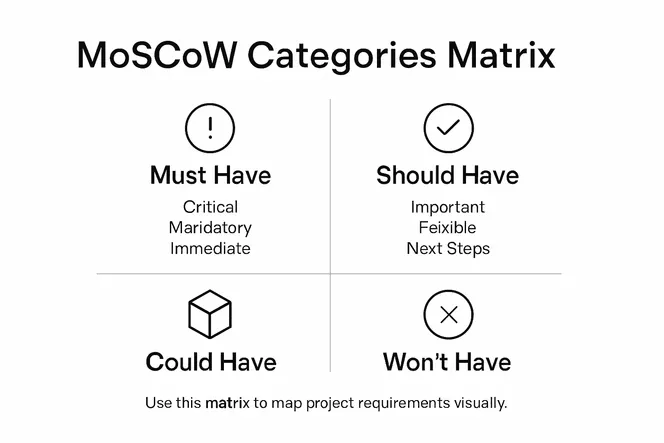
At its core, the MoSCoW method breaks down project requirements into four distinct categories, each representing a different level of importance and urgency:
- Must Have: Critical requirements absolutely essential for project success
- Should Have: Important requirements that add significant value but aren’t mandatory
- Could Have: Desirable elements that would be nice to include if time and resources permit
- Won’t Have (This Time): Features deliberately deferred or eliminated from the current project scope
Conference research exploring the framework’s conceptual foundations highlights how MoSCoW enables project teams to make clear, strategic decisions about resource allocation. By explicitly categorizing requirements, teams can quickly identify which elements demand immediate attention and which can be postponed or potentially removed. This approach minimizes ambiguity and helps prevent scope creep by establishing transparent priority levels from the project’s outset.
The method’s elegance lies in its simplicity. Project managers can rapidly assess and communicate project priorities, ensuring all stakeholders understand the strategic hierarchy of requirements. Unlike complex prioritization models, MoSCoW offers an intuitive, accessible framework that works across diverse industries and project types.
Pro Tip - Prioritization Hack: Before applying the MoSCoW method, conduct a thorough stakeholder interview to ensure you capture all potential requirements and understand their relative importance from multiple perspectives.
Priority Categories: Must, Should, Could, Won’t
The MoSCoW prioritization framework divides project requirements into four strategic categories that help teams systematically organize and evaluate their workload. According to the official DSDM Project Framework guidelines, each category represents a unique level of importance and urgency in project development.
Let’s break down each priority category in detail:
- Must Have Requirements
- Absolutely critical for project success
- Non-negotiable elements that define the project’s core functionality
- Failure to include these would render the project meaningless
- Typically represent 60-70% of total project requirements
- Should Have Requirements
- High-value features that are important but not strictly mandatory
- Can be postponed if necessary without completely compromising project goals
- Add significant value and improve user experience
- Typically represent 20-30% of project requirements
- Could Have Requirements
- Desirable features that enhance project value
- Nice-to-have elements that can be included if time and resources permit
- Often represent creative or innovative improvements
- Typically represent 10-15% of project requirements
- Won’t Have (This Time) Requirements
- Features deliberately excluded from the current project iteration
- Potential future enhancements or scope expansions
- Clearly documented for potential future development
- Help prevent scope creep by establishing clear boundaries
Understanding these categories allows project managers to create a clear hierarchy of requirements, ensuring that critical elements receive immediate attention while less crucial features are appropriately managed. This systematic approach helps teams maintain focus, allocate resources effectively, and deliver projects that meet core objectives.

Here’s a quick summary of MoSCoW priority categories and their decision impact:
| Category | Focus Area | Typical Percentage | Impact on Delivery |
|---|---|---|---|
| Must Have | Core functionality | 60-70% | Project fails without these |
| Should Have | High-value enhancements | 20-30% | Enhances project, not critical |
| Could Have | Nice-to-have additions | 10-15% | Included if resources allow |
| Won’t Have (This Time) | Deferred features | Documented, variable | Prevents scope creep |
Pro Tip - Priority Mapping: Create a visual priority matrix that maps each requirement into its respective MoSCoW category, making it easier for team members to quickly understand project focus and resource allocation.
How MoSCoW Works In Practice
Implementing the MoSCoW method requires a structured, collaborative approach that transforms theoretical prioritization into actionable project strategy. Teams can leverage systematic workshops and collaborative techniques to effectively categorize and prioritize project requirements with precision and clarity.
The practical implementation of MoSCoW typically follows a sequential process:
- Stakeholder Engagement
- Gather all project stakeholders in an initial prioritization session
- Encourage open dialogue about project objectives and requirements
- Ensure representation from different organizational perspectives
- Requirements Identification
- Document all potential project requirements comprehensively
- Encourage participants to list every conceivable feature and deliverable
- Create an initial, unfiltered inventory of potential project elements
- Collaborative Categorization
- Systematically review each requirement against MoSCoW criteria
- Facilitate group discussions to reach consensus on category placement
- Use voting or negotiation techniques to resolve disagreements
- Aim for clear, agreed-upon prioritization
- Iterative Refinement
- Regularly review and adjust priority categories
- Recognize that priorities can shift during project development
- Maintain flexibility while preserving core project objectives
Operational strategies for MoSCoW integration emphasize continuous communication and transparent decision-making. Project managers must create an environment where team members feel empowered to discuss and challenge requirement priorities. This approach ensures that the most critical elements receive appropriate attention while maintaining team alignment and engagement.
Successful MoSCoW implementation goes beyond simple categorization. It requires a dynamic, collaborative approach that transforms priority management from a static exercise into a living, adaptive process that responds to project evolving needs and organizational constraints.
Pro Tip - Priority Calibration: Schedule quarterly priority review sessions to reassess MoSCoW categories, ensuring your project remains aligned with shifting business objectives and market conditions.
Stakeholder Alignment and Team Collaboration
Stakeholder engagement represents the critical backbone of successful MoSCoW prioritization, transforming theoretical frameworks into actionable project strategies. Effective collaboration techniques help teams build shared understanding and commitment through transparent, inclusive decision-making processes.
Successful stakeholder alignment requires a multifaceted approach:
-
Open Communication Channels
- Create safe spaces for honest dialogue
- Encourage diverse perspectives and constructive feedback
- Establish clear communication protocols
-
Consensus Building Techniques
- Use structured facilitation methods
- Implement democratic voting mechanisms
- Develop compromise strategies for conflicting priorities
-
Transparency Mechanisms
- Document all prioritization discussions
- Share decision-making rationales
- Maintain accessible priority tracking systems
Practical approaches to stakeholder management emphasize creating trust through consistent, clear communication. Project managers must actively cultivate an environment where team members feel empowered to contribute, challenge assumptions, and collaboratively refine project priorities.
The most successful MoSCoW implementations treat prioritization as a dynamic, ongoing conversation rather than a one-time event. This approach requires continuous engagement, periodic reassessment, and a commitment to adaptability. Teams that master this collaborative approach can transform potential conflicts into opportunities for deeper alignment and more strategic project execution.
Stakeholder buy-in emerges not from mandating priorities, but from creating a shared understanding of project goals, constraints, and potential trade-offs. By involving team members in the prioritization process, organizations can generate genuine commitment and reduce resistance to project decisions.
Pro Tip - Alignment Workshop: Design quarterly stakeholder workshops that combine retrospective review with forward-looking priority calibration, ensuring ongoing project relevance and team engagement.
Benefits Over Other Prioritization Methods
Prioritization strategies vary widely, but the MoSCoW method stands out as a uniquely powerful approach to project management and requirement allocation. Quantitative analysis reveals significant statistical advantages that distinguish MoSCoW from traditional prioritization techniques.
Key differentiators of the MoSCoW method include:
-
Clarity and Simplicity
- Intuitive categorization system
- Easy to understand for all stakeholders
- Eliminates complex scoring mechanisms
-
Flexible Prioritization
- Adaptable across different project types
- Allows dynamic reprioritization
- Supports incremental delivery approaches
-
Stakeholder Alignment
- Creates transparent decision-making process
- Reduces ambiguity in project requirements
- Facilitates collaborative prioritization
Unlike traditional methods that rely on complex numerical scoring or intricate weighted systems, MoSCoW provides a straightforward framework that speaks directly to business value. The method’s strength lies in its ability to quickly distinguish between critical requirements and nice-to-have features, enabling teams to focus energy on the most impactful project elements.
Traditional prioritization methods often struggle with:
- Overcomplicated scoring systems
- Difficulty in achieving stakeholder consensus
- Rigid prioritization that fails to adapt to changing project conditions
In contrast, MoSCoW offers a more human-centered approach. It recognizes that project priorities are not just mathematical calculations but collaborative decisions that require nuanced understanding and ongoing dialogue. The method’s four-category system provides enough structure to guide decision-making while maintaining the flexibility to adjust as project contexts evolve.
Compare how MoSCoW and traditional methods address key prioritization challenges:
| Challenge | MoSCoW Approach | Traditional Approach |
|---|---|---|
| Stakeholder Alignment | Transparent discussions | Limited consensus methods |
| Adaptability | Flexible recategorization | Often rigid prioritization |
| Ease of Use | Simple, intuitive labels | Complex scoring systems |
| Focus on Value | Business impact prioritized | Metrics may obscure value |
Pro Tip - Comparative Assessment: When first adopting MoSCoW, conduct a side-by-side comparison with your current prioritization method to demonstrate its effectiveness and gain team buy-in.
Common Mistakes and Implementation Risks
Implementing the MoSCoW method requires careful navigation of potential pitfalls that can undermine its effectiveness. Large-scale project implementations reveal critical challenges that project managers must proactively address to ensure successful prioritization.
Top risks in MoSCoW implementation include:
-
Misclassification of Requirements
- Overloading the ‘Must Have’ category
- Failing to objectively assess true criticality
- Creating unrealistic expectations about deliverables
-
Stakeholder Misalignment
- Insufficient communication about priority definitions
- Lack of consensus on requirement importance
- Inconsistent understanding of categorization criteria
-
Implementation Rigidity
- Treating priorities as permanent instead of flexible
- Neglecting periodic priority reviews
- Resisting necessary adjustments during project lifecycle
Typical implementation mistakes can significantly compromise project outcomes, creating substantial risks for project success. Common errors often stem from a fundamental misunderstanding of the method’s dynamic nature. Teams frequently make the mistake of viewing MoSCoW as a one-time exercise rather than an ongoing, adaptive process.
The most critical risk involves creating an illusion of clarity without substantive prioritization. Simply categorizing requirements does not guarantee effective project management. Project managers must foster a culture of continuous dialogue, regularly challenging and reassessing priorities as project contexts evolve.
Successful MoSCoW implementation demands more than mechanical categorization. It requires a nuanced approach that balances structured decision-making with organizational flexibility. Teams must remain vigilant, continuously validating their priority assumptions and maintaining open communication channels.
Pro Tip - Risk Mitigation: Establish a quarterly priority review board with diverse stakeholders to challenge existing classifications and ensure ongoing alignment with strategic objectives.
Elevate Your MoSCoW Prioritization with Gammatica’s AI-Driven Platform
Understanding the MoSCoW Framework is crucial for streamlining project priorities and avoiding scope creep. If you struggle with classifying requirements into Must Have, Should Have, Could Have, and Won’t Have categories or maintaining alignment across stakeholders, Gammatica.com offers the perfect solution. Our platform’s AI-powered task management and collaborative tools help you capture every requirement clearly, organize priorities intuitively, and adapt dynamically as project needs evolve.

Take control of your project workflow today with Gammatica’s intelligent automation, Kanban boards, and seamless communication features. Don’t let prioritization become a bottleneck. Visit Gammatica now and experience how effortless effective project management can be. Boost your team’s productivity and save valuable time by transforming MoSCoW prioritization into a living, adaptive process with Gammatica.com.
Explore how our platform addresses critical project challenges and makes stakeholder engagement easier to maintain at every step.
Frequently Asked Questions
What is the MoSCoW Framework?
The MoSCoW Framework is a project management prioritization method that categorizes project requirements into four categories: Must Have, Should Have, Could Have, and Won’t Have. This helps teams effectively allocate resources and focus on the most critical project elements.
How do you implement the MoSCoW method in a project?
Implementing the MoSCoW method involves a structured process that includes stakeholder engagement, comprehensive requirements identification, collaborative categorization, and iterative refinement of priorities to keep the project aligned with goals.
What are the main categories in the MoSCoW Framework?
The main categories in the MoSCoW Framework are: Must Have (essential for success), Should Have (high-value but not critical), Could Have (nice-to-have features), and Won’t Have (not included this time, but may be revisited later).
What are the benefits of using the MoSCoW Framework over traditional prioritization methods?
The MoSCoW Framework offers clarity and simplicity, allowing for flexible prioritization, improved stakeholder alignment, and an intuitive process for categorizing requirements, distinguishing it from more complex traditional prioritization techniques.