Most American companies hesitate to launch bold new ideas without clear proof they will actually work. With over 80 percent of innovative projects stalling before full rollout, a reliable method for testing concepts early on saves money and effort. Understanding the proof of concept process is crucial for anyone looking to reduce risk, win stakeholder confidence, and make smarter investment decisions right from the start.
Table of Contents
- Defining Proof Of Concept Basics
- Types Of Proof Of Concept Explained
- How Proof Of Concept Operates
- Proof Of Concept In SaaS Environments
- Risks, Challenges, And Alternatives
Defining proof of concept basics
A proof of concept (PoC) is a strategic validation approach that helps businesses test the feasibility and potential of an innovative idea before investing significant resources. According to Coursera, a PoC demonstrates whether a product, design, or concept can actually work in practice.
At its core, a proof of concept serves as an initial experiment that determines whether an idea is technically and logistically possible. Wikipedia defines it as an “inchoate realization” designed to showcase practical potential without requiring full development. This means companies can quickly assess the viability of a project without committing extensive time, money, or personnel.
The primary objectives of a proof of concept typically include:
- Validating technical feasibility
- Identifying potential challenges early
- Reducing financial risk
- Generating stakeholder confidence
- Providing a foundation for further development
Unlike a full prototype or minimum viable product, a PoC is intentionally small and focused. It concentrates on proving core principles rather than creating a complete, polished solution. This approach allows teams to explore innovative concepts efficiently and make informed decisions about future investment.
Pro Tip - Strategic Validation: Always define clear, measurable success criteria for your proof of concept before beginning, ensuring you can objectively evaluate whether the core concept demonstrates genuine potential.
Types of proof of concept explained
In the realm of business innovation, proof of concept (PoC) emerges in multiple distinct forms, each serving a unique strategic purpose. According to Wikipedia’s technical perspective, these variations can range from software development assessments to engineering prototypes, each designed to validate different aspects of an emerging idea.
Three primary types of proof of concept dominate professional practice:
- Technical Feasibility PoC
- Evaluates underlying technological infrastructure
- Determines whether a proposed solution can actually be implemented
- Tests core technical requirements and system compatibility
- Business Viability PoC
- Assesses market potential and economic sustainability
- Examines potential customer interest and revenue generation
- Validates business model assumptions
- Product Functionality PoC
- Demonstrates core product features and performance
- Provides a basic working model of the proposed solution
- Allows engineers to construct rough prototypes using preliminary technologies like breadboards or minimal code implementations
Each type of proof of concept offers unique insights, helping organizations minimize risk and optimize resource allocation before significant investment. The selection depends on specific project requirements, industry standards, and strategic objectives.
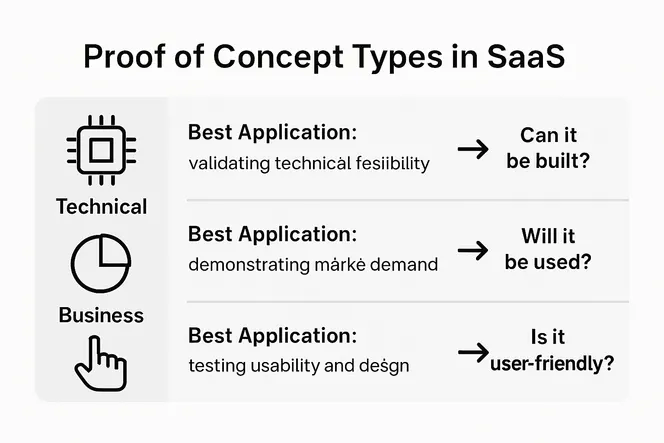
Here’s a comparison of proof of concept types and their ideal use cases:
| PoC Type | Best Application Area | Key Question Answered |
|---|---|---|
| Technical Feasibility | New technology adoption | Can it technically be built? |
| Business Viability | Market expansion assessments | Will the market support it? |
| Product Functionality | Concept demonstration stages | Does the feature work as needed? |
Pro Tip - Strategic Selection: Choose your proof of concept type based on your most critical uncertainty - whether that’s technical complexity, market acceptance, or core product functionality.
How proof of concept operates
The operational process of a proof of concept (PoC) involves a systematic approach to validating innovative ideas through strategic assessment and experimentation. According to Coursera, businesses can determine critical factors such as idea feasibility, market potential, and implementation challenges through a structured PoC methodology.
The typical proof of concept workflow consists of several interconnected stages:
- Conceptualization
- Define the core problem or opportunity
- Outline specific objectives and success criteria
- Establish measurable performance indicators
- Design and Planning
- Develop a minimal representation of the concept
- Identify required resources and potential constraints
- Create a focused testing framework
- Implementation
- Build a small-scale prototype or simulation
- Conduct targeted experiments
- Collect quantitative and qualitative data
- Evaluation
- Analyze test results against predefined criteria
- Assess technical and business viability through comprehensive review
- Make recommendations for potential advancement or pivoting
Through this methodical process, organizations can efficiently explore innovative concepts while minimizing financial risk and resource expenditure. The approach allows teams to quickly validate ideas before committing to full-scale development.

Pro Tip - Iterative Validation: Treat your proof of concept as a dynamic exploration, maintaining flexibility to adjust your approach based on emerging insights and unexpected discoveries.
Proof of concept in SaaS environments
In the dynamic world of Software as a Service (SaaS), proof of concept (PoC) plays a critical role in validating innovative technological solutions before full-scale implementation. According to Coursera, SaaS vendors utilize proof of concept to establish whether a system satisfies its intended purpose, ultimately determining the potential for market success and technological viability.
The unique landscape of SaaS proof of concept encompasses several distinctive characteristics:
- Technical Validation
- Assess cloud infrastructure compatibility
- Test scalability and performance metrics
- Evaluate integration capabilities with existing systems
- User Experience Exploration
- Simulate core software functionality
- Validate user interface and interaction design
- Measure potential user engagement and adoption rates
- Security and Compliance Testing
- Verify data protection mechanisms
- Test authentication and access control protocols
- Ensure compliance with industry regulations
- Economic Feasibility
- Analyze potential return on investment
- Compare development costs against expected market value
- Assess potential pricing strategies
Vendor roles in SaaS proof of concept typically involve creating initial prototypes to seek funding and demonstrate potential to prospective customers. This approach allows companies to minimize financial risk while exploring innovative software solutions that could transform business operations.
Pro Tip - Strategic Exploration: Develop a minimally viable proof of concept that focuses on your software’s most unique and compelling features, allowing potential stakeholders to quickly understand its transformative potential.
Risks, challenges, and alternatives
Navigating the proof of concept (PoC) landscape involves understanding potential pitfalls and strategic alternatives that can significantly impact project success. According to research on vulnerability assessments, proof of concept processes face substantial challenges, including information dispersion, diverse implementation styles, and reproducibility difficulties.
Key risks and challenges in proof of concept development include:
- Information Limitations
- Incomplete documentation
- Inconsistent reporting standards
- Difficulty reproducing initial findings
- Technical Constraints
- Platform compatibility issues
- Scalability limitations
- Performance inconsistencies
- Resource Allocation
- High initial development costs
- Time-intensive exploration processes
- Potential misallocation of technical resources
- Validation Complexities
- Difficulty quantifying potential value
- Subjective interpretation of results
- Risk of false positive assessments
Research highlights significant challenges in creating comprehensive proof of concept reports, particularly around information quality and platform diversity. These challenges underscore the importance of developing robust, well-documented exploration strategies that go beyond surface-level assessments.
The table below summarizes common proof of concept risks and alternative validation approaches:
| Main Risk Area | Example Challenge | Alternative Approach |
|---|---|---|
| Technical Limitations | Incompatible platforms | Use rapid prototyping |
| Documentation Gaps | Inconsistent reporting | Enhance cross-team reviews |
| High Early Costs | Excessive resource use | Start with MVP development |
| Value Uncertainty | Hard to measure true impact | Pilot simulations with users |
Alternative approaches to traditional proof of concept include minimal viable product development, rapid prototyping, and simulation-based validation. Each method offers unique advantages in mitigating risks associated with full-scale implementation.
Pro Tip - Risk Mitigation: Develop a multi-layered validation strategy that combines quantitative metrics, stakeholder feedback, and iterative testing to create a more comprehensive proof of concept assessment.
Accelerate Your SaaS Innovation with Proven Project Management Solutions
Implementing a proof of concept in SaaS development brings critical challenges like validating technical feasibility, ensuring business viability, and demonstrating product functionality. These steps require precise coordination, clear success criteria, and continuous iteration to minimize risks and maximize impact. If you struggle with organizing your team’s workflows, tracking progress, or integrating automation to reduce overhead, these pain points can stall your innovation and drain valuable time.
Gammatica.com is designed to solve these specific challenges by offering an AI-driven platform that streamlines project and team management. With tools like automated task management, CRM integration, Kanban boards, and customizable checklists, you can efficiently manage your proof of concept phases while maintaining focus on core objectives. Our automation features help you cut administrative tasks and free up to 16 hours per week so your team can concentrate on validating your SaaS ideas faster and with greater confidence.
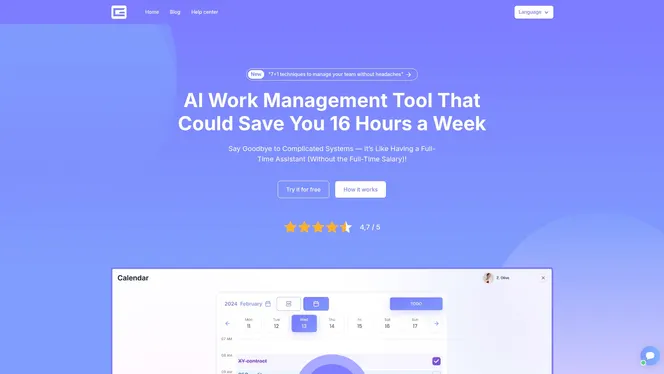
Take control of your SaaS innovation today. Explore how Gammatica.com can support your proof of concept journey by simplifying workflows, enhancing collaboration, and accelerating decision-making. Visit Gammatica.com now and start turning your ideas into validated solutions with efficiency and clarity. To dive deeper into managing collaborative projects effectively, check our project and team management platform.
Frequently Asked Questions
What is a proof of concept (PoC) in SaaS?
A proof of concept (PoC) in SaaS is a validation exercise that assesses whether a software solution can meet its intended purpose. It tests technical feasibility, user experience, and market potential before significant investment is made.
Why is a proof of concept important for SaaS innovation?
A PoC helps identify potential challenges, assess technical viability, validate user engagement, and ensure economic feasibility. This process minimizes risks and enhances stakeholder confidence in a new idea or product.
How can I structure a proof of concept project in my SaaS environment?
A structured PoC project should include stages of conceptualization, design and planning, implementation, and evaluation. Each stage should be well-defined with clear objectives and measurable success criteria to effectively assess the idea’s viability.
What are the common risks associated with developing a proof of concept?
Common risks include information limitations, technical constraints, high resource allocation, and validation complexities. Addressing these risks involves thorough documentation, efficient resource management, and using alternative validation approaches when necessary.