Project management interviews can feel like a test of both your technical expertise and your ability to guide teams through complex challenges. In mid-sized tech companies, hiring managers need to separate candidates who talk theory from those who deliver real results. Understanding the five critical phases of project management and how interview questions are specifically designed to assess these stages will help you stand out. This guide offers proven strategies for navigating today’s interviews—including how AI tools are changing what top companies expect from you.
Table of Contents
- Defining Project Management Interview Questions
- Types of Questions and Their Purposes
- Critical Technical and Soft Skills Evaluated
- AI, Automation, and Modern Tools in Interviews
- Common Mistakes and Effective Answer Strategies
- Comparing Alternatives and Preparing for Success
Defining Project Management Interview Questions
Project management interview questions are assessments designed to evaluate whether candidates possess the knowledge, skills, and experience necessary to lead projects successfully. Unlike generic interview questions, these are specifically crafted to probe how applicants handle real project challenges. They examine everything from strategic planning and resource management to risk handling and team leadership.
At their core, project management interview questions aim to assess your ability to align project goals with organizational objectives while managing typical project obstacles. When you’re interviewing for a role in a mid-sized tech company, hiring managers want to understand more than just your resume. They need to know how you think through problems, make decisions under pressure, and keep teams moving forward when things get complicated.
The foundation of these questions rests on understanding what project management actually means. It’s the application of knowledge, skills, tools, and techniques to meet a project’s requirements within defined time and budget constraints. This breaks down into five critical phases:
- Project initiation: defining what needs to be accomplished and why
- Planning: determining how resources, timelines, and risks will be managed
- Execution: getting the actual work done according to the plan
- Monitoring: tracking progress and adjusting when necessary
- Closing: wrapping up deliverables and capturing lessons learned
When interviewers ask project management questions, they’re exploring your grasp of these phases and your role within each one. In tech environments specifically, this means understanding how to manage teams distributed across time zones, handle rapidly changing requirements, balance automation and human oversight, and use tools that keep everyone aligned on what matters most. Your ability to articulate how you’ve navigated these phases in past projects reveals whether you can actually deliver results, not just talk about methodology.
Pro tip: Before your interview, prepare 2-3 specific examples from your past projects where you managed each phase successfully, including the metrics that proved your success such as on-time delivery percentage or budget variance.
Types of Questions and Their Purposes
Project management interview questions aren’t all created equal. Interviewers use different question types strategically, each designed to reveal different aspects of your abilities and experience. Understanding these distinctions helps you prepare more effectively and recognize what information the hiring manager is actually seeking when they ask a particular question.
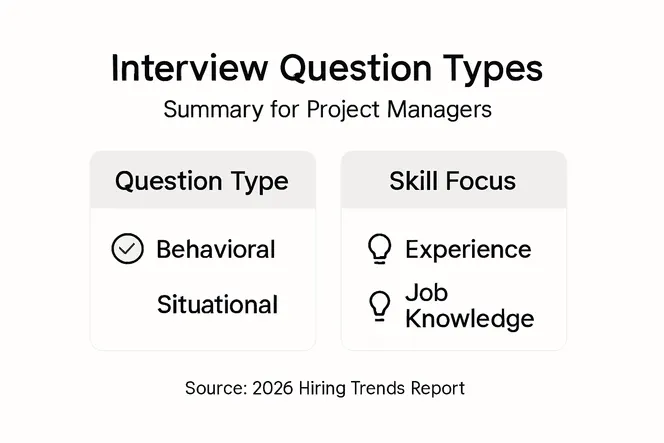
Structured interviews typically include four major question types, each with distinct purposes:
Behavioral Questions focus on what you’ve actually done in the past. When an interviewer asks “Tell me about a time when a project went over budget,” they’re using a behavioral question. These predict job performance better than most other question types because they reveal how you’ve handled real situations. Your past decisions and actions are the strongest indicator of future performance.
Situational Questions present hypothetical scenarios to see how you’d respond. “If you discovered a critical risk mid-project that wasn’t in your original plan, how would you handle it?” falls into this category. These questions assess your decision making and problem solving when facing unfamiliar territory. They show your thinking process even when you don’t have a precedent to reference.
Background Questions explore your qualifications, experience, and personal history. These establish credibility and context. They confirm you have the foundation needed for the role, such as years of project management experience or specific certifications like PMP or Scrum Master credentials.
Job Knowledge Questions assess your technical expertise and understanding of frameworks. You might face questions about Agile methodology, Waterfall approaches, or specific project management challenges like risk assessment techniques. These confirm you understand the methodologies and tools relevant to the position.
In tech environments specifically, you’ll encounter a blend of all four types. Expect experience related questions about how you’ve managed distributed teams, methodological questions about whether you prefer Scrum or Kanban, scenario based questions about handling scope creep, and job knowledge questions about specific tools or frameworks your company uses. The best preparation addresses all these angles.
Here’s a comparison of key project management interview question types and what each reveals to employers:
| Question Type | What It Assesses | Typical Use in Tech Interviews | Candidate Response Strategy |
|---|---|---|---|
| Behavioral | Past actions and decisions | Managing teams, overcoming setbacks | Use STAR, include metrics |
| Situational | Problem solving approach | Handling risk, scope changes | Detail logical process, trade-offs |
| Background | Qualifications and history | Certifications, relevant experience | Highlight context and expertise |
| Job Knowledge | Technical frameworks/tools | Agile, automation, software skills | Reference methods and best uses |
Pro tip: Create a reference document with 3-4 real project examples covering different scenarios (success, failure, conflict resolution, technical complexity), then match each to the question type being asked to respond with the most relevant evidence.
Critical Technical and Soft Skills Evaluated
Project management interview questions assess two distinct but equally important skill categories. The balance between them matters because a brilliant technician who cannot communicate will derail projects just as quickly as a charismatic leader without scheduling expertise. Interviewers probe both dimensions because successful project managers integrate technical precision with human-centered abilities.

On the technical side, interviewers evaluate your mastery of concrete, measurable competencies. Scheduling and timeline management reveal whether you can create realistic plans and keep projects on track. Budgeting and cost control demonstrate your ability to manage financial resources responsibly. Risk management shows you can anticipate problems before they become catastrophes. Familiarity with project management methodologies like Agile, Scrum, Waterfall, or Kanban indicates you understand different approaches and know when to apply each. Knowledge of tools specific to your company or industry rounds out this category. In tech environments, you might face questions about specific platforms your organization uses or how you’d leverage automation and AI driven solutions to improve visibility and reduce manual overhead.
Critical soft skills in project management include communication, leadership, interpersonal abilities, and emotional intelligence. These aren’t secondary concerns. Communication determines whether your team understands priorities, deadlines, and expectations. Active listening helps you catch problems early when team members voice concerns. Leadership capability inspires teams to perform at their best, especially during high pressure periods. Conflict management keeps disagreements from becoming team fractures. Motivation and negotiation skills enable you to work across organizational boundaries and get buy in from stakeholders who don’t directly report to you. Cultural awareness helps you manage distributed global teams effectively.
The research is clear: soft skills significantly impact project success because coordinated teamwork and stakeholder engagement overcome complex challenges. In mid-sized tech companies specifically, interviewers care deeply about how you handle rapidly changing requirements, manage conflict between competing priorities, and keep remote teams aligned. They want to know if you can motivate developers who are frustrated by scope creep or have difficult conversations with leadership about unrealistic timelines.
Here’s what sets strong candidates apart: they don’t present these as separate categories. They demonstrate how technical knowledge and interpersonal ability work together. When answering questions about a difficult project, you show both the scheduling decisions you made and how you communicated those decisions to keep the team motivated.
The following table compares critical technical and soft skills commonly evaluated in project management interviews:
| Skill Category | Core Example | Why Interviewers Value It | How to Demonstrate in Answers |
|---|---|---|---|
| Technical Skills | Scheduling | Ensures timely project delivery | Show resource allocation results |
| Technical Skills | Risk Analysis | Avoids costly project disruptions | Describe preventive actions taken |
| Soft Skills | Communication | Aligns team and stakeholder vision | Cite clear feedback, resolved issues |
| Soft Skills | Leadership | Maintains team motivation and focus | Share influence on team performance |
Pro tip: Prepare specific examples that showcase both technical competency and soft skill execution simultaneously, such as describing how you used data driven scheduling to present a realistic timeline to skeptical stakeholders, rather than discussing these skill sets in isolation.
AI, Automation, and Modern Tools in Interviews
The project management interview landscape has shifted dramatically. Five years ago, questions about AI and automation were rarities. Today, they’re standard. If you’re interviewing at a mid-sized tech company, expect your interviewer to ask how you’d leverage technology to reduce administrative burden and improve team visibility. This isn’t a nice-to-have skill anymore. It’s baseline.
Artificial intelligence and automation are increasingly integrated into project management for improving forecasting, resource allocation, risk mitigation, and workflow efficiency. When hiring managers ask about your experience with modern tools, they’re not just checking a box. They want to know if you understand how technology can free up your team from repetitive work. Can you identify which tasks waste your team’s time? Do you know how to evaluate tools that promise to save hours weekly? Can you implement solutions without disrupting existing workflows?
Specific technologies now appear regularly in interviews. Predictive analytics help you forecast project timelines more accurately and identify risks before they materialize. Automation handles routine administrative tasks like status report compilation, meeting scheduling, and progress tracking. Real time dashboards replace the weekly status meeting for basic updates. Natural language processing and generative AI assist with documentation and knowledge management. These aren’t theoretical concepts anymore. Companies are deploying them, and they expect new hires to understand how to work within these systems.
AI technologies like machine learning and generative AI are transforming project management by enabling automation of routine tasks, real time progress tracking, and enhanced decision making. This matters directly to your interview performance. Interviewers now evaluate your proficiency with AI enabled project software, your understanding of data driven management approaches, and your ability to leverage technology for strategic advantage. They want concrete examples. Don’t just say you’re comfortable with technology. Explain how you used data analytics to convince leadership to shift resources, or how automation reduced your team’s administrative overhead by measurable hours each week.
In tech environments specifically, be ready to discuss how you’d balance automation with human judgment. Some tasks should be automated. Others require the nuance and creativity only humans provide. Good project managers know the difference and can articulate it clearly. They also understand that introducing new tools requires change management and team buy in, not just technical implementation.
Pro tip: Research the specific AI driven platforms and automation solutions your target company uses, then prepare 2-3 examples showing how you’ve successfully adopted similar technologies, focusing on measurable outcomes like time saved or accuracy improved.
Common Mistakes and Effective Answer Strategies
Most candidates fail project management interviews not because they lack experience, but because they answer questions poorly. You might have managed five successful projects, but if you fumble the explanation during your interview, none of that matters. The difference between a strong candidate and a rejected one often comes down to how they frame their stories and respond to pressure.
Common mistakes in project management include poor scope management, unrealistic scheduling, improper resource allocation, and ineffective communication. Here’s the critical part: candidates who demonstrate awareness of these pitfalls and provide examples of how they mitigated or avoided them tend to perform exceptionally well. Don’t hide your mistakes. Instead, show that you recognize where project management commonly fails and that you have strategies to prevent those failures. When an interviewer asks about a challenge you faced, this is your opportunity to demonstrate structured problem solving and proactive management.
One of the biggest mistakes candidates make is rambling. You start answering a question and five minutes later you’re still talking, the interviewer has zoned out, and you’ve buried your key point under unnecessary details. Another frequent error is being too vague. Saying “I managed the team well” tells the interviewer nothing. Saying “I implemented daily stand ups to catch blockers early, which reduced our resolution time by an average of 14 hours per issue” demonstrates actual competency.
Effective answer strategies emphasize the STAR method: Situation, Task, Action, Result. Start by setting the context. What was the project? What constraints existed? Move to the task: what was your specific responsibility? Then explain your action: what exactly did you do? Finish with the result: what happened as a consequence of your decisions? Numbers matter. Timelines, budget percentages, team sizes, and outcome metrics make your answer credible and memorable. Say “I reduced project overhead by 16 hours weekly through automation” rather than “I improved efficiency.”
A critical strategic error is claiming credit for team accomplishments. Interviewers recognize this immediately and penalize it. Instead, talk about how you led, supported, or enabled your team to achieve results. This demonstrates leadership maturity. Another mistake is overselling your role in projects where things went well but underselling your responsibility when things went wrong. Be honest about what you control versus what you don’t. Show that you take accountability for your decisions while also demonstrating realistic perspective about external factors.
For hypothetical scenario questions, avoid giving theoretical textbook answers. Interviewers already know what the textbook says. They want to hear how you’d actually handle the situation given real world constraints and politics. Show your thinking process. Walk through your decision making. Explain trade offs you’d consider. This transparency reveals far more than a clean, perfect answer ever could.
Pro tip: Record yourself answering 5-7 tough project management questions, then listen back critically to identify rambling, vagueness, or missing details, then re-record using the STAR framework with specific metrics until your answers are concise, credible, and memorable.
Comparing Alternatives and Preparing for Success
Not all preparation strategies are equally effective. Some candidates spend weeks memorizing textbook definitions. Others practice with friends. Still others research the company obsessively. The question isn’t whether you prepare, but whether you prepare strategically. Understanding how different interview approaches work reveals which methods actually improve your performance.
Past behavioral and situational questions tend to predict job performance more effectively than background or job knowledge questions. This insight matters directly to your preparation. If you know the interviewer will likely ask behavioral questions, you should prepare specific project examples, not memorize industry definitions. If situational questions dominate, you need to practice thinking through hypothetical scenarios and articulating your decision making process. Generic preparation wastes your time. Targeted preparation wins interviews.
Here’s what distinguishes strong candidates from average ones. They understand that situational questions measure future intentions while behavioral questions assess past actions. This means your answers should differ. For behavioral questions, you describe what you actually did and the measurable results. For situational questions, you walk through your thinking process, explaining how you’d approach the scenario given real world constraints. The interviewer isn’t looking for the theoretically perfect answer. They want to understand how you think.
A strategic comparison approach identifies your strengths and gaps. If you’re naturally strong with behavioral storytelling but weaker with hypothetical scenarios, you need more practice with situational questions. If you understand project management methodologies deeply but struggle to articulate soft skills, adjust your preparation accordingly. Many candidates prepare uniformly, spending equal time on all areas. Instead, allocate your preparation time based on where you’re weakest.
The most effective preparation combines multiple elements. Research the specific company, the role, and the team you’d join. Prepare 6-8 project examples covering different challenge types: budget constraints, timeline pressure, team conflict, scope creep, technical complexity, and successful outcomes. Practice the STAR method until it becomes natural. Mock interview with someone who will give honest feedback. Learn about the company’s technology stack, recent projects, and strategic priorities. When you walk into that interview, you’re not hoping they ask questions you’ve prepared for. You’re prepared for whatever they ask because you’ve built a strong foundation.
Timing matters too. Start preparation at least two weeks before your interview. Cramming the night before helps nobody. Distributed practice over time builds confidence and fluency. Review your project examples multiple times. Sleep the night before your interview. Show up mentally fresh.
Pro tip: Create a preparation matrix listing five project examples, then map each to behavioral, situational, background, and technical question types so you can quickly match the right story to whatever question appears during your interview.
Boost Your Project Management Success with AI-Driven Solutions
Mastering project management interview questions requires more than just knowledge of methodologies and soft skills. The key challenge is managing complex workflows, reducing administrative burdens, and delivering results with precision and clarity. If you want to stand out in 2026 and beyond, aligning these interview concepts with the right tools is crucial. With Gammatica.com, you can streamline task management, automate routine processes, and keep your team motivated and on schedule—exactly what the article highlights as critical to project success.
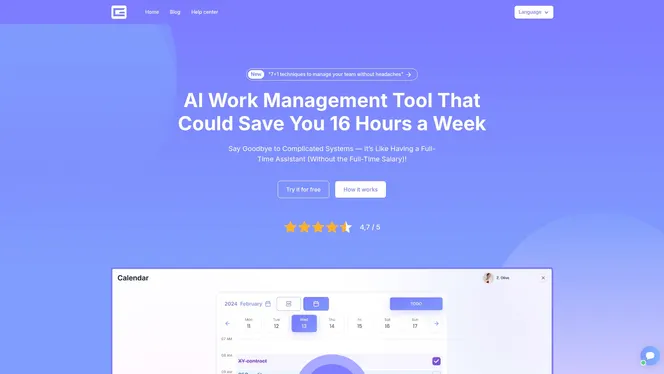
Experience firsthand how intelligent automation and real-time collaboration can free up to 16 hours weekly, allowing you to focus on strategic leadership and problem solving during your next interview and role. Explore the power of AI-enhanced task tracking, integrated calendars, and customizable checklists designed for teams of all sizes. Don’t just prepare for your project management interview. Prepare to lead projects confidently by exploring Gammatica.com, learn how it complements your expertise with actionable insights, and transform your team’s productivity today.
Frequently Asked Questions
What types of project management interview questions can I expect?
These interviews typically include behavioral, situational, background, and job knowledge questions that assess your past actions, problem-solving approach, qualifications, and technical expertise.
How can I prepare for project management interview questions effectively?
Preparing effectively involves creating a matrix of past project examples that map to different question types, practicing the STAR method for answering, and researching the specific company and role to tailor your responses.
What skills are evaluated in project management interviews?
Interviewers evaluate both technical skills, such as scheduling, budgeting, and risk management, and soft skills, including communication, leadership, and emotional intelligence, to assess your overall capability as a project manager.
How should I respond to hypothetical situational questions during an interview?
For situational questions, you should walk through your decision-making process by explaining how you would approach the scenario, considering real-world constraints and discussing your thought process rather than providing a textbook answer.