Many project managers at Hungarian tech startups find themselves firefighting the same issues week after week. This struggle often traces back to a missing balance between precision and accuracy in team workflows. Understanding the difference can be the shift between repeated chaos and reliable results. By focusing on both consistency in task execution and alignment with project targets, you build a foundation that minimizes wasted effort and reduces daily administrative headaches.
Table of Contents
- Precision And Accuracy Defined In Project Management
- Key Differences Between Precision And Accuracy
- When To Prioritize Precision Or Accuracy
- Measuring And Improving Team Performance
- Common Pitfalls And How To Avoid Them
Precision and Accuracy Defined in Project Management
When you’re managing projects at a Hungarian tech startup, you hear these terms tossed around as if they mean the same thing. They don’t. Understanding the difference between precision and accuracy is what separates teams that consistently deliver from teams that constantly firefight. Here’s what matters: accuracy means your project outcomes actually hit the target you set. You wanted to launch the feature by March 15th and within budget? That’s accuracy. You hit the deadline and stayed within 5% of budget. Precision, on the other hand, is about consistency and repeatability. It’s the ability to perform the same tasks the same way, over and over, with predictable results. If your team processes customer support tickets following the exact same workflow every single time, with the same documentation and handoff steps, that’s precision in action. How closely a process outcome aligns with its target value versus how consistent your team is in executing those processes determines whether you build sustainable operations or remain trapped in chaos.
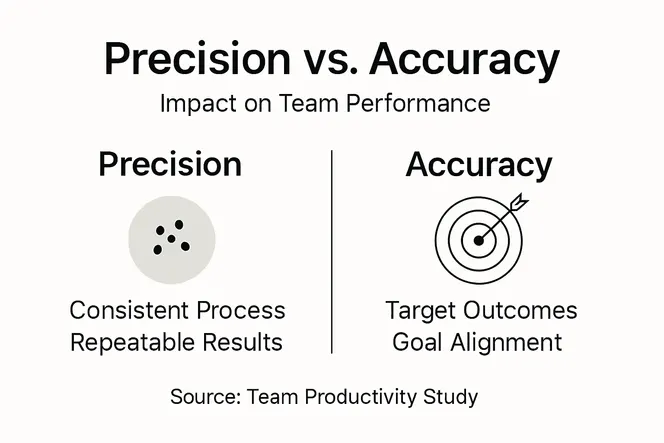
Think of it this way: imagine your team is shooting arrows at a target. Accuracy means the arrows land where you aimed them. Precision means all your arrows land in the same spot, whether that spot is the bullseye or not. Now here’s where it gets real for your startup. You need both. A team with high accuracy but low precision might hit deadlines occasionally but can’t reliably repeat the success. A team with high precision but low accuracy will execute tasks consistently while systematically missing your actual business goals. Your job as a project manager is orchestrating both simultaneously. This means defining clear targets (that’s accuracy) while standardizing how your team works toward those targets (that’s precision). When you combine them, you create what matters most: predictable, scalable delivery.
To clarify how precision and accuracy affect project outcomes, see the comparison below:
| Scenario | Precision Level | Accuracy Level | Resulting Impact |
|---|---|---|---|
| Consistent process, misses target | High | Low | Repeats mistakes efficiently |
| Random methods, hits target | Low | High | Occasional wins, not repeatable |
| Consistent process, meets target | High | High | Predictable, scalable success |
| Random methods, misses target | Low | Low | Chaos and wasted effort |
In practical terms, this means several things for how you structure your team’s workflow. First, you need defined goals with measurable outcomes for every project or sprint. These are your accuracy anchors. Then you need standardized processes and repeatable workflows so your team executes the same way each time. That’s your precision foundation. When both operate together, your team stops improvising constantly. They know what they’re aiming for, and they know exactly how they’re supposed to get there. The result? Less time wasted on “wait, how did we do this last time?” questions and more time on actual work. For mid-level project managers dealing with administrative overhead, this distinction is crucial because it directly impacts how many hours your team wastes on coordination, clarification, and rework.
Pro tip: Start by documenting your three most critical recurring tasks and define both the target outcome (accuracy) and the exact steps required to reach it (precision). Use this as your template for standardizing other workflows across your team.
Key Differences Between Precision and Accuracy
You might think precision and accuracy are interchangeable terms. Most people do. But in project management, confusing the two will cost you time, resources, and team morale. The distinction is straightforward yet critical. Accuracy is about hitting the target. It answers the question: did we achieve what we set out to achieve? Did the software launch on the promised date? Did the feature perform as specified? Did we stay within the approved budget? Precision, by contrast, is about consistency and repeatability. It answers a different question: can we reliably produce the same results using the same methods? Your team might follow identical processes for creating project status reports every single week, yet those reports might still miss key stakeholder requirements. That’s high precision, low accuracy. Conversely, you might randomly hit project deadlines through sheer effort and improvisation, but your team can’t replicate that success because there’s no standardized approach. That’s low precision, high accuracy. Accuracy and precision are independent qualities that require different management strategies to control.
Here’s where this distinction becomes operational for your tech startup. Consider how your team manages sprint planning. If every sprint follows the same ceremony structure, uses the same estimation methods, and produces consistent velocity numbers, you have precision. But if your sprints consistently miss their committed deliverables, your accuracy is low. Another example: your customer onboarding process. If each customer receives the same documentation, follows the same setup steps, and experiences identical timelines (whether that takes 3 days or 10 days), that’s precision. But if half your customers feel supported and half feel confused, your accuracy is suffering. The real impact hits your bottom line when you realize that high precision without accuracy wastes consistent effort on the wrong outcomes. Your team becomes efficient at failing.

Building both into your workflow requires different levers. For accuracy, focus on outcome definition. What does success actually look like? Set specific, measurable targets. For customer support, maybe it’s resolving 95% of tickets within 48 hours. For feature development, it’s clear acceptance criteria before work begins. For precision, build standardized workflows and document them relentlessly. Create templates, checklists, and runbooks. Use task management systems that enforce consistent processes. When you codify how work gets done, precision follows naturally. The intersection of both creates the magic: teams that deliver predictable, quality results. You stop wasting administrative time explaining what went wrong because you’ve eliminated the variables. Your team doesn’t reinvent the wheel with every project. They execute against clear targets using proven methods.
Pro tip: Audit your three largest ongoing projects this week and rate each on accuracy (are we hitting goals?) and precision (are we executing consistently?). Identify which dimension needs the most attention, then assign one person ownership of that improvement.
When to Prioritize Precision or Accuracy
Here’s the truth most project managers learn through painful experience: you cannot maximize both precision and accuracy simultaneously in every phase of your project. Resources are finite. Time is finite. Attention is finite. The smart move is understanding when each one matters most and directing your team’s energy accordingly. Prioritizing precision during early development phases and accuracy during final delivery creates a natural workflow that produces better outcomes with less wasted effort. Think about your typical software development cycle. During the exploration and prototyping phases, your team needs permission to iterate. You’re building processes, testing approaches, and learning what works. This is where precision becomes your north star. You want your team to follow consistent development practices, use the same code review processes, and maintain repeatable sprint structures. You’re not yet concerned with shipping the perfect product. You’re concerned with building a reliable machine that can produce consistent output. Your developers should use the same testing frameworks, the same documentation standards, and the same deployment procedures every single time. That consistency lets you identify problems in your process rather than struggling with variables everywhere.
Fast forward to the weeks before launch or customer delivery. Suddenly accuracy dominates. Does the feature work as promised? Does the product meet the requirements stakeholders signed off on? Will customers be satisfied with what they receive? At this stage, process consistency matters less than outcome correctness. You might temporarily bypass some of your usual precision checkpoints if it means delivering what was actually promised. A startup that ships a product that works 95% correctly on time beats one that ships 100% correctly six months late. Your team shifts focus from “are we executing our process consistently?” to “are we hitting the target outcomes?” This shift feels uncomfortable because it looks like you’re abandoning your standardized approach. You’re not. You’re recognizing that the goal has changed.
The reality for mid-level managers at tech startups is more nuanced. Most projects run multiple workstreams simultaneously. Your backend team might be in deep development phase requiring precision focus. Your customer success team is onboarding clients, requiring accuracy focus. Your QA department is testing the final product, also requiring accuracy focus. You manage these different contexts by being explicit about what matters in each area. Tell your backend team their job is building consistent, repeatable architecture. Tell customer success their job is hitting satisfaction metrics. Tell QA their job is catching deviations from specification. This prevents the exhausting scenario where everyone is trying to optimize for both dimensions at once, achieving neither.
Here’s a summary of where each dimension should be emphasized during a typical project lifecycle:
| Project Phase | Focus Priority | Why It Matters |
|---|---|---|
| Early Development | Precision | Builds stable, repeatable foundation |
| Prototyping | Precision | Enables evaluation of process consistency |
| Final Delivery | Accuracy | Ensures promised outcomes are met |
| Post-Launch | Both | Supports sustainable improvement |
Consider also the cost of failure in each dimension. High precision with low accuracy wastes resources on the wrong outcomes. High accuracy with low precision creates burnout because your team performs unpredictable heroics to hit targets. Neither is sustainable. The balanced approach: build precision into your standard operations during development and planning phases, then tighten accuracy controls as you approach delivery. Use your standardized processes as a foundation. Use accuracy audits as your safety net. Your team knows how work should flow because you’ve standardized it. Your stakeholders know their requirements will be met because you’re measuring against them.
Pro tip: Map your current major initiatives onto a timeline and explicitly label each phase as “precision priority” or “accuracy priority.” Share this with your team so they understand why you’re emphasizing consistency in some phases and outcome correctness in others.
Measuring and Improving Team Performance
You cannot improve what you don’t measure. This sounds obvious until you realize most mid-level managers at tech startups measure activity instead of outcomes. Your team delivered 47 tickets this sprint. Great. But were those estimates accurate? Can your team reliably predict how long work takes? Were the results precise, meaning they consistently executed the same way? These questions matter because they reveal whether your improvements are actually working. Tracking accuracy and precision of key outputs like budget estimations and timelines directly correlates to better project control and team performance. Start by identifying what you actually want to measure. For most tech startups, this means tracking estimation accuracy (did we estimate correctly?), delivery accuracy (did we ship what we promised?), and execution precision (do we execute consistently?). Pick three metrics that reflect your biggest pain points. If your team constantly misses deadlines, measure delivery accuracy. If budgets balloon unexpectedly, track budget estimation accuracy. If you waste time explaining processes to new team members, measure execution precision.
The measurement part is straightforward but requires discipline. When your team estimates a task will take 5 days, record that. When they complete it in 4 days or 7 days, record the actual. Over time, you build a pattern. Maybe your team consistently estimates 10 percent lower than reality. That’s actionable information. You now know to apply a 10 percent buffer to future estimates. Maybe your estimates cluster tightly around the actual time but miss in both directions randomly. That’s high precision, moderate accuracy. You need better estimation methods. Maybe your estimates are all over the map. That’s low precision and accuracy. You need to standardize your estimation approach entirely. The point is that without measurement, you’re making decisions blind. With measurement, every number tells a story about your team’s performance.
Improvement comes from acting on these measurements. If estimation accuracy is poor, implement structured estimation techniques. Using three-point estimation and analytical methods improves both accuracy and precision, turning vague guesses into data-driven predictions. Instead of asking “how long will this take?”, ask “what’s the best case, worst case, and most likely scenario?” Then calculate the expected value. If delivery accuracy is low, run a retrospective focused specifically on estimation versus reality. What assumptions were wrong? What did we underestimate? What changed mid-project? If execution precision is poor, document your processes step by step. Create checklists. Use templates. Make the right way the easy way.
Here’s what separates good managers from overwhelmed ones: you measure continuously but change infrequently. Don’t overreact to one missed deadline. Look for patterns over 3 to 5 sprints. Once you identify a pattern, commit to one improvement and stick with it for at least a month before evaluating whether it worked. Your team needs stability to build new habits. Constant process changes create chaos. A simpler approach: measure your team’s accuracy and precision in one area for two weeks without telling them you’re measuring. Get a baseline. Then announce the focus area and implement one improvement. Measure again four weeks later. Did it improve? Keep it. Did it not move? Try something different. This iterative approach builds momentum because your team sees their own improvement.
Pro tip: Create a simple spreadsheet tracking three metrics: estimated hours versus actual hours for at least 10 recent tasks, percentage of deliverables that met acceptance criteria, and percentage of sprints where velocity was within 10 percent of the previous sprint. Review this quarterly with your team and discuss one improvement for each metric.
Common Pitfalls and How to Avoid Them
The most dangerous trap for project managers is celebrating precision while ignoring accuracy. Your team executes flawlessly. Every sprint follows the same ceremony. Status reports arrive on schedule. Processes are documented. Everything looks organized. Then your stakeholders ask why the product doesn’t match what was promised six months ago. This is the precision trap. You’ve built a machine that consistently produces the wrong output. Confusing accuracy with precision leads teams to deliver consistent results that miss actual goals, wasting resources on misaligned efforts. The solution starts before any work begins. Define success explicitly. What does the finished product look like? What problems does it solve? What metrics indicate success? Write these down. Share them. Get agreement. Then build your precision machine around those accurate targets. Without this foundation, all your consistency becomes counterproductive.
The opposite pitfall is equally damaging. Your team hits project deadlines randomly. Sometimes features work perfectly. Sometimes they ship half-baked. Your budget occasionally comes in under, sometimes it blows past. You achieved accuracy by accident, not by design. This random correctness creates false confidence. Your stakeholders think you’re doing great because you hit three deadlines in a row. Then you miss the fourth by two months. They lose trust because they never understood your success was inconsistent. Precision without accuracy means repeating errors consistently while accuracy without precision means random correct outcomes without reliability. Both are problems. Random wins don’t build trust. Consistent failures definitely don’t. You need both working together.
For mid-level managers at tech startups, the most common pitfall is measuring the wrong things. You track velocity religiously. You monitor sprint burndown charts. You celebrate on-time delivery. But you don’t measure whether the delivered product actually works or whether customers are satisfied. You don’t track whether your estimates are getting more accurate over time. You don’t measure if your team is executing processes consistently or constantly inventing new ways to solve the same problems. Fix this by shifting what you measure. Track estimation accuracy (how close were we?). Track delivery quality (did it work as promised?). Track execution consistency (did we follow our process?). These three metrics tell you whether your precision is serving your accuracy.
Another pitfall emerges when you implement precision tools without accuracy clarity. You introduce project management software with beautiful workflows and templates. Your team now spends hours maintaining system data that nobody reads. The process is precise but disconnected from what people actually care about. The solution is simple: start with accuracy. Define your project goals, success criteria, and acceptance conditions. Only then implement the processes and tools that support hitting those targets. Let precision serve accuracy, never the reverse. When your team sees that the process helps them deliver what was actually promised, they’ll follow it willingly. When they see it’s bureaucracy for its own sake, they’ll find workarounds.
Pro tip: Schedule a 30-minute meeting with your core team and ask three questions: Are we clear on what success looks like for our current projects? Do we execute the same way every time we do similar work? Where does our current process prevent us from hitting targets? Use their answers to identify whether you need accuracy improvement, precision improvement, or both.
Boost Your Team’s Precision and Accuracy with Gammatica
Managing the delicate balance between precision and accuracy in project workflows can feel overwhelming. When your team struggles to consistently hit targets while maintaining reliable processes, productivity stalls and frustration grows. This article highlights how crucial it is to standardize tasks and define clear outcomes to transform chaos into predictable success. Gammatica.com offers powerful AI-driven tools designed specifically to tackle these challenges by automating task management, streamlining workflows, and enabling clear goal-setting across your team.

Experience how Gammatica’s customizable checklists and Kanban boards empower your team to follow proven processes with precision while AI suggestions keep your projects aligned with accuracy goals. Free up to 16 hours weekly by reducing administrative burdens and improving coordination with features like calendar integration and automated notifications. Take control of your project delivery now and move from random wins to reliable success. Discover the difference between executing tasks consistently and hitting the right targets at Gammatica. Start optimizing your team’s precision and accuracy today.
Frequently Asked Questions
What is the difference between precision and accuracy in project management?
Accuracy refers to how closely project outcomes align with the intended target, while precision indicates the consistency and repeatability of achieving those outcomes.
Why are both precision and accuracy important for team productivity?
Both precision and accuracy are essential for predictable and scalable success. Accuracy ensures that teams meet their goals, while precision establishes standardized processes for reliable outcomes.
How can I measure the accuracy and precision of my team’s work?
You can measure accuracy by tracking whether your team meets defined targets, such as project deadlines and budget. Measure precision by evaluating the consistency of workflows and whether the team follows established processes reliably.
When should I prioritize precision over accuracy in a project?
During early development phases, you should prioritize precision to build a reliable and repeatable foundation. As delivery approaches, shift the focus to accuracy to ensure that the final outcomes meet stakeholder expectations.