Project planning rarely goes as expected, even for the most agile European tech startups. Facing uncertain timelines and shifting priorities, project managers often turn to the Program Evaluation and Review Technique, or PERT, believing it delivers precise scheduling clarity. Yet a closer look reveals that PERT is a probabilistic tool, relying on subjective estimates of best, worst, and most likely task durations to produce a more realistic project timeline. This introduction breaks down the fundamentals and clears up common misconceptions, helping you apply PERT more effectively within AI-driven management workflows.
Table of Contents
- Pert Formula Fundamentals And Misconceptions
- How Three-Point Estimation Works In Pert
- Types Of Estimates Used In Pert Formula
- Real-World Applications In Project Management
- Risks, Limitations, And Common Pitfalls
- Pert Versus Other Estimation Techniques
PERT formula fundamentals and misconceptions
The Program Evaluation and Review Technique (PERT) represents a sophisticated statistical approach for calculating project timelines with nuanced uncertainty. While many project managers view PERT as a straightforward estimation method, its underlying complexity demands deeper understanding. Advanced research on PERT methodologies reveals significant misconceptions about its application and precision.
PERT fundamentally differs from traditional linear project scheduling by introducing probabilistic time estimates through three key parameters:
- Optimistic Time (O): The best-case scenario duration
- Most Likely Time (M): The expected, typical project completion timeline
- Pessimistic Time (P): The worst-case scenario duration
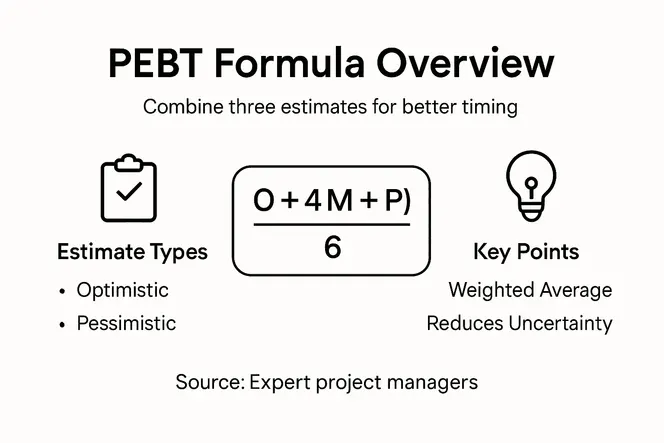
These parameters enable project managers to calculate a weighted average that accounts for potential variations, making PERT more dynamic than deterministic scheduling methods. The formula itself involves calculating an expected time using a beta distribution weighted average: Expected Time = (O + 4M + P) ÷ 6, which provides a more nuanced projection than simple linear estimates.
Common misconceptions about PERT include assumptions that it guarantees precise predictions or eliminates project uncertainties. In reality, PERT is a probabilistic tool, not a precise prediction mechanism. Project managers must understand that while PERT offers superior insights compared to traditional methods, it still relies on subjective estimates and cannot completely eliminate scheduling risks.
Pro tip: Always validate your PERT estimates by comparing initial projections with actual project performance to progressively refine your estimation accuracy.
How three-point estimation works in PERT
Three-point estimation represents a sophisticated approach to project time prediction that goes beyond traditional linear scheduling methods. Advanced project management techniques reveal that this method provides a more nuanced and statistically robust way of estimating project timelines by incorporating multiple potential scenarios.
The three-point estimation technique involves identifying three critical time estimates for each project task:
- Optimistic Time (O): The best possible scenario where everything goes perfectly
- Most Likely Time (M): The realistic, expected duration based on typical project conditions
- Pessimistic Time (P): The worst-case scenario accounting for potential complications
Three-point estimating method calculates the expected duration using a weighted formula that gives more significance to the most likely time. The mathematical representation of this calculation is: Expected Time = (O + 4M + P) ÷ 6. This approach introduces statistical weight to the estimate, recognizing that the most probable outcome should have greater influence than extreme scenarios.

By incorporating variability and potential risks, three-point estimation provides project managers with a more comprehensive view of potential project timelines. Unlike single-point estimates that offer a simplistic prediction, this method acknowledges the inherent uncertainties in project planning and provides a more dynamic approach to scheduling.
Pro tip: Document your three-point estimates in a tracking spreadsheet to help identify patterns in your estimation accuracy over multiple projects.
Types of estimates used in PERT formula
Advanced project management techniques rely on three distinct time estimates to create a comprehensive understanding of potential project timelines. These estimates represent different scenarios that capture the inherent uncertainty in project planning, providing project managers with a more nuanced approach to scheduling and risk assessment.
The three primary types of estimates in the PERT formula include:
-
Optimistic Time (O): The best-case scenario where everything proceeds perfectly
- Represents minimal time required
- Assumes no unexpected complications
- Reflects ideal project conditions
-
Most Likely Time (M): The realistic duration based on typical project conditions
- Represents the standard expected timeline
- Accounts for normal project challenges
- Reflects team’s typical performance
-
Pessimistic Time (P): The worst-case scenario accounting for potential complications
- Represents maximum time potentially required
- Includes buffer for unexpected challenges
- Considers potential project risks
Quality project estimation techniques demonstrate that these three estimates work together to create a probabilistic view of project duration. By capturing the range of possible outcomes, project managers can develop more resilient and adaptable scheduling strategies that account for inherent uncertainties.
The power of these multiple estimates lies in their ability to provide a statistical distribution of potential project timelines, moving beyond simplistic single-point predictions. This approach allows teams to understand potential variations, prepare contingency plans, and communicate more transparently about project expectations.
Summary of how each PERT estimate impacts project management decisions:
| Estimate Type | Decision Influence | Typical Use Case |
|---|---|---|
| Optimistic Time | Identifies best-case scenario | Setting aggressive targets |
| Most Likely Time | Informs realistic schedule | Planning standard projects |
| Pessimistic Time | Drives risk contingency plans | Preparing for challenges |
Pro tip: Collect historical project data to improve the accuracy of your time estimates by comparing previous project durations across optimistic, most likely, and pessimistic scenarios.
Real-world applications in project management
Advanced project management techniques reveal the critical role of PERT in transforming project planning across diverse industries. By providing a probabilistic approach to time estimation, PERT enables organizations to navigate complex project landscapes with greater precision and strategic insight.
Real-world applications of PERT span multiple critical sectors:
-
Construction Projects
- Predicting building completion timelines
- Managing complex infrastructure developments
- Coordinating multiple contractor schedules
-
Software Development
- Estimating development sprint durations
- Tracking multi-phase product releases
- Managing feature implementation timelines
-
Research and Development
- Planning scientific research initiatives
- Tracking experimental project milestones
- Allocating resources for long-term innovations
Worldwide project management approaches demonstrate PERT’s versatility in handling non-routine, complex projects where time constraints and uncertainty are significant challenges. Military logistics, aerospace engineering, and large-scale technological implementations particularly benefit from PERT’s nuanced estimation capabilities.
The technique’s strength lies in its ability to transform uncertainty from a project risk into a manageable, quantifiable parameter. By providing a statistical framework for understanding potential project durations, PERT empowers project managers to make more informed decisions, allocate resources more effectively, and communicate project timelines with greater transparency.
Pro tip: Create a standardized PERT estimation template for your organization to ensure consistent time tracking and improve historical data collection across different project types.
Risks, limitations, and common pitfalls
Project management estimation techniques reveal significant challenges that can undermine the effectiveness of PERT if not carefully understood and managed. While PERT provides a sophisticated approach to time estimation, it is not an infallible method and requires critical awareness of its inherent limitations.
Key risks and limitations of the PERT method include:
-
Estimation Accuracy Challenges
- Difficulty in obtaining realistic time estimates
- Potential for subjective or biased input
- Overconfidence in probabilistic projections
-
Methodological Constraints
- Assumes activities are statistically independent
- Overlooks complex interdependencies between tasks
- May not account for real-world project dynamics
-
Computational Complexity
- Requires sophisticated statistical understanding
- Time-consuming calculation processes
- Potential for misinterpretation of results
Critical analysis of PERT highlights the epistemological challenges of creating an illusion of precision. Project managers often mistakenly treat PERT estimates as definitive predictions rather than probabilistic forecasts, which can lead to misguided decision-making and unrealistic expectations.
The most significant pitfall lies in misunderstanding the fundamental nature of PERT. It is a tool for understanding potential variations, not a crystal ball for exact predictions. Successful implementation requires a nuanced approach that recognizes the method’s strengths while remaining aware of its inherent statistical limitations.
Pro tip: Always validate PERT estimates through multiple independent reviews and maintain a healthy skepticism about the precision of probabilistic projections.
PERT versus other estimation techniques
Project management estimation methods demonstrate significant variations in approach, with PERT standing out as a uniquely probabilistic technique. Unlike traditional estimation approaches, PERT introduces a sophisticated framework for understanding project timeline uncertainties through its three-point estimation strategy.
Key differences between PERT and other estimation techniques include:
-
Critical Path Method (CPM)
- Uses deterministic single-point estimates
- Assumes fixed task durations
- Better for predictable, repetitive projects
-
Single-Point Estimation
- Relies on one linear time estimate
- Ignores potential variability
- Provides less comprehensive risk analysis
-
Agile Estimation Techniques
- Uses story points or relative sizing
- More flexible but less statistically rigorous
- Focuses on team velocity over precise timing
Advanced project management approaches highlight PERT’s unique ability to integrate uncertainty directly into the estimation process. While other methods provide point-in-time predictions, PERT creates a probabilistic range that acknowledges the inherent complexity of project timelines.
The fundamental advantage of PERT lies in its recognition that project estimates are never truly precise. By incorporating optimistic, most likely, and pessimistic scenarios, PERT provides a more nuanced view of potential project durations, enabling more intelligent risk management and resource allocation.
Here’s how PERT compares to other project estimation techniques:
| Technique | Approach | Strength | Limitation |
|---|---|---|---|
| PERT | Probabilistic (three-point) | Handles uncertainty | Requires quality input data |
| Critical Path Method | Deterministic (single-point) | Good for routine tasks | Less accurate for complex projects |
| Agile Estimation | Relative sizing | Flexible, adaptive | Lower statistical rigor |
| Single-Point Estimation | Linear estimate | Simple, fast | Ignores timeline variability |
Pro tip: Combine PERT with other estimation techniques to create a more comprehensive project planning approach that leverages the strengths of multiple methodologies.
Master Project Timing with AI-Powered Precision
The challenges of applying the PERT formula—balancing optimistic, most likely, and pessimistic estimates—highlight the need for dynamic tools that reduce estimation errors and improve team coordination. If you are striving to transform probabilistic project timelines into actionable schedules, overcoming subjective biases and managing complex dependencies can feel overwhelming. Gammatica.com addresses these pain points by offering an AI-driven project and team management platform designed to streamline your task management and automate workflow processes.

Experience how Gammatica.com empowers you to integrate advanced project estimation techniques like PERT with real-time team collaboration, automated scheduling, and performance tracking. Save time spent on administrative tasks and focus on refining your project forecasts with data-driven insights. Start reducing uncertainty in your projects today by visiting Gammatica.com and discover tools tailored to enhance accuracy and productivity at every project phase.
Frequently Asked Questions
What is the PERT formula used for in project management?
The PERT formula is used to estimate project completion times by incorporating uncertainty through three time estimates: optimistic, most likely, and pessimistic. This allows project managers to create more accurate timelines that reflect potential variations in project duration.
How do you calculate expected time using the PERT formula?
Expected time in PERT is calculated using the formula: Expected Time = (Optimistic Time + 4 * Most Likely Time + Pessimistic Time) ÷ 6. This calculation gives more weight to the most likely scenario, providing a robust estimate.
What are the common misconceptions about PERT?
Common misconceptions include the belief that PERT guarantees precise predictions or eliminates uncertainties. In reality, PERT is a probabilistic tool that provides insights based on subjective estimates and does not completely remove project risks.
How does the three-point estimation technique improve project time estimation?
The three-point estimation technique improves project time estimation by accounting for variability and risks with three distinct time scenarios. This nuanced approach provides a comprehensive view of potential project timelines and prepares managers for potential challenges.