Project managers everywhere know that aligning team capabilities with business goals takes more than intuition. When the gap between current performance and strategic objectives is unclear, inefficiencies multiply and productivity suffers. A needs assessment helps clarify these gaps by systematically identifying where resources, skills, or processes fall short, guiding mid-sized tech organizations toward smarter decisions. This guide explains how proven assessment methods can transform vague challenges into precise, actionable strategies that support growth and team optimization in an era of AI-driven project management.
Table of Contents
- Defining Needs Assessment and Key Concepts
- Major Types of Needs Assessment Techniques
- Step-by-Step Needs Assessment Process
- Real-World Applications in Project Management
- Roles, Responsibilities, and Common Pitfalls
- Risks, Costs, and Comparison With Alternatives
Defining Needs Assessment and Key Concepts
Needs assessment represents a strategic diagnostic process for understanding performance gaps and organizational requirements. At its core, needs assessment involves identifying discrepancies between current conditions and desired future states across human and organizational contexts.
The process encompasses multiple dimensions of understanding organizational needs, including:
- Normative Needs: Standards or benchmarks suggesting ideal performance levels
- Felt Needs: Subjective perceptions about requirements from stakeholders
- Expressed Needs: Explicitly communicated demands or expectations
- Comparative Needs: Evaluating performance relative to similar organizations or past performance
Successful needs assessment requires comprehensive information gathering through structured and informal methodologies. Program evaluators determine appropriate interventions by systematically mapping the gap between existing capabilities and strategic objectives.
Organizational needs assessments typically follow a structured approach with key stages:
- Problem Identification
- Data Collection
- Gap Analysis
- Intervention Strategy Development
- Recommendation Formulation
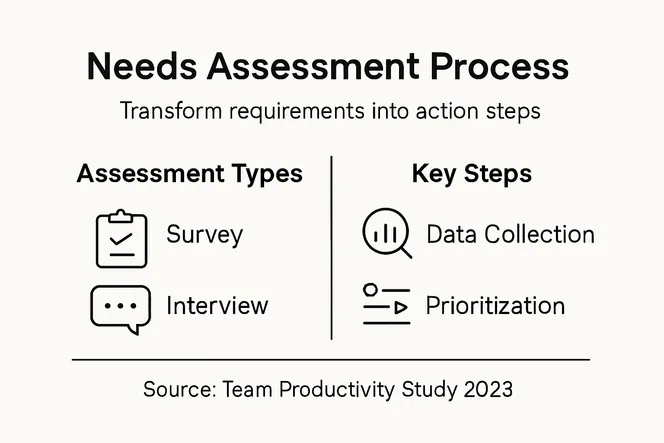
The ultimate goal is transforming abstract requirements into actionable insights that drive targeted improvements across team productivity, skill development, and operational efficiency.
Pro tip: Create a standardized needs assessment template with predefined evaluation criteria to ensure consistent and objective analysis across different organizational contexts.
Major Types of Needs Assessment Techniques
Needs assessment techniques represent crucial methodological approaches for systematically understanding organizational performance gaps and strategic requirements. Multiple assessment techniques enable institutions to capture comprehensive insights into current operational challenges and potential improvement opportunities.
The primary categories of needs assessment techniques include:
-
Quantitative Methods
- Surveys
- Statistical data analysis
- Benchmarking studies
- Structured questionnaires
-
Qualitative Methods
- Focus group discussions
- One-on-one interviews
- Direct observations
- Document and artifact reviews
Organizations typically employ a mixed-method approach, combining different techniques to triangulate evidence and capture diverse perspectives. This comprehensive strategy helps ensure more accurate and nuanced understanding of complex organizational needs.
Here’s a concise comparison of quantitative and qualitative needs assessment methods and their business applications:
| Method Type | Main Tools | Best Used For | Potential Limitation |
|---|---|---|---|
| Quantitative | Surveys, benchmarking | Measuring performance metrics | May miss context or nuance |
| Qualitative | Interviews, observations | Exploring underlying issues | Results can be subjective |
| Mixed Approach | Combination of both | Comprehensive insight | Requires more resources |
Selecting appropriate assessment techniques depends on several critical factors:
- Specific organizational context
- Available resources
- Depth of information required
- Stakeholder accessibility
- Time constraints
Contextual adaptation remains key - no single technique works universally across all scenarios. Successful needs assessment demands flexibility, strategic thinking, and a deep understanding of organizational dynamics.
Pro tip: Design a flexible needs assessment framework that allows for methodological customization while maintaining consistent evaluation standards and data collection protocols.
Step-by-Step Needs Assessment Process
A structured needs assessment process enables organizations to systematically identify, analyze, and address performance gaps and strategic requirements. Comprehensive needs assessment follows a strategic framework that ensures methodical evaluation and actionable insights.
The core stages of an effective needs assessment process include:
-
Problem Definition
- Clarify assessment objectives
- Establish precise scope
- Identify key stakeholders
- Define expected outcomes
-
Data Collection
- Select appropriate research methods
- Develop data gathering instruments
- Conduct surveys and interviews
- Gather qualitative and quantitative information
-
Data Analysis
- Organize collected information
- Identify patterns and trends
- Validate data reliability
- Create initial insights
-
Need Prioritization
- Assess impact and feasibility
- Rank identified needs
- Develop preliminary recommendations
- Create strategic intervention framework
-
Reporting and Implementation
- Document findings
- Present recommendations
- Develop action plans
- Establish monitoring mechanisms
Strategic needs assessment techniques require meticulous planning and a systematic approach. Organizations must remain flexible, adapting their methodology to specific contextual requirements while maintaining rigorous analytical standards.

Successful needs assessments demand collaborative engagement, ensuring stakeholders feel heard and insights translate into meaningful organizational improvements. Continuous refinement of the assessment process helps build institutional learning and adaptive capabilities.
Pro tip: Create a standardized needs assessment template with built-in flexibility, allowing for customization while maintaining consistent evaluation protocols and data collection standards.
Real-World Applications in Project Management
Strategic needs assessment techniques play a pivotal role in transforming project management from reactive problem-solving to proactive performance optimization. By systematically analyzing current capabilities and identifying strategic gaps, project managers can develop more targeted, efficient intervention strategies.
Key real-world applications of needs assessment in project management include:
-
Resource Allocation
- Identifying critical skill gaps
- Optimizing team composition
- Prioritizing training investments
- Matching resources to project requirements
-
Risk Mitigation
- Detecting potential project obstacles
- Predicting performance challenges
- Developing preventative strategies
- Creating contingency plans
-
Stakeholder Alignment
- Understanding expectations
- Managing communication channels
- Establishing clear project goals
- Ensuring mutual understanding
Project management needs assessment enables organizations to transform abstract requirements into concrete, actionable strategies. This approach helps teams move beyond traditional reactive management toward a more dynamic, anticipatory project execution model.
Successful implementation requires continuous stakeholder engagement, iterative assessment, and a willingness to adapt strategies based on emerging insights. Project managers must cultivate a flexible mindset, viewing needs assessment as an ongoing process of organizational learning and strategic refinement.
Pro tip: Develop a standardized needs assessment template with clear evaluation metrics that can be quickly customized for different project types and organizational contexts.
Roles, Responsibilities, and Common Pitfalls
Needs assessment roles and responsibilities form a complex ecosystem of interconnected functions critical to successful organizational strategy. Each participant plays a strategic role in transforming raw information into meaningful insights that drive performance improvement.
Key roles in the needs assessment process include:
-
Data Collectors
- Gather information through surveys
- Conduct interviews and focus groups
- Document stakeholder perspectives
- Ensure data integrity and accuracy
-
Analysts
- Process collected information
- Identify patterns and trends
- Develop statistical interpretations
- Create comprehensive reports
-
Decision Makers
- Review assessment findings
- Approve strategic interventions
- Allocate necessary resources
- Monitor implementation progress
Common pitfalls that organizations must proactively address include:
- Insufficient stakeholder engagement
- Unclear assessment objectives
- Poor data collection methods
- Lack of actionable recommendations
- Inconsistent follow-up processes
Organizational needs assessment challenges often stem from communication breakdowns and unrealistic expectations. Successful teams maintain transparency, cultivate collaborative environments, and view needs assessment as an ongoing, iterative process of organizational learning.
Effective needs assessment demands a delicate balance between systematic analysis and adaptive thinking. Teams must remain flexible, continuously refining their approach while maintaining rigorous standards of data collection and interpretation.
Pro tip: Develop a cross-functional team with diverse perspectives to ensure comprehensive needs assessment and minimize blind spots in data interpretation.
Risks, Costs, and Comparison With Alternatives
Needs assessment involves complex analytical risks that organizations must carefully navigate to ensure meaningful strategic insights. Understanding potential challenges and comparative methodologies helps teams develop more robust and effective assessment approaches.
Key risks in needs assessment processes include:
-
Methodological Risks
- Data collection bias
- Sampling errors
- Misinterpretation of results
- Statistical limitations
-
Organizational Risks
- Resource misallocation
- Stakeholder resistance
- Incomplete perspective gathering
- Inappropriate intervention design
Cost considerations for comprehensive needs assessment encompass multiple dimensions:
- Personnel time and expertise
- Data collection tool investments
- Analysis and reporting expenses
- Potential consultation fees
- Technology and software requirements
Structured assessment approaches offer significant advantages over less formal alternatives. Traditional methods like opinion polling or ad-hoc surveys frequently provide superficial insights, while systematic needs assessments deliver deeper, more actionable intelligence.
Below is a summary of how structured needs assessments compare with traditional alternatives:
| Approach | Data Reliability | Stakeholder Engagement | Strategic Value |
|---|---|---|---|
| Structured Assessment | High, validated results | Proactive inclusion | Precise target setting |
| Opinion Polling | Varies, informal | Limited input | Lacks actionable insight |
| Ad-Hoc Surveys | Often inconsistent | Short-term engagement | May miss strategic gaps |
Compared to alternative approaches, comprehensive needs assessments provide superior value through rigorous data validation, stakeholder engagement, and targeted intervention strategies. Organizations gain a more nuanced understanding of complex performance dynamics, enabling more precise resource allocation and strategic planning.
Pro tip: Develop a standardized cost-benefit analysis framework specifically for evaluating different needs assessment methodologies to optimize resource investment.
Elevate Your Needs Assessment with Smarter Team Productivity Tools
The article highlights critical challenges such as identifying performance gaps, prioritizing needs, and engaging stakeholders effectively during a needs assessment. Common hurdles include managing data collection, aligning team resources, and transforming insights into actionable strategies. Gammatica.com addresses these pain points by offering an AI-driven platform designed to streamline project and team management, helping you reduce manual administration and focus on closing gaps efficiently. From customizable templates to automated workflows and real-time collaboration features, our solution supports your needs assessment process with clarity and precision.

Discover how you can optimize your needs assessment techniques and drive targeted improvements in team productivity today. Visit Gammatica.com to explore how features like task management, CRM automation, and Kanban boards empower you to implement strategic interventions faster and smarter. Take control now and transform abstract organizational requirements into clear, actionable plans with Gammatica.com. Start optimizing your team’s productivity and project outcomes without delay.
Frequently Asked Questions
What is a needs assessment?
Needs assessment is a strategic diagnostic process used to identify gaps between current conditions and desired future states in organizations. It helps to clarify performance requirements and guide development strategies.
What are the key stages in the needs assessment process?
The key stages in the needs assessment process include problem definition, data collection, data analysis, need prioritization, and reporting and implementation. These stages ensure a comprehensive and systematic evaluation.
What are common methods used in needs assessments?
Common methods in needs assessments include quantitative methods like surveys and statistical data analysis, as well as qualitative methods such as interviews and focus group discussions. A mixed-method approach is often employed for more comprehensive insights.
What potential pitfalls should be avoided during a needs assessment?
Common pitfalls in needs assessments include insufficient stakeholder engagement, unclear objectives, poor data collection methods, and a lack of actionable recommendations. To avoid these issues, ensure clear communication and a structured approach throughout the process.