TL;DR:
- The Eisenhower Matrix helps prioritize tasks based on urgency and importance.
- High-value work is best protected by scheduling regular Q2 strategic activities.
- Combining the matrix with time-blocking and other scoring methods enhances productivity and decision-making.
Busy doesn’t mean productive. Many business leaders and project managers spend their days reacting to urgent requests, only to realize at day’s end that the truly important work never got touched. This confusion between urgency and importance is one of the most common productivity traps in modern business. The Eisenhower Matrix is a 2x2 prioritization framework that cuts through the noise by sorting every task based on urgency and importance. In this guide, you’ll learn exactly how to use it, see real-world examples for leaders and managers, and discover advanced strategies to squeeze maximum value from this deceptively simple tool.
Key Takeaways
| Point | Details |
|---|---|
| Prioritize impact | The Eisenhower Matrix keeps you focused on important work, not just urgent tasks. |
| Quadrant 2 time is key | Spending 60-80% of your time on important but non-urgent work prevents future crises. |
| Hybrid methods work best | For teams or complex work, combine the Eisenhower Matrix with frameworks like RICE for deeper prioritization. |
| Review regularly | Weekly reviews ensure your Matrix stays aligned with changing priorities and keeps productivity high. |
| Avoid urgency bias | Don’t let urgent, unimportant tasks distract from what truly moves the needle. |
What is the Eisenhower Matrix?
Most people treat their task list like a single pile: everything goes in, and whatever feels most pressing gets done first. The result? Strategic work gets buried under a constant flood of reactive tasks. The Eisenhower Matrix changes that completely.
Named after President Dwight D. Eisenhower, who was famous for his ability to manage competing priorities during his military and political career, the matrix has since become a cornerstone of modern productivity thinking. The 2x2 prioritization framework divides every task into four quadrants based on two axes: urgency (how time-sensitive is it?) and importance (does it align with your goals?).
Here’s how the four quadrants break down:
| Quadrant | Urgency | Importance | Action |
|---|---|---|---|
| Q1 | Urgent | Important | Do immediately |
| Q2 | Not urgent | Important | Schedule it |
| Q3 | Urgent | Not important | Delegate it |
| Q4 | Not urgent | Not important | Delete it |
Each quadrant has a clear directive:
- Q1 (Do): Crises, pressing deadlines, and emergencies that demand your attention right now.
- Q2 (Schedule): Strategic planning, relationship-building, skill development. This is where real growth lives.
- Q3 (Delegate): Interruptions, some meetings, requests that feel urgent but don’t require your specific expertise.
- Q4 (Delete): Time-wasters, low-value browsing, tasks that don’t serve any real goal.
The real power of this framework is in Q2. Most high-performing leaders intentionally protect this quadrant because it’s where prevention, strategy, and long-term results are built. Neglect it, and you’ll always be stuck fighting fires in Q1.
How to use the Eisenhower Matrix for maximum results
Knowing the structure is one thing. Putting it into practice is where most people stumble. Here’s a clear, step-by-step method to make the matrix work for you every single week.
- Brain-dump all your tasks. Start with a full list of everything on your plate, no filtering yet.
- Evaluate urgency. Ask: Is there a real deadline or consequence if this isn’t done today?
- Evaluate importance. Ask: Does this directly support my key goals or responsibilities?
- Sort into quadrants. Place each task into Q1, Q2, Q3, or Q4 based on your answers.
- Act accordingly. Do Q1 tasks now, schedule Q2 time blocks, delegate Q3 tasks, and eliminate Q4 items.
- Review weekly. Revisit your matrix every week and track how much time you’re spending in each quadrant.
This step-by-step methodology is straightforward, but the weekly review step is where most people drop the ball. Without it, old habits creep back in.

Your target? Aim to spend 60 to 80% of your time in Q2. That’s where proactive, high-value work happens. It feels counterintuitive because Q2 tasks rarely feel urgent. But that’s exactly why you have to protect them.
The results back this up. 78% of users report higher productivity after consistently applying the matrix. That’s not a small edge. That’s a meaningful shift in how work gets done.
Pro Tip: Block calendar time for Q2 activities first thing in the morning, before your inbox and meetings have a chance to take over. Treat these blocks like appointments you cannot cancel.
Inside the four quadrants: High-impact examples
Let’s get specific. Here’s how each quadrant plays out in real business scenarios, so you can recognize your own tasks more easily.
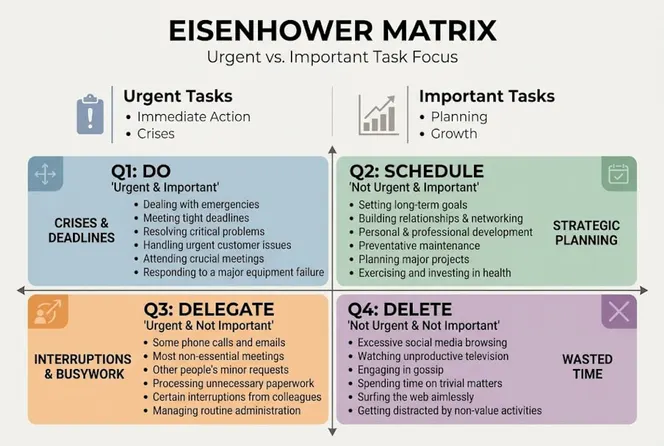
The four quadrant actions map directly to the kinds of decisions leaders face every day:
| Quadrant | Business management | Project oversight | Personal productivity |
|---|---|---|---|
| Q1: Do now | Client escalation call | Production outage fix | Medical appointment today |
| Q2: Schedule | Quarterly strategy session | Risk mitigation planning | Exercise routine, learning |
| Q3: Delegate | Routine status update email | Daily standup facilitation | Scheduling a team lunch |
| Q4: Delete | Redundant internal reports | Low-priority feature requests | Mindless social media scrolling |
Here’s what makes this powerful in practice:
- Q1 tasks demand immediate focus. But if you’re constantly in Q1, something is wrong. It usually means Q2 has been neglected for too long.
- Q2 tasks are the ones that build your business, your team, and your future. Strategic planning, mentoring, process improvement. These rarely feel urgent, but they are absolutely critical.
- Q3 tasks are sneaky. They feel important because someone else is asking urgently. But they don’t need your specific attention. Delegate them confidently.
- Q4 tasks are pure drain. They consume time without producing results. Cut them without guilt.
For project managers specifically, Q2 is where risk planning lives. Teams that invest time here face fewer Q1 crises down the road. It’s a direct trade: proactive effort now for fewer emergencies later.
Beyond the basics: Eisenhower Matrix expert tips and pitfalls
Once you understand the quadrants, the real challenge is avoiding the traps that undermine even experienced users.
The most common mistakes:
- Overfilling Q1 by labeling everything as urgent and important.
- Confusing someone else’s urgency for your own importance.
- Skipping the weekly review and letting the matrix go stale.
- Treating the matrix as a one-time exercise rather than an ongoing habit.
The Mere-Urgency Effect is a real psychological trap. Research shows people are naturally biased toward completing urgent tasks, even when those tasks have lower value than non-urgent ones. Your brain finds urgency rewarding. The matrix is specifically designed to counteract this bias, but only if you use it consistently.
“Structured time management yields 20 to 25% productivity gains.” This isn’t just a motivational stat. It reflects what happens when leaders stop reacting and start choosing.
Pro Tip: Combine the Eisenhower Matrix with time-blocking for your Q2 activities. Reserve specific calendar slots each week for strategic work, and defend those slots like you would a client meeting. The combination with time-blocking is what separates occasional users from people who see lasting change.
Another advanced move: track your Q1 volume over time. If you’re investing properly in Q2, your Q1 emergencies should decrease. Fewer crises mean more capacity for strategic work. It’s a virtuous cycle, and it starts with a single honest week of tracking.
When the Eisenhower Matrix falls short: Alternatives and hybrid methods
The Eisenhower Matrix is a powerful tool. But it isn’t perfect for every situation, and knowing its limits makes you a smarter user.
Here’s where it struggles:
- Large teams with dependencies: The matrix is built for individual prioritization. When tasks are interconnected across teams, it misses complexity.
- Tech and product roadmaps: It doesn’t account for task effort, reach, or confidence. A feature that’s important and not urgent could still be a poor investment if it takes six months to build.
- Async work environments: 34% slower high-value task completion has been observed in complex async environments where static prioritization frameworks are applied without adjustment.
- Subjective assessments: What’s “important” to you may not align with what’s important to your stakeholders or your organization’s strategy.
When the matrix isn’t enough, consider these alternatives:
- RICE scoring (Reach, Impact, Confidence, Effort): Ideal for product and roadmap decisions where you need an objective ranking.
- ICE scoring (Impact, Confidence, Ease): Faster to apply than RICE, good for early-stage prioritization.
- WSJF (Weighted Shortest Job First): Used in agile environments to sequence work by cost of delay.
The smart approach? Use the Eisenhower Matrix as your daily filter to quickly sort incoming tasks, then apply RICE or ICE for deeper roadmap or team-level decisions. These frameworks complement each other well. You don’t have to choose just one.
Fresh perspective: The Eisenhower Matrix works—when you break its rules
Here’s something most productivity guides won’t tell you: rigid quadrant thinking can actually slow you down.
We’ve seen fast-moving teams get paralyzed trying to perfectly categorize every task before acting. The matrix becomes a bureaucratic exercise instead of a decision-making shortcut. That’s the opposite of what it’s designed to do.
The most effective leaders we’ve observed use the matrix as a first-pass filter, not a final verdict. They sort quickly, act decisively, and then layer in more nuanced frameworks like RICE or ICE when the situation calls for it. As advanced prioritization research confirms, the hybrid use of Eisenhower for filtering and RICE for ranking is the optimal approach for experienced teams.
The matrix’s real value is in building the habit of asking two questions: Is this urgent? Is this important? Once that reflex is trained, you stop reacting automatically and start choosing deliberately. That shift in mindset is worth more than any perfect quadrant placement.
Treat the matrix as a starting point, not a rulebook. Adapt it. Combine it. Make it yours.
Take action: Next steps with Eisenhower Matrix productivity
You now have everything you need to start using the Eisenhower Matrix with real confidence. The next step is putting it into practice, and that’s where the right tools make all the difference.
At Gammatica, we’ve built a platform specifically designed to help business leaders and project managers turn prioritization frameworks like this one into daily habits. From AI-powered task management to calendar coordination and team collaboration, Gammatica gives you the structure to protect your Q2 time and reduce Q1 firefighting. Explore our sales and leadership resources to see how smarter workflows translate directly into better results. Your time is your most valuable asset. Let’s make sure you’re spending it on what actually matters.
Frequently asked questions
What makes the Eisenhower Matrix more effective than simple to-do lists?
It distinguishes between urgent and important tasks, ensuring you focus on impactful work instead of reacting to every request. A 2x2 prioritization framework gives you a decision system, not just a list.
How often should I update my Eisenhower Matrix?
Review and update your Matrix at least weekly to keep it relevant and maximize productivity. Weekly review and Q2 tracking are essential steps in the methodology.
Can the Eisenhower Matrix work for team or project boards?
It works best for individual prioritization, but for teams, hybrid frameworks like RICE or ICE are more effective. Team and roadmap decisions benefit from frameworks that account for effort and dependencies.
What productivity gains can I expect from using the Eisenhower Matrix?
Users report 20 to 25% productivity gains and a clearer focus on high-value work when applying structured time management practices consistently.
What’s the main pitfall to avoid with the Eisenhower Matrix?
Don’t let urgent but low-importance tasks dominate your day. The Mere-Urgency Effect naturally pulls attention toward urgency, so protect your Q2 time deliberately.