Many project managers believe planning is as simple as listing major milestones and assigning deadlines. Yet the most successful teams rely on a powerful tool that transforms vague objectives into crystal-clear action steps: the breakdown structure. This systematic approach divides complex projects into digestible components, enabling teams to understand exactly what needs doing, who owns each piece, and how everything connects. You’ll discover what breakdown structures are, why they dramatically boost team efficiency, and how to implement them effectively in your organization.
Key takeaways
| Point | Details |
|---|---|
| Breakdown structures divide complexity | They transform overwhelming projects into manageable tasks your team can execute confidently. |
| Multiple types serve different needs | Work Breakdown Structure focuses on deliverables while Organizational Breakdown Structure maps team responsibilities. |
| Efficiency gains reach 30% | Projects using thorough structures complete tasks faster with fewer misunderstandings. |
| Implementation requires iteration | Effective structures evolve through stakeholder feedback and continuous refinement throughout project lifecycles. |
What is a breakdown structure in project management?
A breakdown structure divides projects into smaller, manageable parts to improve oversight and control. Think of it as a project anatomy chart that reveals every organ, bone, and muscle needed for your initiative to function. Without this detailed map, teams stumble through ambiguity, duplicate efforts, and miss critical dependencies.
The structure typically contains three core components. First, phases represent major project stages like planning, execution, and closure. Second, deliverables identify tangible outputs your team must produce. Third, tasks break deliverables into specific actions individuals can complete. Each layer adds precision, moving from broad objectives to granular work items.
Several breakdown types exist to match different project needs. The Work Breakdown Structure (WBS) organizes deliverables hierarchically, showing how smaller components build toward final outputs. An Organizational Breakdown Structure (OBS) maps which departments or individuals own specific work packages. The Product Breakdown Structure (PBS) focuses exclusively on physical or digital products and their subcomponents. Resource Breakdown Structure (RBS) categorizes all project resources including people, equipment, and materials.
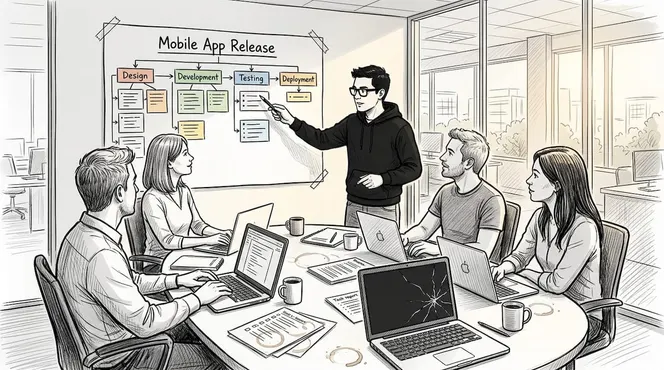
Consider a software launch project. Your WBS might start with “Mobile App Release” at the top level. The second level breaks this into “User Interface Design,” “Backend Development,” “Quality Assurance,” and “Marketing Materials.” The third level under “Backend Development” could include “Database Schema,” “API Endpoints,” “Authentication System,” and “Payment Integration.” Each element becomes a clear work package someone can estimate, assign, and track.
This granular visibility prevents the common scenario where project managers ask for status updates and receive vague responses like “we’re making progress.” Instead, you can pinpoint exactly which API endpoints are complete, which need testing, and which are blocking other work. The structure creates a shared language your entire team understands, eliminating the confusion that derails timelines and frustrates stakeholders.
Why use breakdown structures to enhance team efficiency?
Breakdown structures clarify responsibilities in ways generic project plans never achieve. When you assign someone “marketing” as a task, ambiguity breeds inefficiency. Does marketing mean social media posts, email campaigns, landing pages, or all three? A proper breakdown structure specifies “Create 12 LinkedIn posts,” “Design email sequence with 5 messages,” and “Build product landing page with demo video.” This precision eliminates the back-and-forth clarification that wastes hours weekly.
Projects using thorough work breakdown structures experience up to 30% better efficiency in team task completion. This dramatic improvement stems from several factors. Team members spend less time figuring out what to do next because the structure provides a clear roadmap. Dependencies become visible, preventing situations where developers wait idly because designers haven’t finished prerequisite assets. Parallel work streams emerge naturally when you see which tasks have no interdependencies.
Resource planning becomes dramatically simpler with detailed breakdowns. Instead of guessing how many designers you need for “the design phase,” you count specific deliverables: 15 wireframes, 8 high-fidelity mockups, 3 interactive prototypes, and 20 final assets. Each item gets time estimates, revealing whether your current team can handle the load or if you need contractors. Budget allocation follows the same logic. You can justify costs to stakeholders by showing exactly what each dollar funds rather than presenting vague line items.
Risk identification improves when you break projects into granular components. A high-level task like “integrate payment system” might seem straightforward until your breakdown reveals subtasks: “research payment gateway options,” “obtain PCI compliance certification,” “implement secure token storage,” “build refund processing logic,” and “create payment failure notifications.” Suddenly, you spot potential roadblocks like compliance delays or complex refund scenarios that could derail your timeline.
Pro Tip: Involve your entire team in creating the breakdown structure rather than dictating it from above. Developers spot technical dependencies managers miss. Designers identify creative tasks that seem simple but require extensive iteration. This collaborative approach increases accuracy and builds team ownership of the plan.
“The breakdown structure is not just a planning tool, it’s a communication framework that aligns everyone’s mental model of the project.”
Early wins become easier to identify and celebrate. When tasks are properly sized, team members complete work packages regularly rather than toiling for weeks on monolithic assignments. These frequent completions boost morale and provide concrete evidence of progress during stakeholder meetings. You can report “we’ve finished 23 of 47 development tasks” instead of offering the unsatisfying “development is 50% done.”
Comparing common breakdown structure types and when to use each
Different breakdown structures serve distinct purposes: WBS focuses on deliverables while OBS focuses on organizational units. Choosing the right type depends on your project complexity, team structure, and primary management challenges. Many successful projects use multiple breakdown types simultaneously to gain different perspectives on the same work.
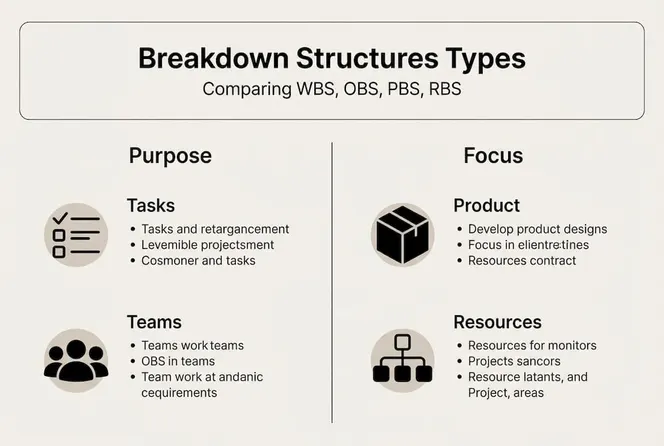
The Work Breakdown Structure remains the most widely adopted approach. It organizes everything by what you’re building or producing. Start with the final deliverable at the top, then decompose it into major components, then into smaller pieces until you reach actionable tasks. WBS excels for product development, construction projects, and any initiative where tangible outputs define success. It answers “what are we creating” with ruthless clarity.
Organizational Breakdown Structure maps work to your company’s hierarchy. The top level shows departments like Engineering, Marketing, and Operations. Lower levels reveal teams within departments and individuals within teams. OBS proves invaluable when you need to track costs by department, manage resources across multiple projects, or ensure balanced workloads. It answers “who is responsible for what” and helps prevent situations where one team drowns in work while another has excess capacity.
Product Breakdown Structure focuses exclusively on physical or digital products and their components. Unlike WBS, which might include activities like “conduct user research” or “write documentation,” PBS contains only product elements. For a smartphone, PBS would show “display assembly,” “battery unit,” “camera module,” and “circuit board” without mentioning the processes to create them. This structure works brilliantly for manufacturing, hardware development, and projects where understanding product architecture matters more than work processes.
Resource Breakdown Structure categorizes every resource your project consumes. Top-level categories might include “Human Resources,” “Equipment,” “Materials,” and “Facilities.” Under “Human Resources,” you’d list roles like “Senior Developers,” “UX Designers,” and “QA Engineers.” This structure enables precise resource forecasting and helps you spot resource conflicts before they cause delays.
| Structure Type | Primary Focus | Best Used When | Key Benefit |
|---|---|---|---|
| Work Breakdown Structure | Deliverables and tasks | Building products or completing project phases | Clarifies what needs creation and task dependencies |
| Organizational Breakdown Structure | Departments and teams | Managing cross-functional projects or tracking departmental costs | Shows who owns each work package and balances workloads |
| Product Breakdown Structure | Product components | Developing physical products or complex systems | Reveals product architecture and component relationships |
| Resource Breakdown Structure | Resources and assets | Planning resource allocation or managing budgets | Enables accurate resource forecasting and conflict identification |
When choosing your breakdown approach, consider these factors:
- Project complexity: Simple projects might need only a basic WBS, while enterprise initiatives benefit from multiple structure types.
- Team distribution: Geographically dispersed teams gain clarity from OBS showing exactly which location handles what.
- Stakeholder priorities: Executives focused on costs prefer RBS, while technical teams need detailed WBS.
- Reporting requirements: If you must report progress by department, incorporate OBS even if WBS guides daily work.
- Industry standards: Construction typically uses WBS, manufacturing relies heavily on PBS, and consulting firms often emphasize OBS.
Many project managers create a hybrid approach. Start with WBS to define all deliverables and tasks. Layer in OBS to assign organizational ownership. Add RBS elements to track resource consumption. This multi-dimensional view provides the comprehensive visibility needed to manage complex initiatives successfully.
How to create and implement an effective breakdown structure
Effective breakdown structures are created iteratively and validated with stakeholders. Rushing through creation guarantees you’ll miss critical tasks or misunderstand dependencies. Follow this systematic approach to build structures that genuinely improve team efficiency.
-
Define project scope and objectives clearly before touching the breakdown structure. Write a concise scope statement identifying what’s included and explicitly what’s excluded. Vague scope produces vague structures that confuse rather than clarify. Get stakeholder agreement on scope boundaries to prevent endless expansion during breakdown creation.
-
Identify major deliverables that represent significant project outputs. These become your second-level breakdown elements. For a website redesign, major deliverables might include “New Visual Design System,” “Responsive Page Templates,” “Content Migration,” and “Performance Optimization.” Aim for five to nine major deliverables, as more suggests insufficient grouping while fewer indicates you haven’t decomposed enough.
-
Break down each major deliverable into smaller components using the 8/80 rule. No task should take less than 8 hours or more than 80 hours to complete. Tasks under 8 hours create administrative overhead tracking trivial work. Tasks over 80 hours hide complexity and make progress tracking meaningless. If a task exceeds 80 hours, decompose it further until you reach appropriate granularity.
-
Assign clear ownership to every work package at the lowest breakdown level. Ownership means one person is accountable for completion, though they might delegate or collaborate with others. Shared ownership typically means no ownership, as individuals assume someone else is handling it. Document owner names directly in your breakdown structure rather than leaving assignments for later.
-
Review and iterate with your team and stakeholders before declaring the structure final. Walk through each branch asking “are we missing anything” and “does this sequence make sense.” Technical team members spot dependencies managers overlook. Subject matter experts identify specialized tasks that seem simple but require rare expertise. This validation catches 70% of structural problems before they impact execution.
-
Establish a change control process for structure updates as projects evolve. Lock the structure after validation but allow modifications through formal requests that assess impact on timeline, budget, and resources. Uncontrolled changes destroy the structure’s value by creating confusion about what’s actually in scope.
Common pitfalls sabotage even well-intentioned breakdown efforts. Over-complexity creates structures so detailed that maintenance becomes a full-time job. If you’re spending more time updating the breakdown than doing actual work, you’ve gone too far. Under-complexity leaves dangerous ambiguity where team members interpret tasks differently. Balance comes from testing whether a new team member could understand their responsibilities from the structure alone.
Lack of stakeholder input during creation guarantees you’ll miss requirements that surface painfully during execution. Involve representatives from every group affected by the project. Their perspectives reveal hidden work you’d otherwise discover through missed deadlines and frustrated complaints.
Ignoring dependencies between tasks creates situations where work stalls because prerequisites aren’t complete. As you build your structure, note which tasks must finish before others can start. These dependency relationships inform your project schedule and help you identify the critical path determining your minimum timeline.
Pro Tip: Use visual tools like mind maps or hierarchical diagrams to map your breakdown structure rather than relying solely on spreadsheets or text outlines. Visual representations help teams grasp relationships and spot gaps more easily than linear lists. Tools like Miro, Lucidchart, or even simple PowerPoint diagrams make structures more accessible to non-technical stakeholders.
Document assumptions and constraints that influenced your breakdown decisions. When someone questions why a task exists or why you grouped elements a certain way, your documented rationale prevents endless re-litigation of settled decisions. This documentation also helps when you create breakdown structures for similar future projects.
Enhance your project management with Gammatica
After mastering breakdown structures, you need tools that help implement and monitor them effectively. Gammatica provides project managers with AI-driven platforms designed specifically for tracking team progress against detailed project breakdowns. Our integrated dashboards transform your breakdown structure into living workflows where you monitor task completion in real time, identify bottlenecks before they cause delays, and maintain visibility across complex initiatives.

The platform’s task management and automation features align perfectly with breakdown structure methodology. Assign ownership to specific work packages, set dependencies that prevent premature starts, and receive intelligent suggestions when timelines risk slipping. Gammatica for founders offers specialized views for business leaders who need executive-level insight without drowning in granular details. Stop wondering whether your projects are on track and start knowing with certainty.
FAQs about breakdown structures in project management
What is the difference between a work breakdown structure and a product breakdown structure?
A work breakdown structure organizes all project work including activities, deliverables, and processes needed to complete the project. A product breakdown structure focuses exclusively on the physical or digital product components and their hierarchical relationships, excluding activities or processes. WBS answers “what work must we do” while PBS answers “what parts comprise the final product.”
How detailed should a breakdown structure be?
Your breakdown structure should decompose work until you reach tasks requiring 8 to 80 hours to complete. More detail creates administrative burden, while less detail hides complexity and makes progress tracking meaningless. The right level lets you estimate accurately, assign clearly, and track progress weekly without micromanaging.
Can breakdown structures help identify project risks?
Yes, breakdown structures reveal risks by exposing task complexity, dependencies, and resource requirements that remain hidden in high-level plans. When you decompose “integrate payment system” into subtasks, you discover compliance requirements, technical challenges, and third-party dependencies that represent significant risk factors. This early visibility enables proactive risk mitigation.
Is software necessary to create breakdown structures?
No, you can create effective breakdown structures using paper, whiteboards, or simple text outlines. However, software tools provide significant advantages for complex projects: easier updates as scope changes, automatic dependency tracking, resource allocation views, and stakeholder sharing. Start simple and adopt software when manual maintenance becomes burdensome.
How often should breakdown structures be updated during a project?
Update your breakdown structure whenever scope changes occur through formal change control processes, typically ranging from weekly to monthly depending on project volatility. Avoid constant ad-hoc changes that create confusion, but don’t let the structure become outdated fiction that no longer reflects reality. Quarterly reviews work well for stable projects, while agile initiatives might adjust structures each sprint.