Many business leaders believe After Action Review (AAR) reports are static documents that gather dust after project completion. The reality is far different. Traditional AARs fail if not actioned, but AI-powered AAR reports transform these retrospectives into dynamic engines for continuous improvement. By automating data collection and analysis, AI enables real-time insights that drive measurable gains in team performance and project oversight. This guide shows you how to leverage AI-enhanced AARs to eliminate repeated mistakes, scale learning across your portfolio, and achieve significant ROI.
Key Takeaways
| Point | Details |
|---|---|
| Real time insights | AI automates data collection and analysis to surface real time insights that guide teams as projects unfold. |
| Scale across portfolio | Pattern recognition across many projects lets organizations scale learning and apply lessons across the portfolio. |
| Enforces action | Automation links insights to follow through, reducing repeated mistakes and accelerating continuous improvement. |
| Human input matters | Human judgment remains essential for interpreting nuance culture and team dynamics that data alone cannot capture. |
Understanding AAR reports and their limitations
After Action Reviews serve as structured retrospectives that document what happened during a project, why it happened, and how teams can improve future outcomes. These reports traditionally capture successes, failures, and lessons learned to build organizational knowledge. However, many AAR initiatives fail to deliver lasting value.
The primary challenge lies in execution. Traditional AARs fail if not actioned, creating a cycle where teams invest time in retrospectives without seeing meaningful change. Common pitfalls include:
- Sporadic review schedules that miss critical learning windows
- Poor data quality from manual collection and recall bias
- Lack of accountability for implementing recommendations
- Inability to scale insights across project portfolios
- Knowledge loss when team members transition between projects
Manual AAR processes struggle particularly with scale. A project manager overseeing three simultaneous initiatives cannot effectively synthesize lessons across all three using spreadsheets and memory alone. By the time quarterly reviews occur, crucial context has faded and opportunities for correction have passed.
The gap between insight and action represents the most critical failure point. Teams generate thoughtful recommendations during retrospectives, but without systematic follow-through, these insights remain theoretical. Projects repeat the same mistakes quarter after quarter because lessons learned exist only in archived documents rather than embedded workflows.
Human judgment remains essential for interpreting nuanced situations, understanding team dynamics, and recognizing cultural factors that influence project outcomes. Yet manual processes cannot keep pace with the volume and velocity of modern project data. This tension between the need for human insight and the limitations of manual analysis creates the perfect opportunity for AI augmentation.
How AI transforms AAR reports with real-time data and scale
AI-powered tools fundamentally reshape AAR effectiveness by automating data collection and analysis. JPMRC’s Data Assessment Tool automates AAR data collection using MS Forms, Power Automate, and Power BI to create real-time dashboards that surface insights as projects unfold. This approach eliminates the lag between project completion and learning.
The automation advantage extends beyond speed. AI systems capture data continuously and consistently, removing the recall bias that plagues manual retrospectives. When team members answer survey questions three months after an event, their responses reflect current emotions more than historical facts. AI tools log metrics, communications, and decisions as they occur, preserving accurate records for analysis.

Pattern recognition represents another transformative capability. AI algorithms analyze data across dozens or hundreds of projects simultaneously, identifying trends that individual project managers would never spot. You might discover that projects starting in Q4 consistently encounter resource constraints, or that certain client industries require longer onboarding phases. These portfolio-level insights enable strategic adjustments that improve outcomes organization-wide.
Key AI capabilities for enhanced AARs include:
- Automated data extraction from project management systems, emails, and collaboration tools
- Natural language processing to analyze meeting notes and identify sentiment trends
- Predictive analytics that flag projects at risk based on historical patterns
- Real-time dashboards that visualize performance metrics and highlight anomalies
- Integration with existing workflows to minimize disruption and maximize adoption
| Metric | Traditional AAR | AI-Enhanced AAR | Improvement |
|---|---|---|---|
| Data collection time | 8-12 hours | 30-60 minutes | 90% reduction |
| Analysis completion | 2-3 weeks | Real-time | Immediate insights |
| Cross-project learning | Limited | Portfolio-wide | Exponential scale |
| Action tracking | Manual follow-up | Automated alerts | 100% accountability |
Pro Tip: Always validate AI-generated insights with team discussions before implementing major changes. AI excels at identifying patterns in structured data but may miss contextual factors like shifting client priorities or team morale issues that require human interpretation.
The scalability advantage becomes particularly evident in complex environments. A construction firm managing twenty simultaneous projects can use AI to track safety incidents, budget variances, and schedule delays across all sites. The system automatically flags concerning trends and suggests interventions based on what worked in similar past situations. This level of oversight would require an entire analytics team using traditional methods.
Balancing AI automation with human expertise in AARs
AI automation delivers speed and scale, but AI risks missing human nuances like culture that profoundly impact project outcomes. A purely algorithmic approach might recommend aggressive timelines based on historical data while missing that your team is experiencing burnout. Effective AI-enhanced AARs combine computational power with human wisdom.
Cultural context illustrates this balance perfectly. An AI system analyzing communication patterns might flag decreased Slack activity as disengagement. However, your team lead knows the group shifted to in-person collaboration after returning to the office. Without human interpretation, the AI recommendation to increase virtual check-ins would be counterproductive.
The five-step AAR process provides a framework for integrating AI and human input effectively:
- Prepare by defining objectives and identifying key metrics for AI to track
- Gather data through automated collection supplemented by structured team interviews
- Analyze using AI pattern recognition validated through facilitated team discussions
- Recommend actions based on AI insights filtered through human judgment about feasibility
- Track implementation with automated monitoring and human accountability check-ins
Project managers should validate AI with human review, especially for edge cases and external risks that fall outside historical patterns. When your AI system suggests a timeline based on past projects, humans must consider whether current market conditions, regulatory changes, or client-specific factors make that recommendation unrealistic.
Pro Tip: Include diverse team voices in AAR discussions to surface perspectives AI might overlook. Junior team members often notice process inefficiencies that senior leaders miss, while cross-functional participants identify integration challenges that single-discipline teams cannot see.
The human element becomes crucial when interpreting why something happened versus simply what happened. AI excels at documenting that Project X finished 15% over budget. Humans determine whether the overrun stemmed from scope creep, vendor delays, inadequate initial estimates, or client indecision. This causal understanding drives better future decisions.
Continuous human engagement prevents knowledge loss across projects. When team members participate in regular AI-facilitated retrospectives, they develop shared mental models about what success looks like and which practices drive results. This collective learning compounds over time, creating organizational capabilities that persist even as individual contributors change roles.
Implementing AI-powered AAR reports: best practices and frameworks
Successful AI-enhanced AAR implementation follows a structured approach that balances automation with human oversight. Start with these five foundational steps:
- Define clear objectives for what you want to learn from projects and how you will measure success
- Select AI tools that integrate with your existing project management systems to minimize friction
- Establish data collection protocols that capture quantitative metrics and qualitative feedback
- Create facilitation guidelines for human-led discussions that interpret AI-generated insights
- Build accountability mechanisms that ensure recommendations translate into action
Timing matters enormously. Continuous rhythm prevents knowledge loss with 35%+ savings ROI by catching issues while context remains fresh. Implement 48-hour micro-retrospectives after major milestones, weekly analysis of ongoing projects, and comprehensive reviews at project completion. This layered approach captures immediate tactical lessons while building strategic understanding.
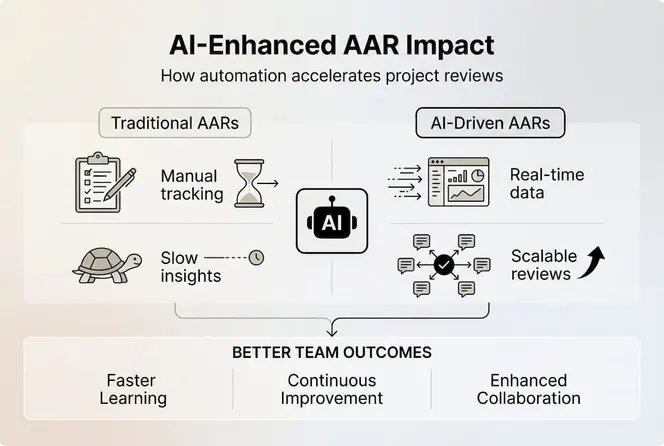
The Project Intelligence framework takes AI-enhanced AARs to the portfolio level. Rather than treating each project as an isolated learning opportunity, this approach builds a knowledge base that improves decision-making across your entire organization. The system tracks which estimation techniques prove most accurate for different project types, which risk mitigation strategies deliver the best results, and which team compositions drive the strongest performance.
| Dimension | Traditional AAR | AI-Enhanced AAR |
|---|---|---|
| Review frequency | Quarterly or at completion | Continuous with 48-hour cycles |
| Data sources | Manual surveys and interviews | Automated extraction plus surveys |
| Analysis depth | Single project focus | Portfolio-wide pattern recognition |
| Action enforcement | Manual follow-up | Automated tracking and alerts |
| ROI measurement | Qualitative assessment | Quantified savings and improvements |
| Knowledge retention | Document archives | Searchable intelligence database |
Pro Tip: Measure and communicate ROI to stakeholders quarterly to maintain support for AI-enhanced AAR initiatives. Calculate time saved through automation, cost avoided by preventing repeated mistakes, and revenue gained from improved project outcomes. Concrete numbers justify continued investment and expansion.
Integration with existing workflows determines adoption success. If your AI-enhanced AAR process requires team members to learn entirely new systems or complete lengthy surveys, engagement will plummet. Instead, configure tools to pull data automatically from systems teams already use and keep human input requirements minimal. A five-question pulse check takes two minutes and yields sufficient qualitative data when combined with automated quantitative metrics.
Start small and scale systematically. Pilot AI-enhanced AARs with one high-visibility project where success will demonstrate value to skeptics. Use lessons from the pilot to refine your approach before rolling out organization-wide. This staged implementation builds capability and confidence while minimizing disruption.
Enhance your project success with AI-driven solutions
Mastering AI-powered AAR reports positions your organization for sustained competitive advantage. The insights you gain translate directly into better project outcomes, stronger team performance, and improved client satisfaction.
Gammatica offers AI-driven platforms designed specifically for business leaders seeking to optimize project and team management. Our sales solutions help you close deals more efficiently by automating follow-up and surfacing the insights that matter most. The Gammatica VEX automation platform streamlines data collection and reporting, freeing your team to focus on strategic decisions rather than administrative tasks.
These tools complement AI-enhanced AAR approaches by ensuring the lessons you learn translate into systematic improvements across your operations. When your retrospectives identify communication gaps or process bottlenecks, Gammatica’s automation capabilities help you implement solutions quickly and track their effectiveness over time.
FAQ
What are AAR reports and why do they matter?
AAR reports document lessons learned after projects to improve future performance by capturing what worked, what didn’t, and why. They help teams identify successes and failures for continuous growth, creating organizational knowledge that prevents repeated mistakes. Effective AARs transform project experience into competitive advantage.
How does AI improve the effectiveness of AAR reports?
AI streamlines data capture and analysis for quicker, data-driven insights by automating AAR data collection and enforcing action through systematic follow-up. Automation helps ensure lessons learned lead to real change rather than remaining theoretical recommendations. The continuous feedback loops AI enables catch issues while they can still be corrected.
What are best practices for integrating AI in AAR reporting?
Use a 5-step process and maintain continuous retrospective rhythm for best results, including preparation, data gathering, analysis, recommendation, and tracking phases. Validate AI findings with human insight to catch nuances that algorithms miss, particularly regarding team dynamics and cultural factors. Maintain frequent retrospectives every 48 hours after milestones to avoid losing knowledge while context remains fresh.
What ROI can organizations expect from AI-powered AAR reports?
Continuous AI-driven retrospectives yield 35%+ savings by avoiding repeated project errors and improving resource allocation accuracy. Organizations also experience improved decision-making quality and enhanced team performance through faster feedback loops. The time savings from automation typically pay for AI tools within the first quarter of implementation.