TL;DR:
- Most SME leaders underestimate teamwork’s impact on hard results, missing out on increased productivity and profitability.
- High-performing teams demonstrate clear roles, trust, and shared purpose, which directly boost engagement and performance.
- Effective leadership behaviors are crucial, as managers influence up to 70% of team collaboration and trust levels.
Most SME leaders treat teamwork as a soft skill, something nice to have rather than a driver of hard results. That thinking is costly. High-performing teams are 20% more productive and profitable than their peers, according to Aon research. The gap between teams that collaborate well and those that don’t isn’t just about morale. It shows up in your revenue, your customer satisfaction scores, and how long your best people stick around. This guide cuts through the noise and gives you evidence-backed insights, plus practical steps you can start using today.
Key Takeaways
| Point | Details |
|---|---|
| Teamwork drives results | Effective teamwork boosts SME productivity, profitability, and engagement by double-digit percentages. |
| Key mechanics matter most | Psychological safety, clear roles, and trust are the proven ingredients for high-performing teams. |
| Balance collaboration and autonomy | Teamwork isn’t always best—sometimes solo work leads to more innovation and accountability. |
| Leadership sets the tone | Managers shape up to 70 percent of a team’s engagement, making leadership the linchpin of teamwork success. |
| Intentional practices win | SMEs should start with clear structure and regular trust-building to see rapid teamwork improvements. |
Why teamwork matters for SME success
Let’s start with the numbers, because they make the case better than any motivational speech.
Businesses that promote collaboration are five times more likely to be classified as high-performing. That’s not a marginal edge. That’s a structural advantage. And for SMEs competing against larger organizations with bigger budgets, every structural advantage matters enormously.
Here’s what strong teamwork actually delivers for your business:
- Higher productivity and output: Teams that communicate well eliminate duplicated work and resolve blockers faster.
- Better customer satisfaction: Coordinated teams respond to clients more consistently and with greater accuracy.
- Lower employee turnover: People stay where they feel supported. Collaboration creates that feeling.
- Stronger profitability: Reduced rework, fewer errors, and faster delivery all feed directly into your margin.
- Greater resilience: When one person is unavailable, a well-coordinated team absorbs the gap instead of stalling.
These aren’t theoretical benefits. They’re measurable. And the research is consistent across industries and company sizes.
“High-performing teams are 20% more productive and profitable.” — Aon Research, via Small Business Australia
The turnover point deserves extra attention. Replacing a skilled employee costs between 50% and 200% of their annual salary when you factor in recruiting, onboarding, and lost productivity. If your team environment is one where people feel isolated or undervalued, you’re essentially paying a hidden tax every year. Investing in employee engagement strategies directly reduces that cost.
The business case for teamwork isn’t just compelling. It’s undeniable. The question shifts from “should we prioritize collaboration?” to “how do we build it intentionally?”
The mechanics of high-performing teams
With a foundation in why teamwork pays off, it’s time to examine what makes teamwork actually work, or fail.
Google spent two years studying 180 of its own teams to answer exactly that question. The result was Project Aristotle, and it identified five key mechanics that distinguish high-performing teams from the rest:
- Psychological safety: Team members feel safe to take risks and speak up without fear of embarrassment or punishment.
- Dependability: People reliably complete quality work on time.
- Structure and clarity: Roles, goals, and execution plans are clearly defined.
- Meaning: The work feels personally significant to team members.
- Impact: The team believes their work makes a real difference.
What’s striking about this list? Notice that technical skills aren’t on it. Neither is compensation. The factors that most predict team effectiveness are relational and cultural, not transactional.
Deloitte research confirms this view. High-performing teams sustain their performance through human capabilities like curiosity, trust, and a commitment to learning, alongside the more obvious factors of structure, skills, and technology. Strip out the human elements and you’re left with a group of people following a process, not a team that generates real results.
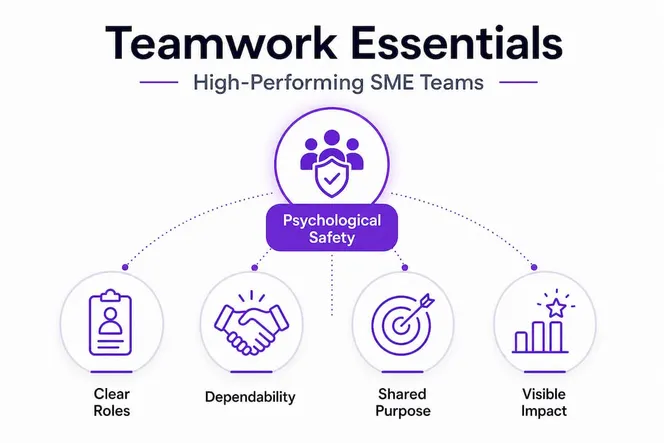
Here’s a quick look at what the research tells us about each mechanic and its impact:
| Mechanic | What it looks like in practice | Business impact |
|---|---|---|
| Psychological safety | Open feedback, no blame culture | Higher innovation, lower turnover |
| Dependability | Clear deadlines, accountability | Fewer missed deliverables |
| Structure and clarity | Defined roles, OKRs, shared goals | Faster decision-making |
| Meaning | Purpose-driven work, recognition | Higher engagement and retention |
| Impact | Visible results, regular progress updates | Stronger motivation and effort |
So how do you actually build these mechanics into your SME? Here’s where to start:
- Set clear roles and OKRs (Objectives and Key Results). Ambiguity about who owns what is one of the most common team killers. Write it down. Make it visible.
- Create a trust-first environment. Run regular one-on-ones. Ask questions more than you give answers. Show that feedback is welcomed, not penalized.
- Invest in team building exercises that build real rapport. Not just annual retreats. Regular, low-stakes activities that help people understand each other’s working styles.
- Connect the work to a bigger purpose. Help your team see how their daily tasks connect to the company’s mission and to your customers’ lives.
- Make progress visible. Share wins publicly. Recognize effort, not just outcomes.
Pro Tip: Managers account for 70% of the variance in team engagement levels, according to Gallup. That means your personal behavior as an SME leader has more influence on your team’s performance than almost any system, tool, or policy you could implement. Model the behaviors you want to see, consistently.
The pitfalls and limits of teamwork
Understanding the limits of teamwork helps leaders apply it more effectively and avoid common traps. Not every task belongs in a group setting, and pretending otherwise can actually hurt your results.
There’s a growing body of evidence suggesting that teamwork isn’t always the right answer. For certain creative or highly specialized tasks, solo work produces better outcomes. When you force collaboration onto work that doesn’t require it, you introduce delays, dilute individual accountability, and risk producing watered-down ideas that please everyone but excite no one.
The phenomenon of groupthink is real and dangerous. When teams prioritize harmony over honest disagreement, bold ideas get smoothed away. The consensus output is safe but rarely exceptional. Many of the most transformative business decisions in history were made by individuals willing to go against the group, not by committees.
“Overemphasis on teamwork without shared character or meaning leads to an illusion of alignment, not real collaboration.” — Forbes, 2026
A Forbes analysis of the Artemis II mission makes a compelling point here: the difference between a team and a crew comes down to character and shared values. Without those foundations, all the collaboration frameworks in the world produce only surface-level alignment. People go through the motions of teamwork without truly operating as one unit.
Here’s a practical comparison to help you decide when to assign collaborative work and when to let individuals run with it:
| Scenario | Best approach | Why |
|---|---|---|
| Complex, interdependent projects | Team collaboration | Multiple inputs and skills are required |
| Deep creative or innovative work | Solo work, then group review | Individual focus produces better original ideas |
| Time-sensitive decisions | Small group or individual | Larger groups slow decision-making |
| Problem-solving with diverse expertise | Team collaboration | Multiple perspectives increase solution quality |
| Repetitive or well-defined tasks | Individual work | Collaboration adds overhead without value |
| Strategic planning | Facilitated team session | Alignment and buy-in require group involvement |
The takeaway? Collaboration is a tool, not a religion. Apply it where it adds value.
Pro Tip: Before assigning any project to a team, ask yourself: does this task genuinely benefit from multiple perspectives and skill sets? If the honest answer is no, protect your top performers’ focus time and let them work independently. The best managers distinguish between tasks that need a team and tasks that just feel safer to outsource to one.
Actionable steps to build stronger teamwork in your SME
Finally, consider how to weave these lessons into your SME’s culture for enduring success. Knowing what high-performing teamwork looks like is one thing. Building it from scratch, or rebuilding it after dysfunction, is another challenge entirely.
Research consistently shows that collaborative firms gain 50% lower turnover and 60% higher engagement compared to peers, but these results require intentional practices rather than passive hope. You can’t wish your way to a collaborative culture. You have to build it step by step.
Here’s a practical playbook:
- Clarify your team’s purpose. Write a one-sentence team mission that everyone knows and believes in. This isn’t corporate fluff. It’s the anchor that pulls people back to shared goals when individual priorities compete.
- Assign clear ownership. Every deliverable needs a named owner. Shared ownership without a lead is often a recipe for nothing getting done.
- Establish a regular communication rhythm. Weekly team check-ins, brief daily standups, or asynchronous status updates, whatever fits your culture. Consistency matters more than format.
- Create psychological safety deliberately. Start meetings by sharing something you got wrong recently and what you learned. This signals that honesty is valued and safe.
- Invest in learning together. Bring in external speakers, share articles, run post-mortems after projects. Teams that learn together develop a shared language and mutual respect.
- Recognize collaboration, not just output. When you see someone helping a teammate, call it out publicly. You reinforce what you reward.
Simple repeatable practices that build trust and shared ownership over time include:
- Weekly wins: A short Friday message celebrating team achievements, big and small.
- Clear “who owns what” docs: A shared document listing each person’s responsibilities and current priorities.
- Retrospectives: A brief monthly conversation about what’s working, what isn’t, and what to change.
- Anonymous feedback channels: A way for team members to raise concerns without fear of attribution.
- Visible goals: A shared dashboard or board where everyone can see progress toward team targets.
One area that SME leaders managing international or multicultural teams often overlook is the role of cultural context in trust-building. Cultural differences significantly affect how teams develop trust. In many Western organizations, openly sharing mistakes is seen as a sign of psychological safety and intellectual honesty. But in cultures that prioritize saving face, the same behavior can actually undermine trust and create discomfort. If your team spans multiple countries or cultural backgrounds, build in time to understand those differences rather than assuming one approach fits everyone.
Pro Tip: Don’t just assess your team’s skills and output. Regularly assess team character: curiosity, openness to feedback, willingness to support peers. These qualities predict sustained high performance far better than individual talent alone. A team assessment every quarter can surface friction points before they become real problems.
The real secret: Effective teamwork starts (and ends) with leadership
Here’s the uncomfortable truth that most teamwork guides skip over: no framework, no software, and no team offsite will fix a collaboration problem that starts at the top.
Most advice about building strong teams focuses on processes. Set up the right meetings. Define the right roles. Choose the right tools. These things matter, but they’re secondary. The primary driver of whether teamwork actually takes root in your organization is the behavior of its leaders, every single day.
Managers drive 70% of the variance in team engagement. Read that again. Seventy percent. That means your team’s level of collaboration, motivation, and psychological safety is largely a reflection of how you show up as a leader. Not how you describe your culture in a hiring interview. How you actually behave in a difficult meeting, after a project fails, or when someone challenges your decision in front of the team.
The best SME leaders we’ve seen build genuinely collaborative cultures share a few specific habits. They admit when they’re wrong, and they do it publicly. They ask for feedback from their teams and act on it visibly. They respond to failure with curiosity rather than blame. And they model the kind of communication they want their teams to practice.
Here’s what that looks like in practice. A manager who says “I want us to be transparent” but reacts defensively when a team member raises a concern has taught their team one lesson: transparency isn’t safe. By contrast, a manager who says “I missed that deadline last week, and here’s what I’ll do differently” has created a permission structure for the whole team to own their mistakes and grow.
The hard truth is that leadership behavior is contagious. Whatever emotional norms you establish, whether that’s defensiveness or openness, blame or learning, your team will mirror them. You set the culture not by writing values on a wall but by how you act under pressure.
Pro Tip: If you want psychological safety in your team, you have to demonstrate it first. Share a real failure in your next team meeting. Invite pushback on a decision you’ve already made. Go first. Your team is watching to see whether collaboration is truly safe, and your actions answer that question louder than any policy.
Put teamwork insights into action with Gammatica
Building a high-performing, collaborative team requires more than good intentions. It requires the right systems for visibility, communication, and accountability.
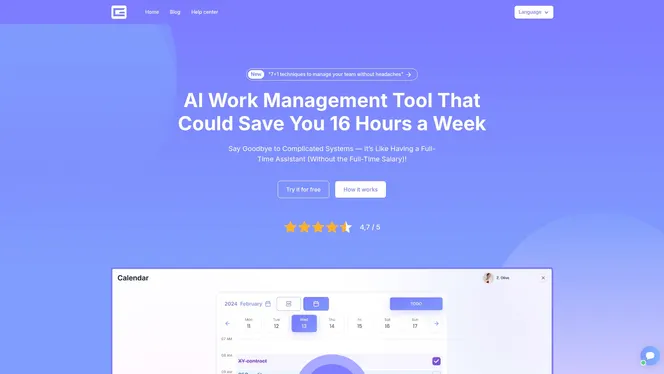
Gammatica is built to help SME leaders put these principles into daily practice. With tools for task management, Kanban workflows, team communication, and automated progress tracking, Gammatica for founders gives you a real-time view of how your team is performing and where collaboration is breaking down. Whether you’re managing a sales team, a project team, or a cross-functional group, Gammatica for sales teams supports the kind of role clarity, transparency, and shared accountability that research shows drives results. You could free up to 16 hours per week by letting the platform handle administrative overhead so your people can focus on meaningful, high-impact work.
Frequently asked questions
How can SMEs start improving teamwork with limited resources?
Begin by defining roles clearly, encouraging open communication, and modeling trust-building behaviors yourself. Google’s Project Aristotle shows that psychological safety and structure, not budget, are the strongest predictors of team effectiveness.
Is teamwork always better than solo work in business?
No. Some tasks are better handled individually, particularly deep creative work or specialized analysis, while teamwork excels on complex, interdependent projects that require multiple skill sets and perspectives.
What are the top factors for building a high-performing team?
Psychological safety, clear roles, dependability, shared purpose, and visible impact are the five essentials identified by Google, while Deloitte’s research adds that human capabilities like curiosity and trust are equally critical alongside structure and skills.
How do cultural differences affect teamwork?
Global teams face significant variation in how trust is built and maintained. Openly sharing mistakes, which builds trust in many Western cultures, can actually erode it in cultures where protecting face and group harmony take priority.