TL;DR:
- Effective task management requires clear ownership, regular progress checks, and fostering team trust.
- Using appropriate frameworks like OKRs, Agile sprints, and Eisenhower Matrix enhances focus and accountability.
- Trust between managers and teams is crucial for delegation success and maintaining high engagement levels.
Picture this: you’re a manager, your calendar is packed, your team is waiting for direction, and somehow half your day has already vanished doing work that was never really yours to begin with. You’re not alone. 46% of manager time gets consumed by individual contributor work, which helps explain why global manager engagement sits at just 22%. This guide gives you practical, proven steps to take back that time, delegate with confidence, and build a team that runs with clarity and purpose.
Key Takeaways
| Point | Details |
|---|---|
| Audit your process | Regularly assess your team’s workflow to find and eliminate bottlenecks. |
| Pick the right tools | Match framework and technology choices to your team’s real needs for best results. |
| Delegate for growth | Effective delegation means clear instructions, accountability, and making it a positive experience. |
| Track and motivate | Ongoing monitoring and feedback are essential to keep teams engaged and productive. |
| Trust drives success | Building team trust matters more than any single software for lasting improvement. |
Assess your current task management process
Once you understand the scope of the problem, it’s time to break down your current system before building a better one.
Most teams don’t feel overwhelmed because they’re lazy or underskilled. They feel overwhelmed because nobody has clearly defined who owns what, when it’s due, or what “done” actually looks like. Sound familiar? If your team regularly misses deadlines, duplicates efforts, or waits on you to make small decisions, those are warning signs your task management process has gaps.
Before fixing anything, audit what you already have. Collect three types of data: your email threads (look for how many messages are clarification requests), your meeting logs (count how many meetings are status updates that could be an async check-in), and screenshots or exports from your current project management tools. You’re looking for bottlenecks, repeated questions, and tasks that stall at the same person or stage every time.
Following office management best practices means treating your process like a product. If it breaks repeatedly at the same point, that’s not a people problem. That’s a system problem.
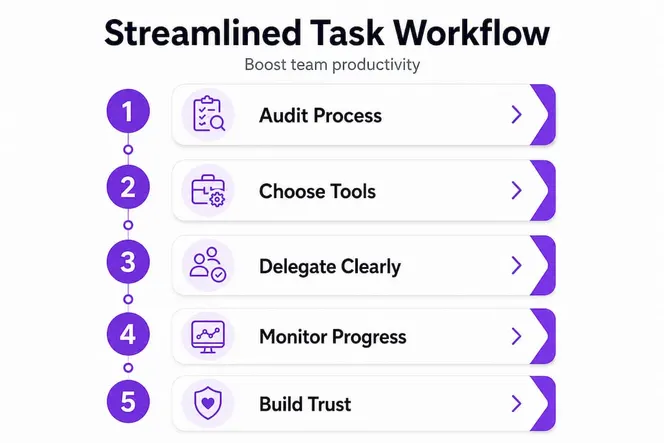
Here’s a quick breakdown of common warning signs and what they signal:
| Warning sign | What it likely means |
|---|---|
| Tasks assigned verbally or by chat only | No single source of truth for task status |
| Repeated status update meetings | No live visibility into progress |
| Manager approves every small decision | Delegation is unclear or not trusted |
| Deadlines missed more than 30% of the time | Priorities aren’t aligned to capacity |
| Team members unsure of their top three tasks | Goal clarity is missing |
The most telling data is usually the simplest. When you ask your team “What are your top three tasks this week?” and they struggle to answer, that tells you everything you need to know.
Common signs your task management needs attention:
- Tasks assigned with no documented deadline or owner
- No visible progress tracker or shared dashboard
- Managers pulled into every decision, large or small
- Feedback is given only at completion, not along the way
- Team members work in silos with no visibility into related work
Pro Tip: Run a one-week time audit on yourself and one or two team members. Track every task in 30-minute blocks, then categorize each as “only I can do this,” “I could delegate this,” or “this shouldn’t exist.” Most managers find that 30 to 40 percent of their week falls into the second or third category. That’s your starting point.
With 46% of manager time lost to low-value individual work, the audit almost always reveals more opportunity than managers expect. The goal here isn’t to criticize your current process. It’s to see it clearly so you can improve it with intention.
Choose the right tools and frameworks
Once you’ve highlighted weaknesses in your current processes, the next step is implementing focused tools and proven frameworks.
The good news is you don’t need a dozen new apps. You need the right approach matched to the right tool. Let’s start with frameworks because tools without a framework are just more noise.
Three frameworks worth knowing:
- OKRs (Objectives and Key Results): Connect daily tasks to broader company goals. Each team member can see how their work ladder up to what the organization is trying to achieve. OKRs align tasks to strategic objectives, with 70% achievement treated as a success benchmark in Agile environments. This reduces busywork because everyone can ask “does this task move my key result?”
- Agile sprints: Time-box work into focused cycles, usually one to two weeks. This works well for teams managing multiple concurrent projects or product development work. It builds a natural rhythm of planning, doing, and reviewing.
- Eisenhower Matrix: Organize tasks by urgency and importance. This is the simplest framework to introduce and it helps teams see the difference between what demands immediate attention and what’s just noise. Many teams use it for their weekly planning sessions.
Comparison of top task management tools:
| Tool | Best for | Key strength | Framework fit |
|---|---|---|---|
| Asana | Mid-sized teams | Visual task tracking | Agile, OKRs |
| Trello | Smaller teams | Simple Kanban boards | Agile sprints |
| Monday.com | Cross-functional projects | Customizable dashboards | OKRs, Agile |
| Gammatica | Managers and founders | AI-driven automation, CRM, delegation | OKRs, Agile |
| Notion | Documentation-heavy teams | Wiki plus task combo | Flexible |
| Jira | Engineering teams | Deep sprint management | Agile |
When streamlining helpdesk workflows or any team process, the best tool is the one your team will actually use consistently. Fancy features mean nothing if adoption is low.
For managers who want digital task management solutions that scale without requiring a full IT rollout, AI-assisted platforms are increasingly the smart choice. They can suggest task priorities, automate recurring reminders, and flag when a project is falling behind, all without you having to monitor every single update.
Pro Tip: Match your tool to your team’s current maturity. If your team doesn’t use any shared task system today, don’t start with a complex enterprise platform. Start with something simple and visible. Upgrade as habits form. A basic Kanban board with clear columns (To Do, In Progress, Done) is enough to transform a chaotic team into a functional one in weeks.
Delegate tasks with clarity and accountability
Choosing the right tool is only step one. How you assign and delegate tasks is where teams either thrive or stall.

Delegation is one of the most misunderstood skills in management. It’s not about offloading work you don’t want. Done well, it builds capability, increases engagement, and frees you to do the strategic work only you can do. Done poorly, it creates confusion, resentment, and rework.
Effective delegation requires a clear briefing that covers the outcome, the authority level, the deadline, available resources, and a scheduled check-in. Without those five elements, even your most capable team member is guessing.
Here’s a 7-step process you can follow for every meaningful task you delegate:
- Choose the right task. Not everything should be delegated. Focus on tasks where someone else can do it nearly as well as you, or tasks that help them grow.
- Choose the right person. Match the task to someone’s current skills or development goals. Stretch is good. Overwhelm is not.
- Clarify the desired outcome. Don’t describe the steps. Describe the result. “I need a slide deck” is not clear. “I need a five-slide summary of our Q2 pipeline for the board, ready by Thursday at noon” is clear.
- Set the authority level. Does this person decide independently? Consult you first? Keep you informed after? Ambiguity here causes constant interruptions.
- Provide the resources and access needed. Don’t delegate a task and then create blockers. Make sure they have what they need before they start.
- Schedule a check-in, not a micromanagement loop. Agree on one or two touchpoints to review progress. This is different from hovering. It’s structured support.
- Give specific feedback at completion. Not just “good job.” Tell them what worked and what could improve next time. This builds the capability that makes your next delegation easier.
“The biggest delegation mistake is assigning a task without agreeing on what success looks like. People disengage not because they can’t do the work, but because they don’t know when they’ve done it right.” Research on Eisenhower Matrix delegation pitfalls confirms that poorly structured delegation quietly demotivates even your strongest performers.
Two patterns kill delegation before it starts. The first is task dumping, where you hand off a pile of work with no context or timeline. The second is over-checking, where you ask for updates so often that the person feels untrusted and stops making decisions independently.
Pro Tip: When you delegate a task, explicitly connect it to the person’s career development. “I want you to lead this client presentation because it builds the kind of stakeholder communication skill you’ll need for a senior role” is far more motivating than “I need you to handle this.” Framing matters. It’s the difference between burden and opportunity.
Monitor progress and keep your team motivated
Effective delegation needs follow-through. Here’s how to measure success and spark ongoing motivation.
Once tasks are assigned, your role shifts from assigner to enabler. You’re not checking up to catch people failing. You’re checking in to remove blockers early and celebrate wins visibly. That distinction changes everything about how your team experiences your leadership.
Here are the most practical ways to track progress without micromanaging:
- Daily or weekly stand-up meetings: Keep them to 15 minutes. Focus on three questions: What did you complete? What are you working on next? What’s blocking you?
- Shared dashboards: A live Kanban board or project tracker gives everyone visibility without requiring a meeting. Status updates happen in the tool, not your inbox.
- Checkpoint data reviews: At the midpoint of any significant project, review key metrics together. This isn’t a performance review. It’s a course correction conversation.
Here’s a simple weekly review table you can use with your team:
| Review question | What to look for |
|---|---|
| Are top priorities still the same? | Scope creep or new urgent tasks shifting focus |
| What got completed this week? | Momentum and team confidence indicators |
| What’s blocked and why? | Systemic issues vs. one-time problems |
| What needs a decision before next week? | Your action items as a manager |
| How is team energy? | Early warning for burnout or disengagement |
Poor task alignment is one of the top drivers of employee disengagement. When global engagement sits at 22% among managers themselves, it’s no surprise it ripples down to their teams. People don’t disengage because the work is hard. They disengage when they can’t see the point of what they’re doing.
Feedback that motivates rather than micromanages:
- Be specific: “Your summary saved us 20 minutes in the meeting” beats “Nice work”
- Be timely: Feedback given the same day lands better than feedback given a week later
- Focus on behavior, not personality: “That report structure was clear and easy to follow” is more useful than “You’re so organized”
- Ask questions before giving answers: “What do you think worked best here?” builds ownership
For practical ideas on boosting employee engagement through task alignment, the core principle is simple. People want to know their work matters. Your job is to show them how it connects to something bigger.
Why managing tasks well is about trust, not just tools
Here’s the take most guides skip: the biggest barrier to better task management isn’t your software. It’s whether your team trusts you to give them real ownership.
We’ve seen managers invest heavily in project management platforms, roll out OKRs with beautiful slides, and redesign their entire workflow structure. And still, nothing changes. Why? Because the tool is the last 20 percent. The first 80 percent is the relationship dynamic between manager and team.
When managers hold on to decisions they should delegate, it’s often fear. Fear that the work won’t be done right. Fear of losing control over outcomes they’re accountable for. That’s understandable. But that fear is expensive. It costs your team’s growth, your own time, and ultimately, their engagement.
Here’s what we’ve noticed about managers who genuinely transform their team’s task management. They don’t just hand off tasks. They hand off ownership. They say “this is yours to figure out, and I trust you” and then actually step back. That single shift, from assigning tasks to granting ownership, changes how people show up.
Trust also multiplies the effectiveness of every framework you implement. OKRs work better when people believe their manager will actually act on what the results show. Agile sprints work better when team members feel safe raising blockers without fear of judgment. The Eisenhower Matrix works better when delegation isn’t code for “work I don’t want.”
You can spot trust in a team’s task management by a few practical signs. Team members raise blockers proactively instead of waiting for things to break. Mistakes get reported early, not hidden. And people ask “what else can I take on?” instead of waiting to be told. That’s not a culture you buy with a software subscription. That’s one you build through consistent, clear, respectful delegation over time. The tools just make the good behavior easier to sustain.
How Gammatica helps leaders master team task management
If you’ve been nodding along to every section of this guide, you already know the core challenge. You need a system that gives your team clarity, makes delegation easy, and lets you track progress without drowning in status updates.
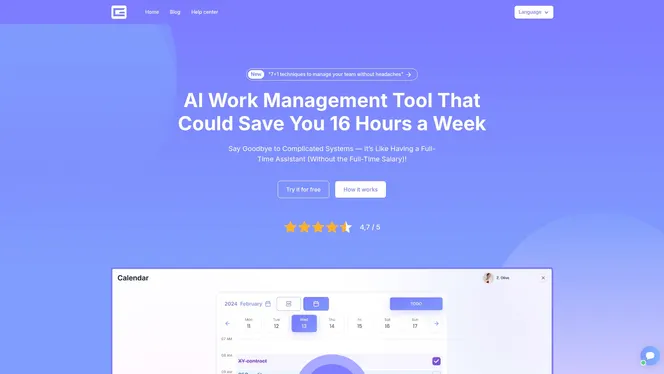
Gammatica for founders and team leaders is built exactly for this. The platform combines AI-driven task management, Kanban boards, automated reminders, and a built-in CRM so you can manage your team’s work and your client relationships in one place. Managers using Gammatica report saving up to 16 hours per week by eliminating the back-and-forth that kills productivity. You get pre-made templates, permission controls, and integrations with tools like Make.com, Zoom, and Google Meet, so the setup is fast and the adoption curve is low. If you’re ready to stop managing chaos and start managing with clarity, Gammatica is worth a serious look.
Frequently asked questions
What’s the most common mistake managers make when delegating tasks?
Most managers fail to define a clear outcome or schedule a structured check-in, which leaves team members guessing and leads to disengagement. A 7-step delegation process covering outcome, authority, deadline, resources, and follow-up prevents this almost entirely.
How often should I review my team’s progress on tasks?
Weekly reviews using a short check-in meeting or a shared dashboard update work well for most teams, with a quick daily stand-up optional for fast-moving projects.
How do OKRs help with managing employee tasks?
OKRs connect each task to a specific measurable goal, so team members always know why their work matters. With a 70% achievement benchmark as the target in Agile environments, OKRs also remove the pressure of perfection while maintaining ambition.
What’s the impact of poor task management on team engagement?
When managers spend nearly half their time on individual contributor work, their teams lose a coach and gain an overwhelmed colleague. This contributes to global engagement dropping to as low as 22%, which has measurable effects on output, retention, and morale.