Losing a new hire within their first six weeks is more common than most managers realize. Up to 20% of turnover happens in the first 45 days, almost always because onboarding was rushed, vague, or treated as a single-day event. For small to mid-sized teams, that kind of churn is expensive and demoralizing. The good news? A structured, phase-based onboarding process can change everything. This guide walks you through exactly what to do, from pre-boarding prep to 90-day check-ins, so your new hires hit the ground running and actually stay.
Key Takeaways
| Point | Details |
|---|---|
| 90-day onboarding matters | Structured onboarding for at least 90 days greatly improves retention and productivity. |
| Tools and checklists boost consistency | Using digital checklists and clear tools minimizes errors and streamlines the process. |
| 4 C’s drive onboarding success | Covering Compliance, Clarification, Culture, and Connection ensures a well-rounded program. |
| Remote teams need extra care | Onboarding remote hires requires extra attention to technology, communication, and early engagement. |
| Regular measurement is essential | Review retention, productivity, and feedback to continuously refine your onboarding efforts. |
What effective onboarding means
Let’s clear something up right away. Orientation and onboarding are not the same thing. Orientation is what happens on Day 1: paperwork, office tour, introductions. Onboarding is the full process of integrating a new hire into your team, culture, and workflows. Onboarding spans at least 90 days and can extend up to 12 months for complex or senior roles.
Why does this distinction matter? Because companies that treat onboarding as a one-day event are leaving serious value on the table. Research shows that structured onboarding programs drive an 82% improvement in retention and a 70% boost in new-hire productivity. That’s a pretty good return on investment for something you can systematize.
“Onboarding is not an event. It’s a process that shapes how a new employee understands their role, their team, and the company’s mission.”
A useful framework to guide your program is the 4 C’s of onboarding:
- Compliance: Legal and policy requirements (contracts, safety, HR paperwork)
- Clarification: Role expectations, goals, and performance standards
- Culture: Company values, norms, and unwritten rules
- Connection: Relationships with teammates, managers, and mentors
Every strong onboarding program addresses all four. Miss one, and you’ll likely see disengagement or confusion down the road.

Essential elements and tools for successful onboarding
Now that you understand why onboarding is so critical, let’s clarify what you’ll need to prepare before welcoming new hires. Good intentions aren’t enough. You need the right resources in place.
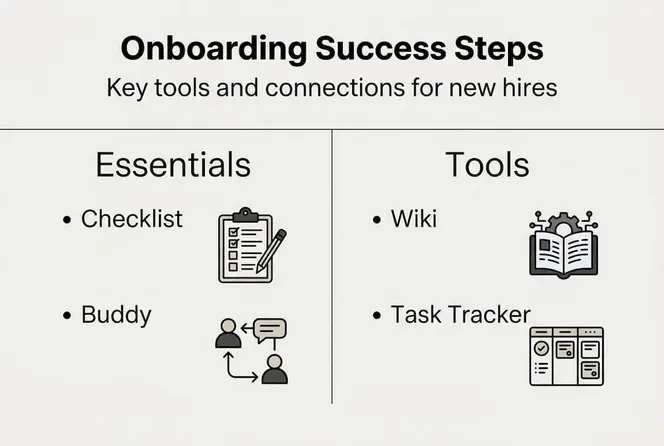
| Resource | Purpose | Example tools |
|---|---|---|
| Onboarding checklist | Tracks tasks and milestones | Gammatica, Notion |
| HRIS software | Manages HR data and paperwork | BambooHR, Rippling |
| Communication channels | Keeps new hires connected | Slack, Microsoft Teams |
| Buddy program | Provides peer support | Internal assignment |
| Training materials | Builds role-specific knowledge | LMS, recorded videos |
Structured checklists reduce errors and ensure nothing falls through the cracks, especially for small teams where HR bandwidth is limited. Digital tools handle paperwork faster, reduce manual follow-up, and give managers a clear view of where each new hire stands.
Speaking of managers, their role in onboarding is often underestimated. Managers should:
- Schedule regular one-on-ones during the first 90 days
- Set clear 30, 60, and 90-day goals with the new hire
- Actively introduce the new hire to key stakeholders
- Gather feedback at each milestone to adjust the process
Pro Tip: Assign a dedicated onboarding buddy (a peer, not a manager) to every new hire. This single step dramatically reduces the anxiety of starting a new job and accelerates cultural integration.
Step-by-step onboarding process: 90-day blueprint
With your tools and resources ready, here’s exactly how to execute a high-impact onboarding process from pre-boarding through the first three months.
Phase 1: Pre-boarding (before Day 1)
- Send a welcome email with first-day logistics, parking, dress code, and schedule
- Set up accounts, equipment, and system access before the hire arrives
- Share a digital welcome packet with company overview and team bios
- Assign an onboarding buddy and notify them of their role
Phase 2: Day 1
- Greet the new hire personally, don’t leave them to figure things out alone
- Complete required compliance paperwork and policy reviews
- Conduct a team introduction (in-person or virtual)
- Walk through the 30-day plan together so expectations are crystal clear
Phase 3: First 30 days
- Focus on learning: product, processes, tools, and team dynamics
- Hold weekly one-on-ones to address questions and build rapport
- Assign a small, achievable project to build confidence
- Gather initial feedback on the onboarding experience
Phase 4: Days 31 to 60
- Shift from learning to contributing: assign real responsibilities
- Review progress against 30-day goals and set 60-day targets
- Introduce cross-functional relationships and broader company context
Phase 5: Days 61 to 90
- Evaluate performance against initial goals
- Discuss career development and long-term expectations
- Formalize the transition from “new hire” to full team member
Phased onboarding reduces time-to-productivity by 34% and gives both managers and new hires clear milestones to work toward. Compare the outcomes:
| Onboarding approach | Retention at 90 days | Time to full productivity |
|---|---|---|
| Unstructured (1-day) | Low (high early turnover) | 6 to 12 months |
| Structured (90-day phased) | High (82% improvement) | 2 to 3 months |
Pro Tip: Document your onboarding process in a shared wiki or checklist tool. This makes it repeatable, scalable, and easy to hand off when your team grows.
Adapting onboarding for remote and hybrid teams
While this process works well for in-person teams, remote and hybrid workplaces require some smart adjustments for success. The core principles stay the same, but the execution looks different.
Here’s what changes for distributed teams:
- Equipment delivery: Ship equipment and IT setup instructions before the start date so the new hire isn’t stuck waiting on Day 1
- Digital check-ins: Replace hallway conversations with scheduled video calls via Zoom or Google Meet
- Virtual introductions: Use structured team calls or async video intros to build connection
- Clear IT documentation: Provide step-by-step guides for accessing tools, VPNs, and communication platforms
- Culture-building: Create virtual coffee chats, online team rituals, and shared digital spaces
“Remote onboarding requires more intentionality than in-person onboarding. What happens naturally in an office must be deliberately designed online.”
For deeper strategy, explore this guidance for hybrid work and these remote staff management strategies to build a program that works across locations. The teams that get remote onboarding right invest in communication infrastructure and manager training, not just technology.
Common mistakes in onboarding and how to avoid them
To maximize the value of your onboarding plan, make sure you sidestep these common mistakes and know exactly how to keep your process on track.
- Treating onboarding as a one-day event. Best practices extend onboarding 90 or more days. A single orientation session leaves new hires confused and unsupported.
- Skipping goal-setting. Without clear 30/60/90-day goals, new hires don’t know what success looks like. Set expectations early and revisit them often.
- Overloading with information on Day 1. Dumping every policy, tool, and process on a new hire in one sitting leads to overwhelm. Spread learning across the first few weeks.
- Ignoring feedback. If you never ask new hires how the process is going, you’ll repeat the same mistakes. Build in formal check-ins and anonymous surveys.
- Leaving managers unprepared. Onboarding doesn’t run itself. Managers need coaching on how to support new hires, set goals, and give constructive feedback.
- Using too many tools. Tool overload is real. Stick to a focused set of platforms and make sure new hires know exactly where to find what they need.
Pro Tip: Run a short retrospective after every new hire’s first 90 days. Ask what worked, what was confusing, and what was missing. Use that input to improve the next onboarding cycle.
Measuring onboarding success and making improvements
Once your onboarding process is active, regularly measuring progress and acting on feedback ensure ongoing improvement and greater impact. You can’t improve what you don’t measure.
Here are the key metrics to track:
- New-hire retention rate at 30, 60, and 90 days: Are people staying? Early exits signal a broken process.
- Time to productivity: How long before a new hire is contributing independently? Shorter is better.
- eNPS (employee Net Promoter Score): This measures how likely employees are to recommend your company as a place to work. Collect it at 30 and 90 days.
- Manager satisfaction scores: Ask managers to rate new-hire readiness at each milestone.
- Onboarding completion rate: Are all checklist items actually being completed, or are steps being skipped?
Track retention, productivity, and eNPS at each milestone to get a clear picture of what’s working. Use pulse surveys (short, 3 to 5 question check-ins) to gather real-time feedback without overwhelming new hires.
The goal isn’t perfection on the first try. It’s building a feedback loop that makes each onboarding cycle better than the last. As your team grows, your onboarding process should scale with it, becoming more structured, more automated, and more personalized over time.
Boost your team’s onboarding with Gammatica
Building a repeatable, structured onboarding process is much easier when you have the right platform behind you. Gammatica brings together task management, checklists, team collaboration, and automation in one place, so you can design and run your entire onboarding workflow without juggling multiple tools.
With Gammatica, you can create onboarding checklists, assign tasks to managers and buddies, track progress across your 90-day plan, and automate reminders so nothing gets missed. The Gammatica Sales platform also supports CRM and customer journey management, making it a strong fit for teams that want to align new-hire onboarding with broader business operations. If you’re ready to stop reinventing the wheel every time someone new joins your team, Gammatica is worth exploring.
Frequently asked questions
How long should onboarding really last?
Onboarding is most effective when it spans at least 90 days, and for complex or senior roles, it can extend up to 12 months. A single day of orientation is never enough.
What are the 4 C’s of onboarding?
The 4 C’s framework covers Compliance, Clarification, Culture, and Connection. Every effective onboarding program should address all four areas to set new hires up for success.
How is onboarding different for remote teams?
Remote and hybrid teams need extra focus on early equipment delivery and digital check-ins, along with intentional relationship-building through virtual meetings and structured communication.
What’s the impact of skipping structured onboarding?
Poor onboarding leads to up to 20% new-hire turnover in the first 45 days, plus slower productivity gains that cost your team time and money.
How do I measure onboarding success?
Track retention and productivity stats along with eNPS at 30, 60, and 90 days. Short pulse surveys after each milestone give you actionable data to improve the next cycle.