TL;DR:
- Buying advanced AI project management tools does not automatically improve team collaboration because core issues like accountability and trust remain leadership responsibilities. Psychological safety, cooperation, and clear structure are vital for team performance and can be actively cultivated through deliberate actions. AI enhances culture and efficiency but cannot replace the human dynamics necessary for thriving teams, especially during different development stages.
Buying the latest AI project management software and expecting your team to suddenly collaborate like a well-oiled machine is a bit like buying a high-end treadmill and expecting to run a marathon without training. The tool matters, but it is not the whole story. Most managers are surprised to discover that even teams using sophisticated AI-driven platforms still struggle with the same old issues: accountability gaps, miscommunication, and low trust. This article gives you concrete, research-backed strategies to close that gap, building teams that genuinely thrive by pairing powerful technology with the human dynamics that actually drive performance.
Key Takeaways
| Point | Details |
|---|---|
| Human dynamics matter most | Team effectiveness depends most on trust, safety, and cooperation, even with advanced AI tools. |
| AI boosts but doesn’t replace | AI-driven platforms can enhance reporting and efficiency but don’t solve core human collaboration issues. |
| Psychological safety can be built | Leaders can use specific interventions to increase safety and cooperation within teams. |
| Stage-based AI impact | AI has the greatest influence during team performance peaks and project closure. |
| Leadership shapes outcomes | The role of managers is crucial in blending technology and culture for lasting team development. |
Why team development matters in the AI era
AI has changed the way teams work. Task automation, smart scheduling, and real-time dashboards have made operations faster and more transparent. But here is what many leaders miss: speed and visibility do not automatically fix the coordination challenges that slow teams down at their core.
The human side of teamwork, things like trust, openness to feedback, and willingness to take risks, remains just as critical as ever. Research consistently backs this up. Psychological safety is a key dynamic for team effectiveness, defined as a shared belief that the team is safe for interpersonal risk-taking. This finding comes from Google’s Project Aristotle, one of the most rigorous studies ever conducted on what separates high-performing teams from average ones. The result was striking: psychological safety outranked everything else, including individual talent.
What does that mean for you as a manager? It means your AI tools can surface who completed what task and when, but they cannot make your team feel safe enough to admit when something is not working. That part is on you.
“AI did not fundamentally solve collaboration issues like accountability and communication, but it shifted collaboration culture toward greater efficiency and transparency.”
The key insight here is that AI shifts the culture around how teams work, but the core collaboration challenges remain a leadership problem. Technology is an enabler, not a replacement. The teams winning right now are the ones whose managers understand this distinction and invest equally in people and tools.
Here is what persists regardless of the AI tools your team uses:
- Accountability gaps: Who is responsible when something falls through the cracks? AI can track tasks, but it cannot build a culture of ownership.
- Communication quality: Dashboards show status updates, not nuance. Misunderstandings still happen.
- Conflict resolution: Disagreements about priorities, approaches, or roles need human judgment to resolve.
- Motivation and morale: No automation tool has ever genuinely motivated a disengaged team member.
Core ingredients: Psychological safety, cooperation, and structure
So what actually builds a strong team? The research points to a clear set of conditions, and psychological safety sits at the top of the list. But it does not exist in isolation. It works together with cooperation, clarity of roles, and deliberate structure to create a team climate where people do their best work.

Let’s look at the evidence across different industries and countries. A cross-national study in Future Business Journal found that psychological safety positively affected cooperation in both Brazil (β=0.365) and Germany (β=0.568), and this effect influenced dynamic capabilities, meaning the team’s ability to adapt and innovate over time. These are not small effects, and the fact that they showed up across two very different business cultures tells you something important: these dynamics are universal.
| Factor | Brazil (β value) | Germany (β value) | Business impact |
|---|---|---|---|
| Psychological safety on cooperation | 0.365 | 0.568 | Higher adaptability and innovation |
| Cooperation on dynamic capabilities | Significant | Significant | Stronger competitive advantage |
| Structure and intervention | Measurable | Measurable | Reduced conflict and bullying |
The good news is that psychological safety is not just a personality trait some teams are lucky to have. It can be actively cultivated. A structured, group-based intervention was shown in a cluster randomized controlled trial to increase psychological safety and reduce bullying behaviors within teams. This means that deliberate, structured efforts by leaders actually move the needle in measurable ways.
What does a structured intervention look like in practice? It can be as practical as facilitated team retrospectives where everyone is invited to share what went well and what did not, with explicit ground rules against negative reactions to honest input. It can include regular one-on-ones where managers ask about barriers rather than just deliverables. The structure itself, consistent, repeated, safe formats for open communication, is what creates the conditions for safety to grow.
Cooperation is the direct output of psychological safety. When people feel safe, they share information, ask for help, and support each other’s success. When they do not feel safe, they protect themselves, hold information back, and compete internally. This is why two teams with identical AI toolsets can produce wildly different results: the human climate determines whether the tools get used effectively.
Pro Tip: Start your next team meeting with a simple “rose and thorn” check-in, where each person shares one thing going well and one challenge. This takes five minutes and consistently builds the psychological safety that transforms team performance over time.
The evolving team: AI’s role in collaboration and performance
Now let’s get specific about what AI tools actually do for teams, and where their limits are.
A longitudinal study of AI in project teams found that AI use was mainly to accelerate individual tasks, while collaboration issues around performance accountability and communication remained. Participants did report meaningful culture shifts, including norms around efficiency and expectations of transparency and responsible use. So AI raises the bar culturally, but it does not resolve the interpersonal dynamics underneath.
On the more optimistic side, a field experiment at Procter & Gamble found that working with AI improved professional performance and helped break down functional silos in new product development teams. That is a significant finding. Cross-functional collaboration is notoriously hard to build, and AI tools that surface shared data and reduce information asymmetry can genuinely help teams work across departments more effectively.
Here is a balanced comparison of where AI delivers and where it falls short:
| Area | AI strengths | AI limitations |
|---|---|---|
| Task management | Automates assignments, tracks deadlines | Cannot enforce accountability culture |
| Communication | Centralizes updates and status reports | Cannot replace meaningful dialogue |
| Performance visibility | Real-time dashboards and metrics | Data without context can mislead |
| Silo-breaking | Shared data across departments | Trust between teams still requires human effort |
| Onboarding | Templates, wikis, structured workflows | Human mentorship and culture cannot be templated |
Based on the research, here are the four most common ways teams misuse AI-driven tools:
- Treating dashboards as conversation replacements. Status updates in a system are not the same as genuine check-ins. Keep your human touchpoints.
- Automating accountability away. When every reminder is automated, no one feels personally responsible. Assign clear human owners.
- Using AI tools as performance surveillance. Tracking everything your team does erodes trust fast. Use data to support, not police.
- Skipping the cultural groundwork. Launching a new platform without aligning the team on how and why you are using it creates confusion, not efficiency.
The teams getting the best results from AI tools are the ones that use them to free up time for more meaningful human interaction, not to replace it.
Applying a staged approach: AI’s influence across team development phases
One of the most practical frameworks for team development is Tuckman’s model, which describes five stages every team moves through: forming, storming, norming, performing, and adjourning. Each stage has different needs, and AI tools are not equally useful across all of them.
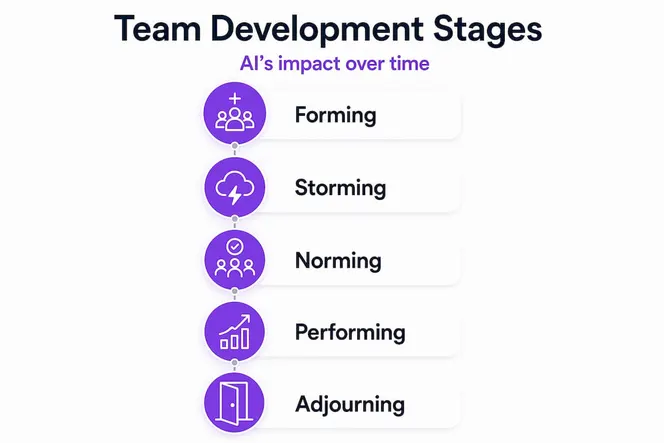
A manager survey on AI across Tuckman’s stages found that perceived AI influence was highest in the performing and adjourning phases. This makes intuitive sense. When a team is already well-coordinated and in full execution mode, AI tools that automate routine tasks and surface performance data add real value. When a team is wrapping up a project, AI can help with documentation, knowledge capture, and transition planning.
What this means for each stage:
- Forming: Use AI tools to onboard team members with structured wikis, role clarity documents, and shared project templates. Keep human introductions and expectations-setting front and center. AI sets the foundation; you set the tone.
- Storming: This is the most human-intensive stage. Conflict and confusion need facilitated conversations, not more automation. Use AI to reduce administrative noise so you can focus more energy on the team dynamics.
- Norming: Start introducing AI-assisted workflows and check-ins. Kanban boards, automated reminders, and shared calendars help reinforce the norms the team is developing.
- Performing: Now is when AI tools shine. Automate routine tasks, track metrics, and use AI suggestions to optimize how work flows through the team. This is also when psychological safety should be strong enough to have honest performance conversations.
- Adjourning: Use AI to capture lessons learned, document processes, and create reusable templates for future teams. Knowledge preservation is one of AI’s clearest strengths.
The takeaway here is that your investment in AI tools should scale with your team’s maturity. Throwing advanced automation at a storming team creates more chaos. Matching the tool to the stage is a simple but powerful shift in how you manage.
Beyond tools: What most team development advice misses
Here is the uncomfortable truth: most team development advice focuses on events, workshops, and tools, when the real work happens in the ordinary moments between those things.
The strongest finding across all the research we have reviewed is that team performance depends on the conditions leaders shape, especially psychological safety combined with clarity and structure. Not on team-building events. Not on the platform you deploy. On the daily choices you make as a manager about how to respond when someone makes a mistake, how you handle disagreement in a meeting, and whether people feel seen and valued.
This is where most technology-first thinking goes wrong. Leaders invest in a new AI project management platform and declare the collaboration problem solved. But the platform only reflects the culture it is embedded in. A psychologically unsafe team will use a sophisticated tool to cover up problems rather than surface them. A high-trust team will use even a basic tool effectively because they are already communicating well.
What you can do right now as a leader:
Build feedback loops, not just reporting cycles. There is a difference between a manager reviewing a dashboard and a team regularly reflecting on what is working. Build structured retrospectives into your rhythm, not just end-of-project reviews.
Design for clarity, not just efficiency. Every team member should be able to answer three questions without hesitation: What am I responsible for? How does my work connect to team goals? What does success look like this week? AI tools help answer the first question. The other two require leadership clarity.
Model psychological safety yourself. When you admit uncertainty, acknowledge mistakes, and genuinely welcome pushback, you give your team permission to do the same. No tool can replicate that signal.
The leaders seeing the biggest results are not necessarily using the most advanced technology. They are using technology intentionally, as an enabler of conditions they are already working hard to create.
See your team thrive with smarter project management
Building a high-performing team requires the right human strategies and the right tools working together. If you are ready to put the frameworks in this article into practice, Gammatica gives your team the infrastructure to make it happen every day.
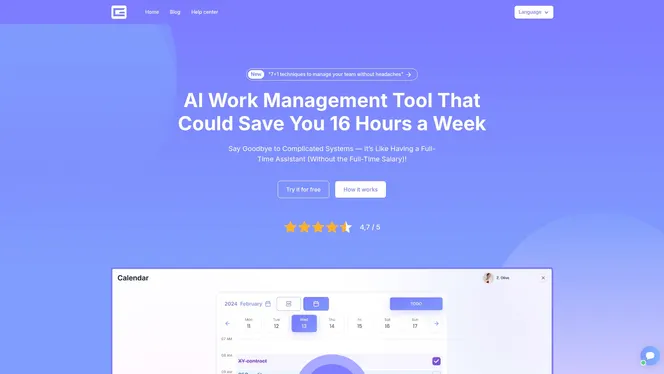
Gammatica’s AI-driven platform brings together task management, Kanban boards, CRM, automation, and team collaboration tools in one place, so your team spends less time on admin and more time on the work that matters. With features like calendar coordination, structured checklists, a company wiki, and permission controls, you can build the clarity and structure that psychological safety depends on. Teams using Gammatica report freeing up to 16 hours per week, time that goes back into real collaboration. Explore how Gammatica can support every stage of your team’s development and turn research-backed strategies into daily practice.
Frequently asked questions
What is psychological safety in team development?
Psychological safety means team members feel safe to take risks, admit mistakes, and share ideas without fear of negative consequences. Google’s Project Aristotle research identified it as the single most important factor in team effectiveness.
Can AI tools replace human factors in effective team collaboration?
No. AI can help with efficiency and transparency, but it cannot fully substitute for essential human dynamics like accountability and communication quality. Research confirms that AI shifts collaboration culture without resolving its core challenges.
How can managers increase psychological safety in remote or hybrid teams?
Managers can use structured group interventions, regular feedback sessions, and open communication channels to boost psychological safety even in virtual settings. A randomized controlled trial showed that structured interventions measurably improve safety and reduce negative team behaviors.
At which stages of team development does AI have the biggest impact?
Research shows AI is most impactful during the performing and adjourning stages. Managers rated perceived AI influence highest in performing (100%) and adjourning (93%), where automation and knowledge capture add the most value.