TL;DR:
- Effective team development relies on structured, goal-oriented activities grounded in behavioral science. AI enhances these activities by providing real-time insights, personalized guidance, and scalable solutions. Leaders should diagnose team needs carefully and prioritize impactful activities over superficial fun to drive measurable performance improvements.
Managers hold more power over team outcomes than most people realize. Managers account for 70% of variance in employee engagement, which means the activities you choose for your team are not just nice-to-haves. They are strategic decisions. Many leaders still default to trust falls, escape rooms, and offsite retreats, assuming that fun automatically builds high performance. It does not. This article walks you through the team development activities that research actually supports, explains how AI is raising the bar even further, and gives you a practical framework for choosing the right approach for your specific team.
Key Takeaways
| Point | Details |
|---|---|
| Evidence wins over fun | Structured activities like retrospectives and planning drive greater gains than casual games. |
| AI accelerates development | AI solutions save time and boost engagement, especially for reviews and team diagnostics. |
| Adapt to your team | The best activities are chosen and customized based on team size, needs, and hybrid status. |
| Repeat for results | Monthly or sprint-based activities drive sustained performance improvements. |
What makes a team development activity truly effective?
Not every team activity delivers real results. The difference between a forgettable afternoon and a genuine performance shift comes down to structure, intent, and alignment with your team’s actual challenges.
Evidence-based team building activities include four core components: goal setting, role clarification, problem-solving exercises, and interpersonal exercises. When an activity hits at least two or three of these, it creates lasting behavioral change. When it hits none of them, you get a good lunch and not much else.
Here is what separates impactful activities from superficial ones:
- Goal setting: Teams that define shared goals before an activity show stronger post-activity alignment and accountability.
- Role clarification: Ambiguity about who owns what is one of the top drivers of friction. Activities that surface and resolve role confusion pay dividends for months.
- Problem-solving exercises: Structured challenges that mirror real work scenarios build the exact cognitive muscles your team uses daily.
- Interpersonal exercises: Trust is not built by sharing fun facts. It is built through vulnerability, feedback, and repeated positive interactions under mild pressure.
The common thread? These activities are designed for outcomes, not just engagement. They treat your team like professionals who need tools, not children who need entertainment.
“The most effective team development activities are those grounded in behavioral science. They target specific team dysfunctions and measure improvement, rather than simply boosting morale in the moment.”
Alignment matters enormously here. An activity that builds trust will not fix a team struggling with unclear ownership. Before you book anything, diagnose first. Ask yourself: is our problem one of communication, trust, clarity, or motivation? The answer should drive your activity selection every single time.
Process also matters. A great activity run poorly, without debrief or follow-up, loses most of its value within days. The debrief is where the learning actually happens. Build it in, protect the time, and make it structured.
Top evidence-based team development activities
Now that you know what to look for, here are four activities with the strongest research support for mid-sized teams.
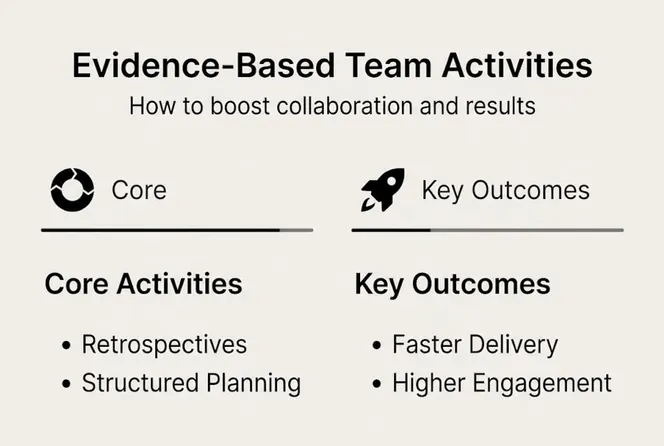
- Retrospectives: A structured review of what worked, what did not, and what to change. Using the 4Ls technique (Liked, Learned, Lacked, Longed For), retrospectives boost responsiveness by 24% and quality by 42%. They are fast, repeatable, and scalable.
- Collaboration planning: Explicit agreements about how the team will work together, communicate, and resolve conflict. 91% of teams that use structured collaboration planning report it as highly valuable.
- Problem-solving workshops: Facilitated sessions where teams tackle real business challenges together. These build both cognitive alignment and interpersonal trust simultaneously.
- Interpersonal skill practice: Structured feedback exercises, active listening drills, or perspective-taking activities that build the relational foundation high performance requires.
| Activity | Core benefit | Best scenario |
|---|---|---|
| Retrospectives | Rapid quality and responsiveness gains | After every sprint or project phase |
| Collaboration planning | Reduces friction, boosts clarity | New teams or restructured groups |
| Problem-solving workshops | Builds shared thinking and trust | Teams facing complex or ambiguous challenges |
| Interpersonal skill practice | Strengthens relationships and communication | Teams with high conflict or low psychological safety |
Structured planning cuts burnout by 29% and boosts collaboration by 84%, according to Gallup data. That is a pretty good return on a one-hour planning session.

Pro Tip: Run your retrospectives with a strict time box of 60 minutes and rotate the facilitator role. Rotating ownership builds facilitation skills across the team and prevents any one voice from dominating the debrief.
How AI is transforming team development
Even the best evidence-based activities have a ceiling when run manually. AI is pushing that ceiling significantly higher, and the results from early adopters are hard to ignore.
Think of AI as a team coach that never sleeps. It tracks patterns in communication, flags early signs of disengagement, surfaces skill gaps before they become performance problems, and personalizes development recommendations at scale. No human manager can do all of that simultaneously across a team of 20 or 50 people.
The numbers from real deployments are striking. AI-driven coaching at Delta cut review time by 90%, 96% of managers recommended the approach, and 70% of AI-facilitated sessions directly addressed employee development needs. Those are not incremental improvements. They are category shifts.
| Dimension | Traditional manual approach | AI-enabled approach |
|---|---|---|
| Speed | Slow, dependent on scheduling | Real-time or near-real-time |
| Reach | Limited by manager bandwidth | Scales across entire organization |
| Insight | Anecdotal, subjective | Data-driven, pattern-based |
| Personalization | One-size-fits-all | Tailored to individual and team context |
The efficiency gains are obvious. But the deeper value is in insight quality. A manager running retrospectives manually might notice that morale dipped after a product launch. An AI system notices that three specific team members consistently disengage during cross-functional meetings, flags it before it becomes attrition, and suggests targeted interventions. That is a fundamentally different level of support.
AI also enables repeatability. One of the biggest failure modes in team development is inconsistency. You run a great workshop, see results, then six months pass with nothing. AI-powered platforms build development into the daily workflow rather than treating it as a quarterly event. The result is compounding improvement rather than one-off spikes.
Choosing and adapting activities for your unique team
With a solid toolkit in hand, the next question is: which activity is right for your team right now? The answer depends on honest diagnosis.
Start by assessing your team’s core needs. Small teams under 10 show the highest engagement variance, which means manager talent and activity selection matter even more at that scale. Larger teams need activities that scale without losing personal relevance.
Before selecting any activity, ask yourself these questions:
- What is the primary friction point? Is it unclear roles, low trust, poor communication, or declining motivation?
- What does success look like in 30 days? Define the measurable outcome before you begin.
- Is this team hybrid, remote, or in-person? Format matters. A great in-person workshop can fall flat over video if it is not redesigned for that medium.
- How much psychological safety exists? Teams with low safety need trust-building activities before problem-solving ones.
- What is the team’s history with development activities? Cynicism from past ineffective sessions is real and must be addressed upfront.
For hybrid teams, the key is parity. Every activity must feel equally engaging for remote and in-person participants. Asynchronous retrospectives, shared digital boards, and AI-facilitated check-ins all help close that gap.
For very small teams, lean into interpersonal exercises and role clarification. The dynamics are more intense at small scale, and clarity about ownership pays off faster.
Pro Tip: Involve your team in co-designing the next development activity. Ask them what they feel is holding the team back. This single step dramatically increases buy-in and ensures the activity addresses a real need rather than one you assumed existed.
The uncomfortable truth about team development activities
Here is what most leadership content will not tell you: the majority of team development spending is wasted. Not because the activities are poorly run, but because they are chosen for the wrong reasons. Leaders pick activities that feel good, look good on a budget report, or require minimal preparation. Then they wonder why nothing changes.
Traditional fun activities consistently underperform compared to structured team building grounded in behavioral science. Retrospectives and collaboration planning outperform ad-hoc games every single time the data is examined. Every time.
The hard lesson from modern organizations is this: your team does not need to like the activity. They need to grow from it. AI makes this easier by removing the guesswork, tracking what works, and enabling scale across diverse or remote teams. But the mindset shift has to come from leadership first. Demand impact, not smiles, as your return on investment. That one change in how you evaluate team development will transform everything downstream.
Upgrade your team development with proven, AI-powered solutions
If this article has you rethinking your approach to team development, you are already ahead of most managers. The next step is putting these principles into a system that works every day, not just on workshop days.
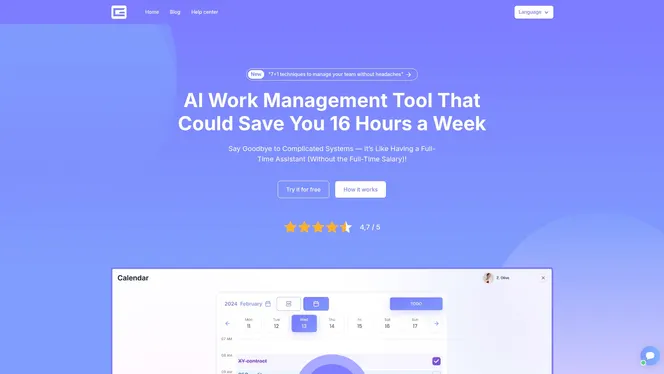
Gammatica is built for exactly this. Whether you are leading a founder-stage team and need AI team insights for founders, or managing a revenue team that needs AI support for sales teams, Gammatica gives you evidence-based frameworks, real-time diagnostics, and collaboration tools that scale. Explore how Gammatica can help your team build momentum, reduce friction, and track development outcomes that actually matter.
Frequently asked questions
Which team development activity offers the fastest measurable impact?
Regular retrospectives drive a 24% boost in responsiveness and 42% higher quality within weeks of adoption, making them the fastest-acting evidence-based option available.
Can AI tools replace in-person team development sessions?
AI optimizes coordination and diagnostics but works best when integrated with human-led activities, not as a full replacement for in-person development.
How often should team development activities be repeated?
Teams achieve the most benefit by holding activities like retrospectives after every project sprint or at least monthly to maintain momentum and continuous improvement.
What if my team is fully remote or hybrid?
Hybrid and remote teams gain up to 84% better collaboration when using structured and regular team development plans tailored for distributed environments.