TL;DR:
- Effective team leadership combines strategic planning, resource management, mentorship, and clear communication.
- Choosing the right methodology, like Agile or Kanban, significantly improves success and productivity rates.
- Utilizing enterprise tools with automation and real-time visibility enhances workflow efficiency and delivers measurable ROI.
Being a team lead at an enterprise isn’t just about handing out tasks and hoping for the best. Agile projects succeed 42% of the time compared to Waterfall’s 13%, and that gap doesn’t come from luck. It comes from method, mindset, and the right tools. Many managers assume that delegation alone defines strong leadership. It doesn’t. The best team leads combine structured frameworks, smart technology, and genuine people skills to drive results at scale. This guide breaks down the real responsibilities of a team lead, the methodologies worth knowing, the tools that deliver measurable ROI, and the pitfalls that quietly derail even experienced leaders.
Key Takeaways
| Point | Details |
|---|---|
| Team lead role clarified | True leadership means balancing mentorship with results, not just assigning tasks. |
| Methodology impacts success | Choosing Agile, Scrum, or Kanban can yield productivity gains up to 40% in enterprises. |
| Tool selection matters | Smart project management tools deliver quantifiable savings in time, cost, and efficiency. |
| Common pitfalls exist | Micromanagement and context switching are frequent traps team leads can avoid for better performance. |
| Tailor for your team | Your team’s context, not just the process, determines lasting success. |
What does a team lead really do in an enterprise?
Let’s clear something up right away. A team lead is not simply a senior contributor who assigns tickets. In large organizations, the role carries real strategic weight. According to Asana, team leads are responsible for organizing work, communicating goals, delegating tasks, allocating resources, problem-solving, managing progress, and reporting to stakeholders, overlapping with project management but emphasizing mentorship and team culture.
That last part matters more than most people admit. Mentorship and culture aren’t soft extras. They’re the engine behind sustained team performance.
Here’s what a strong team lead actually owns on a day-to-day basis:
- Planning and prioritization: Breaking down strategic objectives into executable tasks with clear owners and deadlines
- Resource allocation: Matching the right people to the right work based on capacity and skill, not just availability
- Problem-solving: Removing blockers before they become bottlenecks, not after
- Progress tracking: Keeping visibility across deliverables without hovering over every contributor
- Stakeholder communication: Translating team-level updates into business-level language for leadership
- Coaching and development: Giving feedback that builds capability, not just corrects behavior
Now, how does this differ from a project manager? Project managers typically own the plan, the budget, and the timeline. Team leads own the people and the execution. In practice, the roles overlap constantly in enterprise settings, which is why the best team leads develop fluency in both.
“The team lead role sits at the intersection of strategy and execution. You’re the translator between what leadership wants and what the team can realistically deliver.”
Two traps show up repeatedly in this role. The first is micromanagement. When you review every decision before it moves forward, you slow everything down and signal that you don’t trust your team. The second is absent leadership, where a lead steps back too far and the team loses direction entirely. Neither extreme works.
Pro Tip: Run a weekly 15-minute async check-in instead of daily standups. It keeps you informed without creating dependency, and it gives your team room to solve problems independently before escalating.
Choosing the right methodology: Agile, Scrum, Kanban, and more
With role clarity established, the next question is: how do you structure the work itself? Methodology selection is one of the highest-leverage decisions a team lead makes, and it’s often made too casually.
Key methodologies include Agile, Waterfall, Scrum, Kanban, Lean Six Sigma, and hybrid frameworks that combine predictive and adaptive elements. Each fits a different context.
Here’s a quick breakdown of when to use each:
- Agile: Best for fast-moving, iterative work where requirements evolve. Software development, product teams, and marketing campaigns benefit most.
- Scrum: A structured Agile framework with defined sprints, roles, and ceremonies. Ideal for cross-functional teams with clear sprint goals.
- Kanban: Visualizes work in progress and limits task overload. Great for support teams, ops, and any workflow with continuous incoming requests.
- Waterfall: Sequential and documentation-heavy. Works in regulated industries where requirements are fixed upfront.
- Lean Six Sigma: Focuses on eliminating waste and reducing variation. Common in manufacturing, logistics, and process-heavy environments.
- Hybrid frameworks: Combine Waterfall’s structure with Agile’s flexibility. Useful when compliance requirements coexist with dynamic delivery needs.
The numbers behind these choices are striking. Agile projects succeed 42% of the time versus Waterfall’s 13%, with productivity gains of 20 to 40%. Kanban reduces lead time by 30% and improves throughput by 15%. Scrum improves forecast accuracy and reduces defects across delivery cycles.
| Methodology | Best for | Key benefit | Success rate |
|---|---|---|---|
| Agile | Iterative, evolving projects | 20-40% productivity gain | 42% |
| Waterfall | Fixed-scope, regulated work | Predictable milestones | 13% |
| Scrum | Cross-functional sprints | Fewer defects, better forecasting | High |
| Kanban | Continuous flow work | 30% lead time reduction | High |
| Lean Six Sigma | Process optimization | Waste elimination | Varies |
“Methodology isn’t a religion. It’s a tool. The best teams adapt their framework to the work, not the other way around.”
Pro Tip: Before choosing a methodology, map your team’s current workflow for one week. You’ll often discover you’re already running an informal version of Kanban or Scrum. Formalizing what’s working beats starting from scratch.
Enterprise project management tools: Features, impact, and case data
Once you’ve chosen your methodology, execution depends heavily on the tools your team uses. The right platform can make your methodology hum. The wrong one creates friction at every step.

Enterprise tools like Asana, Celoxis, and Wrike deliver measurable results across industries. Celoxis achieved 30% faster delivery for McDonald’s, a 35% efficiency gain for RheinBrücke, and 30% cost savings for NKI. Asana saved Morningstar $600K per year and freed up 8,055 hours for WRI. Wrike streamlined Walmart Canada’s entire project pipeline.
Those aren’t marketing claims. Those are operational outcomes from organizations with complex, high-stakes workflows.
What features should you actually look for as a team lead? Here’s what the top platforms share:
- Task and workload management: Assign, prioritize, and track work across individuals and teams in real time
- Visual workflow tools: Kanban boards, Gantt charts, and timeline views that give everyone a shared picture of progress
- Automation: Reduce manual handoffs, status updates, and repetitive notifications so your team focuses on actual work
- Integrations: Connect with the tools your team already uses, from Slack to Zoom to your CRM
- Reporting and dashboards: Surface the metrics that matter to leadership without pulling data manually
- Permission controls: Manage who sees what, especially important in enterprise environments with sensitive data
| Platform | Standout feature | Documented impact |
|---|---|---|
| Asana | Timeline and workload views | $600K/year saved (Morningstar) |
| Celoxis | Resource and portfolio management | 30% faster delivery (McDonald’s) |
| Wrike | Cross-team collaboration | Streamlined Walmart Canada pipeline |
| Gammatica | AI-driven automation and CRM | Up to 16 hours saved per week |
The pattern across all these case studies is consistent. Teams that centralize their work in a single platform, automate routine tasks, and maintain real-time visibility over delivery consistently outperform those that rely on email threads and spreadsheets.
Pitfalls and edge cases: Avoiding common team leadership mistakes
Frameworks and tools give you a strong foundation. But knowing where things go wrong is just as important as knowing what to do right.
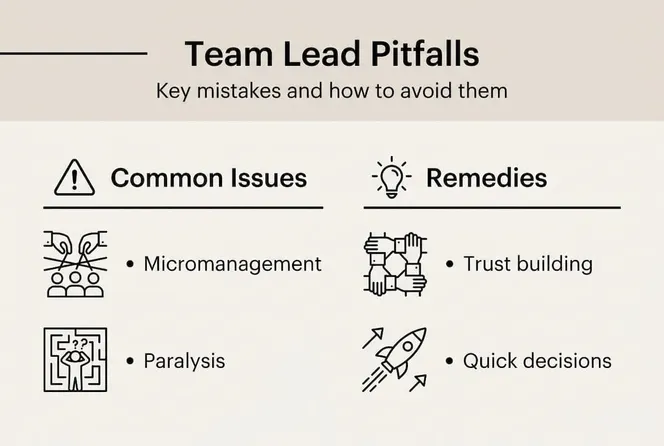
Common workflow pitfalls include micromanagement eroding trust, decision paralysis from incomplete information, context switching in multi-project leads spiking cognitive load, absent leadership in uncertainty causing drift, and hybrid risks like “Scrumfall” from poor framework integration.
Let’s unpack each one.
Micromanagement doesn’t just slow things down. It signals distrust, and once that signal is sent, it’s hard to walk back. Your team stops bringing you problems early because they assume you’ll take over. That’s when small issues become expensive surprises.
Decision paralysis happens when leads wait for perfect information before acting. In enterprise environments, perfect information rarely arrives. Build a threshold: if you have 70% of what you need to make a reasonable call, make it.
Context switching is the silent productivity killer for team leads managing multiple projects. Every time you shift focus between projects, your brain needs time to reload context. Studies consistently show this costs 20 to 40 minutes of productive time per switch.
Leadership drift occurs when a team lead steps back during uncertainty, often with good intentions, but the team loses its sense of direction. Visibility matters most when things are unclear.
Scrumfall is what happens when organizations try to blend Scrum and Waterfall without a clear integration plan. You end up with Waterfall’s rigidity and Agile’s overhead, and none of the benefits of either.
“The most expensive mistakes in team leadership aren’t dramatic failures. They’re slow, quiet erosions of trust, clarity, and momentum.”
Here are quick-wins to sidestep these traps:
- Set clear decision rights so your team knows what they can act on without you
- Use async communication tools to reduce interruptions and protect deep work time
- Limit work in progress per person to reduce context-switching pressure
- Schedule regular one-on-ones to catch drift before it becomes a pattern
- Document your hybrid framework rules explicitly so everyone understands which process applies when
Pro Tip: Create a simple “decision log” where your team records choices they made independently. Review it weekly. It builds accountability and gives you visibility without requiring your approval on everything.
What most guides get wrong about team leadership
Here’s a perspective most leadership content skips. Methodology and technology matter, but they’re not the primary driver of team performance. Context is.
Methodology choice is secondary to project size and team skill, with a 9x success impact from those factors. And elite Agile teams deploy 182 times more frequently with higher quality, not because of the framework itself, but because of continuous, rapid feedback loops.
What does that mean for you as a team lead? It means you can implement the most sophisticated Scrum process in the world, but if your team lacks psychological safety, the retrospectives will be performative and the sprints will be theater.
Real leadership work is removing friction. It’s identifying where your team loses time, clarity, or motivation, and systematically eliminating those obstacles. The framework is just the container. What you put inside it, the trust, the feedback culture, the shared clarity on what success looks like, that’s what actually delivers results.
The most effective team leads we’ve seen don’t obsess over which methodology label to wear. They obsess over shortening the feedback loop between action and insight. That’s the real competitive advantage.
Unlock your team’s productivity with proven tools
You now have the frameworks, the data, and the pitfall map. The next step is putting it all into practice with tools built for exactly this kind of work.
Gammatica is an AI-driven project and team management platform designed for enterprise team leads who want to move faster without adding complexity. From Kanban boards and automated workflows to CRM and calendar coordination, it brings your entire operation into one place. If you’re ready to see how AI-powered management translates into real time savings, explore Gammatica Sales to find the right plan for your team’s size and goals. Your team’s productivity ceiling is higher than you think.
Frequently asked questions
What’s the difference between a team lead and a project manager?
Team leads focus on coaching, culture, and execution, while project managers center on planning, tracking, and stakeholder management. In enterprise settings, both roles often overlap, but the emphasis is distinct.
Which project management methodology is best for team leads?
Agile, Scrum, and Kanban typically boost enterprise productivity, but hybrids fit regulated teams balancing compliance with adaptability. Agile’s 42% success rate versus Waterfall’s 13% makes it the default starting point for most dynamic teams.
What metrics should a team lead track?
Track delivery times, throughput, defect rates, team engagement, and hours saved to measure real impact. Platforms like Asana demonstrate this clearly, having saved Morningstar $600K per year and freed 14,976 hours through centralized tracking.
How can team leads streamline workflow effectively?
Combine automation, synchronization, and workflow centralization in enterprise tools to achieve maximum ROI. Workflow streamlining via automation yields 248% ROI, with four key levers: elimination, synchronization, streamlining, and automation.