More than 90 percent of high performers possess strong emotional intelligence, yet many american workplaces still underestimate its impact. This skill set goes far beyond simple communication, shaping how teams collaborate, leaders inspire, and organizations thrive. By understanding emotional intelligence, professionals gain critical tools for recognizing emotional cues, improving relationships, and creating environments where everyone can perform at their best.
Table of Contents
- Defining Emotional Intelligence in the Workplace
- Core Skills and Components of EI
- Emotional Intelligence Across Job Roles
- Benefits and Practical Applications at Work
- Common Challenges and Mistakes to Avoid
Defining Emotional Intelligence in the Workplace
Emotional intelligence (EI) represents a critical skill set that transforms workplace interactions and leadership effectiveness. At its core, emotional intelligence is the capacity to recognize, understand, and strategically manage emotions within professional environments. Research investigating leadership dynamics reveals that EI competencies fundamentally shape team performance, collaboration, and organizational success.
The framework of emotional intelligence encompasses four primary dimensions that collectively determine an individual’s interpersonal effectiveness. These dimensions include self-awareness (understanding personal emotional states), self-regulation (managing emotional responses), empathy (comprehending others’ emotional experiences), and social skills (navigating complex interpersonal dynamics). Each component plays a pivotal role in creating resilient, communicative workplace cultures where professionals can thrive.
Understanding emotional intelligence through psychological models like Affective Events Theory illuminates how emotions significantly influence job performance and organizational commitment. Workplace incidents trigger emotional responses that can either enhance or diminish productivity, making emotional intelligence a strategic asset for professionals at every organizational level. Managers with high EI can:
- Anticipate team emotional dynamics
- Resolve conflicts more effectively
- Create psychologically safe work environments
- Boost overall team motivation and engagement
By developing emotional intelligence, professionals transform potential emotional volatility into a powerful tool for collaboration, leadership, and sustained workplace success.
Core Skills and Components of EI
Emotional intelligence represents a sophisticated skill set that extends far beyond basic interpersonal interactions. Modern business organizations increasingly recognize that emotional competencies are critical for navigating complex workplace dynamics and achieving sustainable professional success. These skills enable individuals to understand, manage, and effectively leverage emotional information in strategic ways.
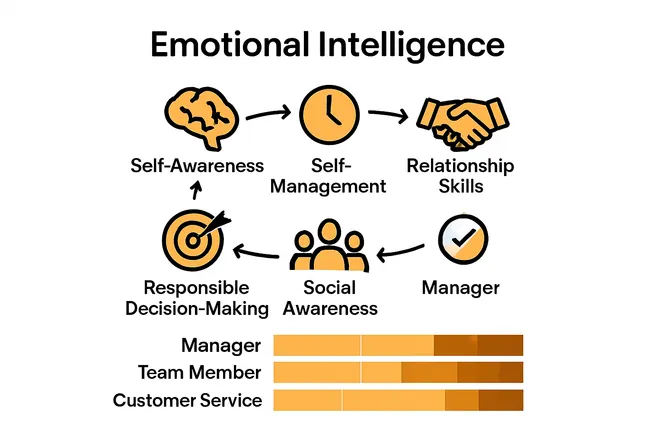
Drawing from established social-emotional learning frameworks, emotional intelligence comprises five core components that collectively enhance professional effectiveness. These interconnected skills include:
- Self-Awareness: Recognizing and understanding personal emotional states
- Self-Management: Regulating emotional responses and maintaining composure
- Social Awareness: Perceiving and interpreting others’ emotional cues
- Relationship Skills: Building and maintaining constructive professional connections
- Responsible Decision-Making: Using emotional insights to make balanced, ethical choices
Each component serves as a critical building block for developing robust emotional intelligence. Self-awareness forms the foundation, enabling professionals to identify their emotional triggers and understand how their feelings impact workplace interactions. Self-management builds upon this by teaching individuals to control impulsive reactions and maintain professional composure during challenging situations.
Professionals who master these emotional intelligence skills can transform workplace interactions. They communicate more effectively, resolve conflicts with greater nuance, and create environments of psychological safety and mutual understanding. By developing these skills, individuals not only enhance their personal performance but also contribute to more collaborative, resilient, and emotionally intelligent organizational cultures.

Emotional Intelligence Across Job Roles
Emotional intelligence transcends traditional job boundaries, emerging as a critical skill set that shapes professional success across diverse organizational roles. Research exploring job resources and psychological resilience reveals how emotionally intelligent professionals effectively navigate complex workplace challenges by strategically managing interpersonal dynamics and personal stress responses.
The application of emotional intelligence varies significantly across different professional contexts. For instance:
- Managers: Provide emotional regulation and motivational support
- Sales Professionals: Build rapport and read client emotional cues
- Human Resources: Mediate conflicts and understand team dynamics
- Customer Service: Navigate challenging interactions with empathy
- Team Leaders: Create psychologically safe work environments
Comprehensive studies on psychological capital demonstrate that high emotional intelligence correlates with enhanced empathy, resiliency, and interpersonal skills. This translates into tangible workplace benefits, including improved stress management, more effective communication, and greater psychological well-being across professional domains.
Each job role requires a nuanced approach to emotional intelligence. While the core competencies remain consistent, their application differs based on specific workplace demands. Technical roles might emphasize self-management and responsible decision-making, while client-facing positions prioritize social awareness and relationship skills. By recognizing and developing these tailored emotional intelligence strategies, professionals can create more adaptive, resilient, and collaborative workplace environments that drive individual and organizational success.
Benefits and Practical Applications at Work
Emotional intelligence transforms workplace interactions from transactional exchanges to meaningful, collaborative experiences. Research on workplace cooperation demonstrates that employees with strong emotional intelligence significantly improve team performance by coordinating efforts more effectively and demonstrating intrinsic willingness to support colleagues.
The practical applications of emotional intelligence span multiple workplace dimensions:
- Conflict Resolution: Navigating disagreements with empathy and understanding
- Team Collaboration: Creating environments of mutual respect and psychological safety
- Leadership Development: Enhancing communication and motivational strategies
- Performance Management: Understanding individual team member’s emotional needs
- Client Relationships: Building deeper, more authentic professional connections
Exploring communication dynamics reveals that emotional expression within professional boundaries strengthens workplace relationships. By encouraging nuanced emotional communication, organizations can create more transparent, supportive environments where team members feel valued and understood.
Implementing emotional intelligence strategies requires deliberate practice and organizational commitment. Professionals who invest in developing these skills can expect tangible benefits including reduced workplace stress, improved interpersonal dynamics, enhanced problem-solving capabilities, and increased overall job satisfaction. The result is a more resilient, adaptive workforce capable of navigating complex professional challenges with greater empathy and strategic insight.
Common Challenges and Mistakes to Avoid
Emotional intelligence development is not a straightforward journey, and professionals often encounter significant obstacles that can impede their progress. Research on human-computer interaction reveals that understanding emotional complexity requires nuanced approaches and continuous self-reflection, highlighting the intricate nature of developing genuine emotional competence.
Common pitfalls in emotional intelligence development include:
- Misinterpreting Emotional Signals: Jumping to conclusions without careful analysis
- Over-Suppressing Emotions: Believing complete emotional control means total suppression
- Lack of Self-Awareness: Failing to recognize personal emotional patterns
- Inconsistent Emotional Regulation: Responding differently to similar emotional triggers
- Boundary Confusion: Mistaking empathy for emotional absorption
Comparative studies between human and artificial intelligence demonstrate that emotional intelligence transcends simple pattern recognition. Humans possess a unique ability to interpret psychological stimuli that cannot be easily replicated, making authentic emotional understanding a complex skill that requires persistent practice and genuine self-examination.
Professionals must approach emotional intelligence as an ongoing learning process. The most significant mistake is believing emotional intelligence is a fixed trait rather than a dynamic skill set. Successful development requires vulnerability, continuous feedback, and a willingness to challenge personal emotional narratives. By recognizing these potential challenges and maintaining a growth mindset, individuals can transform potential obstacles into opportunities for profound personal and professional development.
Enhance Your Team’s Emotional Intelligence with Smarter Management Solutions
The article highlights how emotional intelligence is essential for managing workplace emotions, building strong relationships, and leading with empathy. Key challenges include improving self-awareness, regulating emotional responses, and creating psychologically safe environments where collaboration thrives. If your goal is to boost these emotional competencies while reducing administrative burden and improving communication, an AI-driven platform is the way to go. Gammatica.com offers a seamless way to support these emotional intelligence dimensions through features like task management, team collaboration, and automated workflows that free up time and mental energy.
Take control of your team’s emotional dynamics and productivity today. With Gammatica.com, you gain tools designed to streamline operations and foster stronger workplace connections. Experience how AI suggestions, integrated checklists, and calendar coordination align perfectly with the emotional skills your team needs to succeed. Discover more and start transforming your work environment by visiting Gammatica’s main site. Elevate your emotional intelligence and team effectiveness now.
Frequently Asked Questions
What is emotional intelligence in the workplace?
Emotional intelligence (EI) is the capacity to recognize, understand, and manage emotions in professional environments. It affects team performance, collaboration, and overall organizational success.
What are the core components of emotional intelligence?
The five core components of emotional intelligence are self-awareness, self-management, social awareness, relationship skills, and responsible decision-making. Each contributes to interpersonal effectiveness and professional success.
How can emotional intelligence improve team collaboration?
High emotional intelligence enhances communication and fosters environments of psychological safety, enabling team members to express emotions openly, resolve conflicts effectively, and support each other collaboratively.
What are common challenges in developing emotional intelligence?
Common challenges include misinterpreting emotional signals, over-suppressing emotions, lack of self-awareness, inconsistent emotional regulation, and boundary confusion. Recognizing these pitfalls can help individuals continuously improve their emotional competencies.