Most American businesses encounter tough decisions where even the best data is not enough for clear answers. The need for expert judgment grows as challenges become more complex. With over 80 percent of organizations now turning to structured group techniques like the Delphi Technique, understanding how consensus is built can give you an edge in planning and problem-solving. This guide uncovers how the Delphi approach transforms expert opinions into reliable action steps.
Table of Contents
- What The Delphi Technique Means
- Key Features Driving Expert Consensus
- Recognizing Delphi Variants And Formats
- When And Where It Works Best
- Pitfalls And Practical Limitations
What the Delphi Technique Means
The Delphi Technique is an advanced structured communication method designed to transform expert knowledge into actionable consensus. Developed as a systematic forecasting approach, this technique allows organizations to tap into collective intelligence through a carefully orchestrated process of iterative questioning and feedback.
At its core, the Delphi Technique involves assembling a panel of experts who independently respond to questionnaires across multiple rounds. This structured decision-making process aims to converge diverse opinions toward a unified perspective on complex topics where definitive data might be limited. The method’s strength lies in its ability to neutralize individual biases and create a balanced, well-considered group judgment.
The technique typically follows a strategic workflow: First, participants receive an initial questionnaire exploring their perspectives on a specific problem or prediction. After the first round, researchers compile and anonymize responses, then redistribute a refined questionnaire that includes aggregate group feedback. This iterative process continues until the group reaches a meaningful consensus or the marginal gains in understanding become minimal.
The Delphi Technique proves particularly valuable in scenarios requiring strategic forecasting, policy development, and complex problem-solving across fields like technology, healthcare, education, and business strategy. Its systematic approach transforms individual insights into collective wisdom, enabling more robust and nuanced decision-making.
Pro Tip: Carefully select your expert panel by prioritizing diverse perspectives and deep domain expertise to maximize the technique’s effectiveness in generating comprehensive insights.
Key Features Driving Expert Consensus
The Delphi Technique distinguishes itself through several critical core features that elevate its effectiveness in generating meaningful expert consensus. Anonymity stands as the foundational principle driving participant engagement and honest feedback, creating an environment where experts can share perspectives without fear of professional repercussions or personal judgment.
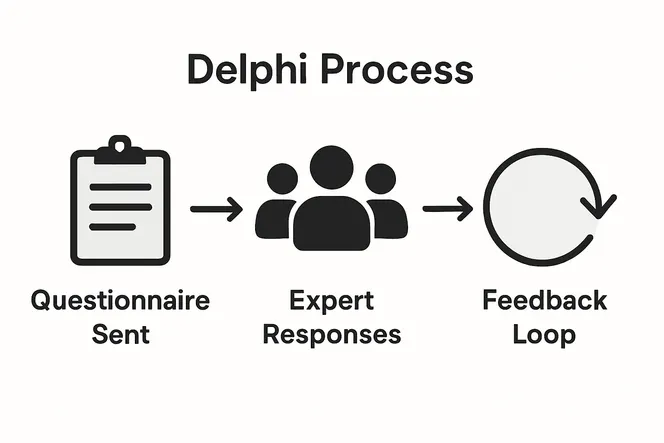
The technique incorporates multiple structured communication rounds designed to progressively refine collective understanding. This carefully managed process eliminates personal biases and power dynamics that might otherwise skew group decision-making. Participants submit responses independently, which are then aggregated, anonymized, and redistributed, allowing for iterative knowledge evolution without direct confrontational interactions.
Key features of the Delphi Technique include systematic information management, iterative questioning, and controlled feedback mechanisms. These components work together to transform individual expert insights into a cohesive, nuanced understanding. The method’s structured approach ensures that:
- Responses remain confidential and unattributed
- Experts can modify their perspectives based on aggregate group insights
- Complex problems receive multifaceted, balanced examination
- Consensus emerges through structured, respectful dialogue
By neutralizing individual cognitive biases and creating a level playing field for expertise, the Delphi Technique enables organizations to tap into collective intelligence more effectively than traditional brainstorming or consensus-building methods.
Pro Tip: Design your Delphi questionnaires with precision, focusing on clear, specific questions that encourage deep, thoughtful responses from your expert panel.
Recognizing Delphi Variants and Formats
The Delphi Technique has evolved beyond its original framework, developing multiple specialized variants that address different research and decision-making contexts. The Policy Delphi represents a significant adaptation, focusing on exploring diverse viewpoints rather than achieving strict consensus, making it particularly useful for complex policy discussions where multiple perspectives hold equal importance.

Delphi Variants can be categorized based on their primary objectives and methodological approaches. The Argument Delphi emerges as another distinctive format, emphasizing ongoing discussion and systematic argument exploration instead of converging on a single unified perspective. These variations demonstrate the technique’s remarkable flexibility in addressing different organizational and research needs.
Key Delphi Method variants include:
- Classic Delphi: Traditional approach seeking group consensus through iterative rounds
- Policy Delphi: Designed to surface multiple perspectives on policy issues
- Argument Delphi: Focuses on exploring and understanding diverse argumentative positions
- Electronic Delphi: Leverages digital platforms for faster, more efficient communication
- Real-Time Delphi: Allows simultaneous, dynamic participant interactions
Each variant maintains the core principles of structured communication and expert knowledge aggregation while adapting to specific contextual requirements. The flexibility of these approaches enables organizations to select a method that best matches their specific information-gathering and decision-making objectives.
Here’s how major Delphi Technique variants differ in focus and use:
| Variant | Main Purpose | Level of Interaction | Typical Application |
|---|---|---|---|
| Classic Delphi | Achieve expert consensus | Low, rounds are anonymous | Technology forecasting |
| Policy Delphi | Explore diverse viewpoints | Moderate, encourages debate | Public policy development |
| Argument Delphi | Analyze structured arguments | High, argument-based | Ethical or controversial issues |
| Electronic Delphi | Accelerate feedback process | Digital, asynchronous | Remote or global collaboration |
| Real-Time Delphi | Enable dynamic feedback | Simultaneous interaction | Fast decision scenarios |
Pro Tip: Match your Delphi variant selection to your specific research goals, considering factors like time constraints, participant availability, and the complexity of the problem you’re investigating.
When and Where It Works Best
The Delphi Technique demonstrates exceptional effectiveness in scenarios involving complex, forward-looking challenges where traditional decision-making methods fall short. Organizations face numerous situations that demand nuanced expert insight, making this approach particularly valuable for strategic planning, technological forecasting, and policy development across diverse professional domains.
Ideal Application Scenarios include contexts characterized by geographical dispersion, specialized knowledge requirements, and the need for structured yet flexible consensus building. The method proves especially powerful when participants cannot be physically assembled, allowing for comprehensive expert input despite logistical constraints. This makes it an invaluable tool for multinational corporations, research institutions, and government agencies seeking comprehensive perspectives.
Key domains where the Delphi Technique excels include:
- Technology Forecasting: Predicting emerging technological trends
- Healthcare Policy: Developing comprehensive medical guidelines
- Environmental Planning: Addressing complex sustainability challenges
- Educational Strategy: Designing innovative curriculum frameworks
- Risk Management: Identifying and mitigating potential organizational risks
The technique’s strength lies in its ability to transform disparate expert perspectives into a cohesive, actionable framework. By creating a structured dialogue mechanism, organizations can navigate complex decision-making landscapes with greater precision and collective intelligence.
This table summarizes how the Delphi Technique impacts business and organizational outcomes:
| Function | Business Impact | Optimal Scenario |
|---|---|---|
| Structured Forecasting | Reduces uncertainty in planning | Strategic technology assessment |
| Expert Knowledge Aggregation | Increases depth of insight | Multidisciplinary research |
| Bias Minimization | Supports neutral decision-making | High-stakes policy formulation |
| Remote Collaboration | Enables input across locations | Distributed team projects |
Pro Tip: Select Delphi participants strategically, prioritizing expertise diversity and ensuring representation from multiple disciplines to maximize the method’s comprehensive insight potential.
Pitfalls and Practical Limitations
The Delphi Technique, while powerful, confronts several critical challenges that can significantly impact its effectiveness and reliability. Organizations must navigate a complex landscape of methodological considerations to ensure the technique delivers meaningful insights, rather than potentially misleading or superficial conclusions.
Key Validity Challenges emerge from multiple interconnected factors. The overall accuracy of the method remains mixed, with poor results often stemming from improper application rather than inherent methodological weakness. Critical areas of potential limitation include:
- Expert Panel Selection: Potential bias in choosing participants
- Questionnaire Design: Challenges in crafting unbiased, comprehensive questions
- Consensus Definition: Difficulty establishing meaningful agreement thresholds
- Response Quality: Variations in participant engagement and depth of insight
- Anonymity Limitations: Potential for reduced accountability in feedback
The technique’s success hinges on meticulous implementation. Researchers must carefully address potential shortcomings by developing rigorous selection criteria, creating nuanced questionnaires, and establishing clear consensus parameters. Without strategic planning, the Delphi method can devolve into a superficial exercise that fails to capture the true complexity of expert perspectives.
Pro Tip: Implement a comprehensive validation process that includes pilot testing your questionnaire, establishing explicit consensus criteria, and conducting thorough participant vetting to mitigate potential methodological weaknesses.
Streamline Your Expert Consensus Process with Intelligent Project Management
The Delphi Technique helps organizations build expert consensus through structured communication and iterative feedback. If you are facing challenges coordinating expert panels, managing complex workflows, or reducing administrative overhead while driving collaborative decision-making, Gammatica.com offers the perfect solution. Our AI-powered platform enhances productivity by automating task management, enabling seamless team collaboration, and organizing workflows with intuitive Kanban boards and checklists. These features perfectly complement the Delphi approach by helping you gather diverse expert insights efficiently and keep all perspectives aligned.
Take control of your expert panels and strategic initiatives now with an integrated platform that supports clear communication, document sharing via a centralized company wiki, and smooth calendar coordination. Whether you need to manage multiple Delphi rounds or accelerate decision-making, you can free up valuable time and reduce bias in the process using AI suggestions and automation tools from Gammatica.com. Start enhancing your consensus-building efforts today by exploring how our platform and the Delphi Technique can work together to deliver actionable, well-informed results.
Discover more by visiting Gammatica.com and transform the way your team collaborates and decides.
Frequently Asked Questions
What is the Delphi Technique?
The Delphi Technique is a structured communication method that seeks to convert expert knowledge into actionable consensus through a series of questionnaires and feedback rounds.
How does the Delphi Technique create expert consensus?
The technique gathers independent responses from a panel of experts, anonymizes their answers, and iteratively refines the questions based on group feedback until a consensus is achieved.
What are some advantages of using the Delphi Technique?
It reduces individual biases, promotes balanced group judgment, fosters participation from experts in different fields, and is especially useful for complex problem-solving and strategic planning.
In which scenarios is the Delphi Technique most effective?
The Delphi Technique excels in situations involving complex, forward-looking challenges, such as technology forecasting, healthcare policy development, and multidisciplinary research, particularly when expert input is needed from diverse locations.