Every tech startup leader in Europe knows the pressure of pushing teams to solve complex problems while staying agile. Balancing productivity and creativity often feels challenging, especially when the stakes are high and deadlines are tight. Understanding the difference between convergent and divergent thinking reveals how combining these strategies can unlock your team’s full potential, giving you practical ways to foster innovation without losing focus.
Table of Contents
- Core Concepts Of Convergent Vs Divergent Thinking
- Distinct Types And Key Characteristics Explained
- Practical Applications In Project Management
- Integrating Convergent And Divergent Approaches Effectively
- Common Challenges And Mistakes For Startup Teams
Core Concepts of Convergent vs Divergent Thinking
Problem-solving is a nuanced cognitive process that involves two distinct yet complementary thinking approaches: convergent and divergent thinking. Cognitive research highlights these methods as critical components of creative problem resolution, representing different yet interconnected strategies for generating and refining ideas.
Convergent thinking operates like a precision instrument, focusing intensely on finding the single most logical and optimal solution. This approach is characterized by:
- Systematic narrowing of possibilities
- Linear, analytical reasoning
- Goal-oriented problem solving
- Emphasis on efficiency and accuracy
- Quick decision-making under structured constraints
Divergent thinking, by contrast, functions more like an exploratory expedition, generating multiple potential solutions and embracing creative uncertainty. Academic studies demonstrate that divergent thinking drives innovation by encouraging mental flexibility and radical idea generation.
The most successful problem-solving strategies integrate both thinking styles. Cognitive flexibility allows professionals to seamlessly transition between generating diverse ideas and selecting the most promising approach. Effective teams recognize that convergent and divergent thinking are not competing processes, but complementary skills that enhance overall creative potential.
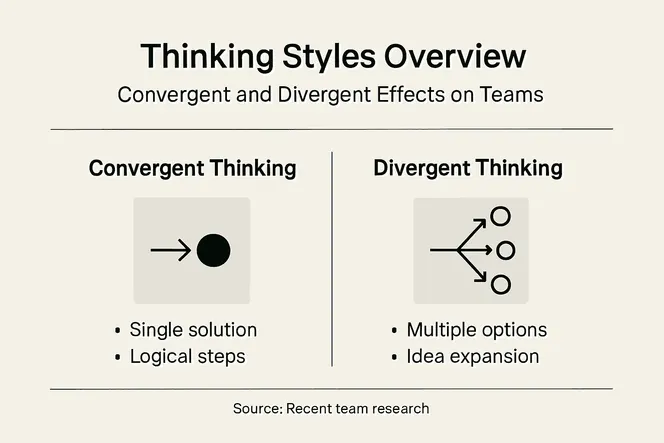
Pro tip: Practice alternating between expansive idea generation and focused solution selection to maximize your team’s creative problem-solving capabilities.
Here’s a concise comparison of convergent and divergent thinking and their business impacts:
| Dimension | Convergent Thinking | Divergent Thinking |
|---|---|---|
| Core Purpose | Find the single best solution | Generate multiple novel solutions |
| Typical Use Case | Final decision-making, evaluation | Brainstorming, initial idea generation |
| Business Impact | Drives operational efficiency | Fuels innovation and creativity |
| Risk if Overused | Missed opportunities, rigidity | Lack of focus, decision paralysis |
Distinct Types and Key Characteristics Explained
Cognitive research reveals that convergent and divergent thinking represent fundamentally different cognitive approaches to problem-solving. These thinking styles are not competing methods, but complementary strategies that enable comprehensive mental processing.
Divergent thinking is characterized by its expansive and exploratory nature, involving:
- Generating multiple unique solutions
- Embracing creative and unconventional perspectives
- Prioritizing originality over traditional constraints
- Encouraging mental flexibility
- Promoting innovative idea generation
Convergent thinking, in contrast, focuses on precision and efficiency. Its key characteristics include:
- Systematic evaluation of potential solutions
- Applying logical reasoning
- Selecting the most optimal answer
- Utilizing established decision-making frameworks
- Emphasizing structured problem-solving
Advanced cognitive studies suggest that creative cognition is not a binary process but a dynamic continuum where thinkers shift between divergent and convergent approaches. Successful problem-solving requires seamlessly transitioning between generating diverse ideas and critically analyzing their potential.
Pro tip: Develop cognitive flexibility by deliberately practicing both expansive idea generation and focused solution refinement techniques in your daily problem-solving processes.
Practical Applications in Project Management
Research frameworks demonstrate that project management requires a strategic balance between divergent and convergent thinking approaches. Successful teams learn to navigate these cognitive modes to drive innovation and maintain operational efficiency.
In project planning, divergent thinking manifests through several critical practices:
- Brainstorming multiple solution strategies
- Encouraging team members to propose unconventional ideas
- Creating open forums for creative exploration
- Challenging existing project assumptions
- Developing contingency plans through expansive thinking
Convergent thinking becomes essential during the implementation and evaluation phases, enabling teams to:
- Assess proposed solutions objectively
- Select the most viable project approaches
- Establish clear performance metrics
- Prioritize resources effectively
- Make data-driven decisions
Strategic thinking requires seamlessly transitioning between these cognitive modes. Project managers must create environments that welcome creative exploration while maintaining structured evaluation processes. This approach transforms potential chaos into organized innovation, allowing teams to generate breakthrough ideas without losing sight of practical constraints.

Pro tip: Implement structured brainstorming sessions that allocate specific time for divergent idea generation followed by focused convergent evaluation to maximize team creativity and project success.
Use this table to identify where each thinking style is most valuable in project workflows:
| Project Stage | Best-suited Thinking Style | Example Impact |
|---|---|---|
| Idea Generation | Divergent | Broad options, creative solutions |
| Solution Evaluation | Convergent | Sharp focus, clear decisions |
| Planning Contingencies | Divergent | Proactive risk preparation |
| Prioritizing Resources | Convergent | Streamlined use, reduced waste |
Integrating Convergent and Divergent Approaches Effectively
Advanced integration strategies reveal that successful teams must create structured environments that seamlessly transition between creative exploration and analytical refinement. The key lies in understanding the complementary nature of these thinking approaches rather than treating them as competing processes.
Effective integration requires implementing specific organizational practices:
- Establishing clear phases for idea generation and evaluation
- Creating psychological safety for unconventional thinking
- Developing robust feedback mechanisms
- Training teams in cognitive flexibility
- Designing iterative problem-solving frameworks
The integration process involves several critical stages of cognitive management:
- Initial divergent brainstorming with minimal criticism
- Structured idea clustering and preliminary assessment
- Systematic convergent evaluation using predefined criteria
- Collaborative refinement of most promising concepts
- Iterative cycles of expansion and consolidation
Cognitive workflow management demands deliberate strategies that balance creative freedom with analytical rigor. Teams must cultivate an environment where wild ideas are welcomed initially, then systematically filtered through logical and practical constraints. This approach transforms potential chaos into structured innovation, allowing breakthrough thinking without sacrificing operational feasibility.
Pro tip: Implement a “two-hat” approach where team members consciously switch between generative and analytical thinking modes during problem-solving sessions.
Common Challenges and Mistakes for Startup Teams
Research on startup dynamics reveals that emerging companies frequently struggle with balancing divergent and convergent thinking approaches. These cognitive challenges can significantly impede innovation and strategic decision-making, creating critical roadblocks for team performance.
Startup teams often encounter several fundamental thinking-related obstacles:
- Getting trapped in endless brainstorming without actionable outcomes
- Prematurely converging on solutions without sufficient exploration
- Failing to leverage diverse team perspectives
- Lacking structured processes for idea evaluation
- Experiencing communication breakdowns between creative and analytical team members
These challenges typically manifest through specific behavioral patterns:
- Overvaluing initial ideas without critical assessment
- Dismissing unconventional approaches too quickly
- Allowing dominant personalities to control idea selection
- Neglecting systematic evaluation frameworks
- Avoiding constructive conflict during idea refinement
Cognitive team dynamics require deliberate strategies to mitigate these common pitfalls. Innovative research frameworks suggest that startups must create explicit mechanisms for transitioning between generative and analytical thinking modes, ensuring that creativity doesn’t devolve into chaos and analysis doesn’t stifle innovation.
Pro tip: Implement a structured “idea pipeline” with dedicated phases for divergent generation and convergent evaluation, using time-boxed intervals to maintain momentum and prevent cognitive gridlock.
Unlock Your Team’s Full Creative Potential with Gammatica
Balancing convergent and divergent thinking is essential for solving complex problems and driving innovation within your team. The challenges highlighted in the article, such as navigating between expansive idea generation and focused decision-making, point to a need for structured yet flexible project management tools. Gammatica.com offers AI-powered task management and collaboration features that help teams organize brainstorming sessions, streamline solution evaluations, and implement effective workflows effortlessly. With tools designed to reduce administrative overhead and increase cognitive flexibility, your team can avoid common pitfalls like idea paralysis or premature decision-making.

Take control of your team’s cognitive workflow by integrating Gammatica’s automation, Kanban boards, and collaborative checklists into your daily operations. Visit Gammatica today and experience how our platform supports both creative exploration and analytical refinement. Start freeing up to 16 hours per week to focus on what truly matters: driving innovation and making clear decisions that lead to success.
Frequently Asked Questions
What is the difference between convergent and divergent thinking?
Convergent thinking focuses on finding the single best solution through systematic evaluation and logical reasoning, while divergent thinking encourages the generation of multiple, novel solutions by embracing creativity and flexibility.
How can teams effectively use both convergent and divergent thinking in problem-solving?
Teams can benefit from alternating between divergent thinking for idea generation and convergent thinking for solution selection. This can be achieved through structured brainstorming sessions followed by focused evaluations where ideas are assessed against established criteria.
What are some common challenges teams face when balancing divergent and convergent thinking?
Common challenges include getting stuck in endless brainstorming without action, prematurely converging on solutions before full exploration, and failing to leverage diverse perspectives. These pitfalls can hinder both creativity and effective decision-making.
How can project managers integrate divergent and convergent thinking practices?
Project managers should establish clear phases for idea generation and evaluation, create a safe environment for unconventional thinking, and design iterative frameworks that allow for both expansive brainstorming and structured assessments of ideas.