Every project manager knows the struggle of guiding a team through complex challenges while keeping collaboration strong. Balancing different ways of thinking is crucial for driving both creative solutions and solid results. By understanding the difference between convergent and divergent thinking, project leaders can help teams unlock new ideas and refine them into actionable plans, making AI-driven task management more effective than ever.
Table of Contents
- Defining Convergent Versus Divergent Thinking
- Comparing Key Characteristics And Differences
- Practical Uses In Project Management
- Balancing Both Approaches For Effective Teams
- Common Pitfalls And How To Avoid Them
Defining Convergent Versus Divergent Thinking
Project managers understand that problem-solving isn’t a one-dimensional process. Cognitive thinking styles dramatically impact how teams approach challenges, generate solutions, and ultimately drive innovation. Two fundamental thinking approaches—convergent and divergent thinking—represent complementary yet distinct strategies for addressing complex problems.
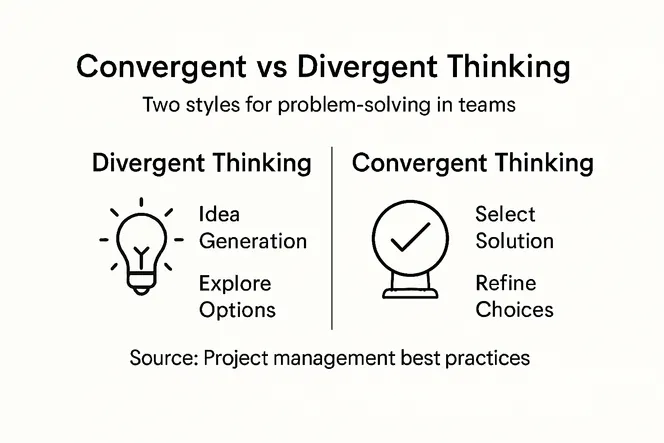
Convergent thinking operates like a precision instrument, focusing on identifying the single most logical and correct solution. Standard cognitive research suggests this approach assumes there’s one optimal answer and systematically narrows possibilities to reach that endpoint. Characteristics of convergent thinking include:
- Analytical and systematic problem resolution
- Linear decision-making processes
- Emphasizing logic and established methodologies
- Quickly evaluating and eliminating potential solutions
In contrast, divergent thinking functions more like an exploratory expedition. Creative problem-solving research reveals this approach generates multiple perspectives and potential solutions. Divergent thinking thrives on:
- Generating numerous unique ideas
- Challenging conventional thinking patterns
- Embracing complexity and ambiguity
- Encouraging radical or unexpected solutions
Understanding these thinking styles reveals their interdependent nature. Creative problem-solving isn’t about choosing between convergent or divergent thinking—it’s about strategically integrating both approaches. Successful project teams recognize when to expand possibilities (divergent) and when to focus and select (convergent).
Pro tip: Practice alternating between divergent and convergent thinking modes during team brainstorming sessions to maximize creative potential and practical implementation.
Comparing Key Characteristics and Differences
In the realm of problem-solving, cognitive approaches reveal distinctive traits that separate convergent and divergent thinking. Cognitive research explores how these thinking styles fundamentally differ in approach, execution, and outcomes.
Convergent thinking exhibits precise, structured characteristics that prioritize efficiency and logical progression. Key attributes include:
- Rapid elimination of impractical solutions
- Strong preference for established methodologies
- Focus on finding the single most accurate answer
- Systematic narrowing of potential approaches
- Linear progression toward problem resolution
Divergent thinking, by contrast, embraces complexity and unpredictability. Its core characteristics encompass:
- Generating multiple innovative solutions
- Challenging traditional problem-solving frameworks
- Exploring unconventional perspectives
- Tolerating ambiguity and uncertainty
- Encouraging creative exploration without immediate judgment
The critical distinction lies not in superiority, but in complementary functionality. Where convergent thinking excels at refining and selecting optimal solutions, divergent thinking shines in generating creative possibilities. Successful project teams understand that these approaches are not competing strategies but interconnected cognitive tools.
Creativity emerges from the dynamic interaction between generating unique ideas and systematically evaluating their potential.
Project managers can leverage both thinking styles by creating structured environments that simultaneously encourage expansive ideation and methodical evaluation. This balanced approach ensures innovative yet practical problem-solving across complex professional challenges.
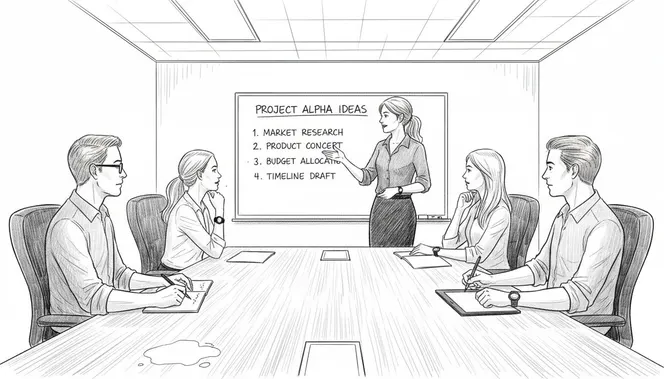
Pro tip: Design team exercises that deliberately alternate between divergent idea generation and convergent solution selection to maximize creative potential.
Practical Uses in Project Management
Project management requires a nuanced approach to problem-solving that strategically integrates both convergent and divergent thinking styles. While no single approach works universally, understanding how to apply these cognitive strategies can dramatically enhance team performance and innovation.
In strategic planning, divergent thinking proves particularly valuable during initial project conceptualization. Teams can leverage this approach through:
- Brainstorming multiple project execution strategies
- Exploring unconventional solution pathways
- Challenging existing project assumptions
- Generating innovative risk mitigation techniques
- Developing creative approaches to complex challenges
Convergent thinking becomes critical during subsequent stages of project implementation. Its structured methodology supports:
- Evaluating proposed solutions systematically
- Selecting the most feasible project approach
- Developing precise implementation protocols
- Identifying potential bottlenecks efficiently
- Streamlining decision-making processes
Effective project management requires seamlessly transitioning between expansive idea generation and focused solution selection.
Successful project managers recognize that these thinking styles are not mutually exclusive but complementary. By creating flexible cognitive environments, teams can maximize both creative potential and practical execution. This balanced approach allows organizations to generate groundbreaking ideas while maintaining operational efficiency.
Pro tip: Implement structured workshops that deliberately allocate time for divergent idea generation followed by convergent evaluation sessions to optimize team creativity and problem-solving.
Here’s a concise comparison of when to use divergent and convergent thinking within project management phases:
| Project Phase | Divergent Thinking Focus | Convergent Thinking Focus |
|---|---|---|
| Planning | Generating creative project ideas | Narrowing options to actionable plans |
| Brainstorming | Exploring multiple solutions | Evaluating idea feasibility |
| Implementation | Adapting to new challenges | Optimizing for efficiency and accuracy |
| Review | Identifying improvement areas | Selecting best practices to adopt |
Balancing Both Approaches for Effective Teams
Team dynamics represent a complex interplay of cognitive strategies where successful collaboration hinges on strategic thinking approach modulation. Research on team performance reveals that the most innovative teams dynamically adjust their thinking modes to maximize both creativity and execution.
Balancing divergent and convergent thinking requires establishing clear team protocols that create structured flexibility. Effective teams implement strategies such as:
- Designating specific brainstorming phases for divergent exploration
- Creating time-boxed intervals for convergent solution selection
- Establishing psychological safety for idea generation
- Developing clear transition mechanisms between thinking modes
- Encouraging respectful critique and collaborative evaluation
Cognitive flexibility becomes the cornerstone of high-performing teams. This approach involves:
- Recognizing individual team members’ cognitive strengths
- Training members to shift between expansive and focused thinking
- Developing shared mental models of problem-solving
- Creating environments that reward both creativity and precision
- Cultivating adaptive communication strategies
Successful teams view cognitive diversity not as a challenge, but as a strategic advantage in problem-solving.
Project leaders play a crucial role in facilitating this balance. By creating frameworks that allow seamless transitions between divergent idea generation and convergent solution refinement, teams can unlock unprecedented levels of innovation and efficiency.
Pro tip: Implement monthly team workshops that explicitly practice switching between divergent and convergent thinking modes to build cognitive flexibility.
This table outlines strategies to promote cognitive flexibility and balance in project teams:
| Strategy | Value for Teams | Example Practice |
|---|---|---|
| Alternate thinking modes | Increases innovation and rigor | Schedule distinct ideation/evaluation sessions |
| Foster psychological safety | Boosts idea sharing and trust | Encourage open, judgment-free feedback |
| Recognize cognitive strengths | Enhances problem-solving capacity | Assign roles based on thinking style strengths |
| Develop shared mental models | Aligns decision-making rapidly | Use collaborative planning tools |
Common Pitfalls and How to Avoid Them
Project team dynamics can quickly derail when cognitive thinking approaches are misunderstood or improperly implemented. Scrum management research highlights several critical challenges that can undermine team performance and innovation.
In divergent thinking phases, teams often encounter significant obstacles that can stifle creativity and collaboration:
- Fear of judgment during brainstorming sessions
- Premature criticism of emerging ideas
- Dominant personalities monopolizing discussions
- Insufficient psychological safety
- Limited time allocated for genuine exploration
Convergent thinking phases present equally challenging potential pitfalls:
- Analysis paralysis from excessive evaluation
- Rushing to premature conclusions
- Overlooking potentially innovative solutions
- Rigid adherence to initial assumptions
- Insufficient systematic evaluation criteria
Effective teams recognize that cognitive diversity requires intentional management and structured approaches.
Successful project managers create environments that systematically mitigate these risks by establishing clear guidelines, fostering open communication, and implementing structured thinking transition protocols. By understanding and anticipating these potential challenges, teams can develop more resilient and adaptive problem-solving strategies.
Pro tip: Implement a “no criticism” rule during initial brainstorming to encourage free-flowing idea generation and defer evaluation to specific convergent thinking phases.
Enhance Your Team’s Problem-Solving with AI-Driven Management
Navigating the balance between convergent and divergent thinking can challenge even the most experienced project managers. The article highlights the need for structured flexibility to maximize creativity while maintaining efficiency. If your team struggles with seamlessly transitioning between generating innovative ideas and selecting practical solutions, you are not alone. Key pain points include overcoming premature criticism, managing time effectively, and fostering an environment where all members can contribute without fear of judgment.
Gammatica.com offers a comprehensive platform designed to address these challenges head-on. With AI-powered task management, automation, and collaborative tools, your team can effortlessly switch between expansive brainstorming phases and focused evaluation stages. Features like Kanban boards and checklists help organize workflows to suit both divergent idea exploration and convergent decision-making, saving you valuable time and reducing administrative burden.

Don’t let cognitive mismatches stall your project’s progress. Visit Gammatica.com today to discover how our intuitive interface and AI-driven automation empower teams to unlock creative potential and achieve operational excellence. Explore how seamless integration with tools like Zoom and Google Meet supports dynamic collaboration that matches your team’s cognitive diversity. Take control of your project management now and free up to 16 hours every week for meaningful innovation and execution.
Frequently Asked Questions
What are convergent and divergent thinking?
Convergent thinking focuses on finding the single best solution to a problem through logical and analytical processes, while divergent thinking emphasizes generating multiple creative ideas and solutions, often challenging conventional assumptions.
How can project managers effectively integrate convergent and divergent thinking?
Project managers can integrate both thinking styles by alternating between phases of expansive idea generation (divergent) and focused solution selection (convergent), ensuring a structured approach that fosters creativity while also addressing operational efficiency.
What are some practical applications of divergent thinking in project management?
Divergent thinking can be applied in project management during the initial planning phase by brainstorming multiple execution strategies, exploring unconventional solutions, and generating innovative approaches to risk mitigation and challenges.
What common pitfalls should teams avoid when using convergent and divergent thinking?
Common pitfalls include judgment during the brainstorming phase, which can stifle creativity, and analysis paralysis during convergent phases that may lead to rushing conclusions. Establishing guidelines and structured approaches can help mitigate these risks.