Over half of all American organizations report that poor delegation directly impacts productivity and morale. Delegation looks easy, but in practice, leaders face deep-rooted psychological barriers and constant skill mismatches that disrupt even the strongest teams. Understanding why so many managers fall into common traps will help you spot what’s truly holding your workplace back and show you how precise delegation can transform both team outcomes and professional growth.
Table of Contents
- Defining Delegation Challenges Accurately
- Common Delegation Pitfalls Explained
- Skill Mismatch And Resource Constraints
- Micromanagement And Control Issues
- Communication Gaps And Follow‑Up Failures
Defining Delegation Challenges Accurately
Delegation seems simple on paper. Yet in reality, organizational leaders consistently struggle with effectively transferring tasks and responsibilities across team structures. The psychological barriers preventing smooth task distribution are complex and deeply rooted in management dynamics.
Understanding delegation challenges requires examining multiple dimensions. Psychological barriers prevent leaders from effectively distributing work because managers often wrestle with fundamental concerns about control, competence, and performance standards. These concerns manifest through behaviors like micromanaging, task hoarding, and reluctance to empower team members.
In technical environments like information technology, delegation mistakes become even more pronounced. Common errors include assigning tasks to unqualified staff and delegating beyond direct supervision boundaries, which can dramatically undermine team productivity and project outcomes. Effective delegation demands nuanced understanding of individual team member capabilities, precise task matching, and clear communication protocols.
Successful delegation isn’t about randomly distributing work but strategically aligning tasks with team member strengths. This requires managers to develop sophisticated skill sets including:
- Accurate performance assessment
- Clear communication of expectations
- Robust accountability mechanisms
- Continuous performance monitoring
- Adaptive task redistribution strategies
Precision matters. Delegation isn’t just transferring work—it’s an intricate leadership skill demanding psychological insight, strategic thinking, and consistent execution.
Common Delegation Pitfalls Explained
Delegation is a critical leadership skill that often falls victim to predictable and destructive patterns. Organizational performance suffers when managers fail to recognize and address these common mistakes that systematically undermine team productivity and individual potential.
Common delegation pitfalls emerge from fundamental management misconceptions, with leaders frequently repeating patterns that create more problems than solutions. These challenges typically manifest through several key behavioral traps, including:
- Lack of clear task instructions
- Inconsistent performance expectations
- Micromanagement tendencies
- Inappropriate task assignments
- Insufficient follow-up mechanisms
Managers often struggle with understanding the delicate balance between providing guidance and allowing team autonomy, which leads to significant productivity barriers. The most destructive delegation errors typically involve:
- Overloading high-performing team members
- Failing to match tasks with individual skill sets
- Neglecting comprehensive communication
- Avoiding meaningful performance accountability
Precise task delegation requires more than simply distributing work. It demands a sophisticated understanding of team dynamics, individual capabilities, and strategic organizational goals. Successful leaders recognize that effective delegation is a nuanced art form requiring continuous learning, adaptation, and interpersonal intelligence.

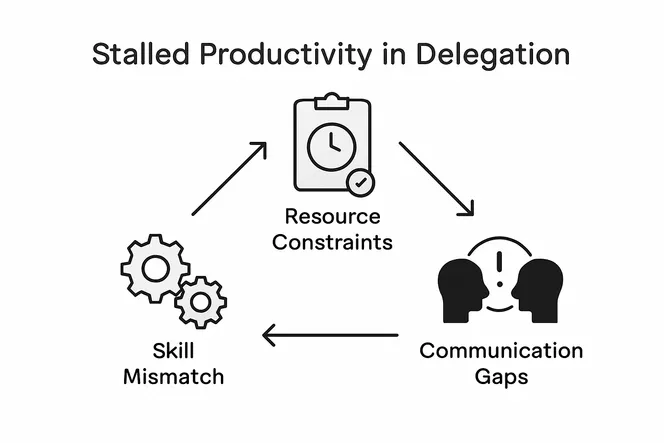
Skill Mismatch And Resource Constraints
Resource allocation represents one of the most critical challenges in effective task delegation, where managers must navigate the complex terrain of matching individual capabilities with organizational needs. The consequences of misalignment can be profound, potentially derailing entire project initiatives and undermining team performance.
Assigning tasks to unqualified or unprepared staff creates significant operational risks that extend far beyond immediate project outcomes. These mismatches manifest through several key indicators:
- Consistently missed deadlines
- Reduced work quality
- Increased team frustration
- Higher error rates
- Diminished overall productivity
Resource constraints compound the challenges of skill alignment, forcing managers to make difficult strategic decisions about task distribution. Effective delegation requires a nuanced understanding of:
- Individual team member strengths
- Current workload capacity
- Skill development potential
- Long-term organizational goals
- Performance tracking mechanisms
Ultimately, successful skill matching is not about perfect alignment but creating strategic development opportunities that balance immediate project needs with individual growth potential. Leaders who master this approach transform delegation from a mere task assignment process into a powerful mechanism for team development and organizational resilience.
Micromanagement And Control Issues
Leaders often sabotage their own delegation efforts through toxic control behaviors that systematically undermine team potential and organizational effectiveness. These micromanagement tendencies represent a profound psychological barrier to productive workplace collaboration, transforming delegation from a strategic empowerment tool into a demoralizing control mechanism.
Micromanaging delegated work destroys team confidence and dramatically reduces individual productivity, creating a destructive cycle of diminishing returns. The most common manifestations of excessive control include:
- Constant unnecessary status checks
- Rejecting work that meets core requirements
- Requiring approval for minor decisions
- Revising completed work without substantive improvements
- Refusing to provide clear initial instructions
Control issues fundamentally stem from leadership insecurity and fear of potential mistakes, which paradoxically generate precisely the performance problems managers seek to prevent. The psychological impact of micromanagement creates several critical organizational risks:
- Reduced employee motivation
- Increased team member turnover
- Stunted professional development
- Diminished innovation potential
- Erosion of trust and psychological safety
Successful delegation requires leaders to embrace vulnerability, trust their team’s capabilities, and create environments where autonomy and accountability coexist. The most effective managers understand that true leadership means guiding outcomes, not controlling every microscopic process.
Communication Gaps And Follow‑Up Failures
Communication breakdown represents the silent killer of effective delegation, transforming potentially successful projects into landscapes of misunderstanding and missed opportunities. Leaders who fail to establish clear communication protocols inadvertently create intricate webs of confusion that can unravel entire organizational initiatives.
Unclear expectations consistently emerge as the primary source of delegation failures, manifesting through critical communication vulnerabilities such as:
- Ambiguous task descriptions
- Undefined performance metrics
- Inconsistent feedback mechanisms
- Insufficient context about project goals
- Lack of transparent communication channels
Effective follow-up requires structured approaches that balance accountability with supportive guidance, demanding managers develop sophisticated communication strategies. Successful follow-up protocols typically involve:
- Establishing clear initial expectations
- Creating predictable check-in schedules
- Providing contextual feedback
- Monitoring progress without micromanaging
- Offering constructive performance insights
Ultimately, exceptional delegation transcends mere task assignment. It represents a nuanced communication dance that requires emotional intelligence, strategic thinking, and a genuine commitment to team development. Managers who master this art transform communication from a potential barrier into a powerful collaborative instrument.
Overcome Delegation Challenges and Boost Your Team’s Productivity Today
Delegation difficulties like micromanagement, communication breakdowns, and skill mismatches can stall your team’s progress and drain valuable time. The detailed pain points addressed in “Challenges in Task Delegation: Why It Stalls Productivity” highlight how crucial it is for leaders to have the right tools to match tasks with skills, maintain clear communication, and track progress without losing control. Gammatica.com is designed to tackle these exact issues with an AI-driven platform that automates task management, streamlines team collaboration, and frees up your time for leadership instead of administrative hassles.

Take control of your delegation process now by exploring how our platform’s Kanban boards, automated checklists, and seamless communication tools align with your needs. Don’t let delegation challenges stall your organizational goals—visit Gammatica.com to discover how you can save up to 16 hours weekly while enhancing accountability and team performance. Get started today and transform complex delegation into your strategic advantage.
Frequently Asked Questions
What are common delegation challenges faced by managers?
Managers often face challenges such as psychological barriers, micromanagement, unclear communication, and mismatching tasks with team members’ skills, which can stall productivity.
How does micromanagement affect delegation?
Micromanagement undermines team confidence and productivity by creating an environment of fear and control, which can lead to low motivation and high turnover rates among team members.
What are effective strategies for successful delegation?
Successful delegation requires accurate performance assessment, clear communication of expectations, robust follow-up mechanisms, and continuous monitoring of individual progress to align tasks with team strengths.
How can communication gaps hinder effective delegation?
Communication gaps can lead to misunderstandings, unmet expectations, and decreased team motivation. Establishing clear communication protocols is essential for successful task delegation.