Nearly every American tech startup spends hundreds of hours annually trying to organize teamwork and keep project schedules on track. For CEOs and project managers in Hungary, this struggle can slow growth and drain resources. Automated tools inspired by the efficiency of American workflows now make it possible to cut wasted time and align teams without constant supervision, giving your company a clearer path from bold ideas to sustainable results.
Table of Contents
- Defining A Business Startup Planner
- Types Of Startup Planners And Tools
- Core Features For Streamlining Workflows
- Legal And Operational Steps For Launch
- Cost, Common Pitfalls, And Time Savings
Defining a Business Startup Planner
A business startup planner represents a strategic roadmap that guides entrepreneurs through the complex journey of transforming innovative ideas into sustainable enterprises. Business planning is fundamentally a systematic process where entrepreneurs gather critical market intelligence, evaluate potential opportunities, assess potential risks, and meticulously document strategies designed to streamline their organizational launch and growth trajectory.
At its core, a business startup planner serves multiple crucial functions. It acts as a comprehensive blueprint that outlines key operational components, financial projections, market analysis, and organizational structure. By providing a structured approach to business development, these planners help entrepreneurs convert abstract concepts into actionable strategies. The planner typically includes detailed sections covering market research, competitive landscape evaluation, financial modeling, marketing strategies, operational workflows, and long-term growth projections.
Successful startup planners distinguish themselves by their ability to combine rigorous analytical frameworks with flexible adaptation strategies. They recognize that business environments are dynamic and unpredictable, requiring entrepreneurs to develop plans that can pivot quickly in response to emerging market conditions. This means creating documents that are simultaneously comprehensive and agile, offering clear strategic direction while maintaining enough flexibility to accommodate unexpected challenges and opportunities.
Pro tip: Start developing your business startup planner by conducting thorough market research and creating multiple scenario-based projections that account for different potential business outcomes.
Types of Startup Planners and Tools
Startup planners and tools have evolved significantly, offering entrepreneurs a diverse range of solutions to support business development. Modern startup resources span multiple critical categories, including brainstorming platforms, business planning software, project management systems, customer relationship management (CRM) tools, legal support applications, communication platforms, and marketing solutions.
The landscape of startup planning tools can be broadly categorized into several key types. Comprehensive Planning Platforms provide end-to-end business development support, integrating features like financial modeling, market research, and strategic planning. Project Management Tools help teams coordinate workflows, track progress, and maintain organizational efficiency. Financial Modeling Software enables precise budgeting, revenue forecasting, and investor pitch preparation. Market Research Platforms assist entrepreneurs in validating business concepts, understanding target demographics, and analyzing competitive landscapes.
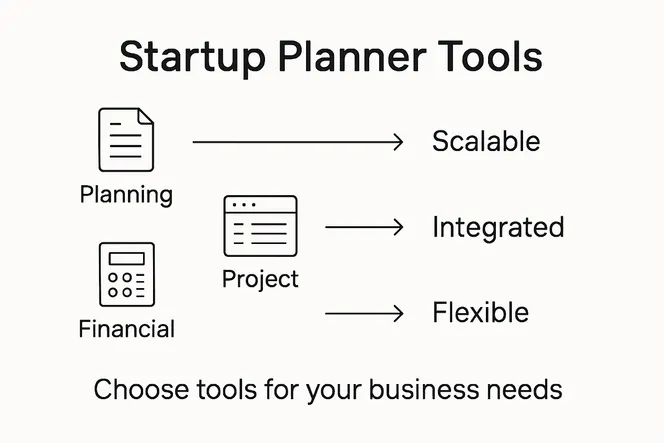
When selecting startup planning tools, entrepreneurs should consider factors such as scalability, integration capabilities, user experience, and alignment with specific business requirements. Advanced startup planning platforms now offer AI-driven features that support business plan creation, financial forecasting, and idea validation, transforming traditional planning processes. These sophisticated tools not only streamline administrative tasks but also provide strategic insights that can significantly enhance decision-making and operational efficiency.
Pro tip: Evaluate startup planning tools based on your specific business needs, prioritizing platforms that offer flexible integrations and scalable features that can adapt as your company grows.
Here’s a comparison of major types of startup planning tools and their primary benefits:
| Tool Type | Key Function | Typical Benefit |
|---|---|---|
| Comprehensive Planning | Integrates business planning | Streamlines end-to-end strategy |
| Project Management | Coordinates team workflows | Boosts productivity |
| Financial Modeling Software | Prepares budgets and forecasts | Improves funding pitches |
| Market Research Platforms | Validates market opportunities | Informs strategic decisions |
Core Features for Streamlining Workflows
Workflow streamlining represents a critical strategy for startups seeking operational excellence and competitive advantage. Effective workflow optimization involves simplifying, consolidating, and automating business processes to enhance overall organizational efficiency and reduce unnecessary administrative burdens.
The core features essential for streamlining workflows can be categorized into several key strategic domains. Process Mapping provides a comprehensive visual representation of current operational sequences, identifying potential bottlenecks and inefficiencies. Automation Technologies enable startups to eliminate repetitive manual tasks, redirecting human resources toward higher-value strategic activities. Performance Analytics offer real-time insights into workflow effectiveness, allowing teams to continuously refine and optimize their operational approaches. Collaboration Tools facilitate seamless communication and task coordination, breaking down traditional departmental silos and promoting cross-functional transparency.

Successful workflow streamlining demands a holistic approach that balances technological implementation with human-centric design principles. Startups must focus on creating adaptable systems that can evolve alongside their organizational growth, integrating flexible tools that support scalability and rapid iteration. By prioritizing clear process ownership, implementing robust tracking mechanisms, and leveraging intelligent automation technologies, businesses can dramatically reduce operational friction and accelerate their strategic execution.
Pro tip: Conduct a comprehensive workflow audit every quarter, systematically mapping each process, identifying potential bottlenecks, and implementing incremental optimization strategies.
Legal and Operational Steps for Launch
Launching a business requires strategic planning and meticulous attention to legal and operational requirements that form the foundation for sustainable entrepreneurial success. Entrepreneurs must navigate a complex landscape of regulatory compliance, corporate structuring, and strategic initialization to transform their business concepts into legally recognized and operationally sound enterprises.
The legal and operational launch process encompasses several critical domains. Business Registration involves selecting an appropriate corporate structure, filing necessary incorporation documents, and obtaining unique tax identification numbers. Regulatory Compliance demands comprehensive understanding of industry-specific regulations, licensing requirements, and potential permit applications. Intellectual Property Protection requires entrepreneurs to secure trademarks, patents, or copyright registrations that safeguard their innovative concepts and competitive advantages. Understanding the comprehensive legal framework becomes essential for mitigating potential operational risks and establishing a solid foundation for future growth.
Successful business launches integrate financial planning, operational infrastructure, and legal preparedness into a cohesive strategic approach. Entrepreneurs must develop robust financial models, establish banking relationships, create detailed operational workflows, and design scalable systems that can adapt to emerging business challenges. This holistic approach ensures not just legal compliance, but creates a resilient framework that supports long-term organizational development and strategic flexibility.
Pro tip: Consult with a specialized business attorney and accountant before finalizing your launch strategy to identify potential legal and financial vulnerabilities and develop comprehensive mitigation strategies.
Cost, Common Pitfalls, and Time Savings
Understanding the financial landscape and potential challenges is crucial for startup survival, with founders needing to navigate complex economic terrain that demands strategic financial planning and proactive risk management. Startup costs extend far beyond initial expectations, encompassing a wide range of expenses that can quickly overwhelm unprepared entrepreneurs.
The most significant startup costs typically involve several critical domains. Technology Infrastructure requires substantial upfront investment in software, hardware, and digital tools. Legal and Administrative Expenses include incorporation fees, licenses, permits, and initial compliance documentation. Marketing and Branding demands strategic budget allocation for initial market positioning and customer acquisition. Operational Overhead covers essential elements like initial office space, equipment, initial staffing, and preliminary supply chain development. High startup failure rates are often directly linked to financial mismanagement and inadequate understanding of comprehensive operational expenses, making meticulous financial planning a non-negotiable aspect of entrepreneurial success.
Mitigating financial risks requires a multifaceted approach that combines strategic budgeting, continuous monitoring, and adaptive financial management. Successful startups implement rigorous cost control mechanisms, maintain flexible resource allocation strategies, and develop contingency funds to address unexpected challenges. Entrepreneurs must cultivate a disciplined approach to financial management, leveraging technology and automation tools to track expenses, optimize spending, and create scalable financial frameworks that support sustainable growth.
Pro tip: Create a comprehensive financial model with at least three scenario projections: conservative, moderate, and aggressive, and maintain a minimum 6-month emergency operating fund to buffer against unexpected financial challenges.
Review these key startup cost areas and how they impact business survival:
| Cost Area | Common Challenges | Long-term Impact |
|---|---|---|
| Technology | Price of hardware/software | Affects scalability |
| Legal/Admin | Complex compliance fees | Prevents costly penalties |
| Marketing/Branding | High initial ad spend | Drives early customer growth |
| Operations | Staff and office expenses | Influences cash runway |
Accelerate Your Business Launch with Smarter Planning and Streamlined Workflows
Navigating the complex journey of a business startup planner requires tackling challenges like managing workflows and reducing administrative burdens. Key pain points such as coordinating team tasks, automating repetitive activities, and maintaining clear operational visibility can slow down progress and increase stress. By leveraging AI-driven tools that offer task management, CRM, automation, and team collaboration, entrepreneurs can transform their comprehensive planning into efficient execution.
At Gammatica.com, our platform is designed to help startups convert their strategic roadmaps into swift, scalable actions. Free up to 16 hours weekly by automating your checklist creation, syncing calendars, and managing projects through intuitive Kanban boards. Whether you are building financial models or ensuring regulatory compliance, Gammatica’s integration with tools like Make.com and communication features including Zoom meetings equip you to overcome common pitfalls highlighted in business startup guides. Experience how AI suggestions can fine-tune your workflows and empower your team to focus on growth.
Take control of your startup journey today by visiting Gammatica.com.

Discover how our AI-driven project and team management platform can be the crucial partner for your business startup planner. Streamline your launch and accelerate your growth by signing up now and see the difference that organized, automated operations make.
Frequently Asked Questions
What is a business startup planner?
A business startup planner is a strategic roadmap that guides entrepreneurs in transforming ideas into sustainable businesses, outlining operational components, financial projections, and market analysis.
What are the main types of startup planning tools?
Main types of startup planning tools include comprehensive planning platforms, project management tools, financial modeling software, and market research platforms, each serving specific functions to support business development.
How can I streamline workflows in my startup?
To streamline workflows, focus on process mapping, automation technologies, performance analytics, and collaboration tools to identify bottlenecks and enhance operational efficiency.
What are common startup costs to consider?
Common startup costs include technology infrastructure, legal and administrative expenses, marketing and branding, and operational overhead, all of which can impact business survival if not managed effectively.