TL;DR:
- Business agility is organizational capacity to sense change and deliver value effectively.
- Frameworks like SAFe and LeSS support scalable agility based on culture and size.
- Successful agility boosts revenue, speed, customer satisfaction, and long-term competitiveness.
Most leaders think business agility means moving fast. Ship faster, decide faster, pivot faster. But speed without direction is just chaos with better branding. Agile organizations are 70% more likely to achieve top organizational health and realize significant strategic and financial advantages. That’s not a speed story. That’s an adaptability story. This guide walks you through what business agility actually means, which frameworks support it, what the data says about its impact, and how to avoid the pitfalls that derail most transformation efforts.
Key Takeaways
| Point | Details |
|---|---|
| Business agility definition | Business agility is an organization’s ability to adapt quickly and deliver value in changing environments. |
| Framework selection | Choosing the right framework depends on your organization’s culture, size, and market needs. |
| Proven benefits | Agile businesses consistently outperform peers in growth, resilience, and customer satisfaction. |
| Sustainable transformation | Long-term agility requires leadership alignment, data-driven metrics, and cultural change. |
What is business agility? A foundational definition
Business agility is the capacity of an organization to sense change, respond effectively, and continuously deliver value to customers and stakeholders. It’s not a project management style or a software development method. It’s an organizational capability that runs across strategy, culture, operations, and leadership.
Many organizations confuse agility with flexibility or informality. That’s a costly mistake. True business agility is strategic responsiveness. It means your teams can shift priorities without losing momentum, your leadership can make informed decisions quickly, and your processes support learning rather than just execution.
As APMG International puts it:
“Agility goes beyond process tweaks — it’s about mindset, culture, and embedding responsiveness across the business.”
The core pillars of business agility include:
- Adaptive culture: Teams embrace change as a normal part of work, not a disruption
- Cross-functional collaboration: Silos break down so decisions happen closer to the work
- Rapid decision-making: Authority is distributed, reducing bottlenecks at the top
- Outcome-based measurement: Success is measured by value delivered, not tasks completed
In practice, business agility looks like this: a product team receives real-time customer feedback and adjusts their roadmap within days, not quarters. A sales team spots a competitor move and realigns their pitch within the same week. An operations leader identifies a process bottleneck and restructures the workflow without waiting for an annual review cycle. Good support for streamlining business operations is often what makes these shifts possible.
The growing relevance of business agility is hard to ignore. Markets shift faster, customer expectations evolve constantly, and competitive pressure comes from unexpected directions. Organizations that treat agility as a one-time initiative will always fall behind those that treat it as a permanent operating model.
Core frameworks and methodologies for business agility
Knowing what business agility is, the next step is understanding which frameworks support its implementation. The good news is that several proven methodologies exist. The challenge is choosing the right one for your organization.
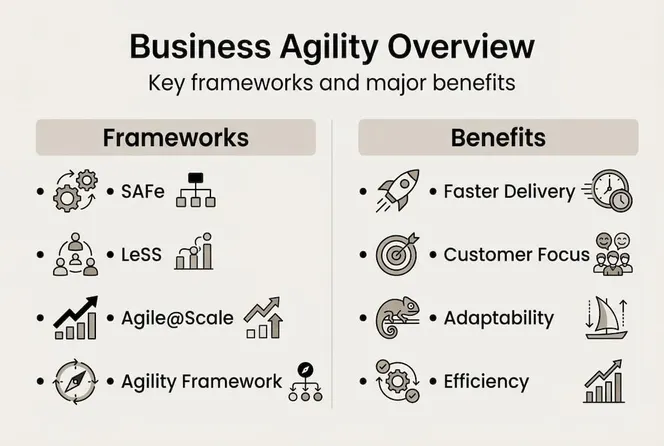
Key methodologies include SAFe (Scaled Agile Framework), LeSS (Large-Scale Scrum), BCG Agile@Scale, and the Framework for Business Agility. Each takes a different approach to how agility is structured and scaled.
| Framework | Primary focus | Best use case | Scale |
|---|---|---|---|
| SAFe | Structured scaling with defined roles and ARTs | Large enterprises needing governance | 100+ teams |
| LeSS | Simplifying Scrum across multiple teams | Organizations wanting to descale complexity | 2-8 teams |
| BCG Agile@Scale | Value-stream organization and portfolio alignment | Companies restructuring around customer value | Enterprise |
| Business Agility Framework | Leadership, delivery, and culture domains | Organizations seeking holistic transformation | All sizes |
SAFe is prescriptive for enterprise-scale efforts, while LeSS focuses on simplification and organizational change. Neither is universally superior. The right choice depends on your culture, your team size, and how much structural change you’re willing to make.
Pro Tip: Before selecting a framework, audit your organizational culture and readiness. A highly hierarchical organization may struggle with LeSS’s decentralization. A fast-growing startup may find SAFe too rigid. Match the framework to where you are, not just where you want to be.
One thing is clear across all frameworks: process-driven approaches alone won’t create lasting agility. Culture-driven approaches, where leaders model new behaviors and teams are empowered to act, produce far more durable results. The framework is the scaffold. The mindset is the building.
The business case: Benefits and measurable impact of agility
Frameworks are only valuable if they drive tangible results. Here’s what the data shows about agility’s business impact.
The numbers are compelling. Mature agile firms saw 42% revenue growth and 47% faster delivery cycles compared to less agile counterparts. That’s not a marginal improvement. That’s a structural competitive advantage.
42% revenue growth and 47% faster cycles are the outcomes mature agile organizations are achieving right now.
| Outcome metric | Agile organizations | Non-agile organizations |
|---|---|---|
| Organizational health (top tier) | 70% more likely | Baseline |
| Revenue growth | +42% | Baseline |
| Delivery cycle speed | 47% faster | Baseline |
| Customer satisfaction | Significantly higher | Moderate |
The top business results from adopting agility include:
- Faster time-to-market: Agile teams release value in shorter cycles, reducing the gap between idea and customer impact
- Improved customer satisfaction: Continuous feedback loops mean products and services stay aligned with real needs
- Increased competitiveness: Organizations can respond to market shifts before competitors even notice them
- Better employee engagement: Teams with autonomy and clear purpose consistently outperform those in rigid structures
- Higher ROI on transformation investments: Agility reduces waste, cuts rework, and focuses effort on what actually matters
Measuring outcomes is essential, not just methodology adoption. Many organizations track agile ceremonies (standups, sprints, retrospectives) without measuring whether those activities produce better results. If your process mapping for efficiency isn’t tied to outcome metrics, you’re measuring activity, not agility.
Smart leaders also look at task automation benefits as a direct enabler of agility. When routine work is automated, teams have more capacity to focus on adaptive, high-value work.
Risks, challenges, and common pitfalls in adopting business agility
While the benefits are clear, business agility isn’t without risks or obstacles. Understanding them is critical for successful transformation.
Common risks organizations face include:
- Cultural resistance: Teams and managers accustomed to hierarchical structures often push back against distributed decision-making
- Overemphasis on process: Adopting agile ceremonies without changing the underlying culture produces theater, not transformation
- Innovation stagnation: Poorly implemented agility can create a bias toward incremental improvements over bold, strategic bets
- Funding misalignment: Traditional annual budget cycles conflict with the iterative, adaptive nature of agile investment
- Scaling too fast: Expanding agile practices before foundational teams are ready creates confusion and inconsistency
Risks of business agility include a short-term focus and lack of innovation if poorly implemented. This is one of the most underappreciated dangers. Organizations chase quick wins and declare victory before the cultural shift has taken hold.
Sustaining agility long-term requires addressing cultural resistance, adopting new funding models, and building robust metrics into the transformation from day one.
Agility is not “anything goes.” It requires discipline, clarity of purpose, and a shared understanding of what success looks like. Without those guardrails, teams can mistake busyness for progress.
Pro Tip: Engage your senior leadership in actively modeling agile behaviors. When executives participate in retrospectives, prioritize outcomes over outputs, and openly discuss failures, it signals that agility is a real organizational value, not just a mandate from HR or IT.
For organizations looking to reduce friction in their transformation, automating processes for agility is a practical starting point. It removes low-value work from teams and creates space for the adaptive thinking agility requires.
Business agility: What most leaders miss
Here’s the uncomfortable truth: most agility transformations fail not because of the wrong framework, but because of the wrong focus. Leaders invest in certifications, hire agile coaches, and restructure teams. Then they wonder why nothing fundamentally changes.
The real lever is leadership behavior. When executives continue to make all key decisions centrally, reward individual heroics over team outcomes, and treat failure as something to hide, no framework will overcome that gravity.
Leadership must embed agility as a core competency, not just enforce methodologies. That means auditing your culture honestly. Are decisions made at the right level? Do teams have the authority to act on what they learn? Is experimentation rewarded or punished?
The organizations that succeed with agility treat it as a leadership discipline first and a process improvement second. Before you evaluate your workflow optimization strategies, evaluate whether your leadership team is genuinely modeling the behaviors they’re asking of everyone else. That’s where real transformation starts.
How Gammatica helps you accelerate agility
If you’re ready to put business agility into practice, the right tools make a real difference. Agility requires visibility, coordination, and the ability to act on information quickly.
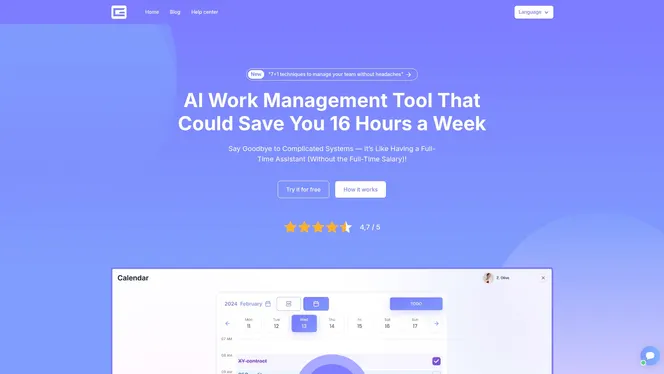
Gammatica is built for exactly this. The platform brings together task management, automation, CRM, and performance tracking in one place, so your teams spend less time on administrative work and more time on adaptive, high-value decisions. With features like Kanban boards, AI-driven suggestions, and workflow automation, Gammatica helps you operationalize agility at every level. Explore the Gammatica Sales tools to see how the platform supports faster cycles, better team alignment, and measurable outcomes from day one.
Frequently asked questions
How does business agility differ from agile project management?
Business agility is broader than project agility, spanning culture, strategy, and leadership across the entire organization, while agile project management focuses specifically on improving flexibility and delivery at the project level.
What are the main frameworks used to implement business agility?
The top frameworks include SAFe, LeSS, BCG Agile@Scale, and the Business Agility Framework, each designed for different organizational sizes and transformation goals.
What are the most common business agility pitfalls?
Major pitfalls include prioritizing short-term wins over lasting culture change, treating agile ceremonies as the goal rather than the means, and failing to build metrics that track real outcomes.
How is the ROI of business agility measured?
ROI is tracked through outcome metrics like time-to-market, revenue growth, and customer satisfaction scores, not by counting agile ceremonies or sprint completions.