Working with a tech team where communication stalls and collaboration feels forced is draining for any American project manager. Building genuine rapport is more than polite exchanges—it’s the operational foundation for trust, engagement, and seamless workflow. When you apply deliberate techniques like active attention, personalization, and approachability, your team will move past barriers to reveal honest feedback and stronger ownership. Rapport is the key concept that transforms isolated tasks into true collaborative achievement.
Table of Contents
- Defining Rapport In Professional Settings
- Core Components Of Effective Rapport
- Types Of Rapport In Team Environments
- Techniques For Building And Sustaining Rapport
- Challenges And Pitfalls To Avoid
- Impact Of Rapport On Project Success
Defining Rapport in Professional Settings
Rapport in professional environments isn’t some vague sense of liking your teammates. It’s a measurable, deliberate state where communication flows naturally, trust solidifies, and people actually want to collaborate. For project managers in tech firms, this distinction matters tremendously. When your team experiences authentic rapport, they share ideas more freely, flag problems earlier, and execute with greater ownership. The alternative—working with colleagues you don’t connect with—drains energy and slows delivery cycles.
Professional rapport research defines the concept around several interconnected components. First, there’s active attention: genuinely focusing on what team members communicate without distraction or mental planning of your next response. Then comes personalization, which means treating interactions as conversations between individuals rather than robotic exchanges of information. You recognize that Sarah codes differently than Marcus, that Jennifer needs clear deadlines while Alex thrives with ambiguity, that David works best in morning standups. Being approachable forms the third pillar—your team perceives you as accessible, non-judgmental, and open to their input. Finally, establishing mutual connections means finding shared interests, values, or experiences that transcend the project itself. These components work together to create what researchers call a “non-coercive environment” where people communicate openly without fear of punishment or dismissal.
The tricky part? Rapport gets operationalized differently across industries and contexts. In healthcare settings, mutual understanding between professionals emphasizes empathy and trust in patient care. In tech project management, rapport still involves empathy and trust, but it channels toward collective problem-solving, code quality, and deadline accountability. Your definition must account for your specific environment. A tech team’s rapport might look like psychological safety during code reviews—knowing your peers will critique the logic, not your competence. It might sound like honest retrospectives where engineers openly discuss what failed in the sprint without defensiveness. In a mid-sized tech firm, rapport often manifests as team members staying late to help a colleague finish a critical feature, not because the manager demanded it, but because they feel genuine connection to shared success.
Think of rapport as the operational foundation that enables everything else your team attempts. Without it, your project management platform handles tasks and timelines, but your people remain isolated operators. With it, those same tools become enablers for collaborative brilliance. The distinction between “managing” a project and leading a team often hinges on this single factor: whether rapport exists or merely the appearance of politeness.
Pro tip: Start identifying rapport gaps by observing communication patterns in your next standup—who speaks up freely versus who stays silent, and what does that silence actually mean for your project’s information flow?
Core Components of Effective Rapport
Rapport doesn’t emerge from a single behavior or moment. It builds through deliberate attention to multiple interconnected elements that work in concert. Understanding each component helps you see where your team interactions might be breaking down and where you can strengthen connections. Research into rapport development identifies several critical factors that contribute collectively to establishing trust and facilitating cooperation among team members. In tech project management, recognizing these components transforms rapport from an abstract concept into something you can actually observe, measure, and improve.
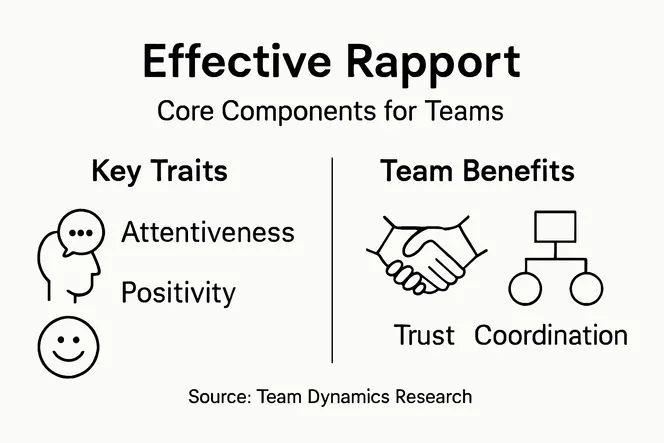
The first component is mutual attentiveness. This goes deeper than simply listening without interrupting. Mutual attentiveness means you and your team members are genuinely focused on understanding each other’s perspectives, concerns, and working styles. When your developer mentions they struggled with unclear requirements during the sprint, mutual attentiveness means you pause and ask clarifying questions rather than defending the spec you wrote. It means your team returns this focus to you as well. They notice when you’re stressed before launch and offer support without being asked. This reciprocal attention creates a rhythm where people feel seen and valued. The second pillar is positivity. This doesn’t mean forced cheerfulness or pretending problems don’t exist. Positivity in professional rapport means approaching interactions with genuine interest in finding solutions rather than assigning blame. It’s the difference between “Why wasn’t this tested?” and “What obstacles made thorough testing difficult, and how can we prevent this next sprint?” Positivity also includes acknowledging small wins, recognizing effort, and maintaining confidence in your team’s ability to improve. The third component is coordination, often called synchronization. This is where team members naturally align their actions, communication styles, and work rhythms. You notice this when meetings start on time because everyone respects the schedule, when team members pick up tasks without requiring detailed assignment because they understand the project’s direction, or when someone identifies a blocking issue and immediately escalates it because they know that’s how your team operates.
The combination of mutual attentiveness, positivity, and coordination enables emotional connection that sustains professional relationships over time. But there’s another layer that tech managers often overlook: professionalism maintained alongside warmth. This means being consistently reliable, following through on commitments, and establishing clear boundaries. Your team feels comfortable discussing personal challenges during one-on-ones, but they also trust you to maintain confidentiality and make decisions based on merit, not favoritism. It means admitting when you don’t know something rather than pretending expertise you lack. When a critical production issue erupts at 11 PM, your team knows you’ll roll up your sleeves with them because you’ve built credibility through consistent professional behavior. This professionalism prevents rapport from becoming superficial friendliness that crumbles under pressure.
Take a moment to assess your current team. Which component feels strongest? If mutual attentiveness is low, your team might hold back ideas in meetings. If positivity dips, people become defensive during retrospectives. If coordination struggles, projects stall as people wait for direction instead of self-organizing. If professionalism slips, trust erodes even when personal warmth exists. The strongest teams balance all four.
Here’s a consolidated view of the core components that build effective rapport and how they impact team dynamics:
| Core Component | Description | Team Impact |
|---|---|---|
| Mutual Attentiveness | Focused attention on each other’s viewpoints | Enables honest feedback, increases trust |
| Positivity | Solution-focused, acknowledges achievements | Reduces defensiveness, boosts morale |
| Coordination | Actions and communication are in sync | Improves workflow, avoids bottlenecks |
| Professionalism + Warmth | Reliability with empathetic behavior | Builds deep trust, maintains respect |
Pro tip: Record yourself in your next team standup and listen for interruptions, dismissive language, or moments where you switched focus—these reveal rapport gaps you can target with specific behavioral changes.
Types of Rapport in Team Environments
Rapport isn’t monolithic. Different situations demand different flavors of connection, and understanding these variations helps you respond authentically to what your team actually needs. In tech environments, you’re constantly switching between multiple rapport types without always realizing it. Rapport manifests through verbal, nonverbal, and paraverbal behaviors that each serve distinct purposes in team dynamics. Recognizing when to activate each type transforms you from someone who tries to build one generic version of rapport into a manager who meets people where they actually are.
Task-related rapport focuses on alignment around work objectives and execution. This is the rapport you build when your engineer knows you understand the technical debt they’re wrestling with, when you ask informed questions about their implementation approach, and when you recognize the specific challenge they solved. Task rapport emerges through shared language, demonstrated competence, and mutual respect for capabilities. You’re not asking how their weekend was. You’re saying, “That refactoring you completed cut load times by 18 percent. Walk me through your approach.” In sprint planning, task rapport means your team trusts you’ve understood the scope and won’t pile on midway changes. It means you read their pull request comments and offer meaningful technical feedback rather than rubber-stamping approvals. This type directly impacts project delivery because it ensures everyone’s pulling in the same direction with aligned expectations. When task rapport is strong, people work harder not from pressure but from seeing that their effort connects to something real.
Social rapport, by contrast, emphasizes interpersonal relationships and personal connection. This is where you remember that Marcus just bought a house, that Jennifer’s kid started soccer, that David struggled with impostor syndrome last year. Social rapport creates psychological safety and builds the human bonds that sustain teams through crunch periods. This isn’t about becoming best friends with your reports. It’s about recognizing them as complete people with lives outside code commits. You achieve social rapport through consistent one-on-ones, genuine questions that go beyond surface level, and follow-up on things people shared with you. When you later ask how the house inspection went or congratulate someone on their kid’s first game, you’re depositing trust credits that matter when difficult feedback needs to happen. Social rapport makes people want to solve problems together rather than protecting their own positions.
Dynamic rapport types evolve with changing team structures and objectives, which means you need both types operating simultaneously. Here’s where it gets practical: different team members may respond more strongly to one type than the other. Your highly analytical architect might primarily respect task rapport and feel uncomfortable with social chitchat. Your creative designer might need social connection before they’ll trust your technical judgment. Your veteran developer might expect both in equal measure. The mistake many managers make is assuming everyone values rapport the same way. You’ve probably noticed someone seeming distant after you tried to connect socially, not because you overstepped but because they prefer proving capability before personal sharing. Conversely, you might have team members who won’t engage fully with work until they feel genuinely known.
The strongest teams maintain both types in healthy balance. Task rapport without social rapport creates efficient but fragile teams that break apart under stress. Social rapport without task rapport feels warm but lacks the clarity and mutual respect needed for sustained collaboration. Your role is diagnosing which type needs attention in each relationship and adjusting accordingly.
To clarify different rapport types, see how task and social rapport compare in a team environment:
| Rapport Type | Focus Area | Key Example | Primary Benefit |
|---|---|---|---|
| Task | Work objectives | Informed code review | Clarity, efficient progress |
| Social | Personal connection | Remembering life events | Trust, higher engagement |
Pro tip: In your next one-on-one, consciously build one type of rapport that feels weaker in that relationship—if you’ve been all business, ask a personal question; if you’ve been social, dig into their technical interests or development goals.
Techniques for Building and Sustaining Rapport
Knowing what rapport is matters far less than knowing how to actually build it. The gap between understanding rapport theoretically and executing it daily trips up most managers. Effective techniques include establishing trust through open communication, demonstrating genuine interest, and maintaining consistent approachability. These aren’t complicated strategies requiring special training. They’re behaviors you can start implementing in your next interaction, though sustaining them requires intentional practice and genuine commitment to your team’s experience.

Start with active listening as your foundation technique. Most managers listen while simultaneously planning their response, checking email, or mentally moving to the next meeting. Active listening means you’re fully present, asking clarifying questions, and reflecting back what you heard to confirm understanding. When your designer describes frustration with inconsistent design feedback across stakeholders, you don’t immediately offer solutions. You say, “It sounds like you’re getting conflicting direction, which makes it hard to know which direction to pursue. Is that accurate?” This simple confirmation signals that you genuinely understand before jumping to fix things. From active listening flows the second major technique: acknowledging contributions explicitly and specifically. Don’t say “Good work on the deployment.” Say, “Your deployment script reduced our rollback time from 12 minutes to 3 minutes. That difference matters when we have live issues.” Specificity proves you’re actually paying attention, not offering generic praise. Your team knows when recognition is real versus performative.
The third technique involves finding and building on common ground. This goes beyond surface-level ice breakers. Building and sustaining rapport involves finding common ground and maintaining consistent relational investment throughout the relationship lifecycle. Look for shared values, not just shared hobbies. You might discover that you and a team member both care deeply about code quality, mentoring juniors, or building features that genuinely solve user problems. When you identify these alignments, reference them explicitly. “I know you care about sustainable pace, and I do too. Let’s figure out how to deliver this feature without burning everyone out.” This transforms you from someone imposing demands to someone partnering around shared principles. The fourth technique is adapting to individual needs and communication styles. Some people prefer written context before meetings. Others need to talk things through verbally. Some want detailed explanations. Others prefer high-level summaries. You learn these preferences through observation and direct questions: “How do you prefer to receive feedback?” or “Do you like time to prepare for discussions, or do you prefer spontaneous conversations?” When you adapt to how people actually work rather than forcing them into your style, rapport deepens because you’re demonstrating respect for their individuality.
Sustaining rapport over time requires consistent relational investment through regular check-ins. Monthly one-on-ones aren’t enough. Brief Friday check-ins, asking how someone’s feeling in the middle of a crunch, or simply noticing when someone seems off and asking about it keep rapport alive. It also requires transparency about decisions and constraints. When you can’t give someone what they requested, explain why with genuine honesty rather than corporate double-speak. Your team respects you more when you say, “Budget constraints mean we can’t hire that specialist role you requested. Here’s what we can do instead,” than when you avoid the conversation. One often-overlooked technique is admitting mistakes and learning from feedback about your own impact. When you snap at someone during a stressful deploy, follow up afterward: “I was frustrated about the timeline, and I spoke sharply to you. That wasn’t okay. I appreciate your work on this.” This models that rapport isn’t about perfection. It’s about genuine connection, mistakes, and commitment to repair.
Pro tip: Schedule a 15-minute session where you sit with each team member individually and ask two questions: “What’s one thing I’m doing well as your manager?” and “What’s one thing I could improve?” Listen without defending, then follow up on their feedback within two weeks to show you’re genuinely investing in the relationship.
Challenges and Pitfalls to Avoid
Building rapport sounds straightforward until you actually try it. Most managers encounter the same predictable obstacles that derail their attempts at genuine connection. Understanding these pitfalls before you face them helps you navigate them with intention rather than accidentally sabotaging relationships you’re trying to strengthen. Common challenges in building rapport include lack of clarity, poor structure, and failure to understand audience needs. In tech environments, these challenges manifest in specific ways that are worth examining directly.
The first major pitfall is superficial rapport attempts that feel performative. You’ve experienced this from managers who suddenly pretend to care about your hobbies for two weeks before reverting to pure transactional interaction. Your team detects this inconsistency immediately. In tech particularly, people are trained to spot false patterns. If you ask about someone’s weekend only during sprint planning, or suddenly emphasize collaboration right before a difficult deadline, people sense the manipulation. Authentic rapport requires consistency across all interactions and all circumstances. If you’re present and engaged during good times but distant during stress, you haven’t built rapport. You’ve built a transaction.
The second pitfall is ignoring nonverbal communication entirely. Many tech managers operate primarily through Slack, email, and recorded messages, which strips away enormous amounts of information. Effective rapport necessitates adaptability, openness, and respect that attend to nonverbal cues. You miss the tone shift when someone says “that’s fine” but their body language screams frustration. You can’t see someone’s eyes light up when they talk about a feature they’re excited about. In distributed teams, this challenge intensifies. Compensate by occasionally switching to video calls where possible, and pay close attention to written tone. Someone using short sentences and period-ending punctuation signals different emotional state than someone using longer sentences with question marks. When you notice these shifts, name them gently: “I’m sensing some hesitation about this approach. Am I reading that right?”
The third pitfall is assuming everyone experiences rapport the same way. Your direct approach to feedback might feel harsh to someone from a culture that values indirect communication. Your emphasis on individual achievement might miss someone who measures success through collective contribution. Ignoring individual differences, cultural backgrounds, or contextual factors impedes genuine rapport development. This is especially critical in tech, where remote teams span multiple countries and cultures. Before assuming someone’s withdrawn because they don’t like you, consider whether your communication style simply doesn’t match theirs. Ask directly: “I’ve noticed you’re quiet in meetings. Is that because you prefer to think before speaking, or is something else happening?” This opens dialogue instead of creating distance based on misinterpretation.
The fourth pitfall is confusing professionalism with emotional distance. Some managers believe that maintaining rapport requires constant warmth and availability, so they swing the opposite direction and become rigid or formal to protect boundaries. This cold professionalism actually prevents connection. Your team doesn’t need you to be their therapist, but they do need to see you as human. Share your own challenges with deadlines. Admit when you don’t know something. Show genuine emotion about project outcomes. This doesn’t mean oversharing personal details or burdening your team with your problems. It means being authentically present rather than performing a role.
The fifth pitfall is failing to create safe channels for open communication. If your team only sees you in formal settings like all-hands meetings or one-on-ones, they won’t speak up naturally. Some people need informal moments, random Slack conversations, or casual coffee chats to feel comfortable sharing. If you’ve created a culture where feedback only happens in scheduled meetings, you’ve closed most communication doors. Create multiple avenues for connection. This is where management tools matter. Platforms that combine task management with team communication channels, calendar coordination, and informal chat spaces reduce friction around genuine connection. When your team can reference shared project context, see each other’s calendars, and communicate asynchronously across different formal and informal spaces, rapport develops more naturally because communication happens in whatever mode each person prefers.
Pro tip: Conduct a communication audit for each team member: write down their preferred channel (video, Slack, email, in-person), communication style (direct or indirect, detailed or summary), and interaction preference (scheduled or spontaneous). Review this audit quarterly and notice if you’re adapting or defaulting to your own style.
Impact of Rapport on Project Success
Rapport isn’t a nice-to-have for creating pleasant workplaces. It’s a direct performance lever that determines whether projects deliver on time, stay within scope, and actually solve the problems they set out to solve. The research is clear on this point. Team rapport significantly enhances information processing and overall project performance, especially when teams face complex challenges or work across distributed environments. In mid-sized tech firms, where tight timelines and ambitious scope are standard, this connection between rapport and delivery becomes immediately visible.
Consider what happens when rapport exists versus when it doesn’t. With strong rapport, your developer notices a critical flaw in architecture three weeks into development and immediately raises it in standup. Without rapport, they stay silent because they fear looking incompetent or creating conflict. The problem gets discovered two months later during integration testing, requiring rework that blows the timeline. That’s not a small difference. That’s the difference between shipping on schedule and explaining delays to stakeholders. Or consider knowledge sharing. With rapport, your experienced engineer mentors the junior developer without resenting the time investment. They explain not just what to do but why, accelerating learning. Without rapport, they provide minimum viable help, slowing the junior’s progress and creating silos of knowledge. Over a year, those silos compound into brittleness and bottlenecks.
Project managers’ competencies in communication, emotional intelligence, and leadership—core aspects of rapport—have profound impact on project success. The mechanism works through several concrete pathways. First, rapport enables faster decision-making. When your team trusts your judgment and you’ve built mutual understanding about priorities, decisions don’t require endless justification. Someone proposes a technical approach, you ask clarifying questions, and the team moves forward confidently rather than spending days debating whether you actually understand the constraint. Second, rapport creates psychological safety that improves problem identification. Teams with strong rapport surface issues early because members know mistakes are learning opportunities, not career threats. Teams without rapport hide problems until they become catastrophes. Third, rapport accelerates onboarding and knowledge transfer. New team members ramp up faster when existing members are invested in their success. They ask more questions, receive better mentoring, and contribute meaningfully weeks faster than in transactional environments.
The fourth impact is reduced turnover and continuity. Your best engineers leave not because of compensation but because they don’t feel connected to their team or manager. You’ve probably experienced this personally. When rapport exists, people endure real hardship because they feel part of something. When it doesn’t, people leave at the first sign of stress. In tech, replacing a senior engineer costs 150 percent of their salary in hiring, onboarding, and lost productivity. If strong rapport keeps even one valuable person on your team for an extra two years, it pays for itself many times over. The fifth impact is innovation and problem-solving quality. Diverse teams with strong rapport generate better solutions because people contribute ideas freely without worrying about judgment. This matters especially in tech where creative technical solutions often come from unexpected angles. If only the loudest voices contribute ideas, you’re leaving innovation on the table.
Measure these impacts concretely. Track cycle time from ticket creation to production deployment. Track the number of bugs discovered in testing versus production. Track voluntary turnover and exit interview themes. Track the time it takes new hires to contribute meaningfully. Track retrospective action items completed versus abandoned. Most managers are shocked to discover that teams with visibly strong rapport deliver 20 to 30 percent faster with significantly fewer post-release issues. This isn’t magic. It’s the natural result of people communicating openly, trusting each other’s judgment, and genuinely investing in collective success. The investments you make in rapport today show up directly in your project metrics within two to three months.
Pro tip: Pull your last three project retrospectives and calculate the percentage of action items completed before the next retrospective—low completion rates usually signal weak rapport, not poor planning; focus your rapport-building efforts on the person or dynamic creating friction.
Elevate Your Team’s Rapport with Smarter Project Management Solutions
Building authentic rapport is essential for project managers striving to boost team synergy. The article highlights the challenges of sustaining mutual attentiveness, positivity, coordination, and professionalism within your team. When communication flows and trust is strong, your projects move faster and your team becomes more engaged. However, juggling these dynamics while managing deadlines and workflows can be overwhelming without the right tools.
Experience how Gammatica.com can transform your approach to building rapport by streamlining task management, enhancing team collaboration, and automating routine work. Its AI-driven platform reduces administrative burdens so you can focus on fostering genuine connections that drive performance. Try it now and start freeing up your time to lead your team with confidence. Discover how effortless managing project communication, coordination, and accountability becomes with Gammatica Project Management.
Take the next step in turning rapport challenges into team successes at Gammatica.com.
Frequently Asked Questions
What is rapport in a professional setting?
Rapport in a professional environment is a deliberate state where communication flows naturally, trust is established, and team members are motivated to collaborate effectively.
How can project managers build rapport with their teams?
Project managers can build rapport by practicing active listening, acknowledging contributions, finding common ground, adapting to individual communication styles, and maintaining regular check-ins with team members.
What are the core components of effective rapport?
The core components of effective rapport include mutual attentiveness, positivity, coordination, and professionalism maintained alongside warmth. These elements work together to foster trust and collaboration within teams.
Why is rapport important for project success?
Rapport is essential for project success as it enables faster decision-making, improves problem identification, accelerates onboarding, reduces turnover, and enhances innovation. Strong rapport leads to better communication and collaboration, ultimately boosting project performance.