Sales professionals using artificial intelligence daily are twice as likely to exceed quota, with 56% now relying on AI tools for routine tasks. This dramatic shift represents more than automation. Companies implementing AI-driven sales solutions report measurable gains in revenue, pipeline velocity, and forecast accuracy. For sales leaders at mid-sized to large organizations, understanding how to deploy AI effectively separates market leaders from laggards. The challenge is not whether to adopt AI, but how to implement it strategically while avoiding the pitfalls that cause most initiatives to fail.
Key Takeaways
| Point | Details |
|---|---|
| Quota attainment boost | AI users are twice as likely to exceed quota and devote more time to engaging prospects. |
| Structured implementation required | AI amplifies existing processes so streamlining workflows and defining clear qualification criteria before automation is essential. |
| Data quality matters | Data quality problems such as duplicates and missing fields sabotage AI outputs so clean and audit CRM data before deployment. |
| Hybrid models outperform | Hybrid human AI models yield the best results for outreach and nurturing. |
The impact of artificial intelligence on sales performance
Artificial intelligence transforms sales outcomes through measurable improvements in revenue, efficiency, and forecasting accuracy. Organizations implementing AI-driven sales tools report substantial returns across diverse industries and company sizes.
Real business results demonstrate AI’s capability to accelerate growth. A SaaS company deploying custom AI solutions achieved a 693% ROI with $2.3M revenue increase within months. Manufacturing firms using AI for lead qualification doubled their win rates while cutting sales cycle times by 30%. These gains stem from AI’s ability to process vast datasets, identify patterns humans miss, and automate repetitive workflows that consume valuable selling time.

The performance gap between AI users and non-users continues widening. Sales professionals leveraging AI tools spend 40% more time engaging prospects and 50% less time on administrative tasks. This reallocation of effort directly impacts pipeline velocity and deal closure rates.
Pro Tip: Start measuring baseline metrics now, before implementing AI. Track conversion rates, cycle times, and quota attainment to quantify AI’s impact accurately.
Key benefits of AI in sales include:
- Increased win rates through better lead qualification and prioritization
- Accelerated pipeline movement via automated follow-ups and nurture sequences
- Improved forecast accuracy using predictive analytics and historical pattern recognition
- Enhanced customer insights from sentiment analysis and behavioral tracking
- Reduced administrative burden freeing reps for high-value activities
| Metric | Improvement with AI | Business Impact |
|---|---|---|
| Win rate | 50-100% increase | More deals closed from same pipeline |
| Sales cycle | 20-30% reduction | Faster revenue realization |
| Forecast accuracy | 15-25% improvement | Better resource allocation and planning |
| Rep productivity | 40% more selling time | Higher quota attainment rates |
| Customer retention | 10-15% increase | Expanded lifetime value |
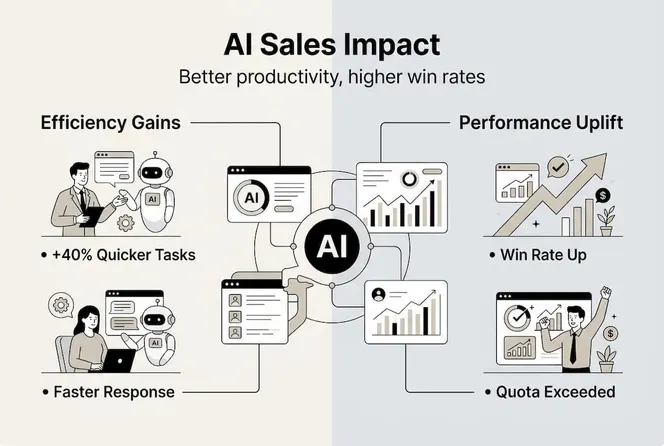
These improvements compound over time. Organizations that implement AI strategically create competitive advantages that become difficult for rivals to overcome. The data quality and model refinement that occur through continuous use create barriers to entry for late adopters.
Why most AI sales initiatives fail and how to avoid pitfalls
Despite promising results, 70-95% of AI projects fail to deliver expected outcomes. Understanding common failure modes helps sales leaders design implementations that succeed.
Poor process structure ranks as the primary culprit. Organizations often deploy AI without first streamlining underlying workflows. AI amplifies existing processes, so automating chaos produces chaotic results. Sales teams lacking clear qualification criteria or standardized stages cannot benefit from AI recommendations. The technology requires structured inputs to generate valuable outputs.
Data quality issues sabotage even well-designed implementations. AI models trained on incomplete, inconsistent, or outdated information produce unreliable predictions. CRM systems containing duplicate records, missing contact details, or inaccurate deal stages feed garbage into AI engines. Sales leaders must audit and clean data before deployment.
“Organizations that skip data preparation and process optimization waste resources on AI tools that cannot deliver value. Structure first, automation second.”
Business misalignment creates another common failure point. IT departments sometimes select AI tools without input from sales leadership or end users. The resulting solutions address technical requirements while missing actual user needs. Sales reps resist adopting tools that complicate rather than simplify their workflows.
Change management failures doom otherwise sound implementations. Sales teams accustomed to intuition-based selling resist data-driven recommendations. Without proper training and clear communication about AI’s role, reps view the technology as threatening rather than enabling.
Critical success factors include:
- Defining clear KPIs and success metrics before deployment
- Ensuring executive sponsorship and cross-functional alignment
- Cleaning and standardizing data across all systems
- Streamlining processes before automating them
- Providing comprehensive training and ongoing support
- Starting with pilot programs to validate assumptions
- Measuring results iteratively and adjusting based on feedback
Pro Tip: Create a cross-functional steering committee including sales, IT, and operations leaders. Weekly check-ins during pilots catch issues early and maintain alignment.
Organizations that address these factors systematically achieve success rates exceeding 80%. The investment in preparation pays dividends through faster adoption, better results, and reduced risk of costly failures.
Optimizing sales with a hybrid human-AI approach
The most effective sales organizations combine AI capabilities with human expertise rather than choosing one over the other. Hybrid human-AI models maximize both scale and relationship effectiveness.
AI excels at tasks requiring speed, consistency, and data processing. Prospecting tools scan thousands of potential leads daily, identifying ideal customer profiles and engagement signals humans would miss. Automated follow-up sequences nurture prospects through early funnel stages without rep involvement. Predictive analytics surface which deals need attention and which objections prospects will likely raise.
Humans excel where judgment, creativity, and relationship building matter most. Complex enterprise deals involving multiple stakeholders require nuanced navigation of organizational politics. Objection handling benefits from empathy and adaptive communication. Strategic account management depends on trust built through consistent human interaction.
Full AI replacement carries significant risks. Companies attempting to automate entire sales processes report conversion rate drops of 15-40%. Prospects perceive purely automated interactions as impersonal, damaging brand perception. High-value customers expect human attention, and removing it signals they are not priorities.
| Sales Activity | Best Handled By | Reason |
|---|---|---|
| Lead research and prospecting | AI | Processes thousands of signals faster than humans |
| Initial outreach sequences | AI | Maintains consistency and timing across large volumes |
| Qualification conversations | Hybrid | AI suggests questions, humans adapt based on responses |
| Complex negotiations | Human | Requires reading subtle cues and creative problem solving |
| Relationship management | Human | Trust building depends on authentic personal connection |
| Forecasting and pipeline analysis | AI | Identifies patterns across historical data objectively |
| Strategic account planning | Hybrid | AI provides insights, humans make judgment calls |
Successful hybrid implementations assign AI to repetitive, high-volume tasks while preserving human involvement in high-stakes interactions. Sales reps focus their time where they add the most value, while AI handles grunt work that previously consumed their days.
The augmentation benefits include:
- Reps spend 60% more time in meaningful prospect conversations
- AI-generated insights improve win rates by 30-50%
- Automated administrative tasks free 10-15 hours weekly per rep
- Predictive scoring helps reps prioritize highest-value opportunities
- Real-time coaching during calls improves messaging effectiveness
Pro Tip: Map your sales process end to end, identifying which steps require human judgment versus data processing. This exercise reveals optimal AI deployment points.
Organizations that view AI as a copilot rather than a replacement create sustainable competitive advantages. Reps become more effective, customers receive better experiences, and companies scale without proportionally increasing headcount.
Practical steps for implementing AI-driven sales solutions
Successful AI deployment follows a structured approach that minimizes risk while maximizing learning. Sales leaders should implement these steps sequentially rather than attempting wholesale transformation.
-
Conduct a pilot program with clear objectives. Select one sales team or territory as a test environment. Define specific metrics you will track, such as conversion rates, cycle times, or rep productivity. Establish a timeline of 60-90 days for initial assessment. Document baseline performance before introducing AI tools.
-
Ensure data quality and system integration. Audit your CRM for completeness, accuracy, and consistency. Remove duplicate records and standardize field formats. Verify that AI tools can access necessary data sources without manual exports. Successful implementations require clean data as a foundation.
-
Provide comprehensive training and support. Schedule hands-on workshops showing reps exactly how to use AI tools in their daily workflows. Address concerns about job security directly and honestly. Designate power users who can help teammates troubleshoot issues. Create quick reference guides for common tasks.
-
Measure performance continuously. Compare pilot results against baseline metrics weekly. Track both quantitative outcomes and qualitative feedback from users. Identify which AI features deliver value and which create friction. Adjust configurations based on what you learn.
-
Scale gradually based on validated results. Expand to additional teams only after pilot success is proven and documented. Refine training materials based on lessons learned. Maintain momentum by celebrating wins and sharing success stories across the organization.
Pro Tip: Appoint an AI champion within the sales team, not IT. Peer influence drives adoption more effectively than top-down mandates.
Common implementation mistakes to avoid include rushing deployment without adequate preparation, selecting tools based on features rather than user needs, and failing to address resistance through change management. Organizations that invest time in each step achieve adoption rates exceeding 90%, while those skipping steps see usage drop below 30% within months.
The measurement phase is particularly critical. Track leading indicators like tool usage rates and data quality scores alongside lagging indicators like quota attainment. This dual focus reveals whether poor results stem from the technology itself or from inadequate adoption.
Integration complexity often surprises organizations. Budget time for API connections, data mapping, and workflow automation setup. Involve IT early to identify technical constraints and security requirements. The smoother your systems communicate, the more value AI can deliver.
Enhance your sales with AI-powered tools from Gammatica
Implementing the strategies outlined above requires platforms designed specifically for sales team productivity and automation. Gammatica provides AI-driven insights and workflow automation tailored for sales leaders seeking measurable efficiency gains.
Our platform combines CRM functionality with intelligent task management, enabling your team to focus on high-value selling activities while AI handles administrative work. Sales managers gain real-time visibility into pipeline health, rep productivity, and forecast accuracy through intuitive dashboards.
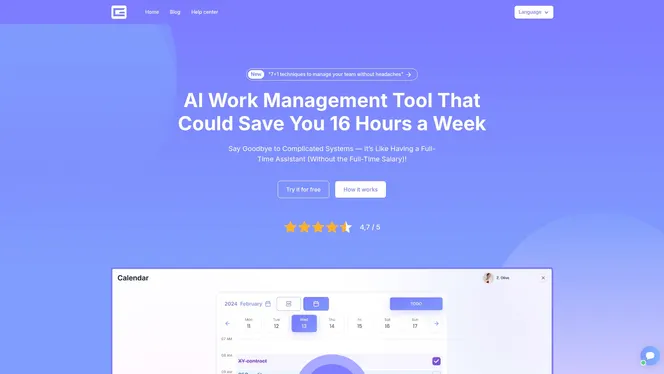
The system integrates seamlessly with existing tools through pre-built connectors and Make.com automation, eliminating the data silos that plague traditional implementations. Gammatica for founders offers specialized features for scaling sales operations, including automated customer journey mapping and AI-powered checklist generation that ensures consistent execution across your team. Our clients report saving up to 16 hours weekly per rep, time they redirect toward prospect engagement and deal advancement.
Frequently asked questions about artificial intelligence sales
What types of sales tasks can AI most effectively automate?
AI handles repetitive, data-intensive tasks with the greatest impact. Lead prospecting, initial outreach sequences, data entry, and follow-up reminders benefit most from automation. These activities require consistency and scale that humans struggle to maintain. Complex negotiations, relationship building, and strategic account planning still require human judgment and emotional intelligence that AI cannot replicate.
Why do so many AI sales projects fail?
Most failures stem from poor process design, inadequate data quality, and lack of organizational alignment. Companies often deploy AI without first cleaning their CRM data or streamlining underlying workflows. Resistance from sales teams who receive insufficient training or feel threatened by the technology also contributes. Structured rollouts with clear KPIs, executive sponsorship, and comprehensive change management increase success rates dramatically.
Will AI replace salespeople?
No widespread displacement has occurred, and hybrid models prove most effective. AI augments sales professionals by handling administrative tasks and providing data-driven insights, but human skills remain essential for complex deals and relationship management. The role is evolving rather than disappearing. Sales professionals who learn to leverage AI tools become significantly more productive and valuable. Organizations should focus on upskilling teams for human-AI collaboration rather than fearing replacement.
How should firms start implementing AI in their sales operations?
Begin with pilot programs focused on specific, measurable outcomes. Select one team or territory as a test environment and establish clear success criteria before deployment. Invest heavily in data quality and CRM cleanup. Provide comprehensive training and address resistance through transparent communication about AI’s role. Measure results weekly and adjust based on feedback. Scale only after validating that the pilot delivers promised benefits and that your team has adopted the tools consistently.