TL;DR:
- Effective team building games should align with team goals, size, budget, and remote capability.
- Debriefing after activities transforms fun exercises into lasting team insights and trust.
- Consistent micro-interventions and trust-building practices significantly boost team performance.
Picking the right team building game sounds simple until you’re staring at a list of 50 options with no idea which ones actually work. Most roundups dump ideas on you without helping you decide. The wrong choice wastes time, kills energy, and can make your team dread the next session. This guide is different. We’ve curated 46 games across three core categories, icebreakers, problem-solving, and communication, using clear criteria built for small to medium-sized teams. You’ll get practical setup tips, group size guidance, and a comparison framework so you can walk into any meeting or offsite with confidence.
Key Takeaways
| Point | Details |
|---|---|
| Curated for SMEs | These 46 games are optimized for small to medium teams’ real needs, not generic options. |
| Selection matters most | Choosing the right game type for your team’s size, location, and comfort level predicts success. |
| Easy adaptation | Each game can be tweaked for remote or hybrid teams without extra cost or hassle. |
| Proven engagement gains | Research shows these games increase trust, engagement, and learning retention substantially. |
How to choose effective team building games
Not all games are created equal. A game that energizes a 10-person startup might fall flat with a 50-person hybrid team. Before you pick anything, you need a simple filter.
Start with game mechanics. Games vary by mechanic: icebreakers build quick connection, problem-solving games challenge strategic thinking, and communication games sharpen listening and clarity. Knowing what you want to achieve narrows your list fast.
Next, think about your SME-specific constraints:
- Budget: Many great games cost nothing. Prioritize free or low-cost options for recurring use.
- Time: Most teams can spare 15 to 30 minutes. Avoid games that require 90-minute setups unless it’s a dedicated team day.
- Group size: Some games cap at 8 people; others scale to 50 or more. Always check before you commit.
- Remote or hybrid fit: If half your team is on video, you need games that work on screen without extra software.
Also consider where your team is in its journey. New teams need low-stakes icebreakers that don’t force personal sharing. Established teams can handle more challenge and vulnerability. Introverts often thrive with written or structured formats rather than open-ended verbal games.
One common mistake is choosing games that require people to share personal stories or physical contact right away. This can create discomfort, not connection. Stick to games that let people opt in at their own pace.
Pro Tip: The best games for recurring use are low-cost and time-flexible. A 10-minute game you run every week builds more culture than a one-time elaborate event.
Icebreakers and energizers: The best games for starting strong
With your criteria in mind, let’s start with the icebreakers that energize any gathering. These 16 games are ideal for first meetings, virtual kickoffs, or any moment when you need to shift the room’s energy.
Top 16 icebreaker and energizer games:
- Two Truths and a Lie: Each person shares three statements; the group guesses which is false. Quick, low-pressure connection makes this a perennial favorite. Best for groups of 5 to 20, takes about 10 minutes.
- Human Bingo: Players fill a bingo card with traits like “has a pet” or “speaks two languages” by talking to colleagues. Great for in-person events, 10 to 40 people, 15 minutes.
- Who Am I?: A name is taped to each person’s back; they ask yes/no questions to figure out who they are. Works for 6 to 30 people, 15 to 20 minutes.
- Emoji Story: Each person describes their morning or weekend using only emojis in a chat. Perfect for remote teams, any size, 5 minutes.
- One Word Check-In: Everyone shares one word describing how they feel right now. Low pressure, 2 minutes, any group size.
- Virtual Background Story: Remote players pick a themed background and explain why. 5 to 25 people, 10 minutes.
- GIF Battle: Each person finds a GIF that represents their current mood. Fun, fast, remote-friendly.
- Speed Networking: Pairs rotate every 2 minutes answering a prompt. 10 to 50 people, 15 minutes.
- Desert Island Picks: Share one item you’d bring to a desert island. Sparks conversation, 5 to 20 people.
- Name and Motion: Each person says their name with a movement; the group mirrors it. Energizing, in-person, 5 to 15 people.
- Photo Share: Everyone shares a photo from their phone that means something to them. Remote or in-person, 5 to 20 people.
- Trivia Warm-Up: Three quick trivia questions to open a meeting. Any size, 5 minutes.
- Would You Rather: Lighthearted either/or questions. Any size, 5 to 10 minutes.
- Word Association: One word is said; each person adds the next word that comes to mind. Fast, verbal, 5 to 15 people.
- Superlatives: Vote on fun categories like “most likely to start a band.” 8 to 30 people, 10 minutes.
- Countdown Facts: Each person shares one surprising fact about themselves. 5 to 25 people, 10 minutes.
Use these as meeting openers or after lunch to re-engage attention. They work best when they feel optional, not mandatory.
Pro Tip: Let team members opt in for personal sharing. Psychological safety grows when people feel they have a choice, not an obligation.
Problem-solving and creative thinking games
Having warmed up your team, move on to games that unlock problem-solving potential. These 15 games push teams to think strategically, iterate quickly, and trust each other under pressure.
- Marshmallow Challenge: Teams build the tallest freestanding structure using spaghetti, tape, and a marshmallow on top. Kindergarteners outperform business students because they prototype early and often. Ideal for 4 to 8 people per team, 18 minutes.
- Escape Room in a Box: Packaged puzzle kits that teams solve together. 4 to 10 people, 45 to 60 minutes.
- Paper Tower: Build the tallest tower using only paper and tape. 4 to 6 people, 15 minutes.
- Code Breakers: Teams decode a message using logic clues. 4 to 8 people, 20 minutes.
- Egg Drop: Protect an egg from a drop using limited materials. 4 to 6 people, 30 minutes.
- Bridge Build: Two sub-teams build bridge halves that must connect in the middle. 6 to 12 people, 30 minutes.
- Scavenger Hunt: Teams solve clues to find items or locations. Scales widely, 30 to 60 minutes.
- Reverse Brainstorm: Instead of solving a problem, brainstorm how to make it worse, then flip the ideas. Any size, 20 minutes.
- Lego Serious Play: Teams build Lego models to represent abstract concepts like team values. 4 to 10 people, 45 minutes.
- Puzzle Race: Teams race to complete a jigsaw puzzle. 4 to 8 people, 20 minutes.
- Survival Scenario: Given a fictional crisis, teams rank survival items by importance. 5 to 10 people, 20 minutes.
- Mystery Dinner: Teams solve a fictional mystery using clues distributed across the group. 8 to 20 people, 45 minutes.
- Innovation Sprint: Teams have 20 minutes to pitch a solution to a real company challenge. Any size, 30 minutes.
- Blind Drawing: One person describes an image; others draw without seeing it. 4 to 12 people, 15 minutes.
- Tower of Hanoi: Teams solve the classic disk puzzle together, discussing strategy out loud. 3 to 6 people, 15 minutes.
| Game | Group size | Duration | Remote-friendly |
|---|---|---|---|
| Marshmallow Challenge | 4 to 8 | 18 min | No |
| Escape Room in a Box | 4 to 10 | 45 to 60 min | Partial |
| Reverse Brainstorm | Any | 20 min | Yes |
| Survival Scenario | 5 to 10 | 20 min | Yes |
| Innovation Sprint | Any | 30 min | Yes |
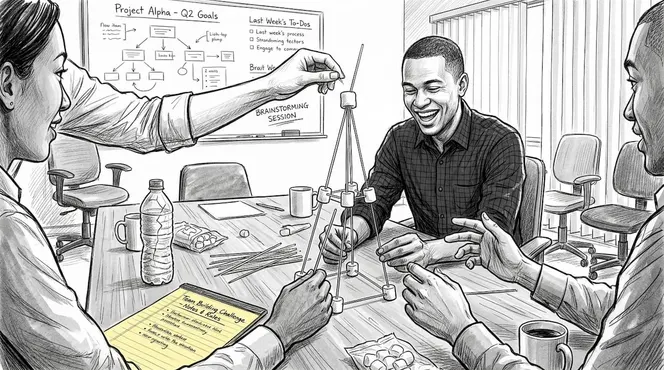
Game-based learning produces retention rates 3 to 4 times higher than traditional training methods, which means these games do double duty: they build team bonds and reinforce real skills.
Communication and collaboration games for every team
Let’s complete the roster with games that deepen collaboration and elevate day-to-day communication. These 15 games work across in-person, remote, and hybrid settings.
- Minefield: One person is blindfolded and guided through an obstacle course by a partner using only verbal instructions. Clear signal amid noise is the core lesson. 6 to 20 people, 20 minutes.
- Back-to-Back Drawing: Partners sit back-to-back; one describes an image while the other draws it. Sharpens instruction-giving. 2 to 30 people, 15 minutes.
- Telephone: A message is whispered down the line; the final version is revealed. Highlights communication gaps. Any size, 10 minutes.
- Virtual Trivia: A team-building trivia platform can scale to 2,000 remote participants. Customizable, competitive, and energizing.
- Desert Island Debate: Teams must agree on five items to bring; consensus is required. 5 to 15 people, 20 minutes.
- Active Listening Pairs: Partners take turns speaking and summarizing what they heard. 4 to 20 people, 15 minutes.
- Story Spine: Each person adds one sentence to build a collaborative story. Any size, 10 minutes.
- Feedback Circle: Structured positive feedback shared in a circle. 5 to 15 people, 20 minutes.
- Role Reversal: Team members swap roles for a task or discussion. Any size, 20 minutes.
- Silent Line-Up: Teams arrange themselves by birthday or height without speaking. 8 to 30 people, 10 minutes.
- Collaborative Drawing: Each person adds to a shared drawing without talking. Remote or in-person, 10 minutes.
- Question Toss: A ball (or virtual turn) is passed; whoever catches it answers a team-related question. 5 to 20 people, 10 minutes.
- One-Sentence Summary: Each person summarizes a project or meeting in one sentence. Any size, 5 minutes.
- Strengths Spotlight: Each team member names one strength they’ve observed in a colleague. 5 to 15 people, 15 minutes.
- Mirror Exercise: Pairs mirror each other’s movements in silence. Builds nonverbal attunement. In-person, 5 to 10 people.
Teams that build high trust see a 50% improvement in performance, making communication games one of the highest-ROI investments you can make in your people.
Finding the perfect fit: A quick comparison of top game types
With dozens of options, here’s a cheat sheet to help you choose the right game for any situation.
| Category | Best for | Time needed | Cost | Remote-friendly | Limitation |
|---|---|---|---|---|---|
| Icebreakers | New teams, meeting openers | 5 to 15 min | Free | Yes | Low depth |
| Problem-solving | Established teams, strategy | 20 to 60 min | Low to medium | Partial | Needs facilitation |
| Communication | All teams, ongoing use | 10 to 30 min | Free | Yes | Requires trust |
Recommended games by scenario:
- First team meeting: Two Truths and a Lie, One Word Check-In, Human Bingo
- Remote kickoff: Virtual Trivia, Emoji Story, Virtual Background Story
- Strategy offsite: Marshmallow Challenge, Innovation Sprint, Survival Scenario
- Weekly check-in opener: Would You Rather, Countdown Facts, Trivia Warm-Up
- Conflict resolution context: Active Listening Pairs, Feedback Circle, Role Reversal
Outdoor activities also boost morale in measurable ways when your team has the opportunity to get outside. Don’t overlook a simple walk-and-talk as a low-cost energizer.
A few special reminders: always have a backup game ready for large groups where logistics can shift. For introverted teams, lean on written or structured formats. And avoid over-personalizing games for mixed teams where trust hasn’t been fully established yet.
What most team building advice misses: The real secret to effective games
Here’s what few leaders hear: playing games is not the same as building a team. Compliance is not engagement. You can run the most creative game on this list and still walk away with a team that feels no more connected than before, if you skip the debrief.
The leaders who see real results do three things differently. They model vulnerability first, sharing their own answer before asking others. They tie the game to a real team goal, not just fun for fun’s sake. And they follow up. One question after a game, like “What did you notice about how we worked together?”, turns a 15-minute activity into a lasting insight.
Teams with high trust show 50% more productivity, but trust isn’t built in a single session. Small, consistent micro-interventions, a weekly icebreaker, a monthly challenge, a quick debrief, compound over time. Grand gestures fade. Habits stick.
Pro Tip: Always debrief. One quick question after any game transforms it from entertainment into a genuine learning moment your team will remember.
Level up your team collaboration with Gammatica
Great team building doesn’t stop when the game ends. The real work happens in how your team communicates, tracks progress, and supports each other every day. That’s where Gammatica for founders comes in.
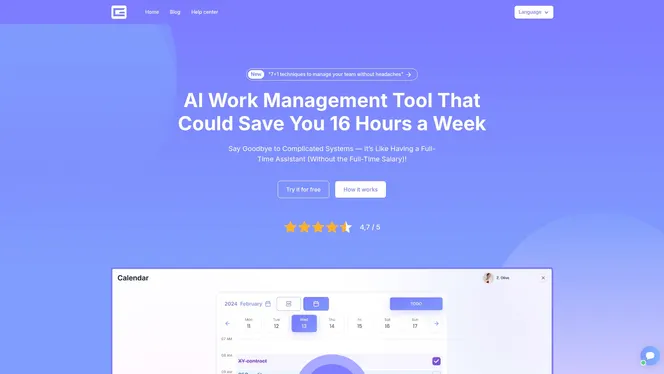
Gammatica is an AI-driven team and project management platform that keeps collaboration alive between your team building sessions. From task management and Kanban boards to automated workflows and calendar coordination, it gives your team the structure they need to stay aligned. Whether you’re managing a remote crew or a hybrid office, Gammatica’s sales tools and team features help you build on the trust and communication skills your games develop. Try it and see how much smoother your team can run.
Frequently asked questions
How do I choose the right team building game for my SME team?
Consider group size, time available, remote or in-person needs, and your team’s comfort with sharing or physical activity. Game mechanics and context matter most for SMEs, so match the game type to your specific goal.
What are the best quick team building games for remote teams?
Try Virtual Trivia, Two Truths and a Lie, or Back-to-Back Drawing. None require extra apps and all can be run in under 20 minutes. Virtual trivia is scalable and works well even for large distributed groups.
Do these games work for introverted teams?
Yes. Low-pressure games like written check-ins, One Word Check-In, or Emoji Story are ideal for introverts. Non-personal activities reduce social anxiety and still build real connection.
How much time should I set aside for team building activities?
Most games fit in 10 to 30 minutes, making them easy to slot into existing meetings. Games can fit a wide range of timeframes, from a quick 5-minute opener to a 60-minute strategy session.
What is the main benefit of team building games according to research?
Game-based learning delivers 3 to 4 times higher retention than traditional training, and teams with trust see significant performance gains. That makes team building one of the smartest investments a manager can make.