Stepping into a week packed with deadlines, most project managers in tech startups face the challenge of deciding where their team’s limited energy delivers real progress. Understanding how to separate routine upkeep from the few impactful tasks matters because wasted effort stalls growth when resources are lean. By focusing on the 20 and 80 rule—the principle that a small set of priorities fuels most results—you can dramatically reshape how time and effort get invested for higher team productivity.
Table of Contents
- Defining The 20 And 80 Rule In Productivity
- Pareto Principle Origins And Key Variations
- How The 20 And 80 Rule Drives Task Prioritization
- Real-World Applications In Tech Startups
- Common Pitfalls And How To Avoid Them
- Best Practices For Ai-Enhanced Implementation
Defining the 20 and 80 Rule in Productivity
The 20 and 80 rule, more formally known as the Pareto Principle, states that roughly 80% of your results come from just 20% of your efforts. Think of it like this: when you look at your task list for the week, a small handful of those tasks will drive the majority of your team’s impact. The rest? They’re important for maintenance, but they’re not the power movers. This principle originated from economist Vilfredo Pareto’s observations about wealth distribution in Italy, but it applies remarkably well to how you manage projects, allocate resources, and prioritize work in tech startups.
For project managers in tech environments, understanding this distribution matters because it directly shapes how you spend your team’s time and energy. You could spend 80% of your sprint working on nice-to-have features, polish, and administrative overhead. Or you could focus that same 80% of effort on the 20% of features that your users actually need and that generate real business value. The difference between these two approaches? Weeks of shipped features versus weeks of invisible work. Management consultant Joseph Juran expanded on Pareto’s concept for quality control, and today it remains one of the most practical frameworks for separating signal from noise in any business context.
What makes this rule particularly valuable for startup teams is that you’re usually operating with lean resources. You don’t have the luxury of half-measures or scattered focus. Your developers could spend time refactoring code that works fine, or they could ship features that move the revenue needle. Your customer support team could handle every low-priority ticket immediately, or they could focus on the 20% of issues that affect 80% of your customers. The 20 and 80 rule forces you to be ruthless about this distinction. It’s not about working harder. It’s about working against the right targets.
The principle works across different dimensions too. When you analyze your team’s output, you’ll typically find that a small group of your team members drives a disproportionate amount of progress. When you review your customer base, a minority of clients likely generates the majority of revenue. When you examine your product backlog, a subset of features will unlock most of the user engagement. Recognizing these patterns is the first step toward rebalancing your priorities and your resource allocation to match actual impact.
Pro tip: Audit your current sprint or project timeline this week. Identify which 20% of tasks or features would deliver 80% of the user value or business outcome, then make those visible to your team as the primary focus areas.
Pareto Principle Origins and Key Variations
The story of the 20 and 80 rule starts in early 1900s Italy with an economist named Vilfredo Pareto. He noticed something striking while studying wealth distribution: 80% of Italy’s land was owned by just 20% of the population. This wasn’t a small quirk or statistical anomaly. It was a pattern so consistent that Pareto recognized it as a fundamental principle of how resources distribute across populations. His observation went beyond land ownership too. He saw the same imbalance showing up in wealth, income, and other measurable outcomes across different societies. What started as an observation about property ownership became a lens for understanding how value concentrates in economic systems. Today, that principle bears his name and shapes how managers, entrepreneurs, and productivity experts think about resource allocation.
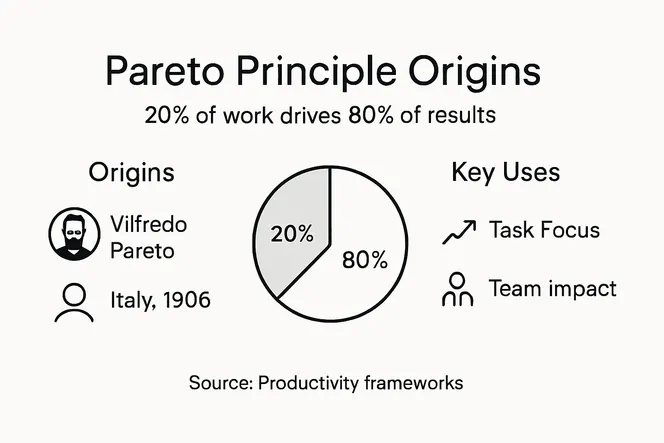
Decades later, Joseph Juran, a management consultant focused on quality control, recognized the power of Pareto’s insight and adapted it to manufacturing and business problems. Juran coined the phrase “the vital few and the trivial many” to describe how a small number of causes typically generate the majority of problems or defects in production systems. This reframing was powerful because it shifted thinking from treating all problems equally to identifying which causes drive most quality issues. In Juran’s framework, if you could fix the 20% of root causes responsible for 80% of your defects, you’d achieve massive quality improvements without fixing everything. This approach became foundational to Six Sigma, lean manufacturing, and continuous improvement methodologies that tech companies and startups still use today.
The principle also connects to something called power law distributions, which explain why outcomes are rarely evenly distributed across inputs. In a power law distribution, a small number of factors have enormous influence, while the majority have minimal impact. This pattern shows up everywhere once you start looking for it. In software companies, a handful of features drive most user engagement. In customer service, a small percentage of issues cause the majority of complaints. In your team’s productivity, a few key people or activities generate disproportionate results. Understanding this mathematical reality helps you stop expecting 100 inputs to give you 100 units of output. Instead, you recognize that some inputs are worth vastly more than others.
The beauty of recognizing these variations is that it gives you permission to be selective. You don’t need to apply equal effort everywhere. The 20 and 80 rule isn’t about ignoring 80% of your work. It’s about tiering your attention and resources based on actual impact. Some tasks need basic maintenance. Others need your full focus because they’re the drivers of real results.
Pro tip: Map out where power law distributions actually exist in your current projects. Ask your team: which 20% of features would users miss most, which clients generate most revenue, and which team members deliver most of the key milestones this quarter.
How the 20 and 80 Rule Drives Task Prioritization
Task prioritization is where the 20 and 80 rule stops being theory and becomes your daily operating system. When you face a sprint with thirty tasks, a backlog with hundreds of items, and a team with limited capacity, you need a way to separate what actually matters from what just feels urgent. The 20 and 80 rule gives you that filter. By identifying the 20% of activities that generate 80% of your results, you can focus efforts on high-impact tasks instead of spreading yourself thin across everything. This isn’t about ignoring work. It’s about being honest about where your time delivers real value.

Here’s how this plays out in a tech startup context. Your product roadmap has feature requests, bug fixes, technical debt, and performance improvements all competing for attention. If you use traditional prioritization, you might treat them equally or let the loudest stakeholder win. With the 20 and 80 rule, you ask different questions: Which features do 80% of users actually need? Which bugs affect 80% of your customer complaints? Which performance improvements unlock 80% of the speed gains users are asking for? Suddenly, your list becomes much shorter and much more focused. You identify the vital few that move the needle and push everything else to a secondary tier. This doesn’t mean the secondary tier never gets done. It means you do the high-impact work first, when energy and resources are fresh.
The practical benefit here is enormous. By recognizing that a small portion of efforts produces the majority of outcomes, you can allocate resources strategically. Your best developers work on the 20% of features that matter most. Your customer support team tackles the 20% of issues causing 80% of customer friction. Your marketing pushes the 20% of channels driving 80% of qualified leads. The principle of effective task prioritization means you’re not just working longer or faster. You’re working smarter by investing your finite time and attention where it has the greatest return.
One critical mindset shift happens when you adopt this rule for prioritization: you stop feeling like you’re abandoning work. The 80% of tasks still exist. They still need attention eventually. But by acknowledging they’re lower impact, you can delegate them, batch them, automate them, or schedule them for later without guilt. You’re making a conscious choice based on impact, not avoiding responsibility. This is the difference between reactive task management and strategic prioritization. And in a startup environment where every week matters and resources are constrained, that distinction directly affects whether you ship features customers want or spend cycles on invisible work.
Pro tip: Create a simple impact matrix for your next sprint. List your top 20 tasks, then identify which 4 would deliver 80% of the user or business value. Make those 4 your sprint anchors, then build everything else around them.
Real-World Applications in Tech Startups
The 20 and 80 rule isn’t just a theoretical framework for startups. It’s become the operating principle that separates companies that scale from those that burn out trying to do everything at once. When you’re building a tech startup with limited runway and a small team, you cannot afford to treat all work equally. Your survival depends on identifying which 20% of your efforts will generate 80% of your impact and then being ruthless about protecting that focus. Research shows that startups drive commercialization of high-impact innovations by concentrating on transformative technologies rather than incremental improvements. The companies winning in your space are the ones that made hard choices about what matters most.
Consider how successful startups allocate their engineering resources. A five-person development team could spread themselves across bug fixes, technical debt, feature requests, infrastructure improvements, and documentation. Instead, the smart ones identify which features 80% of their users actively need and which bugs block 80% of critical workflows. They ruthlessly prioritize those areas and defer everything else. This focus means they ship features faster, customers see improvements they actually care about, and the team maintains momentum instead of fragmenting across dozens of directions. The same applies to sales and marketing. Rather than running ten campaigns hoping something sticks, effective startups identify the 20% of channels driving 80% of qualified leads and double down there. This is how small teams compete against larger competitors with bigger budgets.
Customer support teams in startups also apply this principle constantly. You get inbound issues from dozens of customers every week, but the 20 and 80 rule shows that a small cluster of problems accounts for most of your support volume. By identifying those core issues and fixing them at the root, you reduce support load dramatically. Create a better onboarding experience, and 80% of beginner questions disappear. Improve your API documentation, and 80% of integration problems get solved without anyone contacting support. Fix the top three bugs, and your support team can focus on actual strategic customer work instead of repetitive triage. The World Economic Forum has emphasized how targeted policy actions drive startup ecosystem success, reflecting the same principle. You cannot succeed by spreading effort evenly. Success comes from identifying what actually moves the needle and concentrating there.
The practical reality is that every startup project manager makes daily decisions about where to spend team capacity. The 20 and 80 rule provides a framework for making those decisions intentionally rather than reactively. When a stakeholder asks for a new feature, you can ask: Is this in the vital 20%? When your development backlog grows, you can ask: Which items would unlock 80% of the user value? When you plan your sprint, you can ask: What work would have the highest impact per hour invested? These questions force clarity and prevent the slow creep of unfocused effort that kills startup momentum.
Here’s a summary of how the Pareto Principle influences different roles in tech startups:
| Startup Role | 20% Focus Area | 80% Impact Generated | Example Outcome |
|---|---|---|---|
| Developers | Key feature development | Major user engagement | Faster releases |
| Customer Support | Core recurring issues | Reduced support volume | Improved satisfaction |
| Project Managers | Strategic prioritization | Greater team efficiency | Higher delivered value |
| Marketing | Effective channels | Qualified lead generation | Increased conversions |
Pro tip: Conduct a 20 and 80 analysis on your current project this week. Track where your team actually spent time last sprint, then identify which 20% of work generated 80% of measurable results. Use that insight to reshape next sprint’s priorities.
Common Pitfalls and How to Avoid Them
The 20 and 80 rule is powerful, but it’s also easy to misapply. The biggest mistake project managers make is misidentifying which 20% actually drives results. You think certain tasks are vital because they feel urgent, because they’re visible, or because a stakeholder is pushing them. But urgency and importance are not the same thing. A customer complaint that arrives at 3 p.m. on Friday feels critical in the moment, but it might affect one user while your core feature development affects thousands. The consequences of getting this wrong are brutal: you focus your team’s energy on work that feels productive but delivers minimal impact. Months pass. Your roadmap hasn’t moved. Your most important initiatives stall while you chased shiny objects. Misidentifying the crucial 20% results in misplaced focus and wasted effort on less impactful tasks, so continuous analysis and validation of what truly drives results is essential.
Another critical pitfall is confusing the 80/20 split with a rigid mathematical law. The principle isn’t always exactly 80 and 20. Sometimes it’s 90 and 10. Sometimes it’s 75 and 25. If you treat the numbers as absolute truth rather than as a useful heuristic, you’ll miss important nuance. You might ignore contributors that fall outside the 20% but still matter significantly. A bug that affects 15% of your users is below the typical threshold, but it might block a critical workflow for your largest customer. By assuming the 80/20 split is precise, you could overlook risks or overlook opportunities that don’t fit the clean percentages. View the principle as a heuristic rather than rigid law, and complement it with actual data analysis about your specific context.
A third pitfall is neglecting the 80% while chasing the 20%. Yes, you should prioritize high-impact work. But completely abandoning the remaining 80% creates its own problems. Technical debt doesn’t go away. It compounds. Minor bugs don’t fix themselves. They accumulate into customer frustration. Process gaps don’t disappear. They multiply into inefficiency. The solution isn’t to treat everything equally. It’s to tier your approach. Your best people work on the vital 20%. Your mid-level resources handle important-but-not-critical work from the 80%. Automation and templates address routine tasks. You’re not ignoring the 80%. You’re managing it efficiently while protecting capacity for what matters most.
The final pitfall is short-term thinking without long-term strategy. You identify the 20% that drives results this quarter and focus there. Good move. But six months later, you haven’t invested in infrastructure, training, or foundational improvements that would multiply your impact next year. You’ve optimized the current sprint without building for the future. The antidote is balancing immediate impact with strategic investment. Some portion of your 20% should be high-impact immediate work. Another portion should be foundational work that pays dividends later. Ask yourself: which 20% of our effort this quarter unlocks 80% of our capacity next quarter?
Compare common pitfalls of misapplying the 20 and 80 rule:
| Pitfall | Description | Impact on Productivity | How to Avoid |
|---|---|---|---|
| Misidentifying vital 20% | Confusing urgency with importance | Wasted effort, stalled progress | Use data-driven validation |
| Treating 80/20 as rigid law | Applying fixed ratio as rule | Overlooking key contributors | Adapt percentage to context |
| Neglecting the 80% | Ignoring lower-impact tasks outright | Technical debt, process gaps grow | Tier and efficiently manage |
| Short-term focus only | Prioritizing only immediate gains | Future growth limitations | Balance short and long-term work |
Pro tip: Review your last three sprints and honestly identify which work you thought was in the vital 20% but actually wasn’t. Note the patterns. Use those insights to build a validation checklist before committing resources to new priorities.
Best Practices for AI-Enhanced Implementation
Applying the 20 and 80 rule manually works, but AI changes the game entirely. An AI system can analyze thousands of data points about your team’s work, identify patterns humans would miss, and surface the true vital 20% with speed and accuracy that spreadsheets cannot match. The key is implementing AI thoughtfully. This means starting with clear definitions of what success looks like for your specific team. Are you measuring impact by customer satisfaction, revenue, feature velocity, or something else? Your AI system needs to know. Without clarity on your success metric, even the smartest AI will optimize for the wrong thing. Tell the system to find tasks that maximize user engagement, and it might recommend features that hook users but don’t solve real problems. Tell it to find tasks that increase customer retention, and it might identify something different entirely. The specificity matters.
Human oversight remains essential. Best practices for responsible AI deployment emphasize transparency and accountability, which means you should never blindly trust an AI recommendation just because a system generated it. AI can introduce bias. Your customer base might be skewed toward one demographic, and the AI learns patterns from that skewed data. Your historical project data might reflect past mistakes in prioritization, and the AI learns those mistakes as truth. Your team structure might favor certain types of work visibility, making important behind-the-scenes work invisible to the algorithm. The solution is treating AI as an advisor, not an authority. Use it to surface insights and patterns. Then apply human judgment. Ask: Does this recommendation make sense for our context? Are we missing anything? Would this actually move us toward our goals? That conversation between human expertise and AI capability is where the real power emerges.
Implementation also requires training your team on how to work with AI effectively. Your project managers need to understand what the AI is telling them and why. Your developers need to trust the priorities coming from the system. Your leadership needs to see the transparency in how decisions are being made. Best practices for AI integration in workplace productivity emphasize human-AI collaboration to augment rather than replace human judgment. This means investing time in education. Show your team how the AI analyzes data. Explain the logic behind its recommendations. Let people challenge it with context the AI might not have. This builds confidence and ensures the tool actually improves decision-making rather than creating friction.
One more critical practice: continuously validate and adjust. The 20% that matters now might shift as your product evolves, your market changes, or your team grows. An AI system trained on historical data reflects the past, not necessarily the future. Build in regular reviews. Every month or quarter, ask: Is the AI still identifying the right vital 20%? Are the recommendations delivering the impact we expected? What patterns has it missed? Use those insights to retrain the system or adjust how you’re using it. This keeps AI-enhanced prioritization sharp and adaptive instead of stale.
Pro tip: Start with a pilot. Pick one team or one sprint and let AI suggest priorities based on your success metrics, then compare outcomes against traditional prioritization. Use that real-world data to refine both your metrics and your AI implementation.
Supercharge Your Team’s Impact with AI-Driven Focus
The 20 and 80 rule reveals that just a small portion of your tasks and efforts generate most of your results. Yet narrowing down those vital few tasks and ensuring your team spends time on what truly moves the needle can be challenging. You may struggle with identifying the right 20% of high-impact activities and balancing urgent demands with strategic priorities. This approach demands ruthless focus and data-driven insight to avoid wasted energy on less meaningful work.
At Gammatica, we understand these challenges and offer a powerful AI-driven project and team management platform designed specifically to help you apply the 20 and 80 rule with precision. Our tools streamline task prioritization through intelligent automation, personalized AI suggestions, and easy-to-use Kanban boards that highlight your vital few priorities. With integrated time tracking and automation, you can free up to 16 hours weekly allowing your team to concentrate intensely on the tasks that generate the greatest impact. Every feature from CRM to calendar coordination is crafted to reduce administrative burdens so your focus stays on what matters most.

Stop guessing which activities deliver real value and start maximizing your team’s productivity immediately. Visit Gammatica to discover how our platform can help you identify the impactful 20% swiftly and keep your entire team aligned and efficient. Take control of your project workflows and unlock your startup’s growth potential today.
Frequently Asked Questions
What is the 20 and 80 rule in productivity?
The 20 and 80 rule, or Pareto Principle, states that roughly 80% of your results come from just 20% of your efforts. It’s a framework for prioritizing tasks that deliver the most value to your team or organization.
How can I apply the 20 and 80 rule in a tech startup?
In a tech startup, you can apply the 20 and 80 rule by identifying the key features or tasks that produce the majority of user engagement or business value, and prioritizing those over less impactful tasks that might consume your team’s time.
What are common pitfalls when using the 20 and 80 rule?
Common pitfalls include misidentifying the crucial 20%, treating the 80/20 split as a strict rule rather than a guideline, neglecting the 80%, and focusing solely on short-term results without considering long-term strategy.
How can AI enhance the implementation of the 20 and 80 rule?
AI can enhance the implementation by analyzing large datasets to identify which 20% of tasks are most impactful. However, human oversight is essential to ensure that AI recommendations align with your specific context and team goals.