
TL;DR:
- Effective time management relies on a structured system that protects productivity rather than simple scheduling.
- Most professionals waste 60% of their work hours on low-value tasks, but brief planning can significantly increase output.
Effective time management is defined as a structured system for protecting productive output, not simply a scheduling exercise. Professionals who treat it as a system rather than a calendar habit gain a measurable edge. 60% of working hours are consumed by low-value tasks. That number means most professionals are busy all day while moving very little forward. The good news: 10 minutes of planning can recapture up to 2 hours of productive time daily. The time management strategies 2025 professionals need most are built on four pillars: Planning, Awareness, Triage, and Output Protection. Each pillar addresses a different root cause of lost time, and together they form a system that actually works.
1. The Ivy Lee Method for daily prioritization

The Ivy Lee Method is one of the most effective time management techniques 2025 professionals can adopt. At the end of each workday, you write down your six most important tasks for tomorrow, ranked by priority. You work through them in order the next morning, starting with number one before touching anything else. The method forces you to make hard prioritization decisions the night before, when your mind is clearer about what actually matters. It also eliminates the morning decision fatigue that derails most professionals before 9:00 AM.
2. The Pomodoro Technique for sustained focus
The Pomodoro Technique breaks work into 25-minute focused intervals separated by 5-minute breaks. After four intervals, you take a longer break of 15–30 minutes. This structure works because it matches the brain’s natural attention cycle and prevents the cognitive fatigue that builds up during long, uninterrupted work sessions. Professionals who use it report finishing tasks faster because the time constraint creates urgency. It pairs especially well with deep work blocks where distraction is the primary enemy.
Pro Tip: Set a physical timer, not a phone timer. Your phone is a distraction machine. A dedicated timer keeps the ritual separate from your notification feed.
3. The Eisenhower Matrix for smart task triage
The Eisenhower Matrix sorts every task into one of four quadrants: urgent and important, important but not urgent, urgent but not important, and neither. Most professionals spend the majority of their time in the “urgent but not important” quadrant, reacting to other people’s priorities. The matrix forces you to identify which tasks actually move your goals forward versus which ones just feel pressing. Tasks in the “important but not urgent” quadrant, like strategic planning and relationship building, are where your highest leverage lives. Schedule those first, before urgency crowds them out.
4. Time blocking with calendar integration
Time blocking assigns specific tasks to fixed calendar slots, treating them as non-negotiable appointments. Timeboxing fails when professionals treat blocks as flexible to-do lists rather than firm commitments. The fix is to start each morning with a brief self-planning meeting, a 10–15 minute calendar review where you confirm the day’s blocks and adjust for any overnight changes. This approach merges your task list with your calendar, eliminating the gap between what you plan and what you actually do. It is one of the most reliable 2025 productivity techniques for protecting deep work time.
5. Parkinson’s Law for task duration control
Parkinson’s Law states that work expands to fill the time available for its completion. If you give yourself three hours for a one-hour task, it will take three hours. The practical application is to set artificially tight but realistic deadlines for every task. A report that “needs to be done this week” should have a specific two-hour block assigned to it, not an open-ended window. Professionals who apply this law consistently find they finish more work in less time and with less procrastination.
6. The 3/3/3 Method for balanced daily output
The 3/3/3 Method structures your day into three distinct layers. You spend three hours on your most important deep work project, complete three shorter urgent tasks, and handle three maintenance activities like emails or admin. This structure prevents the common trap of spending all day on reactive work while neglecting the projects that drive real results. It also gives you a clear definition of a “good day,” which reduces end-of-day anxiety. Professionals who use it report a stronger sense of accomplishment because progress on meaningful work is built into the structure.
7. Time auditing to find hidden productivity leaks
A time audit is the foundation of any personalized productivity system. Auditing tasks in 30-minute increments over several days reveals that administrative tasks and context switching consume far more time than professionals expect. You track every activity in a simple log, then categorize each block as high-value, low-value, or wasted. The audit data tells you exactly where your time is going before you try to change anything. Without this baseline, you are guessing at solutions to problems you have not yet accurately diagnosed.
Pro Tip: Run your first time audit for five consecutive workdays before adopting any new framework. The patterns you find will tell you which strategy to try first.
8. Buffer zones and transition time
Buffer zones are scheduled gaps between tasks or meetings that give your brain time to reset. Most professionals schedule back-to-back meetings and then wonder why their afternoon focus collapses. Time management as an executive brain function requires deliberate recovery periods, not just task completion. A 10-minute buffer between meetings lets you close one mental context before opening another. Scheduling these gaps digitally, as actual calendar blocks, prevents colleagues from booking over them.
9. “Eat That Frog” to protect morning energy
“Eat That Frog” is the principle of tackling your most important and most dreaded task first thing in the morning. Your prefrontal cortex, the part of the brain responsible for focus and decision-making, is freshest in the first two hours after you start work. Spending that window on email or low-priority requests is one of the most common and costly time management mistakes professionals make. Completing your hardest task first also creates momentum that carries through the rest of the day. It is a simple rule with a disproportionate impact on daily output.
Why common time management techniques fail high achievers
Only 9% of executives report satisfaction with their current productivity methods. That number is striking. It means the vast majority of high-performing professionals are using systems that do not actually work for them.
The core problem is that most standard techniques focus on scheduling rather than the source of time loss. High achievers often fail with traditional methods because they do not address where tasks and distractions originate. A calendar full of color-coded blocks does not help if the blocks keep getting interrupted by unmanaged communication channels or unclear team boundaries.
Matching a framework to your specific challenges is more effective than applying any single method universally. No single best strategy exists; effectiveness depends on individual context, cognitive load, and personality. The professionals who get the best results treat their approach as a menu, not a mandate.
The solution is to audit your task sources before choosing a framework. Ask where your tasks come from: your own planning, reactive requests, or unclear delegation. Then match your strategy to the answer. If reactive requests dominate your day, boundary setting and async communication rules matter more than a new prioritization matrix.
- Audit task origin before selecting a framework
- Identify your peak cognitive hours and protect them
- Set explicit communication boundaries with your team
- Switch frameworks when the current one stops producing results
- Build buffer zones into your schedule as fixed, non-negotiable blocks
Pro Tip: Review your time management approach every four weeks. What works in a low-demand month often breaks down during a high-pressure quarter. Flexibility is a feature, not a flaw. You can find more job satisfaction tips that complement this adaptive mindset.
How to integrate time management tools with your strategy
The right tool supports your chosen framework. The wrong tool adds friction and becomes another thing to manage. Start with one tool and master it before adding another.
Planning, goal-setting, prioritization, and task organization are the four strategies most consistently linked to improved performance and wellbeing. Your tools should support all four, not just one.
| Framework | Tool type needed | Key feature to look for |
|---|---|---|
| Pomodoro Technique | Focus timer app | Interval tracking, session logs |
| Eisenhower Matrix | Task management platform | Priority quadrant view |
| Time blocking | Digital calendar | Recurring block templates |
| Time auditing | Time tracking software | 30-minute increment logging |
| 3/3/3 Method | Daily planner or task app | Category-based task grouping |
The most effective digital setup merges your task list with your calendar. Every task gets a time slot, not just a due date. Schedule a 10-minute self-planning meeting each morning as a recurring calendar event. Use that time to confirm the day’s blocks and move anything that no longer fits.
Batch your communication into two or three fixed windows per day rather than checking messages continuously. This single habit eliminates the context switching that consumes more time than professionals expect. Set alerts for your focus blocks to signal the start and end of each session, externalizing accountability so your willpower does not have to carry the load alone.
Pro Tip: Turn off all non-essential notifications during focus blocks. Even a notification you do not act on breaks your concentration and costs you recovery time.
How to conduct a time audit and build your personal system
A time audit is a five-step process that takes one week and produces a personalized productivity blueprint.
- Track every activity in 30-minute increments for five consecutive workdays. Use a simple spreadsheet or a time tracking app. Do not edit or judge as you go.
- Categorize each block as deep work, shallow work, communication, admin, or wasted time. Be honest. Most professionals are surprised by how much time falls into admin and communication.
- Identify your top three time leaks. Common culprits include unstructured meetings, reactive email, and unclear task handoffs.
- Match each leak to a strategy. Unstructured meetings call for time blocking and agendas. Reactive email calls for batched communication windows. Unclear handoffs call for better task management systems.
- Run a weekly review every Friday. Spend 20 minutes assessing what worked, what did not, and what you will adjust next week.
Maintaining a menu of frameworks and switching between them as one stops working is what sustains productivity over time. A strategy that works in january may not work in september when your project load changes. Build the habit of reviewing and adapting, not just executing.
| Challenge identified | Recommended strategy | Review frequency |
|---|---|---|
| Reactive task overload | Eisenhower Matrix + batched comms | Weekly |
| Difficulty finishing deep work | Pomodoro + time blocking | Weekly |
| Procrastination on key projects | Eat That Frog + Ivy Lee Method | Daily |
| Unclear daily priorities | 3/3/3 Method + self-planning meeting | Daily |
| Hidden time drains | Time audit + buffer zones | Monthly |
Pro Tip: Pair your weekly review with a scheduling tool that gives you visibility into recurring time commitments. Patterns you cannot see, you cannot fix.
What I have learned from watching professionals manage their time
Most professionals I have worked with do not have a time problem. They have a prioritization problem dressed up as a time problem. They are busy, genuinely busy, but the busyness is not connected to their most important outcomes.
The trap I see most often is neglecting output protection. Professionals invest in planning and prioritization but leave their focus blocks completely undefended. One unscheduled meeting, one Slack thread, and the entire deep work block is gone. The planning was real. The protection was not.
The second trap is underestimating hidden time costs. Transition time between tasks, the mental overhead of context switching, and the recovery time after interruptions add up to hours each week. Most professionals do not count these costs because they are invisible. A time audit makes them visible, and visible problems get solved.
The emotional benefit of a working system is underrated. When you know your priorities are protected and your most important work is getting done, the background anxiety that follows most professionals through their day simply fades. That is not a soft outcome. It is a performance multiplier.
My honest recommendation: pick one framework, commit to it for 30 days, run a weekly review, and adjust from there. The professionals who get this right are not the ones who found the perfect system. They are the ones who kept refining an imperfect one.
— Viktor
Gammatica’s AI platform puts these strategies into practice
Putting time management frameworks into practice is where most professionals stall. The strategy makes sense on paper, but the execution breaks down without the right infrastructure.
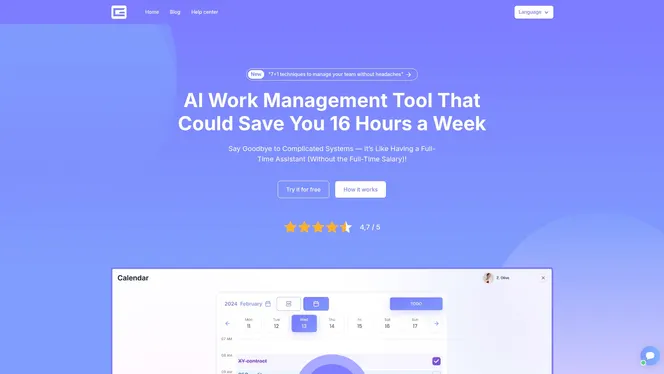
Gammatica is an AI-driven project and team management platform built to handle exactly that gap. It combines task management, calendar coordination, automation, and team collaboration in one place. Gammatica’s AI suggestions help you prioritize tasks, its Kanban boards give you a visual overview of your workload, and its automation tools cut the administrative overhead that eats into your productive hours. Users report freeing up to 16 hours weekly by letting Gammatica handle the operational layer of their work. If you want to see how it fits your specific workflow, book a demo call and get a personalized walkthrough of the platform.
FAQ
What are the most effective time management strategies for professionals in 2025?
The most effective strategies combine planning, prioritization, and output protection. Frameworks like the Ivy Lee Method, Eisenhower Matrix, and time blocking address different root causes of lost time and work best when selected based on a personal time audit.
How do I know which time management technique is right for me?
No single best strategy exists for every professional. Run a five-day time audit in 30-minute increments, identify your top three time leaks, and match each leak to a specific framework.
Why do time management methods often fail high-achieving professionals?
Only 9% of executives are satisfied with their current methods because most techniques focus on scheduling rather than the source of time loss. High achievers need systems that address task origin, cognitive load, and boundary setting.
How much time does daily planning actually save?
10 minutes of planning can recapture up to 2 hours of productive time each day by reducing friction and decision fatigue before work begins.
What is a time audit and how do I start one?
A time audit tracks every work activity in 30-minute increments over five consecutive days. Categorize each block by type, identify your biggest time drains, and use the results to select the right productivity framework for your specific challenges.