Most leaders assume that hiring talented people is enough to build a high-performing team. It isn’t. The gap between a group of skilled individuals and a genuinely effective team is wider than most organizations realize, and it costs real money. Research consistently shows that poor collaboration and communication are among the top reasons enterprise projects fail. If you manage teams at scale, you already know that the usual advice, like “communicate more” or “trust your people,” barely scratches the surface. This article walks you through the real challenges, proven frameworks, and practical strategies that actually move the needle on team performance.
Key Takeaways
| Point | Details |
|---|---|
| Frameworks matter | Scaling frameworks like SAFe enable consistency and alignment across enterprise teams. |
| Trust and clarity | Strong relationships and clear roles are essential for high-performing teams, no matter the process. |
| Action beats theory | Implementing regular routines and feedback drives better teamwork than just discussing methods. |
| Adopt, then adapt | Start with proven practices, then tweak based on your team’s unique needs and feedback. |
Why working within a team is complex in larger organizations
Scaling a team from 10 to 50 or 100 people doesn’t just multiply the workload. It multiplies the complexity. Coordination problems that were manageable at small scale become serious bottlenecks. Communication channels grow exponentially. And the informal trust networks that hold small teams together start to break down.
Here are some of the most common challenges enterprise teams face:
- Silo mentalities: Departments optimize for their own goals, not the organization’s shared objectives.
- Communication breakdowns: Information gets lost between teams, leads to duplicated work, or worse, contradictory decisions.
- Unclear dependencies: Teams don’t always know how their work affects other teams, which creates delays and frustration.
- Inconsistent processes: Different teams follow different workflows, making cross-functional collaboration slow and painful.
Pure Agile works brilliantly for a single squad of 7 to 10 people. But when you have 15 squads working on interdependent products, Agile without a scaling layer creates chaos. Waterfall, on the other hand, offers structure but lacks the flexibility modern enterprises need. Neither approach alone is enough.
“The Scaled Agile Framework provides structured guidance for enterprise-scale agile implementation, emphasizing alignment, built-in quality, transparency, and program execution across multiple teams.”
This is exactly why frameworks designed for scale matter. Without them, even the most talented teams end up working against each other rather than with each other. The goal isn’t to add bureaucracy. It’s to create shared visibility so every team knows where they fit in the bigger picture.
Frameworks for successful teamwork: Agile, Waterfall, and scaling solutions
Choosing the right framework is one of the most impactful decisions a project manager can make. And yet, many organizations default to what’s familiar rather than what fits their actual context.
| Framework | Best for | Key limitation |
|---|---|---|
| Agile | Small, fast-moving teams | Breaks down at scale without structure |
| Waterfall | Predictable, sequential projects | Too rigid for complex, changing environments |
| SAFe / LeSS | Large, multi-team enterprises | Requires significant investment to implement |
Agile excels at speed and adaptability. Waterfall delivers clarity and predictability. But when you’re managing multiple teams with overlapping dependencies, you need something more. That’s where scaling frameworks like SAFe (Scaled Agile Framework) and LeSS (Large-Scale Scrum) come in. SAFe provides structured guidance for scaling Agile across the enterprise, aligning teams around shared goals and synchronized delivery cycles.
Organizations that implement SAFe report measurable improvements in delivery speed, team alignment, and product quality. The structure isn’t about slowing things down. It’s about making sure 200 people are rowing in the same direction.
Pro Tip: Avoid “Frankenstein-ing” your processes by mixing bits of Agile, Waterfall, and SAFe without understanding how they interact. Pick a framework, learn it deeply, and adapt it intentionally rather than randomly.
The most common mistake leaders make is adopting the vocabulary of a framework without the underlying practices. You can call your meetings “sprints” all you want, but if there’s no real backlog management, no retrospectives, and no cross-team alignment, you’re just using new words for old problems.
The building blocks of effective teamwork
Frameworks give you structure. But structure alone doesn’t create great teamwork. What actually drives performance is a combination of trust, clarity, and consistent communication habits.
Here are the four foundational elements every high-performing team needs:
- Psychological safety: Team members speak up, share concerns, and admit mistakes without fear of judgment. Without this, problems stay hidden until they become crises.
- Clear objectives: Every person on the team knows what success looks like, not just for their task, but for the team as a whole.
- Role clarity: Overlapping responsibilities create confusion and conflict. Define who owns what, and make it visible to everyone.
- Feedback loops: Regular, structured opportunities to reflect and adjust. This includes retrospectives, one-on-ones, and team reviews.
“SAFe emphasizes transparency, program execution, and alignment as core drivers of effective teamwork across large organizations.”
Meeting cadences matter more than most leaders think. A well-structured weekly sync, a quick daily check-in, and a monthly retrospective create a rhythm that keeps teams aligned without overwhelming them. The key is that every meeting has a clear outcome tied to a real organizational goal. Not just an update session.
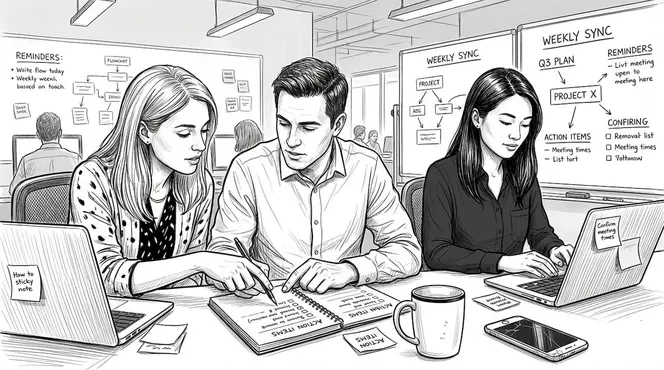
Pro Tip: Before scheduling any recurring meeting, write down the specific decision or outcome it needs to produce. If you can’t define it, you probably don’t need the meeting.
Role clarity is especially critical in enterprise environments where people wear multiple hats. When two team members both think they own a decision, neither of them fully commits. A simple RACI matrix (Responsible, Accountable, Consulted, Informed) can eliminate this confusion in under an hour.
Practical strategies to boost collaboration and productivity
Knowing the building blocks is one thing. Putting them into practice is another. Here are strategies you can start using right now.
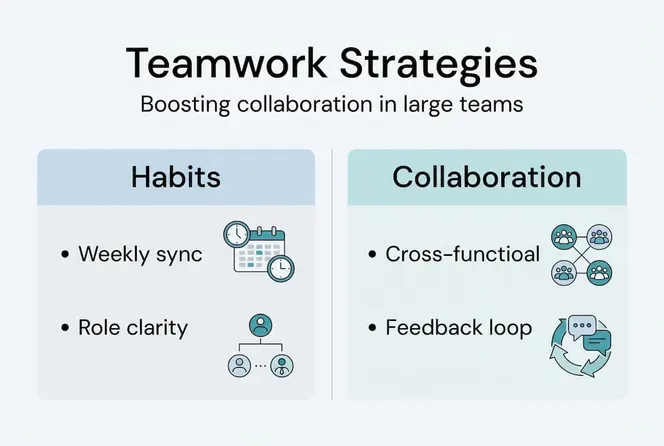
Cross-functional sync sessions are one of the highest-impact habits you can build. When teams that depend on each other meet regularly, blockers get surfaced early and resolved faster. SAFe practices, when implemented, consistently improve alignment and program execution across multi-team environments.
| Strategy | Expected impact | Time investment |
|---|---|---|
| Weekly cross-team sync | Reduces blockers by up to 30% | 30 to 60 minutes per week |
| Team agreements document | Cuts miscommunication significantly | 2 to 3 hours one-time setup |
| AI-assisted task automation | Saves 5 to 10 hours weekly per manager | Ongoing, low maintenance |
| Structured retrospectives | Improves team morale and process quality | 60 to 90 minutes per sprint |
Here are additional strategies worth implementing immediately:
- Set explicit team agreements: Document how your team communicates, makes decisions, and handles conflict. This sounds basic, but most teams never do it.
- Use automation for routine coordination: Scheduling, status updates, and task reminders don’t need a human touch. Automate them so your team can focus on work that actually requires judgment.
- Pair junior and senior team members: Knowledge transfer happens faster through pairing than through documentation alone.
- Run structured retrospectives: Don’t just ask “what went well?” Ask “what would we do differently if we started this project today?” That question unlocks real insight.
- Create shared knowledge hubs: A company wiki or shared documentation space reduces the time teams spend hunting for information.
Small, consistent habits compound over time. A 30-minute weekly sync might feel minor, but over a quarter it adds up to a significant reduction in misalignment and rework.
What most leaders miss about working within a team
Here’s something most team management articles won’t tell you: tools and frameworks can’t compensate for missing trust or an unclear sense of purpose. We’ve seen organizations roll out SAFe, invest in premium project management software, and still struggle because the underlying team culture was never addressed.
High-performing teams don’t just follow processes. They believe in what they’re building. They know why their work matters. And they feel safe enough to challenge each other when something isn’t working.
Another thing leaders often miss is that communication needs change as teams scale. What worked at 20 people won’t work at 80. The cadences, the tools, and the level of formality all need to evolve. The best teams we’ve observed treat their own processes as a product, constantly reviewing and improving how they work together.
Finally, make space for experimentation. Not every initiative will succeed. The teams that grow fastest are the ones that run small experiments, learn quickly, and adjust without blame. That mindset is harder to build than any framework, but it’s the real driver of long-term performance.
Elevate your team’s performance with Gammatica
Putting these strategies into practice is much easier when you have the right tools supporting your team. That’s where Gammatica comes in.
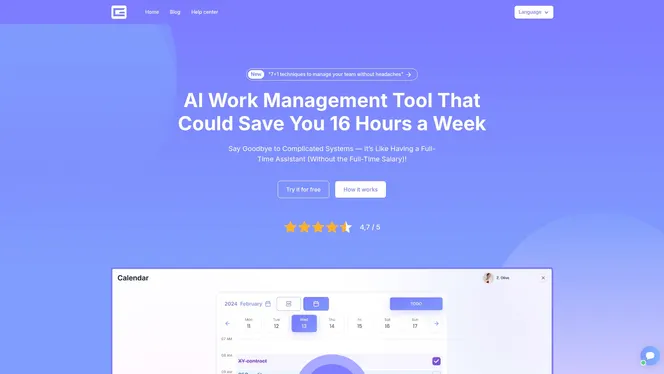
Gammatica is an AI-driven platform built for exactly the kind of enterprise collaboration challenges we’ve covered here. With team visibility tools that give every stakeholder a clear view of progress, and AI automation for teams that handles routine coordination so your people can focus on high-value work, Gammatica makes it practical to apply the frameworks and habits discussed above. Whether you’re managing cross-functional projects or scaling your sales team solutions, Gammatica helps you build the structure, transparency, and rhythm that high-performing teams need.
Frequently asked questions
What is the biggest challenge when working within a team at scale?
Alignment across multiple teams and communication breakdowns are the most common challenges. SAFe addresses this by providing structured guidance for enterprise-scale agile implementation with a strong emphasis on alignment.
How do scaling frameworks like SAFe improve teamwork?
Scaling frameworks provide structured processes that boost alignment, transparency, and program execution. SAFe specifically guides organizations in scaling Agile practices across many teams without losing coordination.
Are frequent meetings always necessary for team success?
No, effective meetings are about quality, not quantity. Regular but purposeful check-ins support clarity without overloading your team’s schedule or reducing time for focused work.
What can project managers do to immediately improve teamwork?
Establish role clarity, set clear objectives, and build regular feedback routines. SAFe emphasizes alignment and transparency as foundational practices that project managers can adopt right away to see measurable improvement.