TL;DR:
- Teams led democratically have higher productivity and engagement compared to autocratic teams.
- Implementing structured input and feedback systems fosters ownership, trust, and better business outcomes.
- Leadership style should adapt to context, balancing democracy with directive actions during crises.
Teams led democratically maintain 46% productivity without the leader present, compared to just 29% for autocratic teams. That single number should make you rethink everything you assume about “slow” collaborative leadership. Many business leaders still believe that giving teams a voice means losing control and wasting time. The reality is the opposite. Leader democracy, when applied with structure and intention, energizes teams, drives ownership, and produces measurable results. This article gives you clear frameworks, real data, and actionable steps to bring democratic leadership principles into your daily management practice.
Key Takeaways
| Point | Details |
|---|---|
| Democratic leadership drives results | Teams managed democratically achieve notably higher productivity, profitability, and retention rates. |
| Implementation requires structure | Structured feedback and public attribution help sustain leader democracy and boost engagement. |
| Adaptation is critical | Switch between democratic and autocratic styles based on team readiness and urgency for best outcomes. |
| Expert tools support change | Practical frameworks and team empowerment tools make leader democracy actionable at scale. |
Understanding leader democracy in business teams
Leader democracy is a leadership philosophy where managers actively involve team members in decision-making, idea generation, and feedback loops. It is not about endless meetings or voting on every choice. It is about creating a culture where people feel heard, valued, and responsible for outcomes.
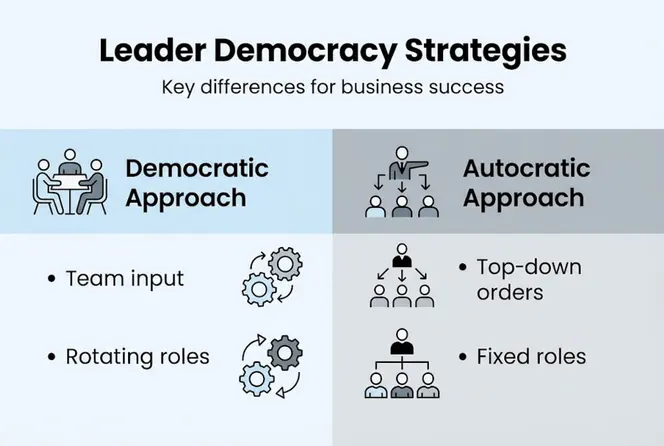
How does it differ from autocratic leadership? In autocratic settings, the leader decides, and the team executes. In leader democracy, the leader facilitates, and the team co-creates. The leader still holds final authority, but input from the team shapes the direction. That distinction matters enormously for engagement.
The core tenets of leader democracy include:
- Shared decision-making: Team members contribute to choices that affect their work, increasing buy-in.
- Open feedback channels: Leaders actively solicit and act on input, not just collect it.
- Idea ownership: When someone’s suggestion is implemented, they receive public credit.
- Transparent communication: Decisions are explained, not just announced.
- Psychological safety: Dissent is welcomed, not penalized.
These principles create a fundamentally different team dynamic. People stop waiting to be told what to do. They start thinking like stakeholders.
“Leader democracy maintains higher productivity, engagement, and profitability compared to autocratic leadership styles, particularly in knowledge-based and creative work environments.”
The contrast with traditional management is sharp. Autocratic leaders often produce short-term compliance but long-term disengagement. Democratic leaders invest more time upfront in collaboration, but the compounding returns in loyalty, creativity, and performance are significant. Think of it as the difference between renting effort and owning it. When your team feels genuine ownership, their energy does not disappear the moment you leave the room.
This is not a soft, feel-good concept. It is a strategic approach to building teams that perform consistently, adapt quickly, and retain top talent. And the data backs it up.
Empirical impacts: Productivity, profitability, and engagement
Let’s look at the numbers. The evidence for leader democracy is not anecdotal. Democratic leadership tends to produce superior business outcomes across multiple dimensions.
Engaged teams under democratic leadership tend to be more profitable and to keep their people longer than disengaged teams under autocratic management. Those are not marginal gains. Lower turnover alone saves real money in recruiting, onboarding, and lost productivity.

| Metric | Democratic leadership | Autocratic leadership |
|---|---|---|
| Productivity without leader present | 46% | 29% |
| Profitability (engaged teams) | +23% | Baseline |
| Employee turnover rate | 51% lower | Baseline |
| Innovation and idea generation | High | Low to moderate |
| Employee satisfaction scores | High | Low to moderate |
The Lewin study, one of the foundational pieces of leadership research, identified democratic leadership as the most effective style for sustained performance in most organizational contexts. Teams were more creative, more motivated, and more resilient when their leader involved them in the process.
What does this mean practically for your business operations?
- Reduced management overhead: Engaged teams self-manage more effectively, freeing leaders for strategic work.
- Faster problem-solving: Diverse input surfaces solutions faster than top-down analysis.
- Stronger retention: People stay where they feel respected and heard.
- Higher quality output: Ownership drives attention to detail and personal accountability.
These outcomes are not accidental. They are the direct result of building systems that make people feel like contributors, not just workers. The investment in democratic leadership pays dividends that compound over time.
Tools and strategies for implementing leader democracy
Knowing the benefits is one thing. Knowing how to actually build a democratic leadership culture is another. Here is a practical, step-by-step approach you can start using this week.
- Create structured input channels. Don’t rely on open-door policies alone. Use regular pulse surveys, anonymous suggestion tools, or dedicated agenda slots in team meetings for idea sharing. Structure makes participation feel safe and expected.
- Rotate facilitation roles. Let different team members lead weekly standups or project retrospectives. This builds leadership capacity across the team and signals that every voice has authority.
- Attribute ideas publicly. When a team member’s suggestion is implemented, name them in the announcement. This simple act reinforces that contributions matter and encourages others to speak up.
- Close the feedback loop. If you ask for input and then ignore it without explanation, trust erodes fast. Always communicate what happened to a suggestion, even if the answer is “not right now, and here’s why.”
- Reward productive dissent. Create explicit recognition for team members who challenge assumptions constructively. This signals that disagreement is a feature, not a bug.
Implementation strategies like these work best when they are systematized, not left to chance.
| Approach | Structured implementation | Organic implementation |
|---|---|---|
| Consistency | High | Low |
| Scalability | Strong | Weak |
| Trust-building speed | Faster | Slower |
| Risk of participation fatigue | Managed | High |
Pro Tip: Keep a leadership journal where you log team suggestions, your responses, and outcomes. Review it monthly. Patterns will emerge that show you where your democratic practices are working and where they are falling short. This reflection habit is one of the most underused tools in a manager’s toolkit.
The goal is not to make every decision by committee. It is to create a reliable system where input flows naturally, ideas are recognized, and people feel genuinely invested in the team’s success.
Limits, pitfalls, and situational adaptation
Leader democracy is powerful, but it is not a universal solution. Applying it without judgment can create real problems. Understanding when to adapt your style is just as important as knowing how to use it.
Democratic leadership can frustrate high performers and becomes a liability during crises when speed and clarity matter more than consensus. Situational adaptation is not a compromise. It is a sign of leadership maturity.
Here are situations where you should consider shifting away from a purely democratic approach:
- Crisis or emergency: When decisions need to happen in minutes, not hours, directive leadership is more effective.
- Low-skill or new team members: Inexperienced team members may need clear direction before they can contribute meaningfully to decisions.
- Decision fatigue: If your team is already overloaded, adding more participatory decisions can drain energy rather than build it.
- High-stakes, low-reversibility choices: Some decisions carry too much risk to be distributed broadly.
- Highly resistant team culture: If trust is low, jumping straight to democratic methods can feel performative and backfire.
Pro Tip: Think of your leadership style as a dial, not a switch. In stable, creative environments, turn it toward democratic. In urgent or unstable situations, turn it toward directive. The best leaders move fluidly across this spectrum based on context, not habit.
“The most effective leaders adapt their style based on the team’s readiness, the urgency of the situation, and the complexity of the task. No single style works in every context.”
The key is intentionality. Know why you are choosing a particular approach in a given moment. When your team sees that your style shifts are purposeful and explained, they trust you more, not less. Adaptive leadership is not inconsistency. It is intelligence.
Our perspective: What most guides miss about leader democracy
Most articles on leader democracy treat it like a personality trait you either have or you don’t. We see it differently. Leader democracy is a system, and systems require design, maintenance, and honest evaluation.
The biggest mistake we see business leaders make is going “fully democratic” without assessing team readiness first. Democratic leadership fosters innovation and ownership but requires skilled, psychologically safe teams to function well. Dropping it into a team that lacks trust or experience creates confusion, not collaboration.
The leaders who get the best results blend democratic methods with clear directive moments. They create participation structures that are consistent and low-friction. They invest in building team confidence before expanding decision-making authority. And they measure outcomes, not just intentions.
Style choice matters less than team readiness. Build the foundation first. The democratic culture will follow naturally, and it will actually stick.
Next steps: Empower your team with leader democracy tools
You now have the frameworks, the data, and the practical strategies to start building a genuinely democratic leadership culture in your team. The next step is making sure your management infrastructure supports it.

Gammatica gives business leaders and managers the tools to put these principles into practice every day. From structured collaboration workflows to team task management and feedback tracking, the platform is built for leaders who want to move fast without losing people. If you want to increase sales team collaboration or explore the full range of team empowerment tools, Gammatica is designed to support exactly the kind of adaptive, engaged leadership this article describes. Your team is ready. The tools are here.
Frequently asked questions
What is leader democracy and how is it different from democratic leadership?
Leader democracy is a structured approach where business leaders drive engagement through ownership and public attribution, while general democratic leadership is a broader philosophy. The key difference is that leader democracy emphasizes leader-initiated structure rather than purely organic participation.
Does leader democracy work in emergency or crisis situations?
No. Democratic leadership in crises is slower and less effective because consensus takes time. Autocratic leadership is recommended during emergencies when fast, clear decisions are critical.
What are the best practices for implementing leader democracy?
Structured input channels, public idea attribution, closing feedback loops, rewarding productive dissent, and rotating facilitation roles are the most effective strategies for building a sustainable democratic leadership culture.
Can leader democracy improve profitability and reduce turnover?
Yes. Teams under democratic leadership tend to be more profitable and keep their people longer, making it one of the highest-return leadership investments available to business managers.
How should leaders adapt their style in mixed or unstable environments?
Prioritize democratic methods in stable, creative team settings and shift to directive leadership during urgent or unstable situations to prevent decision fatigue and maintain team momentum.