TL;DR:
- Most cross-functional teams are often dysfunctional due to unclear roles, poor communication, and conflicting priorities.
- Successful teams follow structured frameworks like RACI and RAPID, establish shared goals, and foster psychological safety.
- Effective leadership involves clear decision rights, regular retrospectives, trust-building, and aligned incentives to sustain high performance.
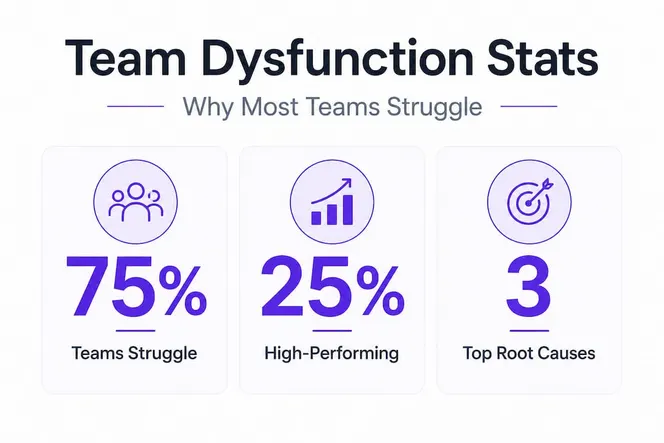
Most cross-functional teams are set up to struggle before the first meeting even ends. 75% of cross-functional teams are dysfunctional, failing on at least three of five performance criteria including staying on budget, meeting deadlines, and maintaining alignment. That’s a sobering number. But here’s the upside: the 25% that do succeed aren’t lucky. They follow a clear approach to structure, communication, and accountability. This guide gives you exactly that. We’ll walk through the most common failure points, the foundational frameworks that actually work, and the practical steps you can take right now to build a high-performing team across departments.
Key Takeaways
| Point | Details |
|---|---|
| Dysfunction is common | Three out of four cross-functional teams struggle with meeting goals and alignment. |
| Foundations drive success | Clear roles and psychological safety are essential for productive collaboration. |
| Use proven frameworks | RACI, RAPID, and team charters clarify responsibility and streamline decisions. |
| Adapt and sustain | Continuous feedback and motivation strategies help teams overcome obstacles and keep improving. |
Understanding the challenges of cross-functional teams
With the stakes clear, let’s examine what makes managing such teams so challenging in the first place.
Cross-functional teams pull people from different departments, each with their own priorities, metrics, and ways of working. A product manager, a finance lead, and a sales director don’t naturally share the same definition of “success.” That tension is baked in from day one. And without a strong structure to manage it, things fall apart quickly.
Cross-functional team dysfunction is more the rule than the exception, with only 25% of teams operating at consistent high performance. That means if you’re managing one right now and something feels off, you’re not alone.
The most common root causes of dysfunction include conflicting priorities, communication breakdowns, accountability gaps, power struggles, siloed thinking, and unclear decision rights. None of these are small issues. Together, they create a team that looks like it’s working but is actually burning time and trust at the same time.
Here’s what separates dysfunctional teams from functional ones:
| Factor | Dysfunctional team | Functional team |
|---|---|---|
| Roles | Unclear or overlapping | Defined with RACI or RAPID |
| Goals | Departmental silos | Shared and aligned |
| Communication | Ad hoc and reactive | Structured and proactive |
| Decision-making | Confused or stalled | Mapped with clear owners |
| Accountability | Individual with no follow-through | Team-based with tracking |
The financial cost of dysfunction is real and often underestimated. Consider a mid-sized company with a 10-person cross-functional team. If just three hours per person per week are lost to confusion, rework, or miscommunication, that’s 30 hours of wasted payroll weekly. Over a quarter, that’s nearly 400 hours, enough to ship a product feature or close a major sales cycle.
“The single biggest hidden cost in cross-functional work isn’t bad strategy. It’s the daily friction of people who don’t know who decides what, and who feel unsafe speaking up about it.”
Common dysfunctions you’re likely seeing right now:
- Competing priorities: Each department leader pulls team members toward their own goals, leaving the cross-functional mission underpowered.
- Communication breakdowns: Updates stay inside functional silos. By the time a blocker reaches the right person, it’s already a crisis.
- Power struggles: Without formal authority, project leaders rely on influence, and without the right tools, that influence falls flat.
- Unclear decision rights: Meetings end without clear owners, so decisions get revisited again and again.
- Accountability gaps: Individual metrics don’t reflect team outcomes, so people optimize for their own scorecard.
Strong leadership strategies and smart agency positioning examples show us that teams with clearly mapped stakeholders, defined influence channels, and escalation rules outperform those who rely on goodwill alone.
Laying the groundwork: Foundation for success
Now that we’ve seen why problems are common, here’s the proven foundation every high-performing cross-functional team needs.
You can’t manage your way out of a structural problem. If the foundation is shaky, no amount of daily standups or color-coded project boards will save you. Before you launch any cross-functional initiative, get these prerequisites locked in.
Critical success factors include clear role definitions, shared goals, psychological safety, structured communication, aligned incentives, and team-based accountability. Miss even two of these, and you’re building on sand.
Here’s a breakdown of the key frameworks you should know:
| Framework | What it does | Best used when |
|---|---|---|
| RACI | Clarifies who is Responsible, Accountable, Consulted, Informed | Roles are overlapping or unclear |
| RAPID | Defines who Recommends, Agrees, Performs, Inputs, Decides | Decision-making is stalled or contested |
| Team Charter | Documents purpose, norms, and commitments | Team is newly formed or restarting |
| Decision Log | Tracks what was decided, by whom, and why | Decisions get revisited or forgotten |
Start with a team charter. It sounds basic, but most teams skip it because they’re in a rush to execute. A good charter covers the team’s mission, expected behaviors, communication norms, and how conflict will be handled. Think of it as your team’s operating agreement.
Shared goals matter more than individual metrics. When a marketing manager is measured only on lead volume and a product manager is measured only on feature launches, they’re playing different games. Align at least one shared KPI (key performance indicator) that every member owns together. This single change shifts the culture from “my job” to “our outcome.”
Psychological safety is the foundation beneath the foundation. If people don’t feel safe speaking up, raising concerns, or flagging mistakes, all your frameworks become theater. The research behind psychological safety, largely developed by Harvard professor Amy Edmondson, shows that teams who feel safe to take interpersonal risks consistently outperform those who don’t.
Pro Tip: In your next team kickoff, open with a simple question: “What’s one thing that would make you feel more comfortable speaking up in this team?” Write down every answer on a shared document. Read them aloud. Then address them directly. This one move signals safety more powerfully than any team-building exercise.
Sponsorship and resources also matter. A cross-functional team without executive sponsorship is a team without air cover. When conflicts escalate or resources are contested, someone above the team needs to have a stake in its success and the authority to unblock it fast.
Sales and marketing alignment examples show this clearly: teams that operate with a documented charter, role clarity, and executive buy-in are far more likely to hit their milestones on time.
Step-by-step: Managing execution and collaboration
With the foundation in place, here’s how to run and coordinate your team for real results.

Structure without execution is just paperwork. Here are five steps that translate your foundation into daily action.
Step 1: Run a structured kickoff meeting. Don’t just gather everyone and announce the project. Use the kickoff to review the charter, confirm each person’s role using your RACI or RAPID matrix, and surface any concerns early. Record it. Share the notes the same day.
Step 2: Align on measurable goals. Every team member should leave the kickoff knowing exactly what “done” looks like. Use SMART goals (Specific, Measurable, Achievable, Relevant, Time-bound) tied to the shared KPI you established in the foundation phase. Vague goals create vague accountability.
Step 3: Set clear roles and ownership. Even if you’ve defined a RACI matrix, walk through it out loud with the team. Ask each person to confirm their responsibilities. Silence doesn’t mean agreement. Make space for people to raise concerns before work begins.
Step 4: Establish a communication cadence. Cross-functional team methodologies recommend frequent short check-ins over infrequent long ones. A weekly 30-minute sync with a standing agenda works better than a monthly two-hour review. Supplement this with a shared decision log that anyone can update asynchronously.
Step 5: Track progress against team-based metrics. Measure success using productivity benchmarks like reduced cycle times, improved cross-department alignment scores, and milestone completion rates. Don’t just report individual task completion. Ask: is the team moving faster together than it would apart?
Pro Tip: Start a shared decision log from day one. Every time a decision is made in a meeting, someone records it: what was decided, who owns it, and why. This prevents the classic scenario where a decision made in week two gets relitigated in week six because “we never agreed on that.” It also gives new joiners instant context.
Knowing when to use RACI vs. RAPID is a practical skill many leaders overlook. RACI works well when the main challenge is role clarity. RAPID is better when the bottleneck is decision-making speed. Don’t try to run both at the same time on the same issue. Pick the one that fits the problem.
Understanding process as a growth engine is key here. The teams that grow fastest aren’t the ones with the most talented individuals. They’re the ones with the most reliable execution rhythms.
Overcoming obstacles and sustaining high performance
Finally, even top teams face blockers. Here’s how to fix what’s broken and keep your people motivated and aligned.
No team runs perfectly. The goal isn’t to eliminate friction. It’s to resolve it fast before it becomes a culture problem. Here are the obstacles you’re most likely to encounter:
- Power struggles: When team members pull rank from their home departments, the cross-functional mission loses every time. Create clear escalation pathways before conflicts arise, not after.
- Unclear decision rights: When no one knows who can say “yes,” everything slows down. Revisit your decision-making framework at the 30-day mark and update it based on where bottlenecks actually appeared.
- Siloed thinking: People default to their departmental identity when under pressure. Counter this by creating shared rituals: joint retrospectives, cross-team wins announcements, and rotating “ownership” of team-wide goals.
- Accountability without control: Team members are often held responsible for outcomes they can’t fully influence. Acknowledge this openly and adjust expectations accordingly.
Solutions that actually work include stakeholder mapping (identifying who influences whom), applying the Cohen-Bradford influence framework (understanding what each stakeholder values and trading on it), setting explicit escalation rules, and empowering sub-teams with real autonomy over their work.
“Psychological safety isn’t a soft metric. Teams where members feel safe to speak up, challenge ideas, and admit mistakes consistently outperform those where people stay quiet to protect themselves.”
When it comes to motivation, small changes create outsized results. Embedding specialists directly into teams rather than pulling them in as consultants dramatically improves ownership and follow-through. Keeping teams small, ideally under ten members, reduces coordination overhead and makes each person’s contribution more visible.
Asymmetric incentives are an underused lever. Instead of rewarding everyone equally, recognize the behaviors that are hardest to sustain: proactive communication, constructive dissent, and helping teammates across department lines. These are the behaviors that keep a team functional when pressure spikes.
Regular retrospectives are your early warning system. Run them monthly, not just at project end. Ask three questions: What’s working? What’s blocking us? What do we change next month? Keep it under 45 minutes. Act on at least one item every single time. This rhythm builds the muscle of continuous improvement and signals that leadership actually listens.
Leadership tips for scaling reinforce this: sustained high performance comes from adaptive processes, not rigid ones.
What most guides miss about cross-functional teams
Here’s the uncomfortable truth most guides won’t say out loud: the frameworks don’t fail because they’re wrong. They fail because leaders treat them as a replacement for culture rather than a support for it.
We’ve seen mid-sized companies roll out beautiful RACI matrices, detailed charters, and sophisticated decision logs, and still watch their cross-functional teams stall within six weeks. Why? Because no one addressed the underlying trust deficit between the marketing and engineering leads. No one created space for the quieter team members to actually be heard. The tools were there. The culture wasn’t.
What high-performing cross-functional teams share isn’t a superior methodology. It’s a set of micro-alignment habits: brief one-on-ones before big meetings to surface concerns privately, small wins celebrated publicly, and a shared language around what “good” looks like.
The most practical thing you can do isn’t adopt a new framework. It’s identify the one relationship on your team where trust is lowest and invest ten minutes a week in it. That’s where your highest leverage is hiding. Tools scale behavior. They don’t create it.
Level up your cross-functional team management
Managing a cross-functional team is one of the hardest leadership challenges in any mid-sized company. But it doesn’t have to be a constant battle. When you have the right systems in place, execution becomes faster and alignment becomes the default, not the exception.
Gammatica is built for exactly this challenge. With AI-powered task management, Kanban boards, team charters, and built-in collaboration tools, Gammatica helps you keep every member of your cross-functional team aligned, accountable, and moving in the same direction. Teams using Gammatica report freeing up to 16 hours per week by reducing the administrative drag that kills momentum. Explore how Gammatica can help your team operate at its best, starting today.
Frequently asked questions
What is a cross-functional team?
A cross-functional team is a group made up of members from different departments or specialties who work together toward a common goal, combining diverse expertise to tackle complex projects.
Why do most cross-functional teams fail?
Most cross-functional teams fail because of unclear objectives, poor communication, and insufficient role clarity, with 75% of such teams dysfunctional on at least three of five performance criteria.
What frameworks help manage cross-functional teams?
The most effective frameworks include RACI, RAPID, DACI, team charters, and decision logs, each designed to clarify who owns what and how decisions get made.
How can leaders motivate cross-functional teams?
Leaders build lasting motivation by fostering psychological safety, setting shared goals, and using asymmetric incentives that reward collaborative behaviors like proactive communication and peer support.