Retaining clients delivers five to 25 times more profit than acquiring new ones, yet many mid-sized enterprises still chase new logos instead of nurturing existing relationships. The real game changer is not choosing between human touch and AI, but strategically combining both to predict churn, automate outreach, and deepen client partnerships. This guide reveals evidence-based retention strategies including AI-powered health scoring, structured Quarterly Business Reviews, proactive intervention protocols, and the critical balance between automation and human expertise that drives measurable revenue growth for CEOs and project managers.
Key Takeaways
| Point | Details |
|---|---|
| Net revenue focus | Prioritize net revenue retention over gross retention to capture expansion revenue from existing customers. |
| AI health scoring | AI powered health scoring aggregates signals to enable proactive outreach before churn signals appear. |
| Structured quarterly reviews | Quarterly Business Reviews deliver strategic value beyond updates and identify expansion opportunities. |
| Human AI balance | Balancing automation with human oversight prevents trust erosion and improves retention results. |
Understanding client retention benchmarks and core strategies
Mid-sized B2B enterprises face distinct retention challenges compared to startups or enterprise giants. Average annual retention hovers around 70-85%, while top performers consistently achieve 90-95%. The gap between average and excellent represents millions in lost revenue, making retention optimization one of the highest-return investments available.
Net revenue retention (NRR) matters far more than gross retention for growth-focused companies. Gross retention simply measures the percentage of customers who renew, while NRR accounts for expansion revenue from upsells and cross-sells minus any downgrades or churn. Agencies with structured retention approaches achieve 110-130% net revenue retention, meaning they grow revenue from existing clients even before adding new ones.
Core retention strategies that separate top performers from average include:
- Client health scoring systems that aggregate engagement, satisfaction, and usage data
- Quarterly Business Reviews providing strategic value beyond tactical updates
- Structured outreach cadences balancing frequency with relevance
- At-risk intervention protocols triggered by specific warning signals
- Upsell triggers identifying expansion opportunities at optimal moments
| Retention Level | Annual Churn | Renewal Rate | Profit Impact |
|---|---|---|---|
| Below Average | 25-30% | 70-75% | Baseline |
| Average | 15-20% | 80-85% | +25-40% |
| Top Performer | 5-10% | 90-95% | +65-95% |
The data reveals that retention improvement yields 25-95% profit boost depending on starting position and implementation quality. Companies starting below average see the most dramatic gains, while those already performing well find incremental improvements still deliver substantial returns.
Pro Tip: Prioritize net revenue retention over gross retention metrics. A 90% gross retention rate with no expansion revenue underperforms an 85% gross retention with 30% expansion from existing accounts.
Leveraging AI for predictive client health scoring and proactive outreach
AI transforms retention from reactive firefighting into predictive relationship management. Client health scoring synthesizes dozens of signals into actionable intelligence about account status and future behavior. Modern systems track engagement frequency, feature adoption depth, support ticket patterns, payment timing, stakeholder turnover, and sentiment signals from communications.

Random Forest churn models achieve 95% accuracy when trained on sufficient historical data, while hybrid ML models reach 82% even with limited datasets. These predictions enable proactive outreach weeks or months before visible churn signals appear, giving account teams time to address underlying issues.
Structured outreach cadences integrate seamlessly with AI scoring. Monthly check-ins maintain relationship continuity and surface emerging concerns early. Quarterly reviews provide strategic value discussions that reinforce partnership depth. Annual planning sessions align future roadmaps and identify expansion opportunities. AI determines optimal timing and personalization for each touchpoint based on client behavior patterns and preferences.
Implementing AI-driven scoring requires systematic execution:
- Collect comprehensive data across all client touchpoints including usage logs, communication history, support interactions, and financial transactions
- Select appropriate models based on data volume and prediction requirements, starting with logistic regression for small datasets and advancing to ensemble methods as data grows
- Integrate scoring outputs with outreach cadences so account managers receive timely alerts and recommended actions
- Maintain human oversight reviewing predictions before client-facing interventions to catch edge cases and preserve relationship quality
Advanced implementations layer multiple prediction models for different outcomes. Churn prediction identifies at-risk accounts. Upsell propensity scoring highlights expansion-ready clients. Engagement forecasting anticipates communication preferences. Satisfaction modeling detects sentiment shifts before they impact retention.
AI serves as an augmenting tool that enhances human decision-making rather than replacing the relationship expertise and contextual judgment that account managers bring to client interactions.
Start with tools like Custify or ChurnZero to gain quick wins in AI-driven retention without requiring extensive data science resources. These platforms offer pre-built models and integrations that deliver value within weeks rather than months.
Pro Tip: Combine AI predictions with human review sessions where account managers discuss flagged accounts as a team. This catches anomalies the algorithm misses while building organizational knowledge about retention patterns.
Addressing AI limitations and combining human expertise for balanced retention programs
AI adoption in retention carries significant risks when implemented without appropriate safeguards and human oversight. Poor onboarding drives high early churn as clients struggle with automated systems that fail to address their specific needs. Context retention failures in chatbots frustrate users who must repeat information across conversations, eroding trust in the relationship.
Hallucinations in AI-generated communications present particularly dangerous risks. When chatbots provide incorrect information or make promises the company cannot fulfill, they damage credibility and create service recovery challenges. Gartner forecasts 50% rehiring AI staff by 2027 as organizations recognize the costs of over-automation and insufficient human oversight.
Trust erosion represents the most insidious AI risk because it accumulates gradually through small negative experiences. Clients who feel they are interacting with systems rather than partners begin exploring alternatives even when the core service delivers value. Silent churn occurs when automation masks underlying dissatisfaction, preventing early intervention that could save the relationship.
Common AI limitations requiring human mitigation include:
- Inability to interpret emotional nuance and relationship context in communications
- Difficulty handling edge cases and unique client situations outside training data
- Lack of strategic thinking about long-term account development and expansion opportunities
- Missing the relationship depth that comes from shared history and personal connection
- Over-reliance on historical patterns that may not apply during market shifts or client transitions
Best practices for balancing AI automation with human touch include establishing clear escalation protocols where AI flags issues but humans make final decisions on interventions. Reserve high-stakes communications like renewal negotiations and at-risk discussions for personal outreach. Use AI for data synthesis and recommendation generation while keeping humans responsible for relationship strategy and execution.
Implement rigorous testing protocols for any client-facing AI systems. Test edge cases, unusual inputs, and scenarios outside normal parameters. Monitor actual conversations for quality issues and client frustration signals. Gather explicit feedback about AI interaction experiences and adjust based on patterns.
Pro Tip: Test conversational AI rigorously for edge cases before deployment by having team members role-play difficult client scenarios and documenting failure modes for remediation.
Cost-first automation strategies that prioritize efficiency over effectiveness consistently underperform retention programs that view AI as an enhancement to human expertise rather than a replacement. The companies achieving 110-130% net revenue retention use AI to make account managers more effective, not to eliminate them.
Implementing structured client retention programs for consistent growth
Structured retention programs transform sporadic relationship management into systematic revenue growth engines. Implementation begins with establishing Quarterly Business Reviews as the cornerstone of strategic client relationships. These sessions differ fundamentally from tactical status updates by focusing on business outcomes, strategic alignment, and mutual value creation.
Effective QBR implementation follows a consistent framework:
- Schedule reviews 30 days in advance with key stakeholders, ensuring executive participation for strategic accounts
- Prepare customized agendas addressing client-specific goals, recent wins, and upcoming opportunities
- Present data-driven performance analysis showing measurable business impact from your services
- Facilitate forward-looking discussions about evolving needs, market changes, and partnership expansion
- Document action items, success metrics, and next review scheduling before concluding
- Follow up within 48 hours with meeting summary and commitment tracking
Structured outreach cadences complement QBRs by maintaining relationship continuity between strategic reviews. Monthly check-ins provide tactical updates, surface emerging issues, and demonstrate ongoing attention. These touchpoints should be brief, focused, and valuable rather than perfunctory. AI-powered insights about usage patterns, feature adoption, or industry trends make routine check-ins more relevant and appreciated.
| Retention Approach | Key Features | Business Impact | Resource Requirements |
|---|---|---|---|
| Reactive retention | Responds to cancellation requests, minimal proactive outreach | 70-80% renewal rates, limited expansion | Low initial investment, high churn costs |
| Structured retention | QBRs, outreach cadences, health scoring, intervention protocols | 85-95% renewal rates, 110-130% NRR | Moderate investment, strong ROI |
Intervention protocols for at-risk clients identified by AI scoring require careful calibration. Immediate response protocols trigger when health scores drop below critical thresholds, initiating executive outreach within 24 hours. Escalation pathways ensure appropriate resources engage based on account value and risk severity. Recovery playbooks provide tested approaches for common churn drivers like stakeholder changes, budget constraints, or competitive pressure.
Focusing on net revenue retention (NRR) for sustainable growth requires tracking expansion revenue as rigorously as churn prevention. Identify upsell triggers based on usage patterns, feature requests, and business growth signals. Time expansion conversations strategically around QBRs or major client wins when value perception peaks.
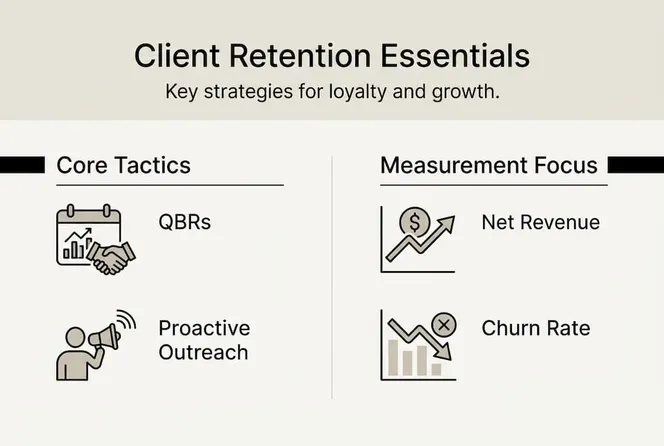
Pro Tip: Start small with QBR pilots for your top 20% of accounts by revenue, refine the process based on feedback and results, then scale systematically to broader client segments using proven templates and frameworks.
Structured retention strategies consistently outperform reactive approaches because they create predictable touchpoints, demonstrate ongoing investment in client success, and catch issues before they escalate to churn decisions. The systematic nature also enables continuous improvement as teams analyze what works and refine their approach.
Enhance your client retention with AI-driven automation
Transforming retention insights into operational reality requires platforms that seamlessly integrate AI intelligence with human workflow. Gammatica delivers exactly this combination through intelligent automation that enhances rather than replaces your team’s relationship management capabilities.
Gammatica VEX AI automation powers predictive client health monitoring while keeping your account managers in control of strategic decisions. The platform synthesizes engagement data, project milestones, and communication patterns into actionable retention intelligence without requiring data science expertise.
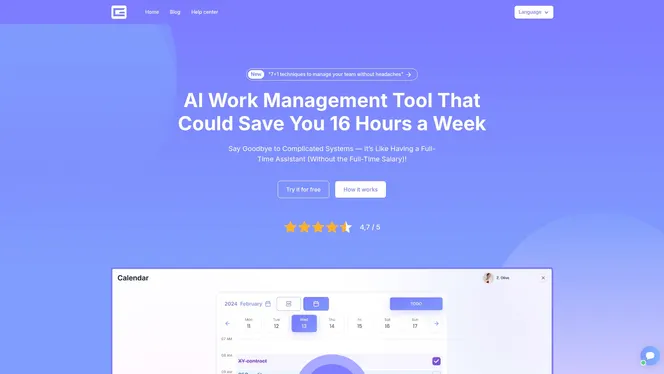
Founders and executives gain visibility into retention metrics and at-risk accounts through Gammatica for Founders, enabling proactive leadership intervention when it matters most. The system structures QBR scheduling, tracks action items, and ensures follow-through on retention commitments that strengthen client partnerships.
Gammatica sales automation extends retention capabilities into expansion revenue by identifying upsell opportunities based on client usage patterns and project success indicators. This integrated approach transforms retention from a defensive cost center into a growth driver delivering the 110-130% net revenue retention that top performers achieve.
Frequently asked questions
What core elements improve client retention rates?
Structured Quarterly Business Reviews, AI-powered health scoring, proactive outreach cadences, and rapid intervention protocols for at-risk accounts form the foundation. These elements work synergistically when balanced with human relationship expertise rather than relying solely on automation.
How can AI tools be integrated without losing human touch?
Use AI for data synthesis, pattern recognition, and recommendation generation while keeping humans responsible for strategic decisions and high-stakes communications. Establish clear escalation protocols where AI flags issues but account managers design and execute interventions based on relationship context.
What signs indicate a client is at risk of churning?
Decreasing engagement frequency, reduced feature adoption, delayed payments, stakeholder turnover, increased support tickets, and negative sentiment in communications all signal elevated churn risk. AI health scoring synthesizes these signals into early warning systems that enable proactive intervention.
How often should businesses conduct client reviews like QBRs?
Quarterly reviews work best for most B2B relationships, providing enough time between sessions for meaningful progress while maintaining strategic alignment. High-value accounts may warrant monthly strategic discussions, while smaller accounts can succeed with semi-annual reviews supplemented by regular check-ins.
What are common pitfalls to avoid with AI in client retention?
Over-automation that eliminates human touchpoints, deploying chatbots without rigorous testing, trusting AI recommendations without review, and prioritizing efficiency over relationship quality all undermine retention. The most successful programs use AI to enhance human capabilities rather than replace relationship expertise.