TL;DR:
- AI report builders automate the creation of structured, data-driven business reports, reducing time and costs. They improve report consistency, scalability, and faster delivery, but require governance to prevent subtle errors. The most effective use involves scheduled automation, proper verification, and integration within existing workflows.
An AI business report builder is a software tool that automatically generates structured, data-driven business reports from diverse data inputs, delivering formatted insights to decision-makers within minutes. The industry term for this category is automated business reporting, and the tools that power it, such as Gammatica AI, is reshaping how analysts and business professionals spend their time. Where a manual reporting cycle once consumed entire workdays, AI report generation now compresses that work into a scheduled, repeatable process. This guide covers how these tools work, what they deliver, and how to govern them responsibly.

What is an AI business report builder and how does it work?
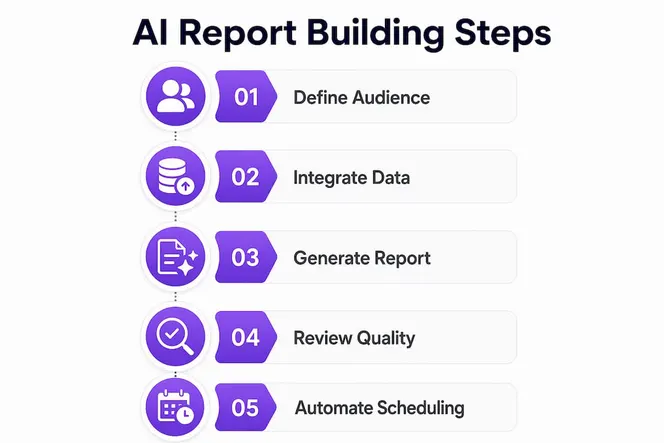
An AI business report builder follows a structured workflow: ingest data, interpret it, format a report, and distribute it. Understanding each step helps you get the most out of any tool you choose.
Here is the typical process from start to finish:
-
Upload your data or connect a source. Tools like Gammatica AI accept raw data files, spreadsheets, CRM exports, and even recorded meetings as input. The richer your input, the more targeted the output.
-
Specify the report type, sections, and audience. Structured input including metric tables, business questions, and audience context significantly improves output accuracy. A sales report for a CFO needs different framing than a weekly ops summary for a team lead.
-
Generate the report. The AI analyzes trends, flags anomalies, and writes natural language commentary. Sembly AI produces outputs in PDF, DOCX, HTML, and Markdown formats within minutes.
-
Review and export. A human reviewer checks the output before distribution. This step is non-negotiable, and the governance section below explains exactly why.
Pro Tip: Before you generate your first report, define your audience in writing. “Executive team” is too vague. “CFO reviewing Q2 margin performance” gives the AI enough context to frame insights correctly.
These tools integrate with spreadsheets, CRMs, project management platforms, and databases. Gammatica, for example, connects task management, CRM data, and automation workflows in one platform, making it a natural fit for teams that want reporting built into their daily operations rather than bolted on afterward.
What operational and financial benefits do AI report builders provide?
The efficiency gains from AI-powered report writing are not incremental. They are structural. One documented case study shows organizations that automated financial reporting reduced manual prep time from 211 hours to 31 hours per month, cutting report delivery from 9.1 days to 0.8 days. That is a 90% reduction in reporting hours. The same organization recorded 31% advisory revenue growth after automation freed analysts to focus on interpretation rather than data assembly.
The financial case is equally direct. AI report generation can reduce the cost per report from approximately $210 in labor costs to $4.10 in API and compute costs, with a payback period under two months after roughly 20 hours of engineering setup. That is a pretty good return on investment for any team running weekly or monthly reporting cycles.
Here is a summary of the core operational benefits:
-
Time savings: Teams typically recover 2–6 hours per week on reporting tasks alone.
-
Faster delivery: Reports that previously took days now arrive the same day data is available.
-
Consistency: AI applies the same formatting rules and brand standards every time, removing the variation that creeps into manually assembled reports.
-
Scalability: Analysts who previously spent half their week on report prep can now take on more advisory work or manage more client accounts.
-
Cost reduction: The shift from labor-intensive reporting to compute-based generation dramatically lowers the per-report cost.
Professional services firms using AI for productivity have documented 3.2x ROI gains, which aligns with the structural shift these tools create. The savings compound over time as automation loops learn which insights matter most to each stakeholder group.
What governance and quality control measures matter for AI-generated reports?
Governance is where most teams underinvest, and it is the area where the risks are highest. The core problem with AI-generated business reports is not obvious errors. It is quietly wrong outputs that look correct but contain subtle factual or reasoning errors. These outputs can pass a quick visual scan and still mislead a decision-maker.
Research benchmarking deep AI research agents found average compliance with grounding and reasoning rubrics under 68%. That means roughly one in three AI-generated outputs fails a systematic quality check. For reports used in financial decisions, board presentations, or client communications, that failure rate is unacceptable without a verification layer.
Effective governance requires both policy and enforcement. Here are the controls that matter:
-
Technical enforcement: Deploy data loss prevention (DLP), single sign-on (SSO), and audit logs. Policy documents without technical controls are just documentation.
-
Quarterly policy reviews: Approved tool lists go stale quickly. A 90-day review cadence keeps your governance current with the pace of AI tool development.
-
Rubric-based verification: Before distributing any AI report, check it against a written rubric covering factual grounding, reasoning soundness, and clarity. This catches the quietly wrong outputs that visual scans miss.
-
Audit log retention: Retain logs of prompts, outputs, and user IDs for a minimum of 7 years for regulated industries. This satisfies requirements under frameworks like the EU AI Act and ISO/IEC 42001.
-
Incident response plan: Define what happens when a flawed report reaches a stakeholder. Who reviews it, who is notified, and how is the record corrected?
Pro Tip: Anchor your AI governance policy to a recognized framework such as the NIST AI Risk Management Framework or ISO/IEC 42001. This gives your policy structure and makes it easier to update as regulations evolve.
Governance is not a one-time setup. It is an ongoing practice that requires the same discipline as your financial controls.
How to select and implement an AI report builder for your organization
Choosing the right intelligent report creator starts with an honest assessment of your current reporting workflow. What data sources do you use? How often do reports go out? Who receives them, and in what format?
Use these criteria to evaluate any tool you consider:
-
Input flexibility: Can the tool ingest your actual data sources, including spreadsheets, CRM exports, and meeting recordings?
-
Output formats: Does it produce the formats your stakeholders need, such as PDF for executives or Markdown for internal wikis?
-
Scheduling and automation: Does it support scheduled report generation, or does every report require a manual trigger?
-
Integration depth: Does it connect to your existing stack, including your CRM, project management tools, and data warehouse?
-
Governance features: Does it provide audit logs, access controls, and version history?
| Criterion | Why it matters |
|---|---|
| Input flexibility | Determines whether you can use your existing data without reformatting |
| Output formats | Affects how easily stakeholders can consume reports |
| Scheduling | Separates true automation from semi-manual workflows |
| Integration depth | Reduces data silos and manual exports |
| Governance features | Required for compliance and quality control |
Start with a pilot program on one report type. Measure time saved, error rate, and stakeholder satisfaction before scaling. Most teams that skip the pilot phase end up rebuilding their workflow after discovering edge cases in production. Measuring ROI is straightforward: track hours saved per week and multiply by your average hourly labor cost, then compare that to the tool’s subscription and setup cost.
Comparing leading AI business report tools in 2026
Several tools now compete in the AI report generation space, each with a different focus. Here is a practical comparison:
| Tool | Best for | Key inputs | Output formats | Scheduling |
|---|---|---|---|---|
| Gamamtica AI | Multi-source research reports | Recordings, files, raw data | PDF, DOCX, HTML, Markdown | Yes with AI Agents |
| Manus | Standard reports | Web data, documents | PDF, Markdown | Limited |
| Venngage | Visual report design | Templates, manual data | PDF, PNG | No |
| Piktochart | Infographic-style reports | Manual data, uploads | PDF, PNG | No |
| Visme | Presentation and report hybrid | Templates, data | PDF, PPTX | No |
Why I think most teams are still using AI report builders wrong
Most analysts I talk to treat their AI report builder like a faster version of a Word template. They upload data, hit generate, and ship the output with a quick read-through. That approach captures maybe 30% of the value these tools can deliver.
The real shift happens when you build a scheduled automation loop. The AI pulls data on a defined cadence, generates the report, flags anomalies in plain language, and routes the output to the right reviewer before it ever reaches a stakeholder. That is not just faster reporting. It is a fundamentally different analyst role. You stop assembling data and start interpreting it.
The governance piece is where I see the most dangerous shortcuts. Teams implement a tool, get excited about the time savings, and skip the verification workflow because it feels like it slows things down. Then a quietly wrong output reaches a client or a board member, and the trust damage takes months to repair. A rubric-based review adds maybe 15 minutes per report. That is a small price for the credibility it protects.
The teams getting the most from data analysis report software are the ones who treat the AI as a first draft, not a final product. They define their audience before generating, they review against a checklist, and they iterate on their prompts based on what the AI gets wrong. That discipline is what separates a team that saves 2 hours a week from one that saves 6.
— Viktor
See Gammatica’s AI reporting and automation in action
Gammatica brings together task management, CRM, automation, and team collaboration in one platform, which means your reporting data lives where your work actually happens.
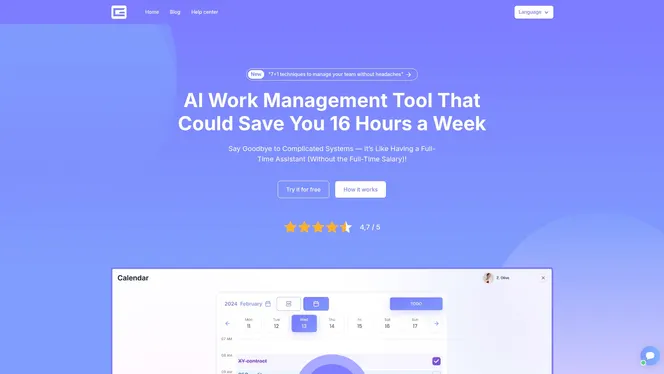
Teams using Gammatica can connect their workflows directly to reporting outputs, set up automation loops through integrations like Make.com, and apply permission controls so the right reports reach the right people. If you want to see how AI-driven report generation fits into a full business management platform, the best next step is a live walkthrough. Book a demo call with the Gammatica team and see how automated reporting works inside a platform built for how modern teams actually operate.
FAQ
What is an AI business report builder?
An AI business report builder is a software tool that automatically generates structured business reports from data inputs such as spreadsheets, CRM exports, and meeting recordings, delivering formatted outputs in PDF, DOCX, or Markdown within minutes.
How much time can AI report generation save?
AI report builders typically save teams 2–6 hours per week on reporting tasks. One documented case study recorded a reduction from 211 hours to 31 hours of monthly reporting work after automation was implemented.
What is the biggest risk of using AI-generated reports?
The biggest risk is quietly wrong outputs that look correct but contain subtle factual or reasoning errors. Research shows AI agents average under 68% compliance with factual grounding and reasoning rubrics, which makes a structured verification workflow non-negotiable.
How often should AI governance policies be reviewed?
Governance policies for AI tools should be reviewed every 90 days. Approved tool lists go stale quickly as the AI market evolves, and quarterly reviews keep your policies aligned with current tools and regulatory requirements.
Do AI report builders replace human analysts?
AI report builders do not replace analysts. They shift the analyst’s role from data assembly to insight interpretation, freeing up time for higher-value advisory work and stakeholder communication.