Companies that implement structured quality assurance reduce defects and rework costs by up to 30%, transforming operations and team performance. Quality assurance (QA) is a proactive business process designed to prevent errors before they occur, enhancing efficiency and reliability. This guide explores QA’s core principles, proven frameworks, common misconceptions, and actionable implementation steps to help you build a quality-first culture that drives measurable productivity gains.
Key takeaways
| Point | Details | |-------|---------|| | QA prevents defects proactively | Unlike reactive quality control, QA focuses on improving processes to stop errors before production. | | ISO 9001 and Six Sigma drive results | These frameworks deliver 10-15% productivity gains and billions in cost savings through systematic quality improvements. | | Cross-functional collaboration is essential | Effective QA requires organization-wide involvement, not just a dedicated team, to build sustainable quality culture. | | Documentation reduces errors significantly | Process checklists cut QA errors by 25%, ensuring consistent execution across teams. | | Automation enhances QA scalability | Digital tools and automated monitoring maintain quality standards as organizations grow and distribute operations. |
Introduction to quality assurance (QA)
Quality assurance represents a systematic business process focused on preventing defects rather than detecting them after the fact. Unlike traditional quality checks that catch problems late, QA embeds quality controls throughout your operations, ensuring processes deliver reliable outcomes consistently.
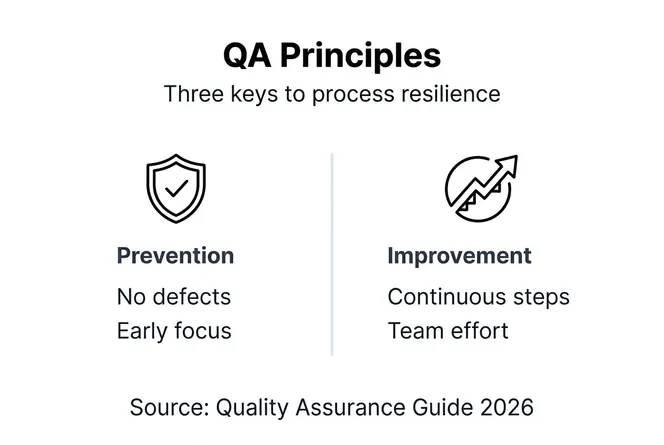
Three core principles define effective QA. Prevention focuses on stopping errors before they happen through robust process design. Process orientation shifts attention from individual product inspections to improving the systems that create those products. Continuous improvement treats quality as an ongoing journey, not a destination, encouraging teams to refine methods based on data and feedback.
This preventive approach delivers tangible business value. Organizations practicing QA experience fewer costly rework cycles, faster delivery times, and higher customer satisfaction. Teams gain clarity on expectations, reducing confusion and duplicated effort.
The Process-Prevention-Performance framework captures QA’s essence:
- Process: Design workflows that minimize error opportunities
- Prevention: Build quality checks into each operational step
- Performance: Measure outcomes to drive continuous refinement
“Quality is never an accident; it is always the result of intelligent effort.” This principle guides successful QA programs, emphasizing intentional system design over reactive firefighting.
By embedding quality thinking into daily operations, you create resilient processes that support scalable growth and operational excellence.
Key concepts: QA vs quality control (QC)
Many business leaders confuse quality assurance with quality control, treating them as interchangeable terms. This misconception leads to ineffective quality strategies and missed improvement opportunities.
QA operates proactively, working within processes to prevent defects from occurring. Teams analyze workflows, identify potential failure points, and implement safeguards before production begins. QC functions reactively, inspecting finished products or service outputs to detect existing defects. Inspectors examine completed work, sorting acceptable items from those requiring rework.
| Aspect | Quality Assurance (QA) | Quality Control (QC) |
|---|---|---|
| Focus | Process improvement | Product inspection |
| Timing | Throughout development | After completion |
| Approach | Proactive prevention | Reactive detection |
| Responsibility | Cross-functional teams | Dedicated QC inspectors |
| Goal | Build quality into systems | Identify defective outputs |
| Cost impact | Reduces long-term expenses | Addresses immediate issues |
The practical differences matter significantly. A manufacturing company practicing QA trains assembly line workers on error-proof techniques and designs jigs that make incorrect assembly physically impossible. The same company’s QC team inspects finished units, removing defective products before shipment.
Misunderstanding these roles creates problems:
- Organizations rely solely on inspection, missing opportunities to prevent defects
- Teams blame QC for quality issues instead of improving upstream processes
- Resources concentrate on detection rather than prevention, inflating costs
- Quality remains inconsistent because root causes go unaddressed
Pro Tip: Implement both QA and QC strategically. Use QA to minimize defect occurrence through process excellence, then apply QC as a safety net to catch the rare issues that slip through. This layered approach maximizes quality while optimizing resource allocation.
Recognizing QA’s preventive nature versus QC’s detective function enables smarter quality investments. You build systems that generate quality outputs naturally rather than relying on expensive, after-the-fact sorting.
QA frameworks and methodologies
Structured frameworks transform quality assurance from abstract principle to practical business system. Two proven methodologies stand out for their track record and widespread adoption.
ISO 9001 establishes quality management system standards recognized globally. Organizations certified under ISO 9001 demonstrate commitment to customer focus, leadership engagement, process approach, and continual improvement. The framework requires documented procedures, regular audits, and corrective action processes. Companies achieving ISO 9001 certification gain 10-15% productivity improvement on average, alongside enhanced customer confidence and market access.
ISO 9001 benefits include:
- Standardized quality processes across departments and locations
- Clear accountability through documented procedures and responsibilities
- Systematic approach to identifying and eliminating waste
- Enhanced credibility with customers and regulatory bodies
Six Sigma targets near-perfect quality through data-driven defect reduction. The methodology defines quality statistically, aiming for no more than 3.4 defects per million opportunities. Six Sigma projects follow the DMAIC cycle: Define problems, Measure current performance, Analyze root causes, Improve processes, and Control ongoing results. Six Sigma initiatives have saved corporations $2 billion cumulatively by systematically eliminating variation and errors.
Key Six Sigma elements:
- Statistical analysis identifying variation sources
- Project-based approach tackling specific quality challenges
- Belt certification system developing internal expertise
- Focus on customer-defined quality requirements
Automation amplifies these frameworks’ effectiveness. Modern QA software automates testing, monitors processes in real time, and flags deviations instantly. Automated systems execute repetitive quality checks faster and more consistently than manual methods, freeing human experts for strategic analysis.
Pro Tip: Start with ISO 9001 to establish foundational quality systems, then layer Six Sigma projects to address specific high-impact defect areas. Automation tools accelerate both frameworks, providing data visibility that drives informed decisions.
These methodologies provide proven roadmaps for QA implementation. Organizations don’t need to create quality systems from scratch when established frameworks offer tested approaches delivering measurable returns.
Common misconceptions about QA
Several persistent myths undermine quality assurance effectiveness in organizations. Correcting these misunderstandings unlocks QA’s full potential.
The most damaging misconception positions QA as solely a dedicated team’s responsibility. Leaders establish QA departments, then assume quality happens automatically. Reality differs sharply. While specialized QA professionals provide valuable expertise, quality assurance requires organization-wide participation. Developers, operations staff, sales teams, and support personnel all influence quality outcomes through their daily decisions and actions.
Another common error treats QA as a final checkpoint before delivery. Teams develop products or services in isolation, submitting completed work for QA approval. This approach contradicts QA’s preventive nature, turning quality assurance into quality control. Effective QA integrates throughout development cycles, catching and correcting issues early when fixes cost less.
Siloed QA teams create significant problems:
- Quality becomes someone else’s problem, reducing accountability
- Feedback arrives too late to influence fundamental design decisions
- QA professionals lack context to evaluate whether outputs meet true business needs
- Communication gaps allow misaligned expectations to persist
- Quality culture fails to develop beyond the QA department
Cross-functional collaboration transforms QA from isolated function to shared responsibility. When product managers, engineers, marketers, and support staff participate in quality discussions, everyone gains quality awareness. Teams surface potential issues earlier, share diverse perspectives on quality standards, and collectively own outcomes.
Building quality culture requires:
- Leadership modeling quality-first behaviors and decisions
- Regular cross-team quality reviews including diverse stakeholders
- Transparent quality metrics visible across the organization
- Celebrating quality wins and learning from quality failures openly
- Embedding quality criteria into all role definitions and performance evaluations
Pro Tip: Create quality champions in each department who coordinate with central QA but drive quality improvements within their teams. This distributed model maintains specialized expertise while spreading quality ownership throughout your organization.
Recognizing QA as a collaborative, continuous process rather than a departmental function or final gate enables sustainable quality improvements. Quality becomes everyone’s job, embedded in organizational DNA.
Practical implementation of QA in business operations
Transforming quality assurance concepts into operational reality requires systematic execution. Follow these steps to embed QA throughout your business processes.
1. Define clear quality standards aligned with business goals
Start by articulating what quality means for your specific context. Generic quality statements lack actionable guidance. Instead, establish measurable criteria linked to customer needs and business objectives. A software company might define quality as zero critical bugs in production, 99.9% uptime, and sub-two-second page load times. A service business could specify first-contact resolution rates, customer satisfaction scores, and process completion times.
2. Document processes and create operational checklists
Undocumented processes breed inconsistency and errors. Map critical workflows step by step, identifying decision points, handoffs, and quality criteria at each stage. Process documentation and checklists reduce errors by 25%, ensuring teams execute consistently regardless of individual experience levels. Documentation also accelerates onboarding and enables process analysis for continuous improvement.

3. Train teams on QA principles and quality culture
Equip everyone with quality knowledge and skills. Training shouldn’t focus solely on technical quality methods. Address mindsets, helping teams understand why quality matters, how their work impacts downstream processes, and what quality looks like in their specific roles. Regular refresher sessions maintain quality awareness as team composition changes.
4. Leverage automation and monitoring tools strategically
Automated systems excel at repetitive quality checks humans find tedious. Implement automated testing for software, sensor-based monitoring for manufacturing, or rule-based validation for service delivery. Real-time dashboards surface quality metrics, enabling quick responses to emerging issues. Automation frees skilled staff for judgment-intensive quality activities machines can’t handle.
5. Review metrics continuously and refine processes
Establish regular quality review cycles analyzing performance against standards. Track leading indicators predicting quality issues alongside lagging measures confirming outcomes. When quality falls short, conduct root cause analysis to address underlying problems rather than treating symptoms. Update processes based on lessons learned, creating improvement feedback loops.
Key implementation elements:
- Start small with pilot processes before scaling organization-wide
- Secure visible executive sponsorship demonstrating quality’s strategic importance
- Allocate sufficient resources for documentation, training, and tools
- Celebrate quality improvements publicly to reinforce desired behaviors
- Adapt frameworks to your context rather than following rigid templates
Successful QA implementation balances structure with flexibility. Frameworks provide proven approaches, but customization ensures relevance to your unique operational realities and business priorities.
Challenges and solutions in scaling QA
As organizations grow across multiple locations and distributed teams, maintaining consistent quality standards becomes increasingly complex. Common scaling challenges threaten quality consistency.
Geographic distribution complicates communication and alignment. Teams operating in different time zones struggle to coordinate on quality issues in real time. Cultural differences influence quality perceptions and practices. Remote workers may feel disconnected from quality initiatives centered at headquarters.
Standardization grows difficult as customization pressures mount. Regional teams request process modifications to accommodate local conditions. Each variation creates consistency risks and complicates quality measurement across the organization.
Solutions for scaling QA effectively:
- Centralized documentation with local adaptation guidelines: Maintain core quality standards centrally while providing clear frameworks for permissible local variations. This approach balances consistency with necessary flexibility.
- Digital collaboration platforms: Implement shared quality management systems giving all teams visibility into standards, procedures, and quality metrics. Cloud-based tools enable real-time collaboration regardless of location.
- Automated quality monitoring: Deploy systems that continuously measure quality across all locations using standardized metrics. Automation ensures consistent evaluation criteria regardless of where work occurs.
- Regular cross-location quality forums: Schedule virtual quality reviews bringing together representatives from all locations. These sessions share best practices, address emerging challenges, and reinforce unified quality culture.
- Traveling quality coaches: Designate senior QA professionals who rotate through locations, providing hands-on coaching and ensuring practices align with organizational standards.
Leadership commitment proves critical at scale. Executives must consistently prioritize quality in decisions, resource allocation, and communications. When leaders demonstrate quality’s importance through actions, distributed teams recognize quality as non-negotiable regardless of local pressures.
Ongoing training maintains quality competency as teams evolve. New hires need quality onboarding, while existing staff require refreshers and updates as standards advance. Investing in continuous quality education prevents skill erosion and keeps quality top of mind.
Scaling QA successfully requires intentional system design anticipating growth challenges. Organizations that proactively address distributed quality management maintain standards while expanding operations.
Benefits of QA on business outcomes
Structured quality assurance delivers measurable improvements across multiple business dimensions. Evidence-based benefits justify QA investments.
Defect reduction and rework elimination generate immediate cost savings. Organizations implementing systematic QA reduce defects and rework expenses by up to 30%, recovering resources previously spent fixing avoidable errors. These savings flow directly to profitability while accelerating delivery timelines.
Productivity gains emerge as processes become more predictable and efficient. Companies achieving ISO 9001 certification experience productivity improvements of 10-15% on average. Standardized, well-documented processes enable faster execution, easier troubleshooting, and reduced learning curves for new team members.
| Business Metric | Typical QA Impact |
|---|---|
| Defect rates | 25-35% reduction |
| Rework costs | 30% decrease |
| Productivity | 10-15% improvement |
| Customer satisfaction | 15-20% increase |
| Team efficiency | 12-18% gain |
| Delivery speed | 20-25% faster |
Customer satisfaction rises when quality becomes reliable and predictable. Consistent delivery builds trust, reducing complaints and returns while increasing repeat business and referrals. Customers notice quality improvements quickly, translating directly into loyalty and revenue growth.
Team collaboration improves significantly under structured QA. Clear quality standards eliminate ambiguity about expectations. Documented processes reduce miscommunication and duplicated efforts. Regular quality reviews create forums for cross-functional dialogue, breaking down silos.
“Quality assurance transformed how our teams work together. Everyone understands their role in delivering excellence, and we catch issues before they become expensive problems. The productivity gains alone justified our QA investment within six months.”
These benefits compound over time. Initial QA implementation requires effort and resources, but sustained practice generates accelerating returns. Organizations building quality culture create competitive advantages competitors struggle to replicate quickly.
Improve your sales and automation with Gammatica
Applying quality assurance principles to your sales and operational workflows unlocks significant efficiency gains. Gammatica’s platform combines the systematic approach QA demands with intelligent automation that eliminates repetitive tasks.
Gammatica Sales brings process discipline to revenue generation. Map your sales methodology, document proven approaches, and ensure every team member executes consistently. Built-in checklists guide representatives through qualification, proposal development, and closing sequences, reducing errors and accelerating deal velocity. The platform’s analytics surface quality metrics like conversion rates and cycle times, enabling continuous sales process refinement.
Gammatica AI automation handles the repetitive quality monitoring and data validation tasks that consume valuable time. Automated workflows ensure critical process steps never get skipped, while intelligent triggers flag potential quality issues for human review. By eliminating manual, error-prone activities, your team focuses on judgment-intensive work where expertise creates the most value.
Frequently asked questions
What is the difference between quality assurance and quality control?
Quality assurance focuses proactively on improving processes to prevent defects from occurring in the first place. Quality control operates reactively, inspecting completed products or services to detect existing defects before delivery. QA builds quality into your systems, while QC catches problems after they happen.
Which industries benefit most from implementing QA?
Every industry gains from quality assurance, though manufacturing, software development, healthcare, and financial services see particularly strong returns. Any organization delivering products or services to customers benefits from reduced defects, improved consistency, and enhanced operational efficiency that QA provides.
How long does QA implementation typically take?
Basic QA implementation for a small team can show results within three to six months. Comprehensive, organization-wide QA transformation typically requires 12 to 24 months depending on company size, process complexity, and existing quality maturity. Starting with pilot projects accelerates learning and demonstrates value before scaling.
Can small businesses afford quality assurance programs?
Small businesses absolutely can implement effective QA without large budgets. Start by documenting critical processes, creating simple checklists, and training teams on error prevention. Many QA tools offer affordable tiers for smaller organizations. The cost of poor quality through defects, rework, and lost customers typically exceeds QA investment significantly.
What metrics should we track to measure QA effectiveness?
Track defect rates, rework costs, customer complaints, delivery cycle times, and first-time quality percentages. Leading indicators like process compliance rates and training completion predict future quality performance. Combine quantitative metrics with qualitative feedback from customers and teams to gain comprehensive quality visibility.